Category: Commentary

  • The Deep State Isn’t a Conspiracy—It’s a System, and It’s Rigged

    For years, the term “Deep State” has been used as political shorthand. Sometimes it’s a joke. Sometimes it’s used as a catch-all to describe corruption in government. And sometimes, it’s written off entirely by smug talking heads who tell you “that’s just conspiracy theory stuff.”

    But let’s be clear—the Deep State is not a theory. It’s a structure. A machinery. And thanks to recent undercover reporting from O’Keefe Media Group, we’ve now got whistleblowers and White House insiders on video admitting what many of us have suspected for years: there is a class of unelected bureaucrats who actively subvert the will of elected officials, distort public perception, and control the narrative.


    Government by Ghosts: What the O’Keefe Video Reveals

    Meet Byron Cohen, a public health adviser at the White House who works in the Office of Pandemic Preparedness and Response. He’s not a political appointee—he’s what they call a “detailee.” Translation? He wasn’t elected, he wasn’t vetted by voters, and he wasn’t nominated by the President. He was placed into the White House by a fellowship program that plugs bureaucrats into powerful offices.

    Byron is the kind of guy who brags on dating apps about working “next to the President,” while simultaneously admitting that he and others in the bureaucracy have the tools to block policy decisions they don’t like. Don’t take my word for it—watch him say it on video.

    He openly admits:

    “People joke about the Deep State, but to some degree it’s real. They have ways they can slow things down or block you without you realizing it.”

    And how do they do that? It’s not about tanks in the streets or assassinations in the shadows. It’s about death by delay. Create a commission. Order a “study.” Launch a panel. Drag it out for years. All the while, nothing changes, and the elected official leaves office without getting anything done.


    Bureaucratic Sabotage in Action

    Byron lays it out clearly. Let’s say someone like RFK Jr. gets appointed to Health and Human Services (HHS)—a guy who questions the vaccine-industrial complex and wants to reform the system.

    The bureaucracy’s response?

    “You can make him think something is happening when it’s not… We’ll put together a commission to study vaccine safety. He’ll be like ‘Great!’ and then years will pass and nothing will happen.”

    That’s not a conspiracy. That’s an admission of deliberate sabotage—a government insider boasting about how the administrative state can override elected officials, silence dissenting policy, and keep their own power protected.

    Even worse? Cohen admits he would personally stay on longer if the incoming administration follows his ideology—but would quit if they don’t.

    In other words, it’s not about serving the American people. It’s about serving their own agenda.


    The Social Media Iron Curtain

    Let’s rewind a bit.

    Back in 2019 and 2020, Disruptarian.com was averaging over 30 million impressions per month across Facebook, Twitter (now X), and YouTube. Our libertarian commentary, edgy political takes, and challenges to the corporate-state narrative were gaining serious traction.

    Then came COVID. Then came the election.

    And bam—we were hit with content violations left and right. Posts questioning lockdown policies? Flagged. Articles linking to peer-reviewed studies on early treatments? Removed. Videos highlighting hypocrisy in COVID enforcement? Demonetized and buried. Even posts about social issues, questioning the narrative. Zapped!

    Our numbers plummeted from 30 million views a month to 30 thousand. Just like that.

    We weren’t spamming. We weren’t doxxing. We weren’t spreading violence. We were simply asking the wrong questions—and the algorithmic hammer came down.

    Fast forward, and now we know why.


    The DOJ, CDC, and Big Tech Collusion

    Thanks to whistleblower documents, FOIA requests, and direct admissions—including testimony from Mark Zuckerberg himself—we now know that government agencies directly coordinated with social media platforms to silence dissent.

    Zuckerberg admitted in an interview that Facebook suppressed stories because the FBI contacted them in the run-up to the 2020 election. The CDC had dedicated portals to flag content for removal on Twitter. The White House demanded deplatforming of individuals who questioned vaccine efficacy or lockdowns.

    This wasn’t “moderation.” It was state-sponsored censorship. And it was bipartisan.

    It happened under Trump’s final year. It continued under Biden. Because the Deep State doesn’t care who’s president. What it cares about is control—of the platform, the narrative, and ultimately, the people.


    “Subverting the Will of the People Is Justified”

    Let that phrase sink in.

    That’s what Byron Cohen says on tape—verbatim. When asked if subverting RFK Jr.’s policies would be a betrayal of democracy, he shrugs it off. His rationale? Most Americans don’t agree with RFK’s views on vaccines, so crushing his influence is “probably consistent with what the majority wants.”

    That’s not how democracy works.

    In a republic, we elect leaders to make decisions. We don’t let unelected bureaucrats override policy because they think they know better.

    But that’s exactly what we’ve built—a system where power has shifted from the visible to the invisible. From elected officials to unelected functionaries. From representative government to bureaucratic oligarchy.


    My Conclusion: Burn the Narrative Down

    Look—I’m not saying every government worker is part of some Illuminati cabal. I’m saying the system is rigged to preserve itself, regardless of who you vote for.

    When I got censored in 2020, I have poof, and with the O’Keefe video, the Twitter Files, and congressional hearings, we all do.

    The Deep State doesn’t need your consent. It just needs your compliance.

    And it’s time to stop complying.

    This is why Disruptarian exists. Not to feed you rage-bait. Not to repeat tribal talking points. But to expose the mechanics behind the illusion—and light a fire under every complacent citizen still waiting for a savior from either party.

    The savior is you. The revolution is information. The enemy is silence.


    Final Thought
    We live in an empire of soft tyranny—run by smug technocrats, fortified by corporate censors, and protected by bureaucrats who think they’re the guardians of truth. It’s not a conspiracy. It’s a structure.

    And the only way to tear it down is to name it. Loudly. Relentlessly. And without fear.

    Stay loud. Stay free. Stay Disruptarian.

    Spun Web Technology SMART SEO

    Spun Web Technology SMART SEO

  • Why I Speak Out: Retired, Unfiltered, and Reporting from the Philippines

    Why I Speak Out: Retired, Unfiltered, and Reporting from the Philippines

    Disruptarian featured image for Why I Speak Out: Retired, Unfiltered, and Reporting from the Philippines

    Verified at: 2026-06-22 6:37:39

    Why I Speak Out: Retired, Unfiltered, and Reporting from the Philippines is the kind of subject that fits the Disruptarian lane because it sits where independent media, culture, music, and political commentary collide.

    The source description frames it this way: Ryan Thompson explains why he keeps speaking out from retirement in the Philippines, without the corporate filter or approved-media script. This Disruptarian Report frames independent commentary as a personal duty: say what you see, challenge official narratives, and keep telling the truth from outside the usual political machine. Original YouTube title: Why I Speak Out: Retired & Unfiltered from the Philippines – Disruptarian Report Source: https://www.youtube.com/watch?v=1r7YmFBmrpg Disruptarian: https://www.disruptarian.com

    The useful question is not only what happened, but why the story matters to people who distrust scripted narratives, recycled outrage, and corporate-approved commentary.

    A Disruptarian reading starts with individual agency. The listener is not asked to accept a packaged conclusion. The point is to pull the claim apart, compare incentives, and look for the pressure points that legacy media often skips.

    That approach matters for libertarian radio commentary because the audience is usually looking for more than a headline. They want context, motive, contradiction, and a practical sense of how public stories become private consequences.

    The cultural layer is just as important. Disruptarian music and reggae punk energy are not decorations around the message. They give the work its rhythm: skeptical, confrontational, and rooted in the idea that speech should stay alive even when institutions prefer silence.

    For search readers arriving cold, the primary source is included below either as an embed or as a direct source link. Start there if you want the full tone, timing, and argument. The written analysis expands the title and description into a searchable article that can stand on its own.

    The strongest SEO value here is clarity. The article keeps the title language visible, uses descriptive headings, and connects the topic to Disruptarian Radio, independent media, libertarian commentary, political culture, and original music without stuffing the page with empty repetition.

    The larger takeaway is simple: independent commentary survives by documenting what was said, preserving the source, and adding a point of view that does not depend on permission from gatekeepers.

    That is why this post exists as part of the static Disruptarian archive. The video remains embedded, the title and description remain traceable, and the surrounding article gives search engines and readers enough context to understand why the episode belongs in the broader Disruptarian catalog.

    The title itself carries the first keyword signal, but a durable post needs more than a copied headline. It needs a clear H1, a concise meta description, a featured image with descriptive alt text, and enough editorial framing for readers to know why the video is part of this archive.

    From an independent media perspective, the value is in keeping the primary source visible. Embedding the video prevents the article from becoming detached commentary. Readers can compare the written interpretation against the actual recording and decide whether the argument holds up.

    The libertarian angle is not automatic partisanship. It is a suspicion of concentrated power, public manipulation, and narratives that ask citizens to outsource judgment. That suspicion applies to government, platforms, corporations, activist institutions, and media brands alike.

    Disruptarian Radio also treats culture as evidence. Music, political language, online mobs, censorship fights, moral panics, and personal stories all reveal where pressure is being applied. That is why a radio episode can be more than entertainment; it can become a record of a moment.

    For listeners who follow DJ Disruptarian, the same pattern shows up in the music catalog: reggae rhythm, punk edge, spiritual critique, and anti-authoritarian instinct. The written post keeps that identity attached to the video instead of letting it disappear into a platform feed.

    Good SEO on a page like this should help people find the conversation without flattening the voice. The article uses natural phrases such as Disruptarian Radio, independent media, libertarian podcast, political commentary, original music, and disruptive conversations only where they make sense.

    The featured image should follow the Disruptarian editorial-collage style: torn paper, smoke, halftone grit, dirty cream paper, black and oxblood pressure, muted gold accents, and symbolic props tied to the subject rather than generic filler. Its alt text names the subject so search engines and screen readers get useful context.

    The article also keeps a stable URL under the static blog. That matters because feeds move, platforms change embeds, and social links decay. A static post gives the episode a second home that can be indexed, backed up, linked, and reviewed later.

    The final point is documentation. When a channel publishes a new video, the title and description are often the only structured metadata available. Turning that metadata into a post creates a stronger archive without pretending to replace the original recording.

    This is the practical Disruptarian method: preserve the video, state the source, add commentary, keep the searchable terms honest, and let the reader move between the embedded media and the written analysis without friction.

    This additional context keeps the post useful for readers who arrive from search rather than from the original channel. It explains the source, preserves the embed, and connects the subject back to the larger Disruptarian archive.

    This additional context keeps the post useful for readers who arrive from search rather than from the original channel. It explains the source, preserves the embed, and connects the subject back to the larger Disruptarian archive.

    This additional context keeps the post useful for readers who arrive from search rather than from the original channel. It explains the source, preserves the embed, and connects the subject back to the larger Disruptarian archive.


    The shortlink was copied to your clipboard

    X
    f
    r

    Related Reading

    Similar posts


    Disruptarian Blog

    2026-06-22

    Disruptarian Blog

    Disruptarian commentary on Orwell Was Right: Free Speech in a Dystopian Age with embedded source video, independent media context, and libertarian radio analysis.

  • Hawaiian Shirts, Order from Chaos, and the Counter-Narrative of the Boogaloo and Proud Boys

    Hawaiian Shirts, Order from Chaos, and the Counter-Narrative of the Boogaloo and Proud Boys

    America is in a culture war—and the uniforms have changed. Forget the starched military fatigues or red armbands of history. In the 2020s, rebellion wears Hawaiian shirts, flies Gadsden flags, and trolls the establishment with memes instead of manifestos.

    This is the strange, symbolic world of the Boogaloo Bois—a loosely affiliated, heavily armed, anti-authoritarian group that emerged from internet subcultures into the real world during the turbulent years of COVID lockdowns, civil unrest, and political polarization.

    To the untrained eye, they’re chaos incarnate. But look closer, and you’ll see something deeper: a modern warning shot against tyranny, not unlike what Thomas Jefferson envisioned when he wrote that “the tree of liberty must be refreshed from time to time with the blood of patriots and tyrants.”


    🌺 Why Hawaiian Shirts?

    The Boogaloo Bois didn’t choose Hawaiian shirts because they’re fun. They chose them because they’re absurd. In a world where the state is armored, surveilling, and militarized, the Hawaiian shirt is a paradoxical act of defiance.

    It’s the ultimate meme uniform—ironic, flamboyant, and ungovernable. The shirts started as an inside joke about the “Boogaloo”—internet slang for a second American civil war. But they became a cultural symbol for armed resistance to authoritarianism.

    Unlike leftist militants who drape themselves in black bloc, the Boogaloo aesthetic leans into satire. It disarms the media narrative by playing with absurdity while carrying a rifle.

    The absurdity is the point.


    🔫 Boogaloo Bois: The Libertarian Paradox

    Let me be clear: I’m not a member of the Boogaloo Bois or any other group I discuss here. I’m a chronicler of American rebellion, not a foot soldier. Like Andy Ngo reporting on Antifa from behind the camera lens, I watch from the side of liberty.

    But I can’t ignore what the Boogaloo Bois represented: armed resistance against state overreach and forced conformity.

    Many of them were libertarians or anarchists in the anti-war tradition. They weren’t MAGA loyalists. Some even showed up to oppose both Trump and Biden. Their focus? Police overreach, unconstitutional lockdowns, and state violence.

    They were painted as domestic terrorists by the media, but the reality was more complicated. Some protested with Black Lives Matter against police brutality. Others clashed with the far left when those protests turned into riots.

    They were, in essence, order out of chaos—ordo ab chao—a Latin phrase tied to secret societies and revolutions, meaning “order from chaos.” The Boogaloo Bois didn’t want to burn America down. They wanted to reset it back to individual sovereignty and constitutional limits.


    🛑 Proud Boys vs. the Riot Left

    Alongside the Boogaloo Bois came the Proud Boys—another controversial group that the media loves to hate. But if you were watching closely, they didn’t start the fight.

    They responded to the far-left aggression—when Antifa rioters trashed cities, torched courthouses, and brutalized anyone who questioned the liberal narrative.

    February 1st, 2017, Berkeley was burned and vandalized during a leftist riot over Milo Yiannopoulos’s scheduled speech. The so-called “anti-fascists” set fire to ATMs, launched fireworks at police, and assaulted bystanders. The authorities folded. Campus security stood down. The First Amendment was left gasping for breath.

    Where was the opposition? Nowhere.

    Until groups like the Proud Boys—and eventually the Boogaloo Bois—started showing up.

    Not to suppress free speech. To protect it.


    🧭 Between Tyranny and Anarchy

    The Proud Boys and Boogaloo Bois exist in a strange middle ground—rejected by both mainstream conservatives and the radical left. And that’s exactly why they matter.

    They emerged when institutions failed:

    • Police departments that wouldn’t defend communities.
    • Universities that surrendered to mobs.
    • Politicians who watched cities burn and called it “mostly peaceful.”

    They didn’t emerge to dominate. They emerged to counterbalance. Like Kyle Rittenhouse—another vilified symbol of individual defense—they stepped in when the state refused to protect.

    You may not like their tactics. You may not agree with all their ideas. But the principle they act upon—that free people must stand against violent coercion and mob tyranny—is undeniably American.


    💣 The Left’s Fascist Tendencies

    Here’s the irony: the left screams “fascism!” at anyone wearing tactical gear, but they’re blind to their own jackboots.

    • BLM “protests” led to over $2 billion in damage nationwide.
    • Antifa physically silenced opposing viewpoints at campuses and city halls.
    • “Transtifa” activists now openly threaten people who question gender ideology, often with armed intimidation.

    These are not “civil rights” movements. They are coercive movements. They punish dissent. They use fear. They demonize and dehumanize opponents.

    That’s not liberty. That’s authoritarianism in rainbow packaging.

    In that landscape, counterforces were inevitable.


    ⚖️ Not Just Violence—Symbolism

    Both the Proud Boys and Boogaloo Bois represent something larger than street skirmishes. They’re symbols—blunt, messy, and often misunderstood—of resistance against a collapsing narrative and a centralized control system.

    Their existence is a cultural flare: a signal that order is no longer coming from above, so it will be forged below.

    And no, this isn’t an endorsement. I don’t wear their colors or join their ranks. But I observe, and I recognize that history is always shaped by the disruptors—those who challenge the dominant power structures, even if imperfectly.


    🗽 Rebellion Is American

    Let’s remember: rebellion is not un-American. It is America. The Founders were radicals. Jefferson literally said rebellion “is as necessary in the political world as storms are in the physical.” They didn’t wait for permission—they created new systems when the old ones became tyrannical.

    Today’s dissidents—armed or not—are tapping into that same ethos. Whether with Hawaiian shirts or MAGA hats, body armor or livestreams, they are saying the same thing:

    “The system no longer represents us. So we represent ourselves.”


    🏁 Final Word: The Disruptarian View

    At Disruptarian, we don’t shy from controversy—we lean into the fire. We explore the uncomfortable truths that corporate media won’t touch and frame them through the lens of liberty.

    I don’t endorse everything these groups have done. I don’t vouch for every individual within them. But I refuse to let the narrative be dictated by those who burn down cities, suppress speech, and hide behind moral superiority while enforcing ideological conformity.

    The Proud Boys and Boogaloo Bois weren’t born out of hate. They were born out of absence—a vacuum left by cowardly leaders, politicized police, and corrupt institutions.

    And when the system collapses, the people rise. Some with flowers. Some with flags. Some with rifles and Hawaiian shirts.

    That, my friend, is America.


    About the Author
    Ryan “Dickie” Thompson is The Punk Rock Libertarian behind Disruptarian.com. An advocate of radical free speech, limited government, and DIY resistance to tyranny. He reports, he questions, and he disrupts—with words, not weapons.

    Spun Web Technology SMART SEO

    Spun Web Technology SMART SEO

  • From Tears to Truth: How Bari Weiss Overcame Trump Derangement Syndrome


    From Tears to Truth: Bari Weiss and the Cure for Trump Derangement Syndrome

    Back in 2016, the elite media class had a collective breakdown. The election of Donald Trump sent legacy journalists, academics, and Silicon Valley billionaires into a psychological spiral. The fearmongering was intense—predictions of fascism, civil war, and the literal end of democracy. But perhaps no story captures this hysteria—and the path out of it—better than the evolution of Bari Weiss.

    Yes, that Bari Weiss. The former New York Times editor and journalist who openly admitted to sobbing at her Wall Street Journal desk the day after Trump won.

    “I was a sufferer of what conservatives would have called TDS—Trump Derangement Syndrome,” she told Honestly, her podcast on Free Press.

    Let’s unpack that.


    What Is Trump Derangement Syndrome?

    Trump Derangement Syndrome (TDS) is what happens when rational thinking is replaced by emotional overdrive at the mere mention of Donald J. Trump. It’s not disagreement on policy—it’s a reflexive, almost religious-level opposition to anything associated with the man.

    It led supposed liberals to embrace censorship, surveillance, and media manipulation, all in the name of “protecting democracy.” It turned legacy journalists into activists and made critical thinking a threat to the narrative.


    Bari’s Red Pill Moment

    Bari Weiss’s case is important—not because she became a Trump fan (she didn’t), but because she broke free from the mental rigidity that TDS installs. In her own words, she began to notice two things:

    1. The authoritarianism of the so-called “Progressive” left. “The sort of overzealous, out-of-touch, hysterical reaction to him… is actually extraordinarily authoritarian and totalitarian in its impulses.”
    2. That Trump, despite his flaws, governed better than the media wanted to admit. “The economy was better… and Americans had lived through four years of him and things didn’t fall apart.”

    Bari did what too few in the corporate media ever do: she changed her mind based on reality. That takes guts—especially in an environment where ideological purity is demanded at the cost of truth.


    A Lesson in Intellectual Honesty

    Weiss’s transformation is less about Trump and more about the importance of thinking for yourself. She had the intellectual integrity to admit when she got it wrong. And in today’s cancel-happy climate, that’s radical.

    What she realized—and what many Americans have come to understand—is that the greater threat to democracy didn’t come from Trump’s tweets. It came from a class of elites willing to silence dissent, manipulate facts, and weaponize fear to maintain control.


    RFK Jr. on TDS: The Enemy of Nuance

    Bari isn’t alone. RFK Jr.—another ideological dissenter—has spoken about how TDS poisons political discourse. In a recent episode of Honestly, he emphasized that Trump Derangement Syndrome has made people blind to civil liberties violations if they think it “hurts Trump.”

    This phenomenon has allowed things like:

    • Collusion between Big Tech and government agencies
    • Censorship of alternative viewpoints (especially during COVID)
    • FBI pressure campaigns on journalists
    • The weaponization of “fact-checking” against dissent

    You don’t have to be pro-Trump to see how dangerous this is. You just have to be pro-freedom.


    The Libertarian Take

    At Disruptarian, we don’t worship politicians. We don’t follow parties. What we do care about is individual liberty, voluntary exchange, and the right to speak truth—even when it’s unpopular.

    Bari Weiss shows us that redemption from ideological capture is possible. It starts with humility, followed by curiosity, and ultimately, the courage to say: “Maybe I was wrong.”

    If more people on the left (and yes, the right too) had that kind of intellectual honesty, we’d be a freer society.


    Final Thoughts

    Trump Derangement Syndrome is real—but it’s curable. Bari Weiss is proof that you can break out of the matrix if you’re willing to confront uncomfortable truths. As RFK Jr. put it, when TDS takes hold, nuance dies. And when nuance dies, liberty soon follows.

    Let’s bring nuance back.


    Listen to Bari’s full story here:
    🎧 “RFK Jr. Is Striking a Nerve” – Honestly with Bari Weiss

    📺 Watch the TDS interview clip: YouTube Interview with Bari Weiss


    About the Author
    Ryan “Dickie” Thompson, The Punk Rock Libertarian, is the content anarchist at Disruptarian.com. He’s allergic to authoritarianism, addicted to free speech, and powered by coffee and dissent.

    Spun Web Technology SMART SEO

    Spun Web Technology SMART SEO

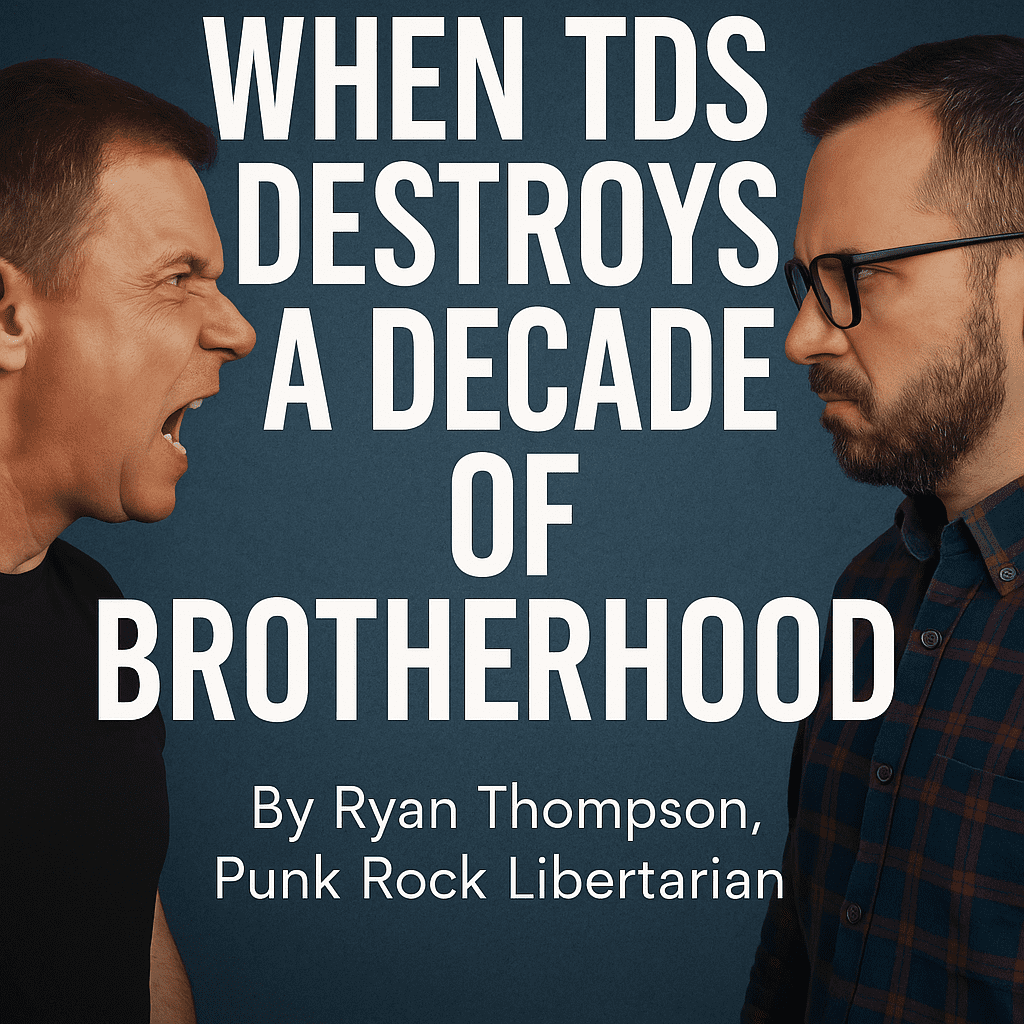
  • When TDS Destroys a Decade of Brotherhood

    By Ryan Thompson, Punk Rock Libertarian

    In 2010, I met Tim Loe during the campaign for Initiative 1068 to decriminalize cannabis in Washington State. We were thick as thieves. He was an AR-15 toting, truth-telling, cannabis-growing outlaw from Spokane; I was working as an automation engineer at Talyst and spending my off-hours organizing for freedom. Together, we helped steer the ship of Sensible Washington, coordinating grassroots signature drives and leading statewide meetings. Tim had grit, guts, and a deep-rooted distrust of government overreach.

    Fourteen years later, I barely recognize the man I once considered a comrade.

    The Fall From Liberty

    Tim and I used to talk about decentralization, voluntary exchange, personal liberty, and the right to say no to state coercion. Somewhere between the end of the Obama era and the Trump phenomenon, Tim transformed. What was once mutual skepticism of power mutated into a full-throated defense of government as long as it targeted Trump.

    I’m not even here to defend Trump. What concerns me is the complete collapse of our shared principles. Tim didn’t just change his mind—he changed his entire outlook on liberty. Suddenly, free markets were dangerous. Private industry was inherently evil. Self-regulation was a myth. And anyone who disagreed? A “Trumpkin.”

    I’ve seen this before. It’s called Trump Derangement Syndrome. And it’s not just a meme—it’s a real psychological phenomenon. When someone’s hatred of Trump becomes so blinding that it overrides reason, facts, and formerly held values, that’s TDS.

    Conversation 1: The Social Security Showdown

    Reference to the full context: Click here

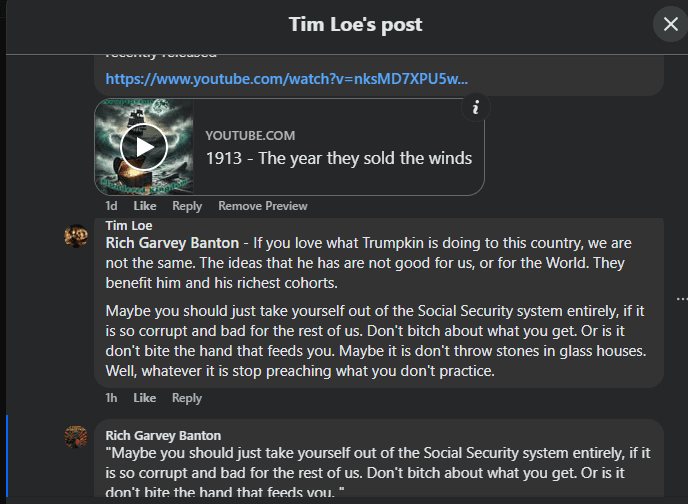
    Tim Loe: “Maybe you should just take yourself out of the Social Security system entirely, if it is so corrupt and bad for the rest of us. Don’t bitch about what you get.”

    My response: I never said “end Social Security.” I said don’t force me to participate. That’s a fundamental libertarian position: choice. I was forced to pay into a system for decades. I didn’t want to. But when I got injured in 2013, I cashed in on what was rightfully mine. That’s not hypocrisy. That’s justice.

    Tim’s take here? That questioning the system disqualifies you from using it, even if it was forced upon you. That’s not logic—that’s bitterness.

    Conversation 2: Industrial Poison and the Death of Free Markets

    Reference to the full context: click here

    Tim Loe: “I don’t trust many industries to regulate themselves. Corporations like Monsanto and Dow have poisoned people.”

    My reply: I get it. My family were downwinders—killed by government WMD tests in Utah. Cancer ran through my lineage because of radioactive fallout. But I don’t jump from corporate misconduct to central planning. We fix harm with transparency, not centralized force. Let people choose better, and let bad actors fall on their face.

    Tim wants government to fix what government already broke. That’s not liberty. That’s learned helplessness.

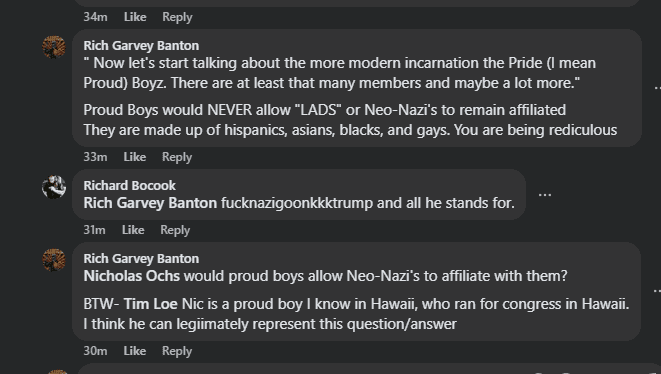
    Conversation 3: The Proud Boys Smear

    Reference to the full context: click here

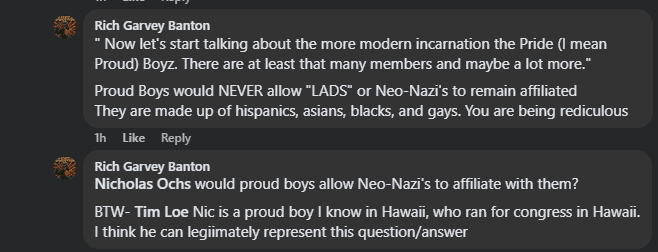
    Tim Loe: “Let’s talk about the more modern incarnation: the Pride (I mean Proud) Boyz.”

    My reply: Proud Boys aren’t neo-Nazis. They’re multiracial. They expelled real racists. My friend Nicholas Ochs, a Proud Boy, ran for Congress in Hawaii. You can disagree with their tactics or style, but painting them as white supremacists is a smear tactic, not an argument.

    It was like talking to MSNBC.

    Star of Babylon to Star of Statism

    Tim once authored books under the banner of Star of Babylon Press. That was back when he opposed Empire. Now, he defends it. Back then, he published against the mainstream. Now, he parrots it. Back then, he wanted decentralization. Now, he wants federal oversight.

    What happened?

    Was it the trauma of illness in his family? The heartbreak of corporate abuse? The betrayal of institutions? I can empathize. But I can’t condone abandoning the principles we once shared.

    What TDS Really Does

    Trump didn’t break Tim. TDS did. The inability to separate the man from the movement, the policies from the personality, the cringe from the constitution—that’s what kills relationships.

    TDS made Tim forget that the enemy isn’t Trump. It’s authoritarianism, regardless of who wields it. It’s censorship, regardless of who it’s aimed at. It’s tyranny, whether it comes in red ties or rainbow flags.

    We can’t fix this country by turning on each other. We can’t restore liberty by endorsing censorship, coercion, and guilt by association.

    A Message to Tim (and Anyone Else Suffering TDS)

    Tim, you’re still my brother, somewhere deep in there. I know your heart’s been through hell. But the solution isn’t more government. The solution is more freedom. If you ever find your way back to voluntaryism, to principled skepticism of power, I’ll be here. But I can’t walk with you down this new road.

    And to those who’ve lost friends to TDS, know this: it’s not about Trump. It’s about fear, control, and the seductive appeal of moral certainty. Be patient. Be principled. And never stop standing for liberty—even if you have to stand alone.


    References:

    Spun Web Technology SMART SEO

    Spun Web Technology SMART SEO

  • Rodrigo Duterte Wins as Davao City Mayor, Disrupts Loyalist to Marcos

    In a political twist that defies convention and challenges the status quo, former Philippine President Rodrigo Duterte has been re-elected as mayor of Davao City, despite being detained by the International Criminal Court (ICC) in The Hague on charges related to his controversial war on drugs. This development not only underscores the enduring influence of the Duterte political dynasty but also signals a significant disruption to the Marcos administration’s grip on power.

    A Landslide Victory from Behind Bars

    Rodrigo Duterte secured a resounding victory in the Davao City mayoral race, garnering over 660,000 votes—eight times more than his closest rival, Karlo Nograles, a former Civil Service Commission chair and perceived ally of President Ferdinand Marcos Jr. This outcome is particularly remarkable given Duterte’s current incarceration, highlighting the unwavering support he commands in his hometown.

    The Duterte Political Machine Remains Unbroken

    The election results extend beyond Rodrigo Duterte’s personal triumph. His son, Sebastian “Baste” Duterte, won the vice mayoral seat with a significant margin, and other family members secured key political positions. This consolidation of power within the Duterte family demonstrates their continued dominance in Davao City’s political landscape.

    A Direct Challenge to the Marcos Administration

    The Duterte family’s resurgence poses a direct challenge to President Marcos Jr.’s administration. The election results suggest a shift in public sentiment, with voters favoring the Duterte brand of governance over the current leadership. This shift is further emphasized by the election of several Duterte allies to the Senate, potentially impacting the balance of power at the national level.

    Governance Amid Legal Challenges

    Despite his detention, Rodrigo Duterte’s election raises questions about the logistics of governance. While the legal framework allows for his proclamation as mayor, the practicalities of administering city affairs from a detention center in The Hague remain uncertain. In the interim, Vice Mayor-elect Baste Duterte is expected to assume the responsibilities of the mayoral office.

    Public Sentiment and the Future of Philippine Politics

    The Duterte family’s electoral success reflects a broader public sentiment that values their approach to governance, characterized by a tough stance on crime and a focus on order. This sentiment suggests a potential shift in the political landscape, with implications for future elections and the overall direction of the country’s leadership.

    Conclusion

    Rodrigo Duterte’s re-election as Davao City mayor, despite his detention, underscores the complexities of Philippine politics and the enduring influence of political dynasties. This development challenges the Marcos administration and signals a potential realignment in the country’s political dynamics.


    References:

    Spun Web Technology SMART SEO

    Spun Web Technology SMART SEO

  • Antifa and the Brownshirts: A Mirror of Irony in Political Violence

    In the name of fighting fascism, Antifa has become a militant movement known more for its confrontational and violent tactics than for principled resistance to authoritarianism. While it claims to oppose totalitarianism, the methods of Antifa in the United States today bear an unsettling resemblance to those of the Sturmabteilung (SA)—the infamous Brownshirts who paved the way for Hitler’s rise in 1930s Germany.

    This article explores the history and tactics of Antifa, compares them to the National Socialist Brownshirts, and draws attention to the tragic irony that Antifa’s actions closely align with the very definition of fascism. Further, we examine how several governments have formally classified Antifa as a terrorist group, and how the United States may soon follow suit.


    Who Is Antifa?

    Antifa—short for “anti-fascist”—is not a unified organization but a loosely affiliated network of left-wing activists. It lacks centralized leadership and formal structure, but its adherents are bound together by a shared opposition to what they consider fascism, racism, and authoritarianism. According to the CSIS , Antifa draws much of its inspiration from European anti-fascist movements, particularly from Germany and Italy in the early 20th century.

    Tactically, Antifa engages in what it calls “direct action.” This includes doxing political opponents, counter-protesting conservative events, destroying property, assaulting individuals they label as fascists or racists, and advocating for the de-platforming of speakers—especially those from right-wing or libertarian backgrounds. The movement’s hallmark is the “black bloc” strategy, where activists wear black clothing and masks to conceal their identities during demonstrations.

    Though its supporters argue that such tactics are necessary to prevent the spread of fascist ideologies, others—including many on the left—have expressed alarm at Antifa’s authoritarian behavior. The use of coercion, intimidation, and physical violence to silence dissent is at the core of the critique.

    One illustrative example comes from Portland, Oregon, where conservative journalist Andy Ngo was repeatedly assaulted while reporting on Antifa activities. In 2023, a jury awarded Ngo $300,000 in a lawsuit against Antifa members who were found liable for physical attacks (KPTV).


    The Brownshirts: Shock Troops of Authoritarianism

    The Sturmabteilung (SA), also known as the Brownshirts, served as the paramilitary wing of Adolf Hitler’s National Socialist German Workers’ Party (Nazi Party) during its early rise to power in Weimar Germany. The SA was instrumental in the Nazi strategy of suppressing dissent through street-level violence and political intimidation. Led by Ernst Röhm, the Brownshirts disrupted political rallies, attacked rival political groups (particularly communists and social democrats), and enforced ideological conformity through fear.

    Wearing uniforms and operating with the implicit backing of the Nazi Party, the SA created a climate of lawlessness and political terror in Germany. Their actions were vital in undermining the legitimacy of the democratic Weimar Republic and preparing the ground for totalitarian rule.

    The SA eventually became too powerful and unruly even for Hitler. In 1934, during the “Night of the Long Knives,” Hitler ordered the execution of Röhm and other top SA leaders to consolidate his control and reassure the German military elite.


    Parallels Between Antifa and the SA

    Though Antifa and the SA emerge from different ideological roots—left-wing anarchism versus right-wing nationalism—their tactics, strategies, and ultimate effects on civil society show troubling overlap:

    1. Political Intimidation

    Both Antifa and the SA used violence and threats to suppress opposing viewpoints. For the SA, it was communists and liberals; for Antifa, it’s conservatives, libertarians, and anyone deemed “fascist”—often based on loose criteria or guilt by association.

    2. Street Violence as a Political Tool

    The Brownshirts famously engaged in brawls and riots. Antifa has followed suit, often initiating clashes at public events and protests. Numerous Antifa actions in cities like Portland and Berkeley have resulted in serious injuries and widespread property damage.

    3. Suppression of Speech

    The SA disrupted speeches and meetings by opponents. Antifa routinely shuts down events and intimidates speakers at universities or political rallies. They’ve even attacked journalists and bystanders, mirroring the SA’s disdain for independent reporting.

    4. Uniformity and Anonymity

    The SA wore brown uniforms to project force and discipline. Antifa’s black bloc serves a similar function—intimidation, solidarity, and the protection of anonymity to avoid accountability.


    The Fascist Irony

    Fascism, as defined by Merriam-Webster, involves “forcible suppression of opposition,” centralized control, and the exaltation of ideology above individual rights. The hallmark of fascism is not necessarily its political direction—left or right—but its authoritarian nature and the methods used to enforce compliance.

    This is where the bitter irony lies: Antifa, in its pursuit to root out fascism, employs the very mechanisms of fascist oppression. Its willingness to use violence, to suppress dissent, and to intimidate political rivals violates the principles of liberal democracy and free expression. It acts not as a bulwark against tyranny but as a mirror of it.


    Antifa’s Global Classification as a Terrorist Group

    Governments around the world have started recognizing the threat posed by violent Antifa cells. In 2020, Germany, which has a particularly high sensitivity to political extremism due to its history, classified some Antifa groups as violent extremists. In Austria, violent Antifa groups have been scrutinized for inciting political violence under anti-terror laws.

    The United States is now considering similar action. H.Res.26—introduced in the 119th Congress—calls for the designation of Antifa as a domestic terrorist organization. The resolution states:

    “Antifa represents opposition to the democratic ideals of peaceful assembly and free speech for all. They have used violence to achieve political ends, much like other domestic extremist movements of the past.”
    (Congressional Source)

    While the bill has yet to pass, it reflects growing concern over the destabilizing effects of ideologically driven political violence—regardless of whether it wears a red armband or a black hoodie.


    Conclusion: The Price of Fighting Monsters

    Philosopher Friedrich Nietzsche warned, “He who fights with monsters should look to it that he himself does not become a monster.” In attempting to fight fascism with fists and firebombs, Antifa has crossed the line into the very realm of authoritarian coercion it claims to oppose.

    The comparison to the Nazi Brownshirts is not mere hyperbole—it is a sober reflection on how political violence, once normalized, becomes self-justifying and destructive. If our society is to preserve the values of liberty, tolerance, and dialogue, we must reject all forms of ideological extremism that rely on violence—no matter their stated goals.

    To oppose fascism effectively, we must do so without becoming fascists ourselves.

    Spun Web Technology SMART SEO

    Spun Web Technology SMART SEO

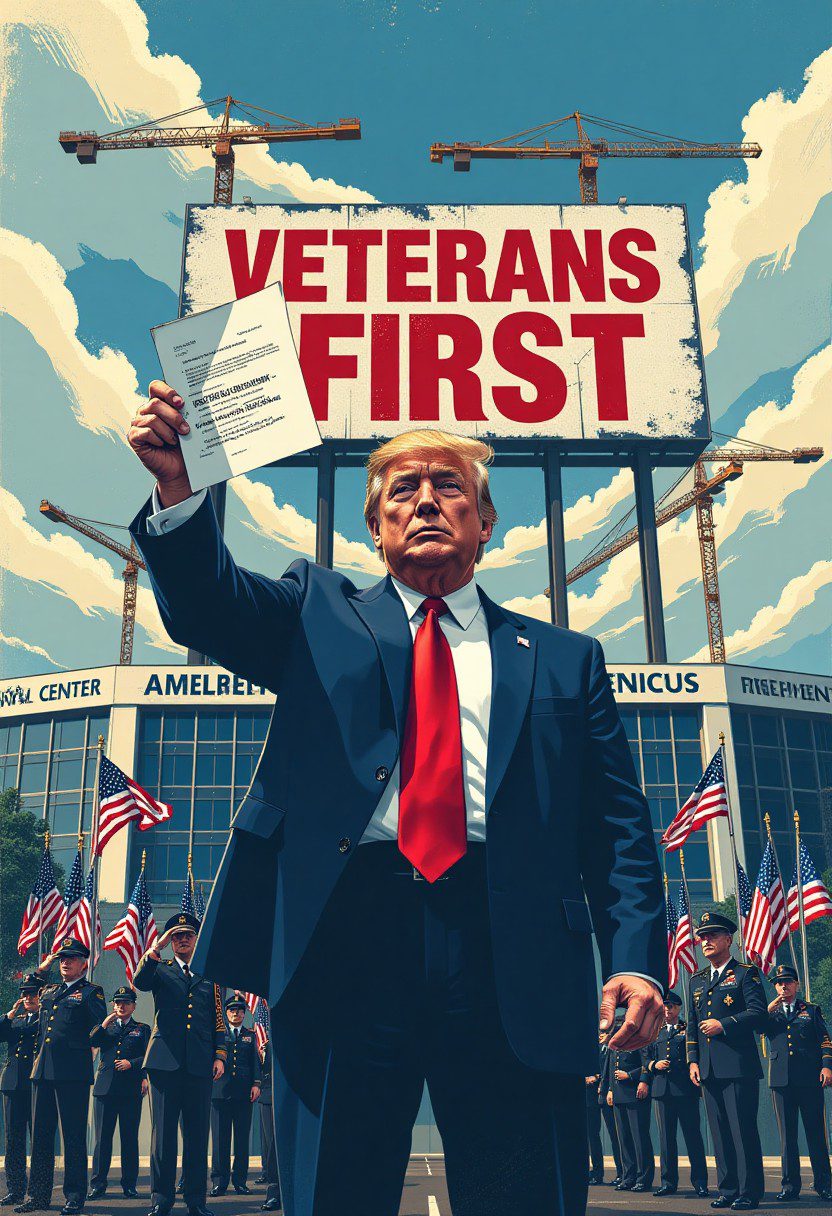
  • Real Patriotism: Trump Redirects Aid From Illegals to Homeless Veterans—Finally, Priorities That Make Sense

    While the corporate press still pretends that defending your borders is a thought crime and prioritizing your own citizens is somehow “xenophobic,” President Donald Trump just dropped a disruption bomb on that narrative—one that actually helps people who deserve it. And I mean really deserve it: our homeless veterans.

    According to Fox News Digital, Trump signed an executive order creating the National Center for Warrior Independence, using funds that were previously wasted on housing and services for illegal aliens. You read that right—money that was going toward people who broke the law to get into the U.S. is now being rightfully reallocated to help men and women who risked life and limb to protect this country.

    Priorities: Finally in Order

    Let’s call this what it is: a total reframing of American values in policy form. After years of watching bureaucrats fawn over “undocumented migrants” while veterans slept in tents blocks away from government offices, it’s refreshing to see leadership that doesn’t treat patriotism like a punchline.

    This new center in Los Angeles is being designed to house up to 6,000 homeless vets by 2028—in a city with the highest concentration of homeless veterans in the country. It’s not just about housing either. It’s about rebuilding dignity with substance abuse treatment, access to jobs, and streamlined care. This is exactly the kind of self-sufficiency over dependency that real Disruptarians value.

    And for those who say, “But what about the poor migrants?” — let me ask you this:
    How long are we going to ignore the people who earned our support, just to virtue signal about those who didn’t? That’s not compassion, that’s cowardice disguised as kindness.

    Veterans First, Not Last

    This isn’t just symbolic. It’s functional. Trump’s order doesn’t just promise aid—it demands accountability from the Department of Veterans Affairs, a swampy mess of bureaucracy that’s been plagued by corruption, cover-ups, and catastrophic wait times. The fact that this executive order includes provisions to punish VA officials for misconduct and reverse Biden’s policy of reinstating fired bad actors? That’s how you clean house.

    Trump’s move also mandates increased care access, including expanded hours, weekend appointments, and virtual healthcare—you know, the kind of customer service your average DMV couldn’t dream of. This is private-sector logic applied to public sector dysfunction. And for those of us who’ve spent time battling state-run systems—especially after trauma or injury—it’s about damn time.

    Punk Rock Governance? You Bet.

    Some people still ask me why I, a lifelong punk rocker and liberty-lover, support Trump. Here’s why: Because disruption without direction is just noise. But this? This is principled disruption. This is what it looks like when a leader shakes the system to prioritize real people, not just media narratives. When you drain the swamp, you don’t start with slogans—you start with redirecting power and money away from parasites and toward purpose.

    Trump’s executive order is a giant middle finger to the DC cocktail circuit that thinks “border security” is a dirty word and that “national identity” is outdated. It’s a rebuke of the woke technocrats who want to re-engineer society from the top down—while veterans rot in the gutter.

    The Punk Rock Libertarian Bottom Line

    • We’ve been subsidizing failure—open borders, mass illegal immigration, and endless bureaucratic graft—for too long.
    • It’s time to subsidize sacrifice, not lawbreaking.
    • Trump’s move to prioritize homeless veterans over illegal aliens is not just the right call—it’s the only morally defensible one.
    • Rebuilding national pride doesn’t start with corporate slogans. It starts with taking care of the warriors who defended your freedom.

    This is what I mean when I say Disruptarian values in action:
    Decentralized power. Localized aid. Real accountability. Voluntary support where it’s deserved—not coerced redistribution for political gain.

    So to the critics wringing their hands about “xenophobia” or “compassion fatigue,” let me offer this:
    If you don’t put your own oxygen mask on first, you can’t help anyone else.
    And right now, America’s veterans are suffocating.

    Thank you, Trump, for disrupting the rot and reminding us what patriotism with teeth looks like.


    Join the fight. Support liberty. Share this story. And as always—question the narrative, disrupt the system, and never comply.
    — Ryan “Dickie” Thompson, The Punk Rock Libertarian

    Spun Web Technology SMART SEO

    Spun Web Technology SMART SEO

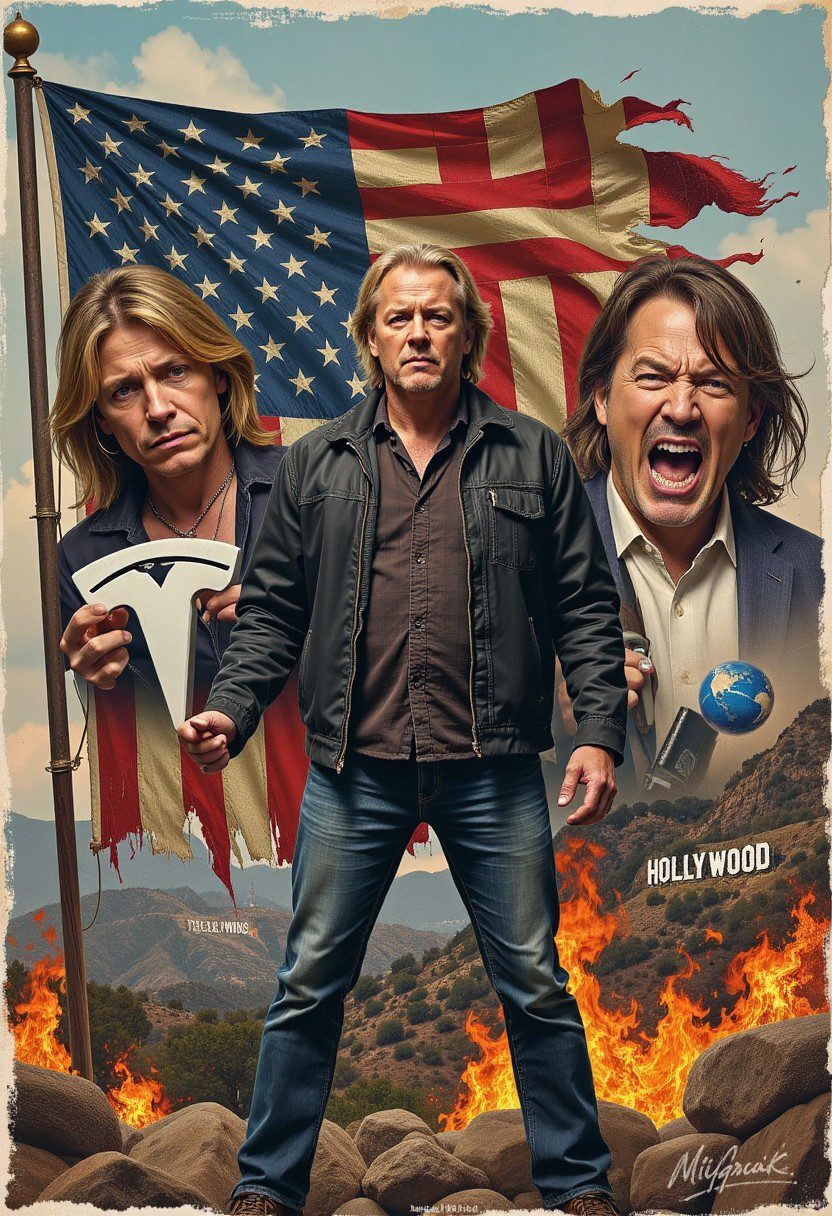
  • The Punk Rock Libertarian Responds: Lefties Losing It, Again

    By Ryan Thompson aka The Punk Rock Libertarian | Disruptarian.com

    It’s not every day you see a parade of cognitive dissonance, hypocrisy, and deranged ideology unravel so perfectly as it did in the latest Sky News breakdown. From Neil Young’s cringe protest ballad to Kamala Harris’ Met Gala cosplay, the spectacle was less “progressive politics” and more like watching a woke circus in slow collapse. And as always, I’m here to cut through the noise.

    Let’s start with the virtue signaler-in-chief, Neil Young. After trying to cancel Joe Rogan from Spotify (because heaven forbid someone express dissent), Young pulled his music in protest. “They can have Rogan or Young. Not both,” he whined. Fast-forward a few months, and guess who’s back on Spotify? Apparently, selling out isn’t just for corporations anymore. His latest protest song against Elon Musk sounds like it was recorded on a broken kazoo during a windstorm. The lyrics? Garbled nonsense about fascism and electric cars. As cringe as it gets.

    But that’s just the opening act.

    Enter the circular firing squad of the Democratic Party. You’ve got James Carville, a relic of Clinton-era triangulation, lambasting younger DNC operatives for turning their guns inward. David Hogg, perpetually angry and terminally woke, doubles down. It’s a civil war of uselessness, and it’s glorious to watch. The left eats its own, because when your politics is based on grievance, purity, and perpetual revolution, you’re never pure enough.

    Sean Penn? Oh man. The Hollywood Marxist compared Trump to a murderous ex-husband who’d rather kill the world than let it go. This from the same guy who sang lullabies to Hugo Chavez, a man who turned Venezuela into a dystopian wasteland. If Trump is a narcissist with a messiah complex, what do we call a guy who slobbers over actual despots but shrieks about imagined ones?

    And speaking of melodrama, Michelle Obama is back in the spotlight with her usual blend of grievance and gold-plated victimhood. Crying about the “costs” of living in the White House while sitting on a net worth somewhere north of $100 million? Tone-deaf doesn’t even begin to describe it. It’s Marie Antoinette levels of elitism wrapped in the language of oppression.

    Meanwhile, Kamala Harris showed up at the Met Gala in an outfit that looked like a half-baked metaphor for her entire career: flashy, expensive, and confusing. She’s polling ahead in the Democratic field, but only because nobody else has dared to put their name in the hat yet. Trust me, once Newsom, Whitmer, or Shapiro decide to jump in, she’ll be relegated back to the sidelines with a scarf and a soundbite.

    Now let’s pivot to border security. Steven Miller (love him or hate him) made a blistering case that the Biden administration’s failure to control illegal immigration has become a national disgrace. And he’s right. We’re not even pretending to vet who comes in anymore. But if you’re a gangbanger, fentanyl trafficker, or child predator, the Democrats want to ensure you get due process and free legal aid. The actual American victims of these crimes? Silenced. Forgotten. Disposable.

    And let’s not overlook the absurd hypocrisy on censorship. Remember when Democrats and their media acolytes screamed about disinformation, fascism, and the end of democracy under Trump? Now they cheer on political prosecutions, censorship of dissenting opinions, and weaponized bureaucracy. But hey, at least they care about pronouns, right?

    Even the entertainment world isn’t spared. The casting of a DEI-overloaded version of Jesus Christ Superstar starring Cynthia Erivo and Adam Lambert isn’t about art or theater—it’s about virtue signaling and box-checking. Don’t expect a Broadway hit; expect a cultural eye-roll and empty seats.

    And then there’s the image of Trump as the Pope. A clear, satirical meme—meant as humor, nothing more. But the media and their cathedral of cancel culture couldn’t handle the joke. Outrage ensued. Meanwhile, real religious mockery in the arts goes unchecked, and actual Christians are ridiculed. The lesson? It’s only offensive when it mocks them.

    Oh, and don’t forget the Puff Daddy drama. Once hip-hop royalty, now possibly facing sex trafficking charges. I’ll wait for the trial to finish, but if he goes down, he won’t go alone. As always, follow the money, follow the tapes, and follow the elite connections they want buried.

    Look, the Disruptarian perspective isn’t about left or right. It’s about seeing the manipulation, calling out the corporate-state complex, and exposing the ideological rot that’s infecting our institutions. Whether it’s grifters pretending to be revolutionaries, celebrities acting like martyrs, or politicians cashing in while America burns, we call it what it is.

    We are the Punk Rock Libertarians. We don’t bend the knee. We don’t apologize for truth. We disrupt.

    Stay loud. Stay sharp. Stay Disruptarian.

    Spun Web Technology SMART SEO

    Spun Web Technology SMART SEO
  • Disruptarian Radio – “Is Social Security a Ponzi Scheme?”

    In this episode of Disruptarian Radio, host Ryan “Dickie” Thompson and co-host Adrian Mulligan tackle one of the most explosive questions in U.S. policy: Is Social Security just a legalized Ponzi scheme?

    Prompted by a bold statement from Elon Musk, who recently called Social Security a Ponzi scheme, the duo dives headfirst into this controversial claim—unpacking the math, the mechanics, and the moral implications of a system millions of Americans rely on but few truly understand.

    They break down the fundamental difference between a legitimate insurance model and the way Social Security actually operates. Unlike private insurance, where premiums are linked to risk and potential payout, Social Security collects a flat payroll tax (13% combined) and offers capped returns—regardless of how much you paid in. That’s why someone like Elon Musk, who could pay in millions, would still only receive the same monthly benefit as someone who paid in a fraction of that amount.

    The conversation explores how the current system depends on incoming worker contributions to fund existing retirees—structurally similar to a Ponzi scheme, which collapses when new contributions dry up. As birth rates fall and life expectancy rises, the worker-to-retiree ratio has dropped dramatically, threatening the sustainability of the entire system.

    Ryan also shares a personal story—his near-fatal car accident and years of striving to work before applying for SSDI—highlighting both the necessity and the inefficiency of the system. He points out how Social Security helped him when he needed it, but he still sees the broader structural flaws as undeniable.

    The episode also exposes disturbing findings from the Department of Government Efficiency, which reported that millions of Social Security checks are still being sent to people who are supposedly over 120 years old—raising serious questions about fraud, mismanagement, and the viability of the trust fund itself.

    From the unsustainable math to generational inequality and administrative waste, this episode pulls no punches. Thompson and Mulligan challenge both the left and the right to stop avoiding reality and start having the hard conversations. They propose possible reforms—from means-testing to partial privatization—while stressing the need to preserve a safety net without pretending it’s something it’s not.

    If you care about economic freedom, personal responsibility, and truth over political theater, this episode of Disruptarian Radio is a must-listen. The system may be broken, but the conversation to fix it starts here.

    🎙️ Listen now, disrupt the narrative, and challenge the myths.

    Reference to my take on this issue in 2011; Social Security is Slavery circa 2011

    Spun Web Technology SMART SEO

    Spun Web Technology SMART SEO