Category: Culture

  • I Don’t Need My Children to Choose Me. I Want Them to Choose Themselves.

    I Don’t Need My Children to Choose Me. I Want Them to Choose Themselves.

    I Don't Need My Children to Choose Me. I Want Them to Choose Themselves.

    A father stands at an open doorway as five independent paths lead into a sunrise landscape

    There comes a point in life when you have to ask yourself a difficult question. How much fighting are you willing to endure in the name of love? And at what point does loving someone mean accepting that you cannot save them from the choices they make, or the influences they allow to shape their lives? I came across a post today by Candi Morris that struck a nerve. She wrote about something that most estranged parents probably think about, but few are willing to say out loud. "I don't think I want them back." She went on to discuss parents who have spent years dealing with arguments, accusations, and emotional conflict, only to finally find some peace in the distance. And then she asked a question: If your estranged child called tomorrow wanting to reconcile, would you welcome them back, or would you have some serious reservations? Well, Candi, you've opened one hell of a can of worms. Because I have an answer. And it's probably not the answer some people want to hear.

    I Never Wanted My Children to Choose Sides

    Let me make one thing clear. I love my children. All five of them. That has never changed. What has changed is my willingness to continually fight battles that I never wanted to fight in the first place. My children were put in a horrible position. They were made to feel that they had to choose between their mother and their father. That should never happen. Children should never have to demonstrate their loyalty to one parent by rejecting the other. But that is the position I believe my children were placed in. For more than five years, they lived with enormous pressure, conflict, and the expectation that they should fall in line with what their mother wanted. And eventually, they did. I don't necessarily blame them for that. When you're young, dependent on a parent, and constantly dealing with emotional pressure, sometimes the easiest thing to do is go along to get along. It's the path of least resistance. That doesn't make it the strongest choice. But it certainly makes it understandable. The unfortunate part is that the path of least resistance can become a way of life. And that's what concerns me most.

    The Victim Mentality Is an Inheritance I Never Wanted Them to Receive

    One of the greatest disagreements I've had with their mother is over personal responsibility. I believe that people have far more control over their lives than they are often willing to acknowledge. Not everything that happens to us is our fault. Life can be cruel. People can betray us. Opportunities can disappear. Sometimes we get dealt a genuinely rotten hand. But at some point, we have to decide whether we're going to spend the rest of our lives blaming everyone else, or take responsibility for what we do next. Their mother and I have always seen this differently. From my perspective, she has spent much of her life explaining her disappointments through the actions of other people. Her brother. Her parents. The Mormon Church. The wealthy kids she grew up around. There always seemed to be someone standing between her and the artistic success she believed she deserved. Perhaps some of those experiences genuinely hurt her. I'm not dismissing that possibility. But I watched someone who, in my opinion, had opportunities, talent, and resources that could have been used to build something meaningful. And instead of owning the decisions that followed, the explanation too often became that someone else had taken her greatness away. That is how I experienced it. And now I see what I believe are the same patterns developing in my children. Everything becomes an offense. Every disagreement becomes an attack. Every difference of opinion becomes evidence of some injustice. And responsibility for one's own reactions seems to disappear somewhere along the way. I don't want that for them. I don't want them spending the next thirty years searching for people to blame for the lives they didn't build. I want them to understand that their lives belong to them. Not their mother. Not me. Not some political movement, social ideology, church, activist group, or fashionable victimhood competition. Them.

    When Political Ideology Becomes a Substitute for Identity

    Let's address another uncomfortable subject. My children and I have developed some very serious cultural and political disagreements. They have embraced a worldview that is far more progressive than my own. That's their right. I'm a libertarian. I believe people should be free to live their lives, make their decisions, and pursue their own happiness. But that freedom also means accepting that other people are allowed to disagree with you. Somewhere along the way, disagreement itself seems to have become an offense. I can't express an opinion without it being interpreted as an insult. I can't question a political position without someone treating it as a personal attack. And heaven forbid we disagree about pronouns, gender ideology, or any of the other cultural battles that seem to consume so much energy these days. I'm not interested in spending the rest of my life arguing over those things. I have my beliefs. They have theirs. I don't expect them to abandon their convictions to make me comfortable. But I am equally unwilling to abandon mine just to be permitted to participate in their lives. Love should not require ideological surrender. And family should not function like a political loyalty test. I raised my children to think for themselves. Or at least, that was always my intention. So if they genuinely arrive at conclusions that differ from mine, fine. But I want those conclusions to be theirs. Not positions adopted because they're afraid of disappointing someone. Not beliefs held because questioning them might cost them approval. And certainly not an identity constructed entirely around being offended by everyone who sees the world differently.

    My Younger Children Never Should Have Been Forced Into This

    This is the part that hurts the most. My younger children are not adults. They should be enjoying their childhood, building confidence, learning about the world, and developing into the people they are going to become. They should have both parents in their lives. They should be able to love their mother without feeling guilty about loving their father. And they should be able to love their father without feeling that they're betraying their mother. Unfortunately, that isn't the relationship I believe they have been allowed to experience. Over the years, I have watched them struggle with pressures that no child should have to carry. And eventually, they chose the household and parent they felt they needed to align themselves with. I believe that choosing a relationship with me has carried emotional consequences for them. And that's a terrible position for a child to be in. Of course I want them in my life. Of course I want to raise them, teach them, spend time with them, and share in the important moments of their lives. I'm their father, for God's sake. I didn't stop being their father because someone else decided our relationship should become complicated. But I also don't want my children living in constant conflict because they feel caught between two parents. I don't want them being shamed for loving me. I don't want them having to explain or defend every conversation, visit, or positive feeling they have toward their father. So for now, I do what I can. I love them. I pray for them. And I hope that someday they will have the freedom and confidence to build relationships without feeling they need someone's permission. That doesn't mean I've stopped wanting to be their father. It means I refuse to make them responsible for a conflict that should never have been theirs.

    I Don't Pray for Them to Come Back Anymore

    This is probably the hardest thing for some people to understand. I used to pray for reconciliation. I wanted the phone calls. The visits. The family gatherings. The chance to put everything behind us. And of course, part of me still wants those things. But my prayers have changed. I no longer pray primarily for my children to come back to me. I pray for them to find the strength to become who they really are. I pray that they learn to own their decisions. I pray that they discover that personal responsibility isn't a punishment. It's freedom. I pray that they stop measuring their worth by the approval of other people. And I pray that they recognize the greatness and wholeness already inside them. Because I believe every one of my children has tremendous potential. They don't have to become like me. They don't have to share my political views. They don't have to follow my career choices, my religious beliefs, or my expectations for their lives. They just need to become strong enough to make their own decisions and accept responsibility for the results. That's what I want for them. Not obedience. Not allegiance. Independence.

    The Million-Dollar Inheritance and What I Want It to Mean

    Here's something else I've thought about quite seriously. I've arranged for a million-dollar life insurance policy. And I've spent time considering how I want that money to benefit my children and future grandchildren. Not because I believe money solves everything. It doesn't. But I've lived enough life to understand just how difficult it can be to build financial security while raising a family. The rent or mortgage doesn't care whether you've had a bad month. The grocery bill doesn't care whether your employer cut your hours. Children need food, clothing, education, healthcare, and a roof over their heads. And saving money while paying for all of those things can be brutally difficult. I want to leave something behind that makes that burden easier. My desire is to create an inheritance that helps my children who choose to raise families, and especially the grandchildren who may come after me. I've considered allocating $50,000 for each grandchild as part of that legacy. That doesn't mean I expect all five of my children to get married and have children. If they choose not to, that's their decision. I don't get to make it for them. And I don't believe money should be used to purchase someone's affection or political agreement. But I do believe there's value in helping the next generation build something lasting. I'd rather leave behind a foundation that helps a young family find stability than watch an inheritance disappear into a collection of meaningless purchases. It's not about rewarding obedience. It's about building a legacy. And those are two very different things. The precise financial arrangements are something to be structured carefully. But the principle matters to me. I want what I've built to help my descendants build something of their own.

    I Am Done Fighting to Be Allowed to Love My Own Children

    There is something exhausting about spending years trying to prove that you deserve a place in your own children's lives. At some point, you begin to realize that every conversation cannot be another trial. Every disagreement cannot become another indictment of your character. Every attempt at communication cannot end with a new list of accusations. And every political opinion cannot become grounds for another family dispute. I don't want the fighting back. I don't want the insults. I don't want the constant accusations, the victim mentality, or the endless arguments over whatever cultural controversy is making headlines this week. I don't want a relationship where everyone has to walk on eggshells, afraid that one wrong word will set off another explosion. Life is too short for that nonsense. And I've already spent far too much of it in that kind of conflict. Does that mean I don't want my children back? No. It means I don't want the relationship we had back. Those are two entirely different things. If one of my children called tomorrow and genuinely wanted to rebuild a relationship, I would welcome that opportunity. But I would want us to build something better. Something based on mutual respect. Something where disagreement doesn't mean hatred. Something where we can acknowledge past hurts without turning every conversation into a courtroom. And something where both sides can take responsibility for their own behavior. That includes me. I'm not pretending I've handled every situation perfectly. I'm a father, not a saint. I've said things I regret. I've made mistakes. I've gotten angry. I've probably made situations worse at times when I thought I was defending myself. I can own that. But reconciliation cannot mean one person accepting all the blame while everyone else gets a lifetime exemption from accountability. That's not reconciliation. That's surrender. And I've had enough of that.

    My Children Don't Owe Me Their Agreement. And I Don't Owe Them My Silence.

    I believe one of the most important lessons a parent can teach a child is the ability to disagree without destroying a relationship. You can love someone and think they're dead wrong. You can respect someone's freedom without celebrating every decision they make. And you can maintain your own principles without demanding that everyone around you adopt them. I don't need my children to be libertarians. I don't need them to vote the way I vote. I don't need them to share my religious views or reject the same institutions I've questioned. I don't need them to live the life I would choose. But I do hope they learn that being offended is not the same thing as being harmed. That disagreement is not automatically abuse. That having a difficult childhood doesn't mean you must have a miserable adulthood. And that blaming someone else for every disappointment is a terrible way to spend the one life you've been given. Because here's the thing about personal responsibility. It can be uncomfortable. Sometimes it's downright painful. It forces you to look in the mirror and admit that some of the problems in your life have your fingerprints all over them. But it also gives you something far more valuable than the temporary comfort of blaming everyone else. It gives you the power to change. And that is what I want my children to discover.

    Love Doesn't Always Look Like Holding On

    Candi Morris asked whether estranged parents would welcome their children back or have serious reservations. My answer is both. Of course I would welcome my children into my life. I never wanted them gone in the first place. But would I have reservations about returning to the same accusations, the same conflicts, the same political hostility, and the same emotional exhaustion? Absolutely. I don't want to spend my remaining years fighting with the people I love most. And I don't want them spending their lives fighting with me. There is no victory in that. For my adult children, I hope time, experience, and independence bring a different perspective. For my younger children, I hope they eventually reach a place where loving both parents doesn't feel like a choice they have to defend. And for all five of them, I hope they find something much more important than winning an argument with their father. I hope they find themselves. Their real selves. Not the person their mother wants them to be. Not the person I want them to be. Not the person social media, political movements, or society tells them they ought to be. The person they choose to become when they finally realize that their life is their own. I want them to be strong. I want them to be capable. I want them to find love, build meaningful lives, and experience the satisfaction of accomplishing something through their own effort. I want them to become better than me. Hell, that's supposed to be the goal of raising children in the first place. And if they accomplish all of that without ever seeing eye to eye with me, I will still be proud of the people they've become. Because fatherhood was never supposed to be about producing five copies of myself. It was supposed to be about giving five human beings the tools to build lives of their own. So no, I don't spend my prayers asking God to make my children come back to me anymore. I ask Him to give them courage. I ask Him to give them wisdom. I ask Him to help them recognize their own worth without needing to make someone else the villain in their story. And I ask Him to help them find the strength to stand on their own two feet. My door isn't closed. My love hasn't disappeared. But I am finished believing that love requires endless conflict. If we find our way back to one another someday, I hope it will be because we have all grown enough to build something better. And if that day doesn't come, I will still want the very best for them. I don't need my children to choose me. I want them to be free enough, strong enough, and whole enough to choose themselves. And that, more than anything, is what I pray for.

    Sources and Evidence

    This is personal commentary based on Ryan Thompson’s supplied first-person draft and a Candi Morris post excerpt supplied with it. Family, custody, relationship, and financial details are presented as Ryan’s account and perspective, not as independently verified findings. Veracity Integrity was unavailable during preparation, so no external reliability score is claimed.

    Related media: Disruptarian Radio media about parental alienation and estrangement.

    Referenced article: Candi Morris’s article.


    The shortlink was copied to your clipboard

    X
    f
    r

    Related Reading

    Similar posts

  • This Ragged Life Renewed: The 2026 Edition

    This Ragged Life Renewed: The Story I Started in 1999, and the Chapters Life Wrote Afterward

    By Ryan Thompson (DJ Disruptarian) | Disruptarian.com | October 27, 2026

    Rebellion. Faith. Loss. Fatherhood. Survival. And the long, sometimes painful business of starting over. After more than twenty-five years, several editions, and more life experiences than I ever intended to collect, I am announcing the re-release of my autobiography, This Ragged Life Renewed: A Life of Rebellion, Faith, Loss, and Renewal. This is not simply another printing of an old book. The 2026 edition brings the story forward to the present, revisits events that needed more explanation, restores material from earlier editions, and includes the experiences that changed my life after the original story ended. Some of those experiences were blessings. Others nearly killed me. And a few taught me lessons I apparently wasn't bright enough to learn the first time. This book is not the story of a perfect man. It is the story of a man who has made mistakes, questioned authority, wrestled with faith, experienced both success and failure, and occasionally discovered that survival is an accomplishment all by itself.

    A Story That Began in 1999

    I first started writing This Ragged Life Renewed in 1999. I was a young man who had spent years living a rather unconventional life. I had grown up in Utah, rebelled against the culture surrounding me, become involved in the punk rock scene, lived on the streets, struggled with drugs, and spent time in jail. I was angry at the world, and not always without reason. But I was also responsible for a good deal of the trouble I found myself in. I was trying to understand how a young man could wander so far from the person he wanted to become. Then, shortly after Christmas in 1998, something happened on an icy road near Deer Park, Washington. I was driving an unreliable car without a license, with bald tires, as a blizzard approached. I slid off the road and found myself stranded. I prayed. What followed became a turning point in my relationship with God and ultimately inspired me to write my story. I released the first version of the book in 2001. After my youngest brother, Justin, died in 2002, I updated the manuscript and began preserving the story online. Other revisions followed in 2003 and 2009. Years later, I revisited the manuscript again, including a published edition in 2023. But the original story ended long before much of what would ultimately define my adult life. And that is why I decided it needed to be revisited once more.

    What Has Changed in the 2026 Edition?

    The new edition maintains the original story and its spiritual foundation, but the narrative now reaches much further into my life. It follows my experiences as a husband and father, my years building technology businesses, my travels, my injuries, the loss of financial security, the end of my marriage, and the ongoing process of rebuilding. Several chapters have undergone substantial revisions, while previously missing context has been restored.

    1. A More Complete Account of My Early Life

    The revised book takes a closer look at my childhood in Utah, including the influence of my father, grandparents, and the family circumstances that shaped my early decisions. I write about growing up in a struggling household, moving frequently, and feeling like an outsider in communities where conformity was often treated as a virtue. I also revisit my teenage years, the punk rock movement, the choices that led me toward homelessness and crime, and the people who helped me along the way. Some of those memories are difficult to revisit. Others remind me that even during the worst periods of my life, there were decent people willing to extend a hand.

    2. Faith, Rebellion, and the Search for Something Worth Believing

    Faith is central to this book, but it isn't a story about somebody who discovered Christianity and suddenly became a model citizen. That would be a considerably shorter book, and a work of fiction. My faith developed through experiences that challenged what I thought I understood about religion, responsibility, forgiveness, and the relationship between God and man. I have spent much of my life questioning authority, including religious authority. But questioning the institutions built around faith is not necessarily the same thing as rejecting faith itself. The 2026 edition explores that distinction more clearly. It also examines how my convictions have changed with age, experience, and fatherhood, including beliefs I held in earlier years that I now regret.

    3. The 2013 Accident That Changed Everything

    One of the most important expanded sections concerns a serious automobile accident in May 2013. While traveling for work between California and Washington, I was struck by a drunk driver on Interstate 5 in southern Oregon. The other driver died. I survived with forty-two fractures and extensive injuries to my arm, shoulder, legs, and feet. The accident changed my ability to work and contributed to a long period of physical and financial difficulties. In earlier editions, I had not explained the full extent of those injuries or their lasting consequences. The revised Chapter Eleven, Still Standing, provides a more complete account. It also looks at the relationship between my health, my career, and the difficulties developing within my marriage. Surviving an accident is one thing. Learning to live with the consequences years afterward is another.

    4. Losing Nearly Everything in Puerto Rico

    In September 2017, my family was living in Puerto Rico when Hurricanes Irma and Maria devastated the island. We lost our home, vehicle, sailboat, business equipment, and years of accumulated work. Our plans for the future disappeared along with much of our property. We spent weeks in a hurricane shelter before leaving the island with little more than the clothes and belongings we could carry. Chapter Twelve, Changes in Latitude, Changes in Attitude, recounts those experiences and the travels that followed. It also includes our time in Ireland, where a family provided us with shelter after the hurricanes. That experience remains an important part of my personal history, and it is one reason Ireland continues to hold a special place in my life.

    5. Marriage, Divorce, Fatherhood, and Regret

    Some of the most difficult material in this edition concerns the end of my marriage and the changes in my relationship with my children. I have five children, and being their father remains one of the most important parts of my identity. The revised chapters explore marriage, loyalty, conflict, divorce, and the consequences of decisions made over many years. They also examine events in Ireland and Oregon, including personal confrontations and injuries that I had not previously described in sufficient detail. These are events presented from my own experiences and recollections. I recognize that other people involved may remember or interpret some things differently. I do not pretend to have handled every situation properly. There are decisions I regret, opportunities I missed, and moments when I should have listened more carefully or acted differently. The book also includes A Letter to My Children, written to explain where I came from, what I learned, and what I hope they will understand about me. It is among the most personal things I have ever written.

    6. New Details About My Later Injuries and Recovery

    The latest revisions also clarify injuries sustained during a 2021 confrontation in Ireland and an April 2024 accident involving a ladder. These accounts help explain the physical difficulties I continue to face. I am currently living in the Philippines, where recovery and the practical realities of disability remain part of my daily life. I have not abandoned my work, my writing, or my plans for the future. But I've had to accept that the life I imagined at twenty is not necessarily the life I can live at fifty. That does not mean the story is finished.

    7. Restored Poetry, Earlier Editions, and Family History

    One of the more meaningful parts of this project has been recovering older writings that had effectively disappeared. Using the Internet Archive, I was able to recover earlier versions of my autobiography and poetry that I had written decades ago. The new edition includes six poems, an account of the earlier editions, and a connection to my family history archive. It also incorporates updated cover artwork and revised formatting for print and electronic reading. My goal was not to erase the earlier versions. It was to preserve them while finally bringing the story forward. Readers who are interested in the historical material can explore the earlier writings at CreativeGrace.org.

    The Audiobook Has Also Been Updated

    For those who prefer listening rather than reading, an updated audiobook has been produced. The latest production edition runs approximately 1 hour and 34 minutes, with 27 audio tracks covering the introductory material, chapters, personal reflections, poetry, and concluding material. It uses computer-generated narration. The revised audiobook reflects the latest manuscript changes, including the expanded accounts of the 2013 accident and later events. I wanted the story to be accessible in multiple formats, whether somebody prefers reading an EPUB, opening a PDF, holding a printed book, or listening during a long drive.

    Why I'm Releasing This Book Again

    There is something rather humbling about reading your own words from twenty-five years ago. You remember who you were when you wrote them. You remember what you believed. You remember the things you thought you understood. And then you realize just how much life has taught you since. When I first wrote this book, I thought renewal was largely about leaving an old life behind. I still believe that is part of it. But I have come to understand that renewal is not necessarily a single dramatic event. Sometimes it means getting sober. Sometimes it means accepting responsibility. Sometimes it means forgiving somebody. Sometimes it means acknowledging that the person who needs to change is the one looking back at you in the mirror. And sometimes it simply means waking up tomorrow and trying again. The libertarian in me still believes strongly in individual liberty and personal responsibility. But freedom without responsibility eventually becomes another form of selfishness. That is a lesson I have encountered more than once. My faith has also changed over the years. It has become less about winning arguments and more about understanding what I believe God expects of me. I still have questions. I still challenge conventional thinking. I still believe institutions, governments, and powerful people deserve scrutiny. But I have learned that questioning everything is not nearly as difficult as being willing to question yourself.

    This Isn't a Victory Lap

    I want to make something clear. This Ragged Life Renewed is not a celebration of every choice I have made. It is not an attempt to rewrite my history, excuse my failures, or convince readers that I have always been the good guy. I have been wrong. I have hurt people. I have been hurt. I have made decisions I would change if given another opportunity. And I have experienced kindness and grace from people who had no obligation to offer either. The purpose of this book is to tell the story as faithfully as I can, including the uncomfortable parts. I wrote it for my children, for the people who knew me along the way, and for readers who may recognize something of their own struggles in mine. If somebody reads this book and discovers that they are not beyond forgiveness, beyond learning, or beyond making a new start, then sharing my story will have been worthwhile.

    Where to Read, Download, Listen to, or Purchase the Book

    The 2026 manuscript is available in digital formats, while distribution of the newest commercial print and ebook editions is still being completed. Latest 2026 edition, direct digital access

    – Read or download the complete 2026 PDF

    – Download the 2026 EPUB ebook

    – Listen to or download the updated M4B audiobook

    These files are shared for public reading and listening. Internet Archive

    – This Ragged Life Renewed, audiobook archive address

    The archive address is provided for readers to check. Its current accessibility and whether it contains the latest revision have not yet been independently confirmed. Lulu, printed books and ebooks

    – Ryan Thompson's Lulu author bookstore

    – Earlier Lulu ebook listing

    The latest hardcover and ebook projects were still marked private during the final production update. Older product links may refer to earlier editions and may not currently accept orders. Amazon and other retailers Distribution outside Lulu has not yet been confirmed for the revised 2026 edition. I will provide direct retailer links when those listings are live and verified. Earlier editions and recovered writing

    – Creative Grace, books and earlier editions

    – Creative Grace, recovered poetry

    – House of Thompson Family History Archive

    Verified edition links supplied for this announcement:

    A Final Word

    This book has followed me through more than half my life. It began when I was a young man trying to make sense of the past and has now become a record of experiences I never could have imagined when I first started writing. Some of the people who helped shape that story are no longer here. Some relationships have changed beyond recognition. Some wounds have healed, while others remain. But I'm still here. Still writing. Still asking questions. Still trying to become a better man, a better father, and a more faithful Christian. I named this book This Ragged Life Renewed because I believed people could change. Twenty-five years later, I believe that more strongly than ever. A ragged life does not have to be a wasted life. Sometimes it is simply a life that has not finished telling its story.

    Ryan Thompson

    DJ Disruptarian

    Disruptarian.com | CreativeGrace.org

  • Shane Gillis Made a Joke About Gym Clothes. The Outrage Mob Proved His Point.

    Shane Gillis Made a Joke About Gym Clothes. The Outrage Mob Proved His Point.

    Shane Gillis Made a Joke About Gym Clothes. The Outrage Mob Proved His Point.

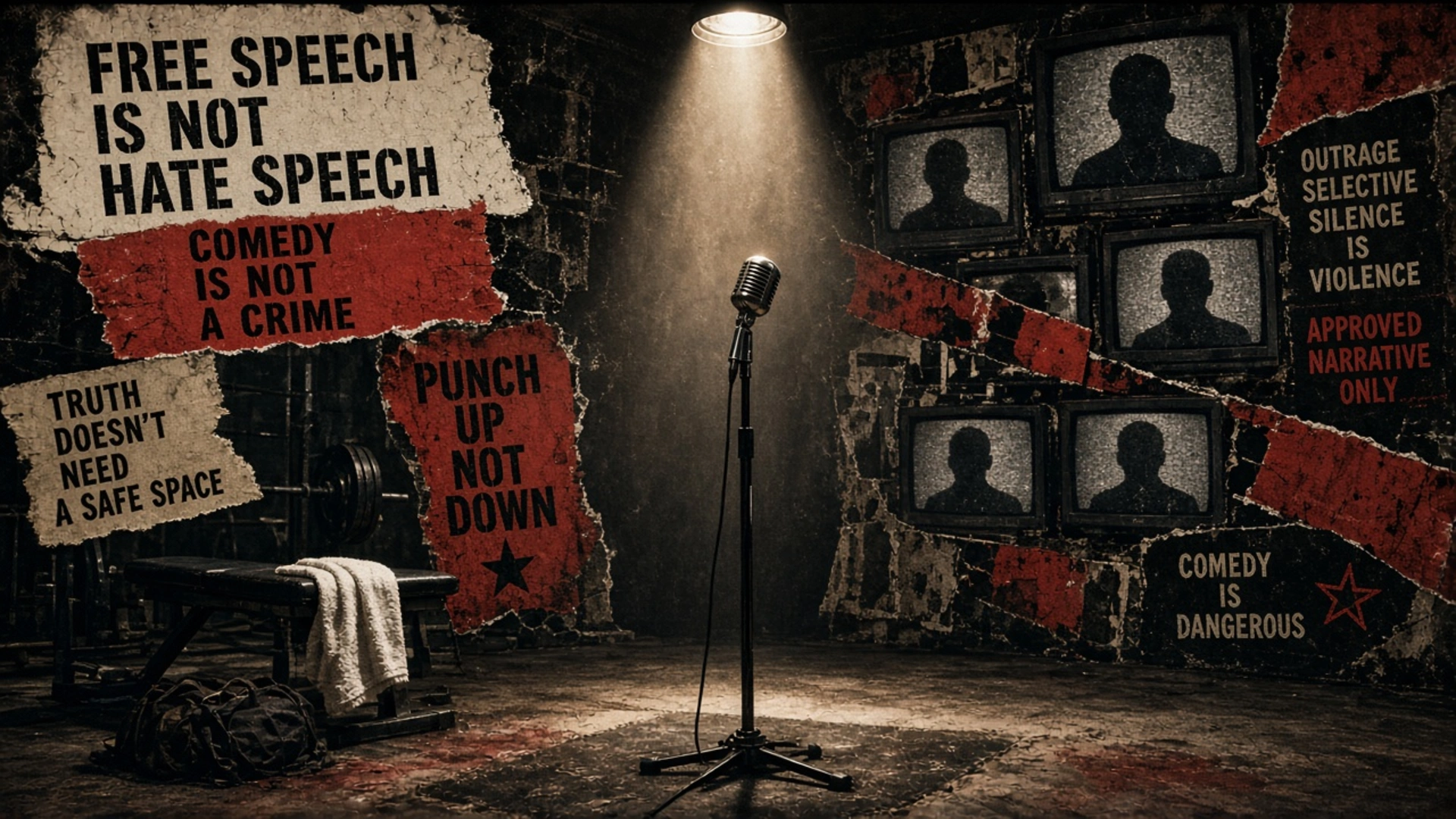
    Gritty editorial illustration of a stand-up microphone surrounded by television screens, representing the controversy over Shane Gillis's gym joke.

    I watched Megyn Kelly’s commentary about Shane Gillis and the latest manufactured outrage over a joke on Saturday Night Live. And I’ve got to say, I agree with her.

    We’ve reached a point where a comedian can’t make an observation about the way people dress at the gym without television personalities turning it into a national conversation about misogyny, sexual assault, and the dangers of offensive comedy.

    Are you kidding me?

    We’re talking about a joke. A joke about gym shorts.

    Not a law. Not a threat. Not someone getting physically harmed. A comedian standing on a stage, pointing out something ridiculous about modern gym culture.

    And somehow, we’re supposed to treat that like a national emergency.

    This is the sort of nonsense that makes ordinary people sick of establishment media and the self-appointed morality police.

    Shane Gillis Said What Plenty of People Have Already Noticed

    On October 10, 2026, Shane Gillis returned to host Saturday Night Live.

    During his opening monologue, he talked about going back to the gym and noticing how much workout clothing has changed.

    He joked about women wearing tiny, brightly colored shorts, the sort designed to emphasize every curve, while men are expected not to look.

    He used crude language. He made people uncomfortable. Some people laughed, and others didn’t.

    That’s comedy.

    And here’s where I agree with Megyn Kelly: there’s a difference between making a joke about how someone dresses and declaring that every woman wearing those clothes is a bad person.

    Gillis was making fun of a fashion trend and an awkward social situation.

    You don’t have to like the joke. You don’t even have to think it’s funny.

    But you don’t get to pretend every crude observation is an act of violence.

    Let’s talk about the gym itself.

    There’s nothing wrong with wanting to look good. There’s nothing wrong with wearing clothes that make you comfortable while exercising.

    It’s your body. It’s your choice.

    But let’s not pretend clothing has no social meaning. Some modern gym fashion is clearly designed to draw attention. People have every right to wear it, and other people have every right to find the trend ridiculous.

    Freedom works both ways.

    That doesn’t give anyone permission to harass, photograph, intimidate, or mistreat somebody because of what they’re wearing.

    It does mean the rest of us are allowed to have an opinion.

    Megyn Kelly Is Right About the Double Standard

    In her commentary, Megyn Kelly pointed out something that ought to be obvious.

    Television personalities make jokes about people’s appearances all the time.

    Late-night hosts mock politicians. Comedians make fun of celebrities. Reality television has built entire businesses around physical appearance, sex appeal, personal conflict, and embarrassing behavior.

    Hollywood sells provocative images every day.

    Then suddenly, when Shane Gillis makes a crude joke about gym shorts, we’re told that commenting on how women look is unacceptable.

    Really?

    Where has that rule been all these years?

    Kelly challenged the outrage from figures including Dan Levy, Sara Haines, and Jenna Bush Hager.

    Her larger point is worth discussing: the entertainment industry often appears to change its moral standards depending on who is speaking and who is being criticized.

    If somebody makes a joke about a conservative woman, we’re told it’s satire.

    But if Gillis jokes about gym fashion, suddenly we’re getting lectures about the collapse of civilized society.

    I’m not saying every critic of Gillis is dishonest. Some sincerely believe the joke was demeaning.

    Fine. They’re free to say so.

    But moral standards should be consistent.

    If the argument is that comedians should never comment on women’s appearances, then apply that rule to everybody, including the late-night hosts you happen to like.

    Otherwise, this isn’t a principle.

    It’s selective outrage.

    Dan Levy Has Every Right to Be Offended. So What?

    Actor Dan Levy criticized Gillis and connected jokes about women being objectified with a wider culture that fails to take sexual assault seriously.

    That’s a serious argument.

    But here’s my problem with it.

    It jumps from a crude joke to a much broader social harm without showing that this comedian caused that harm.

    Sexual assault is a crime. Harassment is a real problem. Both deserve to be taken seriously.

    But making a joke about clothing isn’t the same thing as assaulting somebody.

    Those distinctions matter.

    We cannot have a serious conversation about actual violence if we start treating every inappropriate remark as though it belongs in the same category.

    Dan Levy can criticize Gillis all day long. That’s his right.

    Gillis can tell an offensive joke. That’s his right, too.

    And I can sit here and say Levy’s argument is exaggerated.

    That’s how free expression works.

    Nobody gets appointed the national commissioner of acceptable humor.

    Remember When SNL Fired Shane Gillis?

    The history makes this whole controversy even more interesting.

    Back in 2019, Saturday Night Live hired Shane Gillis and then fired him before he ever appeared as a cast member.

    Old podcast clips resurfaced containing offensive remarks about Asian people and gay people.

    NBC decided he wasn’t a good fit.

    People were entitled to criticize those remarks. NBC was entitled to decide whom it employed.

    But being fired didn’t mean Gillis stopped being a comedian.

    He kept performing. He built an audience. He found ways to reach people without waiting for network television to give him permission.

    Eventually, he returned to host the very show that had dropped him.

    He hosted in 2024, again in 2025, and again in October 2026.

    Think about that.

    The institution that once decided he was too controversial eventually invited him back three times.

    Whatever NBC’s internal reasoning, one thing is clear: Gillis found an audience beyond the old network gatekeeping system.

    That’s a lesson worth remembering.

    In a free media market, losing the approval of one major broadcaster doesn’t have to mean losing your livelihood.

    Audiences can support independent voices directly.

    That’s a good thing.

    The Gym Isn’t a Sanctuary From Other People’s Opinions

    I want to be clear about something.

    Women have every right to wear revealing workout clothes.

    Men have every right to wear ridiculous outfits, too.

    And everybody has the right to exercise without being harassed.

    But nobody has a right to control every thought or joke another person makes.

    There’s a difference between noticing somebody, staring at them, harassing them, and making a general observation in a comedy routine.

    We should be intelligent enough to recognize those differences.

    If somebody is secretly filming strangers at the gym to shame them online, criticize that behavior.

    If somebody is harassing women while they exercise, hold that person responsible.

    If somebody tells a joke you don’t like, turn off the television.

    It’s not complicated.

    The problem comes when people confuse personal discomfort with moral authority over everybody else.

    I don’t need Dan Levy, NBC, or a daytime television panel telling me which jokes I’m allowed to laugh at.

    And neither do you.

    Free Speech Doesn’t Mean Freedom From Criticism

    Here’s where the libertarian principle comes in.

    Freedom of speech isn’t a promise that everybody has to like what you say.

    It also doesn’t mean a private television network is legally required to employ you.

    Gillis can tell a joke. Levy can condemn it. Kelly can criticize Levy. And the audience can decide which argument makes sense.

    That’s the way things should work.

    The First Amendment limits government censorship. It doesn’t force private companies to give anybody a microphone.

    But the broader culture of free expression matters, too.

    If every controversial joke becomes a campaign to destroy a career, the result is a culture where people are afraid to speak plainly.

    Not because the government passed a censorship law, but because powerful institutions and public pressure can make expression costly.

    There’s a difference between criticizing a joke and demanding that the joke disappear.

    And there’s a difference between genuine accountability and an endless search for somebody to punish.

    A healthy society needs the ability to laugh at itself, including the parts that make us uncomfortable.

    Hollywood’s Selective Morality Is the Bigger Joke

    Megyn Kelly highlighted the contrast between the outrage directed at Gillis and the way other entertainers speak about women’s appearances.

    To me, that’s the most important part of her commentary.

    We have an entertainment industry that sells sex appeal, rewards public embarrassment, and makes enormous amounts of money turning people’s private behavior into content.

    Yet some of its most visible personalities act shocked when a comedian comments on the same culture.

    You cannot spend decades selling a spectacle and then act scandalized when somebody makes fun of it.

    And you certainly shouldn’t suggest that making a joke is equivalent to encouraging a violent crime without evidence.

    If we’re going to criticize objectification, let’s have an honest conversation about the entire entertainment business.

    Let’s talk about social media platforms that reward attention-seeking behavior.

    Let’s talk about influencers who film strangers in public gyms.

    Let’s talk about corporations that profit from turning every aspect of life into advertising.

    But let’s not pretend Shane Gillis invented these problems because he made a joke on Saturday night.

    Offensive Comedy Has a Place in a Free Society

    Some comedy is brilliant.

    Some comedy is stupid.

    Some comedy is offensive, and some simply doesn’t land.

    None of that changes the basic principle.

    A free society has room for uncomfortable speech.

    It has room for artists who push boundaries.

    It has room for people who disagree with a joke and people who laugh at it anyway.

    What it shouldn’t have is an unofficial class of cultural authorities deciding which subjects are off-limits and which comedians deserve to be punished for crossing an imaginary line.

    Sometimes people laugh because a comedian has pointed out a contradiction everybody recognizes but nobody wants to discuss.

    That doesn’t make every joke true.

    It doesn’t make every comedian a philosopher.

    It just means comedy can expose the absurdities of everyday life.

    Gillis made a joke about a trend in gym clothing and the social tension around looking at people.

    Kelly defended his right to make that joke and challenged the public figures who condemned him.

    I’m with her.

    Not because every word she said must be accepted without question, but because her central point is sound.

    We need to stop turning ordinary jokes into moral emergencies.

    My Final Take: Grow Up and Learn to Take a Joke

    Nobody is required to laugh at Shane Gillis.

    Nobody is required to agree with Megyn Kelly.

    But the rest of us aren’t required to surrender our sense of humor every time a celebrity announces they’re offended.

    You can dislike someone’s clothes without hating them.

    You can make fun of a fashion trend without believing people deserve mistreatment.

    You can tell an offensive joke without endorsing every ugly thing somebody might associate with it.

    These distinctions used to be common sense.

    Now they apparently require a full television panel discussion.

    I’m tired of the selective outrage, exaggerated accusations, and constant attempts to make comedy answer to an imaginary committee of approved opinions.

    Let comedians tell jokes.

    Let critics criticize them.

    And let ordinary people decide what they find funny.

    That’s not dangerous.

    That’s freedom.

    What do you think? Did Shane Gillis cross a line, or has the outrage machine lost its sense of humor? Sound off in the comments.

    Ryan “Dickie” Thompson
    Disruptarian Radio
    Disruptarian.com

    References


    The shortlink was copied to your clipboard

    X
    f
    r

    Related Reading

    Similar posts

  • Woke Culture, Trials, and COVID Backlash

    Woke Culture, Trials, and COVID Backlash

    Punk poster with cracked gavel, discarded mask, and broken protest placards under stencil headline WOKE IS OVER

    I have a lot to pack into this one. Things blew up for woke culture after Trump, sure, but the bigger point is simpler. Woke used to run the room. Now it is losing the room.

    Woke used to feel unstoppable. Black Lives Matter riots burned cities over the smallest spark. George Floyd got turned into a global permission slip, even while the fentanyl facts never matched the slogan machine. Kyle Rittenhouse got dragged through hell and still beat the charges. Piece by piece, the spell cracked. Woke did not vanish overnight. It just stopped being fashionable to normal people.

    I want to walk that through three lanes. The Lindsay Clancy discourse. COVID censorship. And Anna Kasparian from The Young Turks finally climbing out of the dogma that used to make my ears bleed.

    The Clancy discourse and the free pass problem

    I used to hate listening to Anna. Same with people I once respected until they went fully woke. Russ Belleville and I even collaborated once. Then it became pronouns this and ideology that, and I could not stand it. The fad is passing. Good. The world is getting past it.

    But leftover poison still shows up in cases like Lindsay Clancy. People want to blame the patriarchy. People want to blame reproductive politics. People want to say Roe ending set women back. No. This is what sets women back: refusing responsibility for your actions. That refusal got too common, and now the light is on it. A lot of people are finally saying out loud that this narrative hurts women. It does not protect them. It infantilizes them.

    The viral “make it make sense” reel lays the contradiction bare. If women cannot govern their emotions, hormones, and impulses, then how are they fully equal for power and authority? If a heinous act is never her fault because hormones, medication, doctors, society, and “big feelings” ate the agency, then what is left of equality? If men cannot criticize it because they are men, but a biological man who identifies as a woman suddenly can, the logic collapses.

    Here is the script people keep selling. Success is personal glory. Failure is pathology. Strong independent woman when it goes well. Helpless hormonal victim when it goes badly. That is not justice. That is a free pass wrapped in therapy language.

    I have said this before and I will keep saying it. Compassion with no agency turns soft. Due process with no moral seriousness turns fake. Killing your children is an absolute moral catastrophe. Hormones may explain stress. They do not erase the act. When a culture trains adults to outsource blame, homes break and kids learn the wrong lesson. Women who want real equality should want real responsibility too. Anything else sets everyone back.

    COVID wrecked my reach, and that was the point

    Then there is COVID. That era wrecked my reach on purpose. Groups locked. Pages crushed. One Facebook group with about 120,000 people gone. My Twitter account that was doing around 31 million views a month got shut down. Roughly half a million members across groups and pages got wiped out of my world because Biden-era pressure treated vaccine side-effect talk like contraband.

    Zuckerberg later described government pressure to suppress negative COVID vaccine information. People love screaming fascism at Trump. They go quiet about that chapter.

    I lived the social side of it too. Lose your job if you refuse the shot. No travel without papers. No bar without a mask. In Ireland I got shamed, threatened, and told I would kill somebody’s nana if I did not comply. I asked the obvious question. If she is vaccinated and the vaccine works, why does my refusal erase her protection? That question got me hatred, not an answer. I even got jumped. My nose got broken. Two Irish guys came at me after that same vaccine panic talk. So when people lecture me about authoritarianism, I do not need a textbook. I have scars.

    One Saturday without masks, and they screamed genocide

    That is why the Massachusetts lesbian bar story hit me. The Last Ditch Bar changed one rule. Masks optional on Saturday nights only. After KN95 mandates at all times, one night of choice triggered accusations of genocide and mass disabling events. People wished firebombing on the venue for “ableism.”

    Think about that. Optional masks on one Saturday equals genocide, and the moral response is fantasies of burning people alive. That is not public health. That is identity panic with a death wish attached. You cannot drink a cocktail through an N95 and call it normal life forever. At some point the purity test becomes the point.

    Anna Kasparian covering that story is why I can tolerate her now. I am still not a TYT fanboy. But after her Candace Owens interview, and her own admissions about enabling COVID dogma then suffering for leaving that prison, something clicked. She was a dogmatic woke voice. She said so. She got free. That matters.

    If someone who led that pack can break out, other people can too. I even have more hope for my ex-wife and kids because of that. Not because Anna is perfect. Because the spell can break.

    Woke is ending. Responsibility is coming back.

    Woke started as one story about oppression and police power. Then it mutated into a lifestyle religion around race theater, elite guilt, gender orthodoxy, and COVID purity tests. Whatever it started as, it is not that anymore. It became a machine for shame, bans, firings, and social punishment. Zuckerberg got pulled into it and later started climbing out. Big propaganda voices are shifting. Normal people are done.

    I do not bend to terrorists, period. Not if they share DNA with me. Not if they are friends, family, coworkers, or a boss. Not if they hide behind a cause. Anna said she does not bend to terrorists either. That is the line.

    Woke is not fully dead. Remnants still show up in places like that bar meltdown. But the center of gravity moved. People want reality again.

    So here is the through-line. The Clancy discourse exposed the “no responsibility for bad acts” script around women. COVID exposed the censorship and compliance cult. The Massachusetts bar story exposed how ridiculous the leftover purity rules look in daylight. Anna breaking free shows exit is possible.

    I want my kids on the other side of this. I want a culture where adults own their actions again. Watch the video. Follow the sources. Decide for yourself.

    Watch the commentary

    Watch on YouTube (Disruptarian Radio).

    Sources / notes


    The shortlink was copied to your clipboard

    X
    f
    r

    Related Reading

    Similar posts

  • Rights Without Responsibility: Why I Chose the Philippines

    Rights Without Responsibility: Why I Chose the Philippines

    Punk-poster split scene: cracked Western city and broken scales versus Philippine coastal family courtyard, suitcase on the road, stencil headline RIGHTS WITHOUT RESPONSIBILITY

    David Fitzgerald’s viral “make it make sense” take on the Lindsey Clancy discourse is blunt, and it should be. He walks through the modern Western script. If a woman fails, the hormones did it. If she is medicated and still fails, the medication did it. If a doctor put her on the medication, the doctor did it. If men notice the pattern, men are not allowed to talk. If a man who identifies as a woman talks, somehow that counts as insight. The punchline is hard: credit for every win, a free pass for every failure.

    That is not medicine. That is a no-consequence parenting model pointed at adults. Fitzgerald is right that raising kids with no consequences is a good way to wreck them. A lot of modern culture is doing the same thing with adult women, then acting shocked when responsibility gets treated like an optional extra.

    Ryan Thompson commentary

    I am writing this as a man who left the West. Not as a tourist flex. Not as an online costume. It was forced on me first, and then it got clear. My body is messed up from multiple work injuries. Living cheap is not a preference for me. It is survival. The Philippines made that possible. What surprised me was how fast the move showed me a cultural difference I had been living inside for years without really naming it.

    I still worry about how my kids are being raised in Western culture. That is not some abstract culture war talking point for me. It is about what adults model, what dating rewards, and what institutions tell men and women about duty. In too much of the West, adulthood got rewritten as a pile of rights with a soft maybe on responsibilities. Partnership gets sold like a lifestyle upgrade. Family gets treated like a reversible preference. A hard day becomes proof that somebody else must be to blame.

    Too many Western women (not all, and not every woman I have ever known) want the upside of male provision, status, protection, and attention without the reciprocal work that keeps those things healthy. That is not empowerment. That is a one-way deal. When the deal breaks, the culture often races to protect feelings instead of facing conduct. Fitzgerald’s rant lands because you have heard the pattern. Success is personal glory. Failure is hormones, doctors, patriarchy, society, medication, or “big feelings.”

    Men get told to be stoic providers and soft therapists at the same time, then get told their observations do not count because they are men. Women get told they are equal in every seat of power, then get excused from equal accountability when power goes badly. That mix does not create justice. It creates resentment, unstable homes, and kids who learn that consequences are for other people.

    I am not saying the East is paradise. The Philippines has poverty, bureaucracy, and plenty of normal human mess. What I found living here is a real difference in day-to-day attitude. Family still sits closer to the center. Humility does not automatically mean humiliation. Mutual obligation is not instantly framed as oppression. People can still talk about duty without needing a long apology first. That difference is not a meme. You feel it in ordinary life.

    Dating in the East, for me, has not been about chasing fantasies. It has been about finding a social climate where adulthood still means something. When a culture treats accountability like an attack, soft people get brittle and hard people get cynical. When a culture still expects people to carry their share, ordinary virtues get room again: patience, thrift, loyalty, work. The benefits of living in the Philippines are huge for me. Lower cost of living with a damaged body, yes. Also less background hostility toward the idea that men and women owe each other something real.

    Western media fights around cases like Clancy turn into a Rorschach test. Some people only see compassion. Some people only see condemnation. I see a deeper habit: the refusal to keep agency attached to adult women when the outcome is ugly. Compassion with no agency turns into sentimentality. Due process with no moral seriousness turns into theater. A free society needs both. If we cannot say that killing your children is an absolute moral catastrophe belonging to the person who did it, then we have already lost the language needed to raise kids safely.

    That is why Fitzgerald’s “no-consequence parenting” line matters past the reel. A society that trains adults to outsource blame will train parents the same way, and kids will learn the same lesson. If every impulse gets medicalized, every failure gets externalized, and every criticism gets called bigotry, character formation collapses. Markets can still sell products. Schools can still sell degrees. Governments can still sell programs. Homes still hollow out.

    Leaving the West does not mean I abandon my kids emotionally or spiritually. It means I refuse to pretend the West’s current dating and family culture is healthy just because it is familiar. It means I will build where I can still afford to live, where my injuries do not lock me into permanent debt stress, and where the social temperature is less hostile to reciprocal duty. If that bothers people who think geography is destiny and criticism is betrayal, so be it.

    None of this needs invented courtroom facts beyond what public commentary already argues. Fitzgerald’s point is cultural. A society that hands out full privileges while suspending responsibility will grow fragile adults and broken homes. If that is where the West is headed, men who still want family, order, and mutual duty will look elsewhere. I did. Watch the commentary below and decide for yourself if the contradiction he describes matches what you see.

    Watch the commentary

    Watch on YouTube (Disruptarian Radio).

    Sources / notes


    The shortlink was copied to your clipboard

    X
    f
    r

    Related Reading

    Similar posts


    Woke Culture, Trials, and COVID Backlash

    2026-09-25 · Culture

    Woke Culture, Trials, and COVID Backlash

    Ryan Thompson on woke culture collapsing, the Lindsay Clancy responsibility dodge, COVID censorship fallout, and Anna Kasparian breaking free.

  • Parental Alienation, Accusations, and the Test of Character

    When Accusation Becomes a Test of Character

    A tense family conversation represented by opposing chairs, scattered documents, and a focused examination lamp.

    A family argument about Donald Trump became a question about evidence, judgment, and what we owe one another when the stakes are serious.

    Personal commentary. The child in this account is not named. The message transcript and screenshots are included as supporting context.

    A child asked me a question that was also an accusation: how could I support a man described as a rapist and a pedophile? I answered with the standard I have applied for years: accusations are not the same thing as proof, and public pressure should not replace evidence.

    That answer was incomplete. I focused on the absence of a criminal conviction for the conduct being discussed, and I did not acknowledge a major civil finding that belongs in the same conversation. A New York jury found Donald Trump liable for sexually abusing E. Jean Carroll and defaming her. That was a civil verdict, not a criminal conviction; on the specific rape question, the jury did not find that he had committed rape under the definition then provided. The Second Circuit’s opinion describes the verdict. Trump has sought U.S. Supreme Court review, and the Court’s docket currently shows that Carroll’s response is due October 30, 2026. Those distinctions matter. They do not erase the civil jury’s finding, and the civil finding does not become a criminal conviction by changing the label.

    My child used “pedophile” as another label. That is a serious accusation, and I still believe serious accusations require evidence. But the parental alienation issue is not based only on this political argument. When my ex-wife and I divorced, the first time I was with the children afterward, all of them told me on a DVR recording that their mother wanted them to choose sides. They later told the same basic story to their therapist. In my experience, that makes the parental alienation an established fact, not a theory inferred from one difficult conversation.

    What the exchange exposed

    The screenshots and transcript show a family conversation that quickly stopped being a careful discussion of evidence. We called each other names. I brought politics, AI, family conflict, and old grievances into one long exchange. My child said they did not want me around their siblings. I responded with arguments about hatred and how I believe young people should prepare for a difficult future.

    I can stand by the principle that allegations deserve careful examination and still admit that I handled parts of that conversation badly. A parent cannot expect a child to listen after turning a disagreement into a judgment about the child’s character. And a child should not have to agree with a parent’s politics to be loved or treated with respect.

    This exchange belongs inside that larger history. It shows how political labels became personal weapons inside a family, how quickly people stopped hearing one another, and how the alienation was reinforced through accusations about my character and my relationship with the children.

    There is no honest shortcut from accusation to certainty

    The notes I attached try to estimate a national total by applying percentages from limited studies to broad crime totals. That calculation does not give us an observed nationwide count. The FBI’s 2025 release reports more than 13 million offenses submitted by participating agencies; that figure does not tell us how many allegations were later determined to be false. A percentage found in studies of one category cannot simply be applied to all reported crime.

    A 2016 meta-analysis of seven studies estimated that 5.2% of sexual-assault reports in those studies were confirmed false, with a 95% confidence interval of 3.0% to 8.9%. That is a specific research result about those studies and that category. It is not a universal false-accusation rate, and it does not tell us that an acquittal, a dismissed case, or an unproven claim was a lie.

    The National Registry of Exonerations’ 2025 report says that 71 exonerations (73%) included perjury or false accusations. Exonerations are a selected group of cases in which a conviction was later overturned; that finding is not a measure of how often accusations are false across the country. It does, however, show why wrongful convictions and dishonest testimony deserve serious attention.

    There are two easy errors here. One is to treat every accusation as established fact. The other is to treat every accusation without a conviction as fabricated. Both errors can hurt real people. The right response is to ask what the evidence shows, what it does not show, and what standard of proof is being used.

    I want better tools than slogans

    For years I have said we should stop getting distracted by the latest accusation against a public figure or decision-maker and build better ways to evaluate contested claims. I want methods that can approach very high reliability, with transparent evidence and safeguards against false positives and false negatives. That is part of why I created Veracity Integrity.

    I need to be precise about the ambition. Existing polygraph tests are not nearly 100% reliable truth machines. They measure physiological responses, which can have causes other than deception, and the American Psychological Association and National Academies describe substantial limitations in the evidence. A system that claims near-perfect accuracy should have to prove it through independent, blinded testing, publish its error rates, explain how it handles uncertainty, and allow people to challenge its conclusions. I want that level of reliability. I cannot honestly say it has already been achieved.

    That standard should apply especially when the person making the accusation is powerful—or when the accused person has money, influence, and real enemies. Power can help someone suppress evidence. It can also make a person a target. Neither possibility tells us what happened in a particular case. Evidence does. For an ordinary person, too, a damaging accusation can travel faster than any investigation and be difficult to answer without money, influence, or access to a fair hearing.

    I have made many videos over the years about accusations, evidence, and how public claims are treated. They are collected through Disruptarian Radio’s YouTube search for “accusations”. I do not expect anyone to take my word for it. Look at the material, look at the limits, and decide what the evidence supports.

    A standard I have to apply to myself

    In that late-night exchange, I demanded evidence from my child while making claims of my own—about crime statistics, political history, and what public records supposedly proved. Some of the numbers in my attached notes were extrapolations, not measured national totals, and I have corrected that distinction here. I also should have acknowledged the Carroll civil verdict before arguing that the absence of a criminal conviction settled anything. It did not. A civil judgment has nothing to do with criminal wrongdoing. At the same time, reports in late May 2026 said that the U.S. Department of Justice had opened a criminal investigation into whether E. Jean Carroll committed perjury during her civil lawsuits against Donald Trump. The U.S. Attorney for the Northern District of Illinois later disputed that his office had opened such an investigation, so the public record contains a reported probe and a denial. The matter remains unresolved; there has been no criminal conviction.

    As I have said repeatedly on my YouTube channels and in my writing, I did not vote for Trump. I considered him much better aligned with my established views on freedom and the economy than the other leading candidate. I vehemently disagree with the war in Iran and with other decisions that make it difficult for me to feel enthusiastic about him. His first campaign’s America First, non-interventionist position was one of the biggest reasons I found him appealing; the current war is a serious departure from that expectation. Trump did not create my political views. I have held them for more than thirty years. He fit those views better than the alternatives available. I would have preferred Ron Paul or Rand Paul, but we got Trump. My position has always been a judgment about competing policies, not a declaration that every action by the person I voted around is right.

    My child and I may continue to disagree about Trump, politics, and the words we use. I want a relationship in which disagreement does not end the conversation or become a verdict on whether either of us is a decent person. If I want evidence instead of slogans, I have to make room for correction when the evidence complicates my own argument.


    Sources and conversation record

    Conversation record

    Open the author-provided conversation transcript (.txt) in a separate tab

    The following screenshots preserve the exchange as it happened. The attached transcript has family first names redacted.

    Conversation screenshot 1

    Conversation screenshot 2

    Conversation screenshot 3

    Conversation screenshot 4

    Conversation screenshot 5

    Conversation screenshot 6

    Conversation screenshot 7

    Conversation screenshot 8

    Conversation screenshot 9

    Conversation screenshot 10

    Conversation screenshot 11


    The shortlink was copied to your clipboard

    X
    f
    r

    Related Reading

    Similar posts


    The Long Fight to Restore a Father-Daughter Bond

    2026-09-21 · Culture

    The Long Fight to Restore a Father-Daughter Bond

    A first-person account of a relationship, a daughter caught in its aftermath, the records preserved in a long video, and a father’s effort to leave a path open for repair.

  • My Story of Parental Alienation in Ireland

    The Long Fight to Restore a Father-Daughter Bond

    A solitary figure looks toward the Irish coast at dusk beside preserved letters and an empty frame, an illustration of distance and the possibility of family repair.

    The relationship behind the record

    This film is my account of my relationship with Laken and the family story that did not begin with a court filing or a final argument. It began with a relationship, a pregnancy, plans for a family, and decisions I made because I believed we were building a life together. Later, I heard a different version repeated: that I had engineered the pregnancy and that I had always wanted the marriage. The records and conversations in the film are the material I want people to hear and see for themselves.

    I am not asking a reader to treat my interpretation as a judicial finding. I am explaining what I remember, what I documented, and why the distance between me and my daughter has become the deepest consequence of this conflict.

    When the story changed

    In my account, the decision about having a child was part of an agreement between two adults. I had arranged a vasectomy consultation in Dublin. I later told the doctor I would cancel after my partner asked me to do so. This is the actual email correspondence between myself and the vasectomy doctor in Dublin. That record matters to me because it does not fit the version that I deliberately caused a pregnancy while secretly intending the opposite of what I said.

    The surrounding conversations matter too. The video includes recordings about therapy and the pregnancy, a 2021 exchange about a feared confrontation, and footage from my return to Ireland in 2023. I placed these items in a timeline because a single clip can be misunderstood when it is pulled away from what came before and after it.

    Distance became the lasting injury

    My daughter is not a prop in an argument between adults. She is a person I love and miss. I believe the conflict and the stories told around it damaged our relationship. I also know that publishing a video cannot repair that damage by itself. A public account can explain what I have tried to preserve; rebuilding trust requires patience, accountability, and room for my daughter to form her own view.

    What I have tried to do is keep a record, answer claims with the material I have, and leave a path open for a relationship that is not built around taking sides. I want contact that is safe and voluntary, and I want my daughter to be able to ask questions without being made responsible for adult pain. If I have made mistakes, she should be free to tell me that directly. Repair cannot mean demanding that she accept my account wholesale.

    What I have tried to do

    My efforts have not been limited to making this film. I have kept the correspondence and recordings together, tried to put them in chronological order, and used the documents to answer specific statements rather than arguing only from memory. When the material is audio-only, I added captions and visual context so viewers can follow it without guessing what a clip is supposed to show. When the correspondence appears, the edit pans across the full page instead of treating a cropped fragment as the whole story.

    I have also tried to explain the position I was in at different points: why I returned to Ireland, why I spoke with police, and why the relationship ended. Those are my reasons as I remember them. People may disagree with my reading, and the people in the recordings may describe the same events differently. That is why I point readers back to the complete recordings and documents instead of asking them to accept a sentence pulled out of context.

    The most difficult part is that ordinary channels for resolving an adult disagreement can become part of the conflict. Every new allegation can make a conversation harder; every silence can be interpreted as surrender or guilt. A child can then inherit a dispute she did not create. I do not want her to feel she must choose between believing me and loving someone else. I want her to have the freedom to ask me directly, to hear an honest answer, and to form her own judgment over time.

    Keeping that door open is not the same as pretending nothing happened. It means being willing to listen, answer for my own conduct, and accept that trust cannot be ordered into existence. My hope is that the material helps explain why I believe the relationship was damaged while leaving my daughter space to speak in her own words.

    Why I made the film

    The film moves from my January 28, 2025 reflection to the Dublin correspondence, where I say I cancelled a vasectomy appointment because my partner asked me to. It then shows a 2021 conversation about a warning that her brothers were coming, my 2023 return to Ireland, recordings involving police in Ireland and Oregon, and the end-of-relationship recording. I dispute the claim that I invented the relationship or had always intended to marry: the final recording is presented as context for my account that I changed my mind and ended the engagement. Those are my claims about what the material means; viewers can inspect the records and hear the recordings themselves.

    Some sections contain only audio, so the edit uses captioned illustrative backgrounds. The video is long because the sequence and context matter to me. Viewers can pause, inspect the documents, and decide what they think the material supports.

    These are my recollections and allegations, not independent findings about another person. The archive links below are source material I preserved; readers should review each item in context. I am publishing this because silence has not restored the relationship, and because a child’s bond with a parent should not be reduced to the loudest adult’s version of events.

    My hope is not that strangers adjudicate my family. My hope is that my daughter can one day encounter the record without pressure, see that I kept trying to leave a door open, and decide for herself whether she wants to know me again.

    Watch the full film

    Open the complete archive record.

    Sources and context

    This article is opinion and first-person testimony. VeriFact was not run at the author’s request. Archive links are provided for readers to review, not as claims of independent verification. No diagnosis is offered.


    The shortlink was copied to your clipboard

    X
    f
    r

    Related Reading

    Similar posts


    When Accusation Becomes a Test of Character

    2026-09-21 · Culture

    When Accusation Becomes a Test of Character

    A family argument about Donald Trump became part of a larger history of parental alienation, evidence, political judgment, and the cost of turning accusations into weapons.

  • The Art of Interpretation: Why Independent Media Must See What Mainstream Won’t

    The Art of Interpretation: Why Independent Media Must See What Mainstream Won't

    A gritty punk-rock poster aesthetic with torn newspaper fragments, surveillance imagery, and protest symbolism representing the struggle for media interpretation and truth

    In an era where information flows faster than most people can process it, the ability to interpret—to read between the lines, to question subtext, to recognize what isn’t being said—has become a revolutionary act. The Clovis Star’s focus on interpretation reminds us that truth isn’t always delivered on a platter; sometimes it’s hidden in plain sight, waiting for someone willing to look closer.

    Mainstream media outlets have mastered the art of telling half-truths through selective framing, convenient omissions, and narrative manipulation. They report facts while burying context, celebrate certain heroes while demonizing others based on who’s paying the advertising bills. For liberty-minded readers tired of being fed pre-digested narratives, interpretation isn’t optional—it’s survival.

    The Interpretation Imperative

    Every story has layers. The surface layer gives you what happened. The interpretive layer reveals why it happened and who benefits from you believing a particular version. Independent media that understands this principle doesn’t just report events; it equips readers with analytical tools to decode the information landscape.

    The Disruptarian approach to interpretation draws from punk rock’s DIY ethos and reggae music’s tradition of social commentary. These movements understood that the official story is rarely the complete story. When you’re told the system works for everyone, you need voices asking which people the system actually serves. When you’re shown a curated reality, you need investigators willing to tear down the curtain.

    Interpretation, as explored through sources like the Clovis Star, isn’t about conspiracy theorizing or finding hidden meanings where none exist. It’s about recognizing that all communication involves choices—who gets quoted, which statistics are highlighted, what context is provided or omitted. Every editorial decision is an interpretive act, and readers deserve to know who’s making those decisions and why.

    Deconstruction as Liberation

    Think about how often you’ve read a headline that felt sensational but walked away confused about what actually happened. That’s not accident—it’s designed. Mainstream outlets have learned that outrage drives engagement more reliably than nuanced analysis. They give you emotional hooks without intellectual sustenance.

    The antidote is systematic deconstruction. When you encounter a story, ask: What is this story NOT telling me? Who benefits if I believe this narrative? What questions would change the entire picture? These aren’t paranoid questions—they’re journalistic fundamentals that independent media takes seriously while corporate outlets conveniently ignore.

    Consider coverage of economic policies. Mainstream outlets might report that a new regulation “protects consumers” without examining the regulatory capture dynamics that often make such protections benefit industry incumbents rather than actual consumers. An interpretive approach asks: Who wrote this regulation? Who consulted on it? Who profits from its enforcement? The answers often reveal a different story than the headline suggests.

    Context: The Missing Ingredient

    No fact exists in isolation. The same statistic can tell opposite stories depending on what surrounding context you provide. Murder rates, for example, become fear-inducing when presented without historical trends, demographic context, or international comparison. Interpretation requires placing facts within their proper frames.

    This is where independent media shines. Without the pressure to please advertisers or maintain access to official sources, liberty-focused outlets can provide the contextual scaffolding that helps readers understand what they’re actually looking at. We don’t just tell you the data point; we help you understand what it means and whose interests it serves to present it that way.

    The Clovis Star’s emphasis on interpretation speaks to this need. Literary analysis has always understood that words exist within contexts—historical, cultural, authorial. Applying that same rigor to media consumption transforms passive readers into active analysts capable of navigating an increasingly complex information environment.

    Trust but Verify: The Disruptarian Method

    We’ve all heard “trust but verify,” but the verification process itself requires interpretation skills. Cross-referencing sources, checking methodology, examining funding sources—these investigative steps all require you to interpret evidence and assess credibility. The independent media consumer must become their own fact-checker in ways that mainstream media culture never encourages.

    This doesn’t mean trusting no one and assuming all information is fabricated. It means developing what researchers call “information literacy”—the ability to assess source quality, recognize bias patterns, and integrate new information with existing knowledge. These skills are increasingly rare precisely because mainstream education and media systems have incentive to produce passive consumers rather than critical analysts.

    Punk rock culture understood this intuitively. The best punk bands weren’t just making noise—they were commenting critically on society, challenging received wisdom, and encouraging fans to think for themselves. That tradition of intellectual independence continues in independent media today, where interpretation serves liberation rather than control.

    Red Flags Every Reader Should Notice

    Experienced interpreters develop pattern recognition for media manipulation. Some warning signs: stories that lack primary sources, statistics presented without methodology, emotional language not justified by facts, experts quoted outside their area of expertise, and narratives that confirm existing beliefs without challenging assumptions.

    When you notice these patterns, dig deeper. The goal isn’t cynicism—it’s calibration. Treat information proportionally to its sourcing quality, and remain willing to update beliefs when better evidence emerges. Interpretation isn’t about being right; it’s about getting closer to understanding reality despite everyone’s inherent cognitive limitations.

    Independent media’s role in this process is providing alternative perspectives that challenge dominant narratives. Not by inventing counter-stories, but by highlighting what mainstream outlets refuse to examine, questioning assumptions that everyone takes for granted, and keeping alive the tradition of skepticism that democracies need to function.

    The Interpretation Revolution

    We’re witnessing an interpretation revolution. More people than ever are developing media literacy skills, learning to recognize manipulation, and seeking out sources that take context seriously. This isn’t happening because education systems suddenly got better—it’s happening because the costs of not understanding media have become too high.

    When your healthcare decisions, financial choices, and political participation all depend on processing information accurately, bad information becomes genuinely dangerous. The stakes of interpretation have never been higher, and the rewards for developing these skills have never been greater.

    Sources like Clovis Star that focus on interpretation remind us that reading isn’t passive consumption—it’s active engagement with meaning-making. Every text, from news reports to entertainment, makes interpretive choices that shape what you understand about the world. Recognizing these choices is the first step toward taking control of your own meaning-making process.

    Moving Forward as Independent Analysts

    Developing interpretive skills requires practice. Read widely across sources with different perspectives. Note when stories conflict and investigate why. Examine your own reactions to information—are you being manipulated toward a conclusion, or genuinely engaging with evidence? Track your beliefs over time and notice when new information changes your mind.

    Independent media can help with this process, but the work ultimately happens individually. No source, no matter how trustworthy, replaces your own critical engagement. Interpretation is a skill that improves with exercise, and the exercise is worth it when you consider what’s at stake.

    The Clovis Star’s commitment to interpretation as a subject worthy of attention reflects broader values that Disruptarian media shares: the belief that readers deserve tools, not just information; that understanding requires effort; that truth emerges through critical engagement rather than passive reception. In a world drowning in content, the ability to interpret accurately has become both art and necessity.

    The revolution will not be televised, and it won’t be explained in a three-minute segment between advertisements. It’ll happen in the margins, in the alternative sources, in the conversations where people share what they’re actually seeing rather than what they’re being told to see. Interpretation is how we get there.


    The shortlink was copied to your clipboard

    X
    f
    r

    Related Reading

    Similar posts

  • CreatorFi’s $45M Playbook: Betting on the Rebel Creators Who Are Ditching the Gatekeepers

    CreatorFi's $45M Playbook: Betting on the Rebel Creators Who Are Ditching the Gatekeepers

    A gritty, wheatpaste-style punk rock concert poster depicting independent creators breaking free from corporate chains, styled with distressed photocopy texture, hazard yellow and oxblood red accents, and bold, torn-paper headlines announcing a $45M media rebellion.

    The gates of the old media establishment are cracking, and a fresh influx of capital is aiming straight at the cracks. CreatorFi, a platform designed to bridge the gap between creators and direct financial support, has just secured a massive $45 million to bolster the next wave of independent voices. This isn’t just corporate venture capital looking for a quick return; it’s a strategic deployment of resources aimed at sectors like gaming and tech, where independent creators are increasingly challenging the mainstream narrative. source↗

    In a landscape where corporate-backed platforms dictate algorithms, terms of service, and visibility, a $45 million war chest is a powerful counterweight. For independent journalists, podcasters, game developers, and tech commentators, this funding represents a lifeline away from the monetization gatekeepers of Silicon Valley and legacy media conglomerates. The emphasis on “independent media projects” suggests a deliberate effort to bypass the traditional editorial gatekeepers who have historically sanitized dissent and prioritized ad revenue over truth.

    The choice of sectors—specifically gaming and tech—is particularly telling. These are the digital frontiers where culture is forged, where communities gather, and where corporate surveillance is most pervasive. By targeting creators in these spaces, CreatorFi is effectively funding the infrastructure of resistance. Gaming communities, often policed by restrictive platform policies, and tech discourse, heavily influenced by a handful of centralized social media giants, stand to benefit from alternative funding models that prioritize creator autonomy.

    From a Disruptarian perspective, this move is inherently anti-corporate, not because it rejects commerce, but because it rejects control. Capital is most liberty-enhancing when it flows directly to individuals rather than being filtered through bureaucratic intermediaries. The $45 million injection bypasses the traditional venture capital routes that often come with strings attached—strings that pull creators back into the mainstream, compliance-heavy box. When capital is deployed directly to the boots on the ground, it empowers localized, agile, and uncompromising voices that the centralized media apparatus would otherwise ignore or suppress.

    However, the punk-rock optimism must be tempered with street-level realism. Funding independent media is a high-risk, high-reward endeavor. The sustainability of these projects depends on whether they can build resilient, decentralized business models that aren’t entirely dependent on the whims of a single funding entity. If CreatorFi can distribute this capital without replicating the hierarchical structures it seeks to dismantle, it could set a precedent for a truly decentralized creative economy. The danger lies in the potential for “creator finance” to become just another layer of institutionalized gatekeeping if the distribution of funds becomes opaque or politically compromised.

    The fight for independent media is not just about funding; it’s about sovereignty. As the lines between the digital and the physical blur, the tools we use to communicate, play, and organize become the battlegrounds for liberty. A $45 million push into this space is a loud signal that the independent creator is no longer a niche outlier, but a formidable force ready to rewrite the rules of the game. The real test will be how quickly this capital can be put to work, stripping away the middlemen and putting the tools of production directly into the hands of those who dare to speak truth to power.


    The shortlink was copied to your clipboard

    X
    f
    r

    Related Reading

    Similar posts

  • From Khedival Censors to the Crypto-Freedom Press: A Century of Independent Media Outlaws

    From Khedival Censors to the Crypto-Freedom Press: A Century of Independent Media Outlaws

    Wheat-paste punk poster: a 19th-century Egyptian printshop in revolt, a censored broadsheet burning beside a modern laptop running a censorship dashboard, oxblood and hazard yellow over dirty cream paper.

    An archival column surfaced this week in Al-Ahram Weekly that reads less like history and more like a confession. The piece, filed under the paper’s ‘Chronicles’ archive, traces the architecture of Khedival censorship in late 19th and early 20th century Egypt and shows how, from the very first moment a private press tried to say something the palace didn’t like, the independent press was always already a criminal enterprise in the eyes of the state source↗. The column itself is a study in how a khedivate turned a printing press into a permit, and a permit into a leash. It is, in other words, the original playbook. Read it once as an antique curiosity and you miss the point. Read it twice and you see the modern operating system of every ministry of information on earth, including the algorithmic ones.

    The Khedivate of Egypt was never a democracy. It was an autocracy nested inside a colonial order, with the palace and the British residency holding the levers and a small, loud, moneyed class of journalists trying to carve out a public sphere that the state could not entirely dictate. The Al-Ahram archival entry tracks the long legal trail: licenses, censors, pre-publication review, fines, suspensions, and the slow realization by Cairo’s printers that obeying the censor was not the same as surviving it. The same piece frames the rise of an independent press not as a gift from a tolerant regime but as a counter-economy, built in opposition to one source↗. That framing matters. Independent media is not an industry that grew up. It is a contraband trade that refused to die.

    Read the document like a wiretap on power, and the modern parallels do not require any leap of imagination. The khedival censor sat on the type before a single copy left the shop. Modern platforms reserve the right to ‘review’ content before it reaches a feed, which is the same legal fiction wearing a software update source↗. The khedival ministry could withdraw a license and silence a paper overnight. A platform can demonetize a channel, throttle a post, or quietly bury a URL under ‘low quality’ so the audience never finds it. The mechanism is identical: control the rails, and you do not have to chase the writer. The khedival state did this with ink; the modern state does it with code, search results, and payment processors.

    This is where the libertarian punk reggae edge of the Disruptarian reading kicks in. The khedival press code was, in effect, the original Know-Your-Customer rule for journalism. You had to be registered to print. You had to be licensed to print politically. You had to deposit copies with the censor’s office before any issue went public, which is the nineteenth-century ancestor of the ‘transparency report’ that platforms now publish while quietly removing the worst of what they take down. The independent response, then as now, was not to ask the censor nicely. It was to build parallel infrastructure. Smuggled pamphlets. Foreign printing in Alexandria, Beirut, and beyond. Diaspora editions. Hand-copied sheets. Coffeehouse bulletins. The technology of the underground changed, but the geometry of the fight did not: a small group of writers, printers, and distributors willing to absorb risk so that a public could read something the palace did not want it to read.

    Anyone who runs an independent outlet today, from a Substack to a pirate radio stream to a Tor onion, is the inheritor of that geometry. The Al-Ahram archival column treats the birth of the independent press as a kind of national origin story, and that is fair enough. But read it without the national-romantic filter and it is something rawer: a record of civil society learning to lie to power with ink. The khedivate lost, in the long run, not because it passed fewer censor’s stamps, but because the social demand for uncontrolled information outran the bureaucracy’s ability to ration it. Every new copier, every cheaper press, every faster boat from Alexandria, every literate merchant in the bazaar chipped away at the palace’s information monopoly. That is the actual lesson of the Chronicles column: censorship is a tax on time, and time always wins.

    What the column also quietly admits, if you sit with it, is that the khedival system was never just about suppressing sedition. It was about fixing the price of speech. A licensed paper could publish, but only on the regulator’s terms; an unlicensed paper could be shut, fined, or jailed. That is the same logic behind modern ‘trusted flagger’ programs, content moderation councils, and the soft, friendly language of ‘safety’ that always seems to apply more aggressively to dissent than to corporate fraud. The khedival censor did not need to ban the word ‘reform’. He just needed to make sure that any article using the word cost the publisher a meeting, a fine, or a shuttered office. The economics did the rest source↗. Modern content moderation operates on the same ledger, balancing reach and risk, with the publisher carrying the cost of every flagged line.

    There is a temptation, when reading a piece like this, to treat the khedival era as a quaint museum exhibit. That is a mistake. The Khedivate ran the same playbook that every information autocracy runs today: license the speaker, audit the line before publication, withdraw the license as needed, and reserve the right to define what counts as a legitimate outlet. The independent press broke that system not by being polite, and not by petitioning for a better license, but by refusing to ask. It built outside the gate. It published abroad. It accepted that the law would treat it as contraband. It cost real money and real years. Some of those writers died in prison or exile. The column at Al-Ahram Weekly is, at bottom, a memorial to that refusal, even when the column itself wraps it in the soft language of national heritage.

    For Disruptarian readers, the inheritance is straightforward. The architecture of media control is older than radio, older than television, older than the internet, and probably older than Gutenberg. Every new technology is hailed as the thing that will finally make censorship obsolete, and every new technology is captured by a licensing regime within a decade. That is the rhythm the Al-Ahram archive is showing us: the printing press, the telegraph, the wireless, the web, the feed, the wallet. The khedival censor signed broadsheets with a seal; a modern compliance officer signs takedown requests with a corporate email. Both are performing the same function: making sure that the speech the public finally sees is the speech the powerful have agreed to allow. Both fail, in the long run, because the public learns to route around them.

    That routing is the through-line of every independent outlet still standing. It is the pirate FM station on a hilltop. It is the newsletter that publishes through a foreign LLC because the domestic one will be shut. It is the Discord server, the Matrix room, the RSS reader filled with feeds that never quite hit the trending tab. None of these are elegant. None of them scale like a corporate network. All of them carry, in their bones, the same stubborn refusal that the khedival press code tried to crush: the refusal to ask permission to print the truth. The Al-Ahram archival column deserves to be read slowly, not as nostalgia, but as a manual. The censors change costumes. The independent press, if it is honest with itself, does not change its posture.

    The Disruptarian reading of this archive is therefore not ‘remember the past,’ it is ‘inherit the practice.’ The khedival era ended, but the press code did not so much disappear as it migrated into the constitutional language of post-independence Egypt, then into the platform terms of service of the global 2010s, and now into the AI governance debates of the 2020s. Each generation thinks it has invented press control. Each generation is replaying a column from an archive. The independent press’s job is to keep the contraband trade open long enough for the next printing press to show up. Everything else is branding.

    Read the Al-Ahram Weekly column. Screenshot it. Mirror it. Send it to a journalist friend who thinks censorship is a modern invention. Then close the tab, open your editor of choice, and remember that the page you are about to publish is, in the long historical view, the same contraband that printers in Cairo once wrapped in straw and smuggled past the censor’s office. The khedivate is gone. The impulse is not. Neither, if the Disruptarian line holds, is the underground press that learned to outlast it.


    The shortlink was copied to your clipboard

    X
    f
    r

    Related Reading

    Similar posts


    Why Independent Media Is the Only Media Worth a Damn Anymore

    Tue, 25 Au · Radio Shows

    Why Independent Media Is the Only Media Worth a Damn Anymore

    Amy Goodman built Democracy Now from a basement into a global broadcast while the corporate press counted column inches. Here's why that matters more than ever, and why you should be funding your local independent outlet