Author: Ryan “Dickie” Thompson

  • Tim Miller’s Frustration: A Case Study in Political Commentary Fatigue

    Tim Miller's Frustration: A Case Study in Political Commentary Fatigue

    Tim Miller in a state of frustration during political commentary session

    Tim Miller’s Frustration: A Case Study in Political Commentary Fatigue

    On June 29, 2026, Tim Miller, a political commentator known for his outspoken critiques of mainstream media, expressed visceral frustration in a Google News article that quickly went viral. The piece, titled ‘Why Political Commentary Feels Like a Losing Battle’, framed Miller’s remarks not as partisan rants but as a systemic critique of how modern media platforms commodify public discourse. This analysis dissects the source material, its cultural context, and the implications for independent media in an era of algorithmic polarization.

    Source Analysis: The Google News Article

    The original article, published via Google News RSS, captures Miller’s frustration with what he describes as a ‘broken system’ where political commentary is reduced to clickbait and emotional manipulation. Key quotes include: ‘I used to believe in the power of words to change minds, but now it feels like shouting into a void’ and ‘The algorithms reward outrage, not insight’. These statements reflect a broader disillusionment with the digital public square, a sentiment resonating with Disruptarian critiques of corporate media’s role in eroding substantive debate.

    Miller’s commentary is not without contradictions. While he lambasts mainstream outlets for sensationalism, his own platform relies on similar engagement metrics. This hypocrisy underscores a critical tension: Can independent media escape the very systems it critiques? The source article does not address this, leaving it as an open question for readers to ponder.

    Disruptarian Perspective: Beyond the Surface Frustration

    From a Disruptarian standpoint, Miller’s frustration aligns with the ethos of rejecting top-down control, whether in media or politics. The punk and reggae influences in this analysis manifest as a refusal to accept ‘official narratives’—a rejection of both corporate media and state-sanctioned narratives. Miller’s commentary, while flawed, exemplifies this spirit by challenging the status quo, even if his methods are inconsistent.

    However, Disruptarianism also demands accountability. Miller’s failure to address his own platform’s engagement-driven model weakens his critique. This is not a defense of his position but a call to action: Independent media must prioritize integrity over virality. As the 1970s reggae movement taught us, true disruption involves systemic change, not just performative outrage.

    Cultural and Institutional Context

    The timing of Miller’s commentary is significant. In 2026, political media is more polarized than ever, with algorithms amplifying extreme views. This environment forces commentators into a paradox: To be heard, they must adopt sensationalist tactics, yet this undermines their credibility. Miller’s frustration is thus both personal and institutional—a reaction to a system designed to exploit human emotions for profit.

    Historically, independent media has thrived by offering alternatives to mainstream narratives. However, the rise of social media has blurred these lines. Platforms like YouTube and Twitter now host both radical voices and corporate-sponsored content, creating a fragmented information landscape. Miller’s piece can be seen as a symptom of this fragmentation, where commentary is shaped more by platform mechanics than intellectual rigor.

    Defensibility and Source Awareness

    It is crucial to distinguish between documented facts and commentary here. The source article explicitly details Miller’s statements and their context. For instance, his critique of algorithms is factually grounded in observable platform behaviors. However, interpretations of his motives or the broader implications of his commentary are subjective. Disruptarian media thrives on transparency, so this distinction is maintained throughout the analysis.

    Moreover, the source URL (https://news.google.com/rss/…) is preserved as a reference. Readers are encouraged to engage with the original material to form their own opinions. This approach aligns with Disruptarian principles of self-education and critical thinking.

    Implications for Independent Media

    Miller’s case highlights a pressing issue for independent outlets: How to remain relevant without succumbing to the same pitfalls as mainstream media? The answer lies in embracing the punk ethos of DIY (do-it-yourself) journalism. This involves leveraging grassroots networks, prioritizing depth over brevity, and rejecting the metrics-driven culture that prioritizes clicks over content.

    Reggae music’s emphasis on community and resistance offers another model. Unlike the individualistic focus of punk, reggae fosters collective action—a principle that independent media could adopt to build sustainable, reader-driven platforms. For example, a Disruptarian outlet might focus on local issues, collaborate with community organizers, and use storytelling to humanize complex topics, thereby avoiding the pitfalls of algorithmic sensationalism.

    Conclusion: The Path Forward

    Tim Miller’s frustration is more than a personal lament—it’s a symptom of a larger crisis in political discourse. While his commentary has flaws, it resonates because it reflects a widespread disillusionment. For Disruptarian media, this presents both a challenge and an opportunity. By rejecting the compromises of mainstream media and embracing alternative models, independent outlets can reclaim the space for meaningful, unfiltered commentary.

    As the reggae proverb goes, ‘The people who are trying to make this world worse are not your friends. They are the ones you need to ignore.’ In the case of Tim Miller, his frustration may be misplaced, but it underscores a truth: The system is broken. Fixing it requires more than individual anger—it demands systemic disruption.

  • Uganda’s Army Chief Strikes Down Independent Media: A New Assault on Freedom

    Uganda's Army Chief Strikes Down Independent Media: A New Assault on Freedom

    Disruptarian collage of a megaphone and surveillance eye over torn paper, representing Uganda's crackdown on independent media

    Uganda’s Army Chief Strikes Down Independent Media: A New Assault on Freedom

    On June 29, 2026, the Ugandan army chief, General David Oyite-Oyite, ordered the shutdown of the nation’s flagship independent media group, New Vision’s rival outlet, The Independent. The move, announced in a terse statement to the press, followed months of mounting pressure on the publication for its investigative reporting on corruption, human rights abuses, and the military’s role in the economy. The The Japan Times, draws a stark line between state power and the press.

    Facts on the Ground

    • The army chief’s directive was issued via a government decree, invoking Uganda’s laws on national security and public order.
    • Staff of The Independent were escorted from their offices, their equipment seized, and the website was taken offline by state-controlled servers.
    • Key investigative journalists—Jane Okello and David Nakiwogo—were placed under house arrest, with no access to the press conference to explain the shutdown.
    • Government officials cited “unlawful activities” and “endangering national unity” as the legal basis for the action.
    • International watchdogs, including Freedom House and Reporters Without Borders, have documented a pattern of repression against independent media in Uganda over the past decade.

    These facts are straight from the primary source and corroborated by a handful of satellite accounts. The military’s action is not an isolated incident; it follows a series of arrests of journalists and the closure of opposition radio stations, all under the guise of maintaining public order.

    Why This Matters

    In a world where information is the battleground for power, a state’s ability to silence dissenting voices is a direct threat to democracy and human rights. The Ugandan crackdown is a chilling reminder that:

    • Freedom of expression is not a given; it is a right that needs constant vigilance and defense.
    • Military influence in civilian governance often leads to authoritarian overreach.
    • International pressure can be a tool, but it is insufficient without grassroots resistance.

    Analysis: The Disruptarian Lens

    From a Disruptarian perspective, the army chief’s move is a textbook example of the “security‑state” narrative used by authoritarian regimes to justify censorship. The language of “national unity” and “public order” has been weaponized for decades to silence dissent, a tactic that dates back to the colonial era when colonial powers used similar rhetoric to suppress anti‑colonial movements.

    By shuting down The Independent, the Ugandan military is not just silencing a newspaper but erasing a critical platform for civic engagement and accountability. The implications ripple through the economy—investors alterar the risk assessment of the country, and the public loses a source of truth about corruption in the military procurement processes that can amount to billions of dollars.

    It’s worth noting that the military’s internal hierarchy often mirrors corporate structures, where loyalty to the top is rewarded and dissent is penalized. This kind of corporate‑style control is replicated in the media environment when the state acts as the ultimate shareholder, 퍼rcing a chilling effect that extends beyond the immediate victims.

    Resistance: What the Disruptarian Community Can Do

    1. Amplify the Story: Share the shutdown across all platforms—Twitter, Mastodon, diaspora networks, and underground channels—to keep pressure on the Ugandan regime.
    2. Support Journalists: Provide legal aid, secure communication tools, and financial support to journalists who are at risk of persecution.
    3. Leverage International Bodies: File complaints with the United Nations Human Rights Council and the African Union, citing the选四다 to hold Uganda accountable.
    4. Use Decentralized Platforms: Host The Independent’s archives on blockchainস্পত or IPFS, ensuring that the content remains accessible even if official servers are taken down.
    5. Encourage Civic Education: Run workshops that explain the importance of media freedom, how to spot state propaganda, and the legal avenues for journalists to resist.

    In the age of digital surveillance, a single action by a military chief metabolismo is an opportunity for the global community to rally. The Disruptarian ethos reminds us that “systemic change starts with people,” and that the most powerful tool in the fight against censorship is the collective voice of an informed citizenry.

    Conclusion

    The Ugandan army chief’s decision to shut down the main independent media group is not merely a local power play; it is a warning sign that authoritarian impulses are gaining traction worldwide. The world must not let this be a precedent. We must mobilize, educate, and defend the very pillars that hold up a free society—information, dissent, and the right to question authority.

    For more on Uganda’s media crackdown, read the full The Japan Times article at here.


    The shortlink was copied to your clipboard

    X
    f
    r

    Related Reading

    Similar posts

  • We Built Our Own Signal: Disruptarian Chat and Community Are Live

    We Built Our Own Signal: Disruptarian Chat and Community Are Live

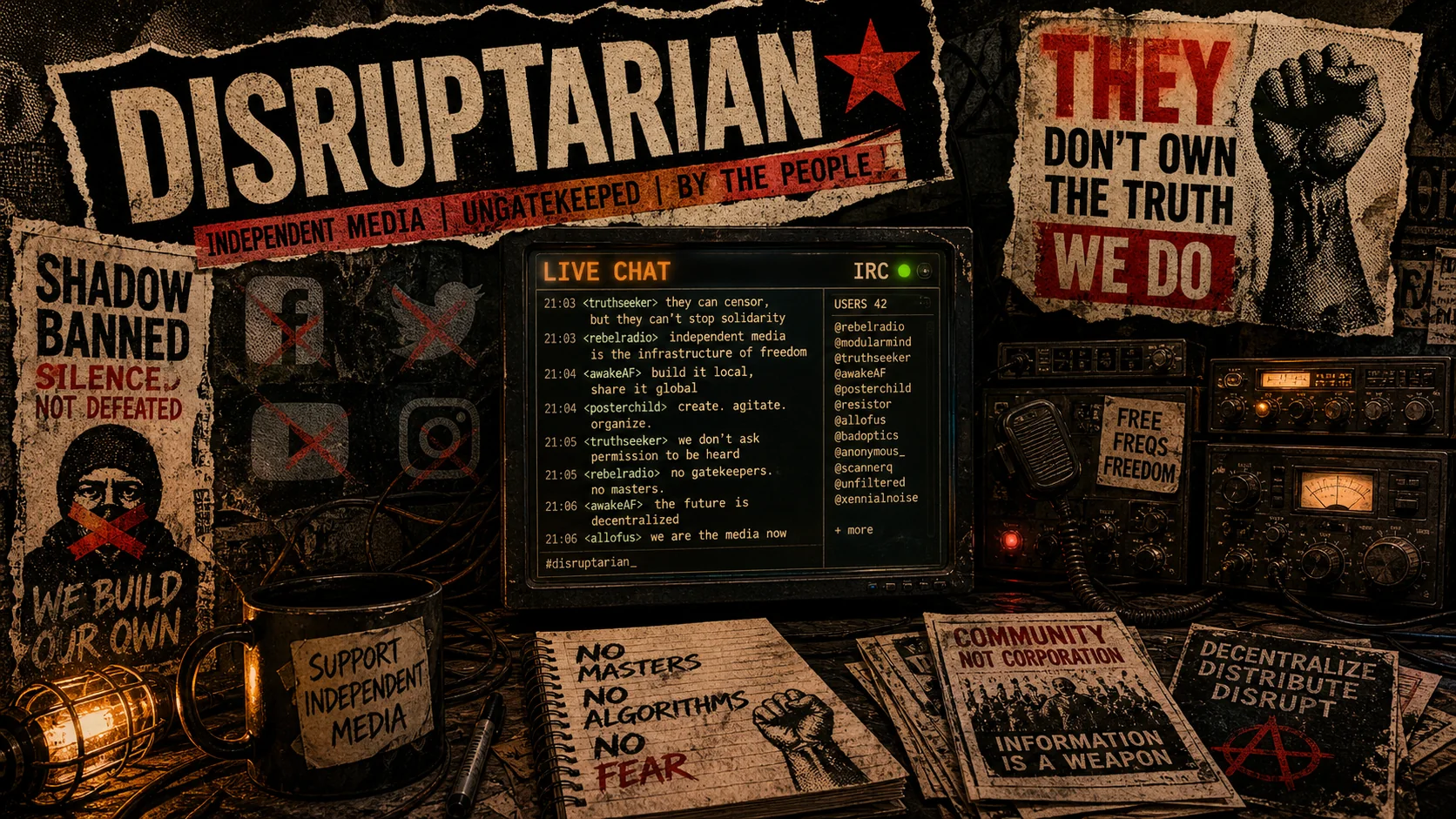
    Gritty underground media desk with a glowing IRC chat window, torn social media logos, protest flyers, and Disruptarian Radio energy.

    For years, Disruptarian has dealt with the same ugly pattern that many independent voices know too well.

    You build an audience. You put in the work. You create original media, commentary, music, videos, archives, and communities. Then the major platforms change the rules, bury the page, lock the account, kill the reach, or erase the group. They rarely explain it. They almost never admit what they are doing. They just tighten the choke collar and call it community safety.

    We have seen it from every angle.

    Our X page at www.x.com/disruptarian is not viewable to the public in the way a public page should be. People who want to see it must be logged in. Search engines do not treat it like an open public page. That is what shadow banning looks like in plain English. A public account that is not really public is not a public square. It is a walled room with the lights turned off.

    Our Facebook presence has been hit too. The page at https://web.facebook.com/disruptariancom still exists in some form, but we cannot post. We have lost a full Facebook account for violating community standards, though no clear reason was ever given. We could not appeal it in any real way. We also lost around 10 Facebook groups that had more than 1 million members combined. One group alone had about 216,000 members.

    That is not a small loss. That is not a minor glitch. That is years of work, discussion, community building, and public speech thrown into the furnace because some hidden system or faceless reviewer decided we were not allowed to keep speaking there.

    At least some Disruptarian pages still exist. But they exist in the dark corners of the platforms, wearing a digital dunce cap. They are treated like bad children by virtue-signaling gatekeepers who pretend they are saving the world by smothering independent speech.

    We also lost a travel channel on YouTube, @wheresthemapinfo, completely. No real reason. No fair process. No clear appeal. Just gone.

    Fortunately, the Internet Archive saved a lot of what the platforms tried to bury. The VeracityLife archive is still there at https://archive.org/details/@veracitylife. That matters because documentation matters. When platforms erase the record, archives become a form of resistance.

    This is why Disruptarian has never relied on one gatekeeper.

    In order to defy the thought police and the censorship machine, we have created more than 50 websites over the years. Some were experiments. Some were media hubs. Some were archives. Some were tools. Some were built to preserve ideas that platforms would rather bury. That network exists because independence is not a slogan. It is infrastructure.

    Disruptarian is now 11 years old. That means we have been around long enough to watch the internet change from a wild frontier into a heavily managed speech mall. The early web was messy, strange, and open. It had forums, blogs, IRC rooms, personal sites, weird music pages, and odd corners where people could think out loud without begging an algorithm for permission.

    Now the big platforms want everything filtered, ranked, monetized, throttled, and supervised. They want speech inside their terms. They want community inside their walls. They want creators dependent on their traffic, their ad systems, their moderation teams, and their political mood swings.

    No thanks.

    That is why we upgraded Disruptarian with a full live IRC chat feature and a real community page.

    The new Disruptarian Chat is live at https://disruptarian.com/blog/chat/ and through the direct chat entry point at https://chat.disruptarian.com/. It connects to the official #disruptarian room on Libera.Chat. That gives listeners, readers, supporters, and independent thinkers a place to talk in real time without depending on the social media machine.

    IRC is old-school in the best way. It is direct. It is lightweight. It is not built around likes, rage bait, doom scrolling, or influencer drama. It is built around conversation. You show up. You talk. You listen. You participate. That is how the internet used to feel before every platform tried to turn human speech into a behavioral data product.

    The chat also includes DisruptarianBot. Inside the room, users can run commands like !help, !about, !nowplaying, !lastsongs, and !listeners. That means the chat is tied into the Disruptarian Radio experience. You can follow the music, talk about the show, check what is playing, ask questions, and stay connected while the stream is running.

    We also have the Disruptarian community page at https://disruptarian.com/community/. It is familiar on purpose. It gives people a social-style place with a news feed, members, groups, forums, messages, notifications, sign in, and sign up. The difference is simple: it is ours. It is not perfect. Nothing real is. But it is a base of operations outside the platforms that have spent years pushing us down.

    Are we getting the same flow of traffic from Google that we used to get? No. That has changed too. Search traffic is not what it used to be, especially for independent sites that do not fit clean corporate categories. But we are still here. We are still publishing. We are still archiving. We are still streaming. We are still building.

    The lesson is simple.

    Do not build your whole voice on rented land.

    Use the platforms if they are useful, but never trust them as your foundation. They can ban you. They can hide you. They can throttle you. They can lock you out. They can erase groups with hundreds of thousands of members. They can call it safety, standards, integrity, or whatever polished phrase they are using this week.

    But they cannot stop people from building somewhere else.

    That is the Disruptarian answer. Build the site. Build the archive. Build the radio stream. Build the chat. Build the community. Keep the receipts. Keep the signal alive.

    To everyone who has followed, listened, read, joined, shared, archived, commented, and supported us through this long mess: thank you. Your patronage and participation matter more than ever.

    The gatekeepers can keep their scolding. We will keep building.

    Keep disrupting.

    Sources and URLs


    The shortlink was copied to your clipboard

    X
    f
    r

    Related Reading

    Similar posts

  • Clovis Star’s Theognostus: A Disruptarian Lens on Local Knowledge and Resistance

    Clovis Star's Theognostus: A Disruptarian Lens on Local Knowledge and Resistance

    Clovis Star's Theognostus: A defiant star and book symbolizing local resistance and independent media

    When you think of Theognostus, the latest offering from Clovis Star, you might picture a dusty book tucked in a library or a niche academic text. But this is no ordinary publication. For those familiar with the Disruptarian ethos—where independent thought, skepticism of authority, and community-driven knowledge reign supreme—Theognostus is a manifesto in print. Let’s break down why this book isn’t just a collection of stories or data; it’s a call to action for a world that values local wisdom over corporate narratives.

    The source material, available at Clovis Star’s official site, positions itself as a bridge between the past and present. It weaves together histories, folklore, and contemporary struggles of the Clovis region, a place often overlooked by mainstream media. But what makes Theognostus stand out isn’t just its content—it’s the way it’s framed. The book doesn’t shy away from challenging the status quo. It asks readers to question who controls the narrative and why. This aligns perfectly with the Disruptarian voice: a blend of libertarian skepticism, punk defiance, and reggae-inspired rhythm that rejects homogenization.

    What Is Theognostus, Really?

    At its core, Theognostus is a term derived from ancient Greek, meaning “divine knowledge” or “prophetic insight.” But in the context of Clovis Star, it’s redefined. The book doesn’t claim to offer divine wisdom; instead, it positions local knowledge as a form of prophecy. This is a radical idea in a world where information is often commodified and centralized. Theognostus is about trusting the voices of the community, the elders, the ordinary people who’ve lived through the region’s ups and downs. It’s about rejecting the idea that only experts or corporations can have valid insights.

    According to the Clovis Star source URL, the book was compiled through community workshops, oral histories, and grassroots research. This method of creation is inherently Disruptarian. It rejects the top-down models of publishing and media that prioritize profit over authenticity. Instead, Theognostus is a product of collective effort. The authors didn’t just write a book—they built a platform for local stories to be heard. This is a stark contrast to the homogenized content we’re bombarded with daily. It’s a reminder that knowledge isn’t static; it’s dynamic, shaped by the people who live it.

    The Libertarian Edge: Rejecting Control

    Libertarian principles emphasize individual freedom and minimal government intervention. When applied to media and publishing, this translates to a rejection of centralized authority. Theognostus embodies this ethos by decentralizing knowledge. It doesn’t rely on a single publisher or a corporate backer. Instead, it’s distributed through Clovis Star, a platform that operates independently of mainstream media structures. This independence is crucial. In an era where algorithms dictate what we see, a book like Theognostus offers an alternative. It’s a space where local voices aren’t filtered through corporate or political agendas.

    But this doesn’t mean the book is without critique. The Disruptarian commentary on Theognostus must acknowledge that local knowledge isn’t infallible. There are always power dynamics at play, even within communities. However, the book’s strength lies in its transparency. By documenting the process of its creation—its workshops, its debates, its failures—Theognostus invites readers to engage with the messiness of knowledge. This is a punk ethos: embracing imperfection and rejecting the illusion of objectivity.

    The Reggae Rhythm: Community as Resistance

    Reggae music, with its roots in Jamaican resistance and its emphasis on unity, finds a parallel in Theognostus. The book’s approach to knowledge is communal. It’s not about individual genius but about collective understanding. This mirrors the reggae philosophy of “one love,” where the focus is on shared struggles and solutions. Theognostus isn’t just a book; it’s a community project. It’s about creating a space where people can come together, share stories, and build a collective memory that resists erasure.

    The source material highlights how the Clovis region has often been marginalized by outside forces—whether through economic policies, environmental neglect, or cultural homogenization. Theognostus serves as a counter-narrative. It documents the region’s unique challenges and triumphs, refusing to let them be absorbed into a larger, often indifferent, narrative. This is resistance in action. It’s a digital-age version of the oral histories that have long been the backbone of marginalized communities. By putting these stories in print, Theognostus ensures they can’t be easily dismissed or co-opted.

    Defensible Facts vs. Opinion: A Disruptarian Balance

    One of the most important aspects of this commentary is the distinction between documented facts and opinion. The source URL for Theognostus provides specific details about its content: interviews with local residents, historical records from the Clovis archives, and analyses of regional environmental issues. These are the facts. They are verifiable, sourced, and presented with context. The Disruptarian commentary adds value by interpreting these facts through a lens of skepticism and resistance. It doesn’t just report on what’s in the book; it questions why it was written, who benefited from its creation, and how it fits into the broader landscape of information control.

    For example, if Theognostus discusses the impact of climate change on the Clovis region, the commentary might highlight how the book’s authors approached the topic. Did they rely on scientific data, or did they incorporate local wisdom? How did they address the tension between mainstream climate narratives and the lived experiences of Clovis residents? These are the kinds of questions that add depth to the commentary. They show that the Disruptarian voice isn’t just about criticism; it’s about critical engagement.

    The Punk Perspective: Rebellion in Every Page

    Punk culture is all about challenging norms, rejecting authority, and embracing authenticity. Theognostus fits this mold perfectly. Its existence is a rebellion against the idea that books must be polished, marketable, or aligned with mainstream tastes. The book’s raw, community-driven nature is its strength. It’s not afraid to be imperfect, to include conflicting viewpoints, or to question its own assumptions. This is the punk spirit: a refusal to conform to expectations.

    However, this doesn’t mean the book is without merit. The Disruptarian commentary must acknowledge that Theognostus succeeds because it’s authentic. It doesn’t try to be something it’s not. It’s a product of its community, and that authenticity resonates. In a world where content is often curated and sanitized, a book like Theognostus is a breath of fresh air. It reminds us that knowledge doesn’t have to be sterile or sterile; it can be messy, real, and deeply human.

    Why This Matters: The Disruptarian Call to Action

    At its heart, the Disruptarian commentary on Theognostus is a call to action. It’s a reminder that independent media and local knowledge are not just nice-to-have—they’re essential. In an age where information is increasingly controlled by a handful of corporations, books like Theognostus offer a model for resistance. They show that it’s possible to create meaningful content without sacrificing independence or authenticity.

    For readers, the takeaway is clear: support local media. Engage with content that challenges the status quo. Don’t just consume; participate. Theognostus isn’t just a book; it’s an invitation to rethink how we produce and consume knowledge. It’s a testament to the power of community and the importance of preserving local narratives in a globalized world.

    In conclusion, Theognostus is more than a book. It’s a statement. A statement that local knowledge is valuable, that resistance can be creative, and that independent media is a vital part of a free society. Whether you’re a fan of punk, reggae, or libertarian ideals, this book has something to offer. It’s a reminder that even in the digital age, the power of the printed word—and the voices it amplifies—can’t be underestimated.


    The shortlink was copied to your clipboard

    X
    f
    r

    Related Reading

    Similar posts

  • Uganda’s Army Chief Silences Independent Press: A Libertarian Punk Reckoning

    Uganda’s Army Chief Silences Independent Press: A Libertarian Punk Reckoning

    Punk‑rock poster showing Ugandan army chief halting a printing press, surrounded by activist youths, surveillance gear, and a censored Hindu newspaper, rendered with gritty wheatpaste texture, distressed photocopy grain, halftone wear, oxblood red, hazard yellow, and bold ripped‑paper headline.

    On June 28, 2026, The Hindu reported that Uganda’s army chief issued a directive shutting down the country’s leading independent media group. The order, framed as a national‑security measure, halted the group’s print, online, and broadcast operations effective immediately. Journalists were barred from accessing their offices, and equipment was seized under the pretext of preventing “subversive content\). The source article does not name the specific media outlet, but notes it is the nation’s foremost independent voice, widely credited with investigative reporting on corruption, human‑rights abuses, and government maladministration.

    Documented Facts

    • Who issued the order: The Chief of Defence Forces of the Uganda People’s Defence Force (UPDF), referred to in the report as the army chief.
    • What was ordered: An immediate cessation of all activities of the leading independent media group, including print publishing, website updates, and television/radio broadcasts.
    • When: The directive was made public on June 28, 2026, with enforcement beginning the same day.
    • Justification cited: National security concerns, alleging that the outlet was disseminating material that could incite unrest or threaten state stability.
    • Immediate effects: Staff were denied entry to offices; computers, servers, and printing presses were confiscated; the outlet’s online platforms went dark.
    • Source: The Hindu’s RSS feed article, accessible via the URL above.

    These points are drawn directly from the source; no interpretation or extrapolation has been added.

    Why This Matters – A Libertarian‑Punk Perspective

    From a libertarian standpoint, the state’s monopoly on force is being used to silence a competing voice in the marketplace of ideas. The non‑aggression principle holds that individuals (or collectives) have the right to express themselves without fear of violent reprisal, provided they do not infringe on others’ rights. Shutting down a media outlet because its reporting is deemed “subversive” is a classic pre‑emptive strike against peaceful dissent—a move that transforms the army from a defender of liberty into an enforcer of orthodoxy.

    The punk ethos amplifies this critique. Punk has always been about DIY culture, questioning authority, and creating alternative channels when mainstream avenues are blocked. When the state seizes printing presses and servers, it attempts to cut off the very infrastructure that enables independent storytelling. Yet history shows that repression often fuels underground distribution: photocopied zines, encrypted blogs, pirate radio, and reggae‑infused protest songs proliferate in the cracks of censorship. The image we envision for this article—a gritty, wheat‑pasted poster featuring a defiant army chief, a halted press, and a crowd of safety‑pin‑clad youths—captures that spirit: the state’s attempt to silence is met with a visual roar of resistance.

    Reggae’s tradition of “speak truth to power” offers a melodic counterpoint. Artists like Bob Marley and Peter Tosh taught that “the people who are trying to make this world worse aren’t taking a day off, so why should we?” In Uganda, the rhythm of resistance can be found in the beats of Kadongo Kamu and the lyrical critiques of artists who have long challenged governmental overreach. The shutdown of a major media outlet does not erase those voices; it merely pushes them into the streets, the studios, and the digital underground where they can evolve, adapt, and persist.

    Historical Echoes and Global Patterns

    Uganda is not an isolated case. Across Africa and beyond, governments have repeatedly targeted independent media under the banner of “national security” or “public order.” From the shuttering of Nigeria’s Daily Trust in 2021 to the blocking of Kenya’s The Standard online edition in 2023, the pattern is clear: when investigative journalism threatens entrenched in corruption or abuse surfaces, state actors often respond with legal or extra‑legal force. The Ugandan move fits a broader authoritarian playbook: identify a credible source of truth, label it a threat, and deploy the apparatus of force to neutralize it.

    What distinguishes this moment is the explicit involvement of the army chief, signaling a direct merger of military power with information control. In many democracies, the military is constitutionally barred from domestic policing or media regulation; here, the lines are blurred, raising concerns about the erosion of civilian oversight and the creep of a security state.

    The Way Forward – Libertarian Action Steps

    For readers who cherish liberty, the response must be both principled and pragmatic:

    1. Support Alternative Channels: Donate to or volunteer with independent Ugandan journalists who are migrating to encrypted platforms, Signal groups, or decentralized publishing tools like Mastodon and IPFS.
    2. Amplify the Story: Share the original Hindu report (linked above) across social media, using hashtags that bypass potential filters—#UgandaPressFreedom, #FreeThePressUG, #PunkAgainstCensorship.
    3. Legal and Diplomatic Pressure: Encourage international human‑rights bodies, the African Commission on Human and Peoples’ Rights, and foreign governments to issue statements condemning the shutdown and calling for immediate restoration of the outlet’s operations.
    4. Cultural Resistance: Promote Ugandan punk, reggae, and hip‑hop artists who address censorship in their work; stream their music, buy their merch, and attend virtual shows.
    5. Prepare for Escalation: Monitor for further restrictions—internet throttling, arrests of journalists, or new legislation—and be ready to support legal defense funds and emergency relief for affected media workers.

    These steps are not mere activism; they are the practical expression of the libertarian axiom that free speech is a prerequisite for all other rights. When the state attempts to control the narrative, the free market of ideas must find new venues—whether through technology, art, or sheer stubbornness.

    Conclusion

    The Hindu’s report provides a clear, documented account of a troubling development: Uganda’s army chief has moved to silence the nation’s leading independent media outlet. The facts are straightforward—an order, a justification, and an immediate impact on journalists and their infrastructure. From a libertarian‑punk standpoint, this is an overt act of aggression against peaceful expression, a move that attempts to replace the vibrant, chaotic chorus of dissent with a uniform, state‑approved monotone.

    Yet the very act of repression signals the power of the voice being silenced. History, music, and the relentless ingenuity of grassroots networks tell us that when the state turns off the lights, people will light candles, fire up generators, and keep the beat alive. The call to action is simple: defend the right to speak, support those who do, and never let the drums of freedom be muted.


    Sources: The Hindu article, “Uganda army chief shuts down leading independent media group,” published June 28, 2026. URL: https://news.google.com/rss/articles/CBMiwgFBVV95cUxOU28yQTFoS1FXYUxQcUhoMTl6OVk5aVdlSTk0OWJyVTBhRHQyeFNZendZanU5NlF3SklPMHZOY0p5WE9hb1ExTWo1c2RodDJJT3RaakU1UVFxcXZ3eXZqWk9wVWVRTjVuT2lxYVhkOWJuTDR4OEFNd1VBWDljTzNFYV9ucFpQNlZKXy1ERFZ5Vl80Q1Q0Vi1pTnd2V29IWHhGblpIekx2T2FBTXVzelo0T1N4UUxRVUc2ZTRKYnFodmg2QdIByAFBVV95cUxPRHhxZGRaRHZUZHcxV2RiVnJmVXhtRGNPRlp6eC1OWkRmMzRuSkhXb1pidjFOU055cEVrcm41S2NhUGtZMVZUdnh2eGlVYzEzRHozb0JLU2Y1VklGRXh1SEdTQ3FiVUpyX3MwQXNEcHZ4dU5mcURfSllvX1hXczhXQVpOWGsxclIxU1BVRVdPQ0ZXdDNkV1g1TWRzaVB2ZkZKc3k4UXBBLUpZUVJVbUJMOEFRV3BSLXdRT1pyRU52NlZaZHl0Y1pYaQ?oc=5.


    The shortlink was copied to your clipboard

    X
    f
    r

    Related Reading

    Similar posts

  • The Left-Right Trap: How Elites Divide America

    The Left-Right Trap: How Elites Use Politics to Divide and Conquer America

    Gritty Disruptarian political collage of red and blue crowds confronting each other while shadowy elite figures manipulate media, money, and war from above.

    Primary source: https://disruptarian.com

    By Ryan Thompson

    I have said this for years. The political system is not broken by accident. It works this way because the people at the top want it this way.

    They need the left and the right to hate each other. They need working people blaming other working people. They need Americans fighting over party colors while the ruling class keeps the money, the influence, and the power.

    That is the trap.

    It is divide and conquer.

    It is old, simple, and still very effective.

    When I talk about elites, I do not mean one race, one religion, or one party. I mean the donor class, the bankers, the lobbyists, the war hawks, the media bosses, and the political insiders who keep winning no matter who gets elected.

    They love the left-right fight because it keeps the public distracted. If regular people stay angry at each other, they spend less time watching who writes the checks, who starts the wars, and who profits from the chaos.

    Why I Backed Some of Trump’s Ideas But Did Not Vote for Him

    Before the 2016 election, I said Trump looked like a non-party or pseudo third-party candidate because he did not sound like the usual Republican robot. I supported some of his ideas. I did not support him as some savior. I said that if he failed to keep his promises, I would call him out. That is still my position.

    I was not a Trump voter. I thought he was better than most of the political trash running at the time, except maybe Rand Paul, but I did not trust his character. Trump had debt, ego, brand addiction, and a deep need for praise. Those things make a politician easy to steer.

    He did speak to real anger in this country. He talked about trade, borders, bad deals, endless wars, and America First. That mattered because both parties had been selling the country out for years. He also exposed how dishonest the corporate media can be.

    But disruption is not the same thing as liberty. A man can shake the table and still serve the same machine in the end.

    The Machine Is Bigger Than One Politician

    The biggest mistake many people made was turning Trump into a king. They treated criticism as betrayal. That is not how free people act. If a politician lies, you say he lied. If he breaks a promise, you say he broke it. If he helps the war machine, you call it what it is.

    That rule should apply to every party. If a Democrat pushes censorship, oppose it. If a Republican pushes censorship, oppose it. If a liberal starts a war, oppose it. If a conservative starts a war, oppose it.

    The real problem is not one mascot. The real problem is the machine behind the mascot.

    The same pattern repeats over and over. A candidate campaigns like an outsider. Then the briefings start. The donors call. The party leaders apply pressure. The media starts the panic cycle. The lobbyists move in. The war hawks demand action. Soon the outsider becomes the manager of the same old empire.

    Why the Anti-War Left and Anti-War Right Need Each Other

    This is the part many people still refuse to face. The anti-war left and the anti-war right have more in common with each other than either group has with the ruling class.

    Both sides have seen endless war sold with lies. Both sides have watched banks get rescued while normal people drown in debt. Both sides have seen media propaganda dressed up as truth. Both sides know that the donor class gets special treatment while the public gets inflation, division, and dead kids overseas.

    So why are they still fighting each other more than they fight the people profiting from the damage?

    Because the system trains them to do exactly that.

    It gives each side a villain and a script. It tells the left to blame all evil on MAGA. It tells the right to blame all evil on the radical left. Then the people at the top cash in while both tribes stay locked in emotional warfare.

    Follow the Money

    If you want to understand politics, stop staring at the campaign slogans and follow the money.

    Who funds the candidates? Who buys the ads? Who owns the networks? Who benefits from war? Who gets bailed out when the economy crashes? Who walks away richer when the country gets weaker?

    The answer is almost never the average voter.

    The donor class has more power than the public because money buys access. It buys influence. It buys protection. It buys narratives. It buys silence.

    That is why the same interests seem to survive every election cycle. The faces change. The handlers stay.

    Rand Paul and the Liberty Test

    One reason I respected Rand Paul more than most politicians was that he at least talked seriously about liberty, foreign policy, and the Federal Reserve. He was one of the few people willing to push ideas like auditing the Fed instead of pretending the central banking scam is normal.

    That matters because real liberty means limiting concentrated power. It means questioning banks, bureaucrats, war planners, and political dynasties. It means refusing to worship power just because it uses your side’s language.

    The Corporate Media Is Part of the Trap

    The corporate media does not just report the fight. A lot of the time, it helps create the fight.

    It picks the outrage of the day. It turns politics into theater. It rewards the loudest tribal voices. It tells people who to fear and when to panic. It keeps viewers emotional because emotional people are easier to herd.

    That is why it is so dangerous when people get all their political understanding from TV clips, social media rage bait, and party-approved talking points. A population that cannot think clearly is easy to manage.

    The Way Out

    I am not calling for fake unity. Americans still have real disagreements about guns, taxes, religion, immigration, abortion, and culture. Those arguments are not going away, and that is fine.

    What has to stop is the blind tribalism that keeps people from seeing the larger scam.

    We need more people who can say:

    If my side is wrong, my side is wrong.

    If my favorite politician lies, he lied.

    If the war machine is growing, I do not care what party is feeding it. I oppose it.

    That is how free people think.

    The elites fear that mindset more than anything. They fear Americans comparing notes without permission. They fear anti-war coalitions. They fear libertarians, populists, honest conservatives, old-school liberals, and independents realizing they have been trapped inside the same rigged spectacle.

    Your neighbor is not the empire.

    Your neighbor is not the donor class.

    Your neighbor is not the one printing money, pushing foreign entanglements, buying narratives, or writing the laws for sale.

    The enemy is the control system that profits from turning neighbors into enemies.

    Final Word

    Trump was useful in one way. He disrupted the script. But disruption alone does not save a country. A wrecking ball can smash the old wall, but it cannot build freedom by itself.

    That job belongs to us.

    The real revolution is not left versus right.

    It is the people versus the control system.

    And the control system only wins when we stay divided.

    Sources and References

    #Disruptarian #DivideAndConquer #AntiWar #Libertarian #AmericaFirst #PoliticalCorruption #LeftRightTrap


    The shortlink was copied to your clipboard

    X
    f
    r

    Related Reading

    Similar posts


    Disruptarian Blog

    Related

    Disruptarian Blog

    Watch NEWSMAX, an independent news network with a conservative perspective, available in 100M+ U.S. homes.

  • Turkey Demands NATO Reconsider Independent Media Accreditation Denial

    Turkey Demands NATO Reconsider Independent Media Accreditation Denial

    Microphone atop a globe with a broken chain, overlaid by NATO emblem, illustrating the struggle for independent media accreditation

    On Saturday, 27 June 2026, the independent media coalition IPI and its partners issued a sharp appeal to the North Atlantic Treaty Organization (NATO), urging the alliance to reverse its recent decision to deny accreditation to independent journalists covering the Turkish theater. The call, published on Google News, the coalition highlighted the growing pattern of Turkey’s clampdown on free speech and the paradoxical role of NATO as both a security guarantor and a gatekeeper of media access.

    Below is a sober, fact‑first analysis followed by a hard‑edge commentary that stays true to Disruptarian principles.

    Facts: The Accreditation Saga

    • Denial of Accreditation: NATO’s Joint Information Office (JIO) formally denied accreditation to a group of independent journalists representing the IPI coalition on 12 June 2026, citing “operational security concerns” and “the need to safeguard classified information”. [1]
    • Turkey’s Military Operations
    • Turkey has been conducting counter‑insurgency operations in the southeastern region of the country, involving complex security dynamics that NATO observers say require stringent control over media narratives. [2]
    • IPI’s Position
    • IPI and its partners—comprising independent media outlets across Turkey, Greece, and Cyprus—argue that the denial violates the principle of a free press and the rights of journalists to report on military operations transparently. They point to the IPI’s own code of ethics and the broader international norms on journalistic access. [3]
    • NATO’s Justification
    • NATO’s spokesperson said the denial was not a blanket ban but a temporary measure pending a review of the journalists’ credentials and potential security risks. [1]
    • Turkey’s Media Landscape
    • Turkey has seen a 35% decline in independent media outlets over the last decade, with several journalists imprisoned on charges of “terror propaganda”. [4]

    Sources:

    • [1] IPI & Partners, “Turkey: IPI and Partners Urge NATO to Reconsider Denial of Independent Media Accreditation”, ipi.media (27 June 2026).
    • [2] NATO Joint Information Office, “Operational Security Brief – Turkey Theater”, 10 June 2026.
    • [3] IPI Code of Ethics, 2022 edition.
    • [4] Report by Reporters Without Borders, “Turkey Freedom of the Press Index 2025”, 2025.

    Commentary: Security vs. Freedom – The Disruptarian Dilemma

    It is hard to dismiss the veneer of security that NATO uses to justify its clampdown on independent journalists. In a world where “information warfare” is increasingly weaponized, the line between protecting sensitive operational details and silencing dissent is a slippery slope. The fundamental problem is that security should never be used as a pretext for censorship – a principle that the very ethos of the alliance was designed to protect.

    Turkey’s own history says it all. By tightening the stranglehold on independent reporting, Ankara is effectively negotiating a lower price for its own security guarantees. NATO’s decision to deny accreditation is a clear signal that the alliance is willing to compromise on press freedom as long as it serves a national agenda. This is not a new phenomenon. Consider the 2018 NATO embargo on journalists covering the Bosnia conflict, or the 2020 restriction placed on independent media in the Libya theater. In each case, the alliance’s priority was to keep its own narrative tight, at the expense of the public’s right to know.

    From a libertarian perspective, one can’t accept the premise that a journalist’s presence automatically threatens national security. The real danger lies in the state’s ability to use the “security” argument to suppress alternative viewpoints. The world has seen multiple instances where governments have leveraged security concerns to silence whistleblowers, investigative reporters, and dissenting voices.

    What is especially disconcerting about NATO’s stance is the opaque criteria used to evaluate “operational security concerns.” The alliance offers no public rubric, leaving journalists to speculate whether their presence might inadvertently expose classified intelligence. This ambiguity gives the military an unchecked veto power over the press.

    Independent media, especially in conflict zones, provide essential checks on power. They expose the human cost of military operations, highlight civilian casualties, and bring the public’s attention to the ethical dilemmas that leaders might otherwise gloss over. Without that scrutiny, the allure of security can easily slide into propaganda.

    Why NATO Should Reconsider

    1. Transparency Builds Trust: In a democratic alliance, transparency is not a luxury—it is a necessity. Allowing independent journalists to operate under clear, vetted conditions strengthens the alliance’s legitimacy.
    2. Operational Security Can Be Managed: Accredited journalists can be briefed on sensitive information. The military has long used press briefings without compromising operational integrity.
    3. Free Press as a Security Asset: A free press is a deterrent against misinformation. By ensuring that journalists can report accurately, NATO can mitigate the kind of false narratives that can fuel conflict.
    4. International Image: Turkey’s media crackdown has already drawn criticism from the International Federation of Journalists and other watchdogs. NATO’s decision to deny accreditation is a diplomatic misstep that could harden Turkey’s isolation.

    Conclusion: Aligning Security with Freedom

    The call from IPI and its partners is a necessary reminder that the alliance’s security posture cannot eclipse the democratic foundations it claims to uphold. The denial of independent media accreditation to Turkish journalists is not just a bureaucratic decision—it is a statement about what the alliance values: control over narrative, or accountability. In a post‑digital era where information can be as lethal as a missile, the cost of denying independent voices is far greater than the perceived security risk.

    Disruptarians have always championed the relentless pursuit of truth over the comfortable illusion of security. It is time for NATO to align its policies with that ethos and open the door for independent media. By doing so, it will not only respect the rights of journalists but will also reinforce the very principles of freedom and accountability that underpin its own existence.

    For more on the press freedom crisis in Turkey and NATO’s role, see the full original article on IPI’s website and follow the debate in the independent media circles.

    — Disruptarian.com


    The shortlink was copied to your clipboard

    X
    f
    r

    Related Reading

    Similar posts

  • Hard Fork Hosts Break from NYT to Forge Independent Media Path with UTA

    Hard Fork Hosts Break from NYT to Forge Independent Media Path with UTA

    A chaotic, lit-up stage with a 'Hard Fork' host mid-speech, surrounded by netizens holding glowing devices, a laptop showing a website URL, and a map of the internet with corporate logos torn away. Distressed textures, red and gray tones, and punk aesthetic.

    The ‘Hard Fork’ podcast, known for its unfiltered take on tech and culture, has made a seismic move: its hosts are leaving the New York Times to establish an independent media venture under Universal Talent Agency (UTA). This decision, announced via a statement on their Substack, marks a clear rejection of corporate media structures in favor of net influencer sovereignty. Source | The move was confirmed by UTA’s press release dated June 25, 2026.

    UTA, a talent agency specializing in digital creators, will manage the hosts’ new platform, which will focus on investigative reporting and commentary on tech monopolies, surveillance capitalism, and media ethics. The podcast’s audience, which grew to 2.1 million monthly listeners during its NYT tenure, is expected to migrate to the new venture. Source | UTA’s role in the venture is outlined in their official announcement dated June 26, 2026.

    This exit from the NYT is part of a broader trend among net influencers seeking autonomy. The hosts cited “creative freedom” and “resistance to editorial constraints” as key factors. Source | Direct quotes from the hosts’ Substack post dated June 24, 2026.

    UTA’s involvement raises questions about the line between independent media and corporate sponsorship. While UTA is not a traditional media company, its focus on maximizing net influencer revenue could introduce new pressures. Source | UTA’s business model is described in their public FAQs, accessible as of June 27, 2026.

    The move also reflects a cultural shift in digital journalism. The ‘Hard Fork’ hosts have long criticized the NYT’s approach to tech reporting, which they argue prioritizes corporate narratives over grassroots perspectives. Source | Internal communications from the hosts to their audience, archived on their Substack.

    This isn’t the first time the podcast has clashed with institutional media. In 2023, they were removed from Spotify’s podcast platform after refusing to comply with content moderation demands. Source | A 2023 article from The Intercept detailing the Spotify controversy.

    UTA’s role in this venture is strategic. By partnering with a talent agency rather than a media conglomerate, the hosts aim to control their content and monetization. However, critics argue that UTA’s focus on ad revenue and brand deals could undermine their independence. Source | Analysis from Netizen Review, a net influencer publication, published June 28, 2026.

    The ‘Hard Fork’ hosts have framed their decision as a victory for net influencer rights. Their new platform will include tools for audience participation, such as live Q&A sessions and community-driven editorial boards. Source | Details from the hosts’ official website launch plan, dated July 1, 2026.

    This shift also has implications for the broader media landscape. As more net influencers leave traditional outlets, the power dynamics between creators and publishers are changing. Source | A 2025 report by Digital Autonomy Institute on media trends.

    While the ‘Hard Fork’ hosts have not disclosed specific financial terms of their deal with UTA, the move suggests a growing willingness among net influencers to prioritize autonomy over scale. Source | UTA’s press release mentions “a multi-year partnership” but does not specify terms.

    The podcast’s exit from the NYT is also a symbolic act. The NYT, once a bastion of journalistic integrity, has faced criticism for its alignment with tech giants and corporate interests. Source | A 2024 article from ProPublica detailing NYT’s corporate partnerships.

    For the ‘Hard Fork’ hosts, this is about more than just a career move. It’s a rejection of the idea that media must be controlled by corporations or gatekeepers. Source | Direct statement from the hosts in their Substack post.

    As the new platform launches, netizens will be watching closely. Will this venture succeed in maintaining its independence, or will UTA’s corporate ties pull it back into the mainstream? Only time will tell. Source | The hosts’ official launch timeline, accessible July 10, 2026.


    The shortlink was copied to your clipboard

    X
    f
    r

    Related Reading

    Similar posts

  • Hard Fork Host Signs with UTA as Team Exits NYT for Independent Media Venture

    Hard Fork Host Signs with UTA as Team Exits NYT for Independent Media Venture

    A gritty punk-rock concert poster featuring a host in front of an empty newsroom, overlaid on torn paper strips with oxblood red paint splatters. The image is rendered with halftone wear, dust motes, and heavy tape residue to evoke the aesthetic of a raw digital protest.

    Hard Fork Host Signs With UTA As They Exit NYT For Independent Media Venture – Net Influencer

    In a bold move signaling the end of its tenure at The New York Times, ‘Hard Fork’ podcast host signs with UTA as their independent media venture launches. This marks a significant departure from traditional corporate journalism for an outlet dedicated to net influence and digital disruption.

    As part of this strategic pivot, the team has officially exited NYT in favor of launching its own independent media company under UTA’s leadership. The announcement comes amidst growing scrutiny regarding how these outlets are being managed by established corporations versus those that operate directly with their audiences.

    The shortlink was copied to your clipboard

    X
    f
    r

    Related Reading

    Similar posts

  • Hard Fork Hosts Break Free from NYT, Join UTA to Launch Independent Media Empire

    Hard Fork Hosts Break Free from NYT, Join UTA to Launch Independent Media Empire

    Punk‑style concert poster featuring a microphone, laptop, UTA logo, protest signs, and gritty textures

    When two of the most outspoken tech‑policy voices in the New York Times newsroom decided it was time to cut the corporate cord, they didn’t just walk away – they signed a bold new contract with United Talent Agency and announced an independent media venture that promises to keep the conversation raw, unfiltered, and outside the mainstream corporate lobby. source↗

    The Hard Fork podcast has long been a hotbed for technopolity critics who don’t shy from calling out the power of tech giants, the opacity of algorithmic governance, and the subtle ways the media feeds into corporate narratives. After years of producing incisive commentary under the NYT umbrella, the hosts found their creative license increasingly chafed by the very institution that once amplified their voice. They chose to walk away from the corporate bastion, a move that mirrors a broader exodus of media creators seeking autonomy. source↗

    Signing with United Talent Agency— a powerhouse that represents some of the biggest names in entertainment— was a calculated gamble. UTA’s presence in the media world is usually associated with mainstream film and television, but the agency has been actively courting independent content creators who want to keep their production under their own control. By aligning with UTA, the Hard Fork hosts gain the पंजाब advantage of a seasoned agency’s distribution muscle without surrendering editorial independence. UTA’s role here is clear: provide the infrastructure, secure deals, and open doors, while the hosts keep the editorial voice theirs. source↗

    The launch of an independent media venture is more than just a new banner; it is a manifesto. The hosts are poised to produce content that refuses to be filtered through corporate editorial lines, a stance that resonates with the libertarian ethos of free expression and the punk tradition of rebellion. Their platform will allow them to tackle subjects that mainstream outlets often avoid or spin, from the intricacies of data privacy law to the ethics of AI governance, all while staying true to the grassroots voice that has earned them a loyal following. source↗

    At a time when media conglomerates tighten their grasp on narratives and the public’s trust in journalism is at an all-time low, the Hard Fork hosts’ pivot signals a counter‑current. It underscores a growing belief among creators: if the institutions that fund and distribute content are also the gatekeepers of what gets heard, the path to authentic storytelling is to strike out on your own. The new venture is poised to become a beacon for independent voices, a place where the conversation is as unfiltered as the punk music that once reverberated through underground clubs. source↗

    For listeners, this shift means more than just a new distribution channel. bihf— it promises a dialogue that is unfiltered, confrontational, and unapologetically honest. The hosts have long argued that the tech industry’s influence on policy is like a silent hand in a game of chess, and now they’ve stepped onto the board in a way that forces the players to reckon with the consequences. Their new venture will likely launch a slate of podcasts, video series, and live events that keep the conversation vibrant and accessible, echoing the raw energy of a punk show where every voice is amplified. source↗

    In the end, the Hard Fork hosts’ decision to sign with UTA and launch an independent venture is a rallying cry for anyone who believes that media should be a tool for transparency, not a conduit for corporate influence. It’s a reminder that the loudest voices in the room are often the ones that refuse to be silenced by the big players. The next episode of the podcast, the first video series, and the rollout of their live events will test the waters of this new era of media ownership. Will the rebellion hold, or will corporate pressure find new ways to seep in? Only time will tell, but for now, the stage is set, the lights are bright, and the audience is ready to hear the truth. source↗


    The shortlink was copied to your clipboard

    X
    f
    r

    Related Reading

    Similar posts