Category: Commentary

  • Show Your Work: Charlie Kirk Backed Candace Owens, and That’s Why the Questions Won’t Stop
    When the state says “trust us,” a free person asks: based on what?

    That’s not paranoia. That’s citizenship.

    Charlie Kirk’s killing is real. The case is real. The grief is real. And the public distrust is also real, because Americans have watched powerful institutions spin, stall, and seal information for years. So when people see a politically charged murder and then hear, “stop asking,” they don’t calm down. They dig in.

    And here’s what a lot of folks miss: Candace Owens questioning the story isn’t some random personality drama. Candace has been a major part of Charlie’s orbit for years. Charlie defended her publicly, promoted her repeatedly, and treated her like an ally on stage and on the road.

    So when Candace asks uncomfortable questions, a lot of people hear it as “disrespect.” I hear it as consistent with the world Charlie lived in, where speech gets punished and institutions get protected.

    Let’s talk about what we know, what we don’t, and why “just trust the FBI” is not a serious argument.

    What’s confirmed about the case so far

    Multiple outlets report Charlie Kirk was killed on September 10, 2025, at an event at Utah Valley University in Orem, Utah. A 22-year-old man, Tyler Robinson, has been charged, including aggravated murder, and prosecutors have said they intend to seek the death penalty. There are active court fights over media access and publicity restrictions. That part is not internet rumor. That is mainstream reporting. (See sources below.)

    You can believe the accused should get due process, and still believe the public has a right to transparency. Those two things are not enemies.

    In fact, that tension is the heartbeat of a free society.

    The real reason people don’t trust “official narratives” anymore

    Here’s the ugly truth: the government trained people to be skeptical.

    Not by accident, and not because Americans are suddenly “radicalized,” but because the modern administrative state lies like it’s a job requirement. Sometimes it’s malice. Sometimes it’s self-protection. Sometimes it’s just a bureaucrat doing what bureaucrats do, which is cover their own backside.

    You know what it feels like? It’s like hiring the fire department to mow your lawn. Expensive, slow, and you’ll probably lose your house in the process.

    So when the public sees a high-profile political killing and the response feels controlled, the instinct is simple:

    Show. The. Work.

    “Nothing to hide” is not the same as “nothing to ask”

    A lot of the online fighting revolves around Erika Kirk.

    In public reporting, Erika has said there’s “nothing to hide” and has supported transparency and media access. That matters. If we’re going to be honest, we can’t pretend she is publicly demanding total secrecy if she’s on record supporting open court access.

    But here’s what also matters: a spouse’s posture is not evidence. A spouse’s tone is not proof. Grief does strange things to people, and I’m not interested in psychoanalyzing someone who just lost their husband.

    The public’s questions should not depend on whether the widow smiles too much, cries too little, or says the right words. The public’s questions should depend on whether the state can back up its claims with verifiable facts.

    So if someone says, “nothing to hide,” the correct reply is: great, then let’s see what you can legally show.

    Transparency is not a vibe. It’s documentation.

    The “gag order” issue, and why it sets people off

    A major spark here is the court trying to manage publicity.

    Reporting describes the judge weighing concerns about pre-trial publicity and how much access the public and media should have. Other reporting describes a large potential witness pool and disputes about what counts as a “witness” under restrictions.

    Does that prove a coverup? No.

    Does it create the conditions for suspicion? Yes.

    Because when people don’t get information, they fill the gap with assumptions. That’s human nature. If officials want fewer rumors, they should reduce the vacuum.

    If the court needs limits to protect the jury pool, fine. Explain the limits clearly, define who is restricted, and publish a timeline for what becomes public later.

    Don’t just say “trust us” and slam the door.

    Two buckets: fair questions vs. unproven claims

    This is where we have to be grown-ups.

    There are two categories of things floating around online.

    Bucket 1: Fair questions tied to documented disputes

    These are grounded in what is openly happening in court and media reporting:

    • What evidence will be released before trial, and what will stay sealed?
    • Why are cameras and courtroom access being fought over?
    • What is the legal basis for restricting certain speech, and who does it apply to?
    • When will key records become public, if at all?

    Those questions are not evil. They’re normal in a major criminal case. In a political killing, they’re unavoidable.

    Bucket 2: Claims asserted online that are not established in the reporting

    The transcript you provided includes claims like “no autopsy,” “no death certificate,” “no ballistics report,” “witnesses forced to delete footage,” and other specific allegations.

    I’m not going to present those as facts without credible documentation. Some of them might be confusion between “not publicly released” and “doesn’t exist.” Those are different things.

    If the government wants to stop those claims from growing legs, it has an easy solution:

    Publish an inventory. What exists, what does not, what will be released, and why.

    No theatrics. Just receipts.

    Why Candace Owens keeps coming up

    Candace Owens is a lightning rod. Always has been.

    Some people love her. Some people can’t stand her. But the “you’re not allowed to ask questions” crowd is the most dangerous group in the room, because they are arguing for obedience, not truth.

    Candace’s role here matters for one simple reason: Charlie Kirk didn’t treat her like some outsider throwing rocks. He treated her like a trusted ally.

    So when critics say Candace is dishonoring Charlie by questioning the narrative, I’m going to ask something basic:

    Based on what?

    Because Charlie publicly defended her, publicly promoted her, and publicly shared the stage with her again and again.

    Receipts: where Charlie Kirk supported Candace Owens


    If you want to understand why it’s hard to paint Candace as some disloyal opportunist, look at the public record.

    1) Charlie defended Candace when Big Tech targeted her

    In August 2018, Candace Owens’ Twitter account was briefly locked. Charlie Kirk publicly defended her and attacked Twitter for a “double standard.” Major outlets reported on Kirk’s comments and his public defense.

    That matters, because the theme is the same: censorship, narrative control, and punishing dissent.

    Charlie wasn’t saying, “Candace is causing trouble.” He was saying, “they’re silencing her.”

    2) Charlie promoted Candace as a key partner on tour

    Turning Point USA’s own site published a piece about the 2021 Gen Free Tour that explicitly name-checks Candace, describing stops “with the great Candace Owens.”

    That’s not a hidden relationship. That’s not a quiet acquaintance. That’s a public alliance.

    3) Charlie talked about being harassed alongside Candace, and pointed out media bias

    A Fox News transcript PDF hosted by Reason includes Charlie describing being in a breakfast diner with Candace Owens when activists stormed in, and he notes it didn’t get much mainstream coverage.

    Again, the pattern is consistent: Charlie questioned the media narrative, and he did it while describing events involving Candace.

    4) A speech archive attributes to Charlie a direct endorsement of Candace’s influence

    There is an archive page that attributes to Charlie a strong verbal endorsement of Candace.

    Would I prefer an official TPUSA-hosted clip or mainstream transcript as the best source? Absolutely. But this does align with the broader, well-documented pattern of Charlie praising and promoting her elsewhere.

    Bottom line: Charlie treated Candace like an ally. Not just once, but repeatedly, in public.

    That’s why it’s hard to argue that “asking questions” is somehow anti-Charlie. Charlie was the kind of guy who didn’t mind asking questions when it came to speech suppression and media manipulation.

    “Respect” does not mean silence

    A free society does not treat questions as violence.

    You can mourn the dead and still demand clarity about how they died.

    You can support a widow’s grief and still insist the state does not get to run the story like a PR campaign.

    You can reject reckless speculation and still push for transparency.

    Those are not contradictions. That’s just thinking like an adult.

    The people who want silence always wrap it in morality.

    “You’re disrespectful.”
    “You’re dangerous.”
    “You’re causing division.”

    You know what? That’s a trick.

    Silencing speech is like putting duct tape over a smoke alarm. The fire still burns. You just can’t hear the warning.

    If the official story is solid, it will survive scrutiny. If it’s weak, the public deserves to know that too.

    What transparency should look like (a liberty standard)

    Here’s the standard I use, and it doesn’t depend on whether you like Candace Owens or dislike her.

    1) Due process for the accused

    Prove the case in court. No shortcuts. No mob pressure. No “trust our conclusion.”

    2) Maximum transparency that does not poison the jury pool

    If the court needs to restrict certain things before trial, fine. But that needs to come with:

    • clear definitions
    • narrow scope
    • written reasoning
    • a timeline for later release

    3) Equal rules for everyone

    If the government wants to restrict speech for “fairness,” it needs to apply rules consistently and explain them clearly.

    4) Treat the public like citizens, not subjects

    When officials talk down to people for asking basic questions, they don’t reduce distrust. They multiply it.

    Why this won’t go away

    This story won’t fade because it’s not just about one crime. It’s about a national pressure point:

    Do we live in a country where power has to explain itself, or in a country where power demands faith?

    Because faith is for church. Government gets audits.

    And when people see court restrictions, media fights, sealed records, and a lot of finger-wagging at the public, they reach the only reasonable conclusion:

    We need more information, not more scolding.

    Final thought

    You don’t have to sign onto every claim in that video to understand why the questions keep coming.

    The public is not crazy for wanting receipts.

    And Candace Owens isn’t some random outsider for asking. Charlie Kirk publicly defended her when she was censored, praised her in TPUSA materials, and spoke about being targeted alongside her.

    If Charlie believed in anything politically, he believed the culture punishes dissent and protects institutions.

    So no, the questions aren’t going away.

    Not until someone in power finally decides to do the one thing that actually calms people down:

    Show the work.


    Sources

    Spun Web Technology SMART SEO
    Spun Web Technology SMART SEO
  • One Skin One Love Rogue Rebel Anthem for Free Thinkers

    One Skin One Love Rogue Rebel Anthem for Free Thinkers

    Listen up: One Skin One Love isn’t a sanitized corporate feel-good jingle. It’s a rogue anthem — loud, unapologetic, and aimed at tearing the curtain off comfortable lies. DJ Disruptarian drops this track like a dare: can you hold unity and skepticism in the same breath? If you’re tuning into Disruptarian Radio, you already know the answer.


    One Skin One Love: A Subversive Call to Unity

    This isn’t kumbaya-lite. The phrase One Skin One Love works as both mirror and mirror-smash. It says we’re all human under the surface, yes — but it also forces you to ask why we let labels and loudmouth authorities slice us into factions. Music is the weapon here: reggae grooves stitched with modern production that gets your body and your brain moving at once.

    Ryan Richard Thompson — aka DJ Disruptarian — isn’t selling a poster slogan. He’s engineering a vibe designed to disrupt the usual narrative: “Divide to rule.” The track’s warmth plays against its bite. You’re invited in with catchy hooks and then nudged — sometimes shoved — into thinking. That’s the point.

    Why this track matters to free thinkers

    Why should libertarians, skeptics, and anti-establishment listeners care? Because One Skin One Love refuses the shallow optics of unity that require you to adopt a boxed identity. It offers unity without uniformity. It celebrates individual sovereignty while demanding we acknowledge our shared humanity.

    You don’t have to buy the mainstream script to accept the song’s premise. In fact, its challenge feels tailor-made for contrarians: can you imagine solidarity without surrendering your principles? That’s the uncomfortable, liberating question the track plants.

    The sound: roots, rebellion, and rhythm

    The production is deliberate — warm basslines, sunlit chords, and percussion that nods to roots music while keeping a modern bite. It’s a sound that invites you to dance alone or with a crowd of strangers who won’t try to convert you on the way to the bar.

    The lyrics are equally calibrated: simple but pointed. They refuse moralizing platitudes and instead offer a vision: shared skin, shared stakes, but distinct minds. That’s radical in a culture that too often conflates sameness with virtue.

    A disruptive philosophy wrapped in melody

    Don’t mistake the gentle chorus for passivity. Disruption doesn’t always look like yelling. Sometimes it’s a steady drumbeat that outlasts propaganda cycles. DJ Disruptarian understands that culture shifts in repetition, not in single megaphone moments. One Skin One Love is a useable melody that can attach itself to movements, conversations, late-night drives, and coalition-building among people who normally wouldn’t share a stage.

    It’s also a provocation. Why is love so often co-opted by those who want your compliance? Why is solidarity demanded but nuance forbidden? This track challenges you to hold tenderness and critique at the same time.

    Who is DJ Disruptarian?

    Ryan Richard Thompson has built his name on sonic subversion. He’s the kind of artist who treats music as both pleasure and platform. He’s not interested in hollow “unity” soundbites or influencer-approved hashtags. He’s here to plant a musical flag for people who want connection without capitulation.

    Thompson’s work has a consistent throughline: create art that entertains, then let it catalyze thought. One Skin One Love is the latest in a catalog that prizes agency — individual and collective.

    How to listen — and what to do next

    Listen loudly, but listen like you’re interrogating the message. Let the groove loosen your shoulders and the words sharpen your questions. Play it in your car. Share it with the friend who complains about political theater but wants better alternatives. Use it at meet-ups that value honest dialogue, not performative conformity.

    And then act. Music that invites reflection is useful; music that seeds action is powerful. Have a conversation that refuses labels. Organize a gathering that centers voluntary cooperation. Support artists who use their platform to nudge culture away from managed division.

    A closing provocation: can unity be free?

    One Skin One Love leaves you with a simple, subversive proposition: unity doesn’t have to mean uniform obedience. It can be an honest, voluntary recognition of shared fate — not a moral cudgel wielded by elites. That’s the kind of unity worth building.

    So crank One Skin One Love, let it rattle your assumptions, and ask yourself: will you keep swallowing the easy narratives, or will you build a different kind of togetherness — one grounded in freedom, curiosity, and mutual respect? If you want a movement that refuses to be monetized into meekness, this is the anthem you put on repeat.

    Spun Web Technology SMART SEO

    Spun Web Technology SMART SEO

  • From “Kop Busters” To Comment Busters: Why I’m Calling Out Barry Cooper On Candace Owens

    By Ryan “Dickie” Thompson

    Barry Cooper is not some stranger I decided to take a swing at.

    Sixteen or seventeen years ago, I was cheering him on from the cheap seats. When he launched Kop Busters, setting up stings to catch dirty cops, I loved it.TrendHunter.com+1

    On my old activist YouTube channel, xCannabis, I pushed his work hard. I made videos about Never Get Busted and Kop Busters, talked him up, defended him when people said he had gone too far. That little un-monetized channel ended up pulling more than a million views total on content that boosted Barry’s work.

    I did that because I believed in what he was doing. Former Texas narcotics officer turns around and starts exposing the drug war machine. Teaches people how to protect themselves. Uses stings and cameras to show how corrupt the system is.Wikipedia+1

    So let me say this at the top:

    This is not a hit piece.

    I still think a lot of Barry’s post-cop work has been brave and important. If he dropped a new project tomorrow exposing some sleazy DEA operation, I would be the first guy to hit Share.

    My problem is not his past. My problem is what he is doing right now.

    He is obsessing over Candace Owens, trying hard to smear her, and deleting reasonable pushback from people who have supported him for years.

    That is what this is about.


    The loyalty line in the sand

    On his Facebook page, Barry basically told people: if you support Candace Owens, I cannot be your friend.

    No nuance. No “I disagree with her on X, Y, and Z, here is why.” Just a hard line.

    So I commented, under my profile “Rich Garvey Banton.” I reminded him that I had been a serious supporter for 16 years. That I posted his early work on my xCannabis channel, which got hundreds of thousands of views for his stuff alone. That I never took a dime for it. I did it because I believed he was doing something good for humanity.

    And I said:

    • Candace is also a hero to me.

    • I am not your enemy. I see myself as a brother.

    • I am sad to watch you go on the offensive against another truth seeker.

    That comment stayed up for a bit. Then more of the conversation unfolded, and eventually a whole chunk of it disappeared.

    Why? I honestly do not know. But it felt like Barry was not just disagreeing. He was curating what his audience is allowed to see.


    The argument over Candace’s investigation

    The big friction point was Candace’s public investigation into the killing of her friend, Charlie.

    Love her or hate her, Candace Owens is a high profile conservative commentator. She has been called far right, she has pushed some wild theories, and she is currently neck deep in controversy and lawsuits.New York Post+3Wikipedia+3Encyclopedia Britannica+3

    Barry’s position seemed to be: she is making claims to millions of people, so she is dangerous and must be called out.

    I agreed with part of that. Big platforms should absolutely be scrutinized.

    Where we parted ways is on the nature of what she is doing.

    In my comments, I said she is not acting like a cop or a judge. She is not arresting anyone. She is asking questions, putting out pieces of data, and inviting the public to dig. She even reached out to people with access to critical evidence, like the camera footage behind Charlie, and updated her own followers when there was “not much to see there.”

    That is not how dogmatic con artists behave. That is how a loud, imperfect, public investigator behaves.

    Barry replied:

    “You’re determined to defend logical fallacies. That’s a real problem.”

    He said there was “literally no way” to argue his logic was wrong, and that he was ending the conversation.

    The ex-cop famous for questioning authority suddenly decided his own view was beyond questioning. That is when my respect started to wobble.


    Who is actually committing the fallacies?

    I am a logic nerd, so I spelled it out in my next replies, the ones he deleted.

    I listed the classic fallacies that were actually creeping into his argument:

    • Appeal to authority: “I am the true investigator, believe me when I tell you what she is doing.”

    • Ad hominem: going after her character more than her evidence.

    • Straw man: talking as if she is making final legal judgments when she is really running a rolling theory board.

    • Hasty generalization, slippery slope, circular reasoning: acting like one commentator’s mistakes prove she is a huge threat to civilization, then using that fear to justify more attacks.

    I also said something he did not address: when Candace gets something wrong, she often corrects herself publicly. That alone puts her miles ahead of most politicians and corporate media.

    Is she perfect? No. Has she pushed things I do not buy? Yes. But being wrong sometimes is not the same thing as being the enemy.

    And none of that explains why Barry felt the need to draw a friendship line around her name and start hitting delete on pushback from long-time allies.


    From “Kop Busters” to busting comments

    Back when Barry launched Kop Busters, he was setting up fake grow houses to catch cops in lies. He laid traps that exposed no-knock raids and corrupt departments on camera.TrendHunter.com+1

    He understood something basic: if you want to see the truth, you have to let the tape roll. You do not get to script reality. You document it.

    Now, on his own page, he is trimming reality. He is cleaning up his comment section so that his followers see a nice, neat version of the conversation where his logic stands unchallenged.

    Look, his Facebook page is his property. As a libertarian, I defend his right to moderate however he wants.

    But let us be honest about what it means:

    When the guy who built his name on transparency starts erasing polite criticism, he is not acting like the rebel cop buster. He is acting like a small-scale platform moderator, deciding which dissent his audience can handle.

    That is not censorship by law. But it is censorship in spirit.


    Big Tech and the mini-me version

    One of my screenshots is from Facebook itself. A woman posted, “I think some recreational drugs here and there can really be a good thing.” with a thumbs-up emoji. Facebook removed it and rejected her appeal because it violates “Community Standards.”

    Meta’s own rules say they restrict content that promotes the sale or use of illicit or recreational drugs.Facebook+3Transparency+3Transparency+3

    So a casual opinion about recreational drugs is now treated like a cartel ad.

    Barry knows this game. His whole career after policing has been about opposing the drug war, bad raids, and abusive enforcement.Wikipedia

    Yet he is now running a pocket version of the same thing. Big Tech censors one side of the drug debate, and Barry censors one side of the Candace debate.

    It feels like hiring the fire department to mow your lawn. It is the wrong tool, used for the wrong job, and your house still burns down.


    This is not about picking a team

    Let me repeat: I am not saying “Everyone must support Candace Owens.”

    She is a lightning rod. She has made harsh comments about a lot of people. She has taken positions on Israel, COVID, race, and now Charlie’s killing that trigger huge reactions.Wikipedia+2Encyclopedia Britannica+2

    Scrutinize her. Debunk her if you think she is wrong. Argue with her all day. That is fine.

    What I am saying is this: when activists start saying “If you support this commentator, you cannot be my friend,” that is not principle. That is tribalism.

    The same system that censors us loves that kind of split. The ruling class does not need to infiltrate movements if we are busy throwing each other out over podcast preferences.

    Liberty people should not be recreating the left vs right, red vs blue, cable news food fight inside our own circles.


    Activists eating their own, again

    We have seen this before.

    • Anti-war activists turned on each other over Trump.

    • Libertarians split into camps that hate each other more than they hate the Fed.

    • Now drug war critics are excommunicating people over whether they listen to Candace Owens while they roll a joint.

    It is like the Fed playing Monopoly with real people’s lives, printing money and inflating everything, while we argue over who picked the dog piece.

    If we cannot tolerate disagreement about commentators, how are we going to stand together against central banks, endless war, or mass surveillance?

    Mass surveillance is like a nosy neighbor staring through your window all day, then swearing it is “for your safety.” The answer to that is not building smaller nosy neighborhoods inside the dissident world.


    What I still hope from Barry

    I am not asking Facebook to ban Barry. I am not calling for boycotts of Never Get Busted. I am not telling anyone to unsubscribe.

    I am saying, as a guy who has backed him for more than a decade:

    Barry, you were at your best when you trusted people with raw, uncut reality. When you let the camera roll and let viewers decide for themselves which cops were crooked.

    You can disagree with Candace without turning your page into a purity test. You can say, “Here is where I think she is wrong,” without deleting respectful replies and cutting off friends who see value in her work.

    And if I am wrong about any of this, leave my comments up and show people why. That is how honest investigation works.

    Logic that cannot be questioned is not logic. It is faith.

    I still respect a lot of what you have done since you left the badge. Kop Busters, Never Get Busted, your willingness to take heat from the state; all of that mattered, and still matters.

    But because it mattered, it also matters when you start drifting toward the same control tactics we both claim to oppose.

    I am not out to destroy you. I am out to defend the principle that got me supporting you in the first place:

    Let people speak. Let evidence be debated. Stop treating disagreement like betrayal.

    If we lose that, we lose the only thing that ever really scared the powers that be: free people thinking out loud together.


    Sources


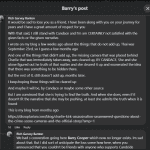
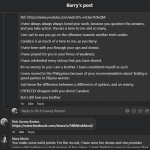
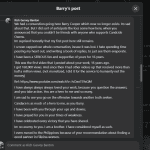
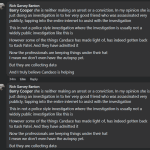
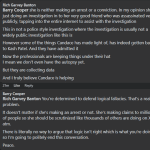
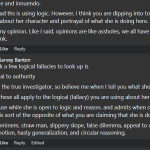
    Screen shots of the comments that I thought might get deleted, since Barry was telling people like me, that he could not be friends with our ilk.  (paraphrased)

    Transcription of the deleted comments and screenshots

    Comment 1: my long message to Barry on his post

    Rich Garvey Banton
    We had s converstion going here Barry Cooper which now no longer exists. Im sad about that. But I did sort of anticipate the loss some how here, when you announced that you couldn’t be friends with anyone who supports Candcide Owens.

    Im suprised honestly that my first post here still remains.

    I screen capped our whole conversation, incase it was lost. I hate spending time pouring my heart out, and writing a book of replies, to just see them evaporate.

    I have been a SERIOUS fan and supportive of yours for 16 years.

    This was the first video that I posted about your work, 16 years ago. I got 160,000 views. And since then I had other videos up that received more than half a million views. (not monetized, I did it for the service to humanity not the money)

    Ref: https://www.youtube.com/watch?v=lvOaoTE9xQM

    I have always always always loved your work, because you question the answers, and you take action. You are a hero to me and so many.

    I am sad to see you go on the offensive towards another truth seeker.

    Candace is as much of a hero to me, as you Barry.

    I have been with you through your ups and downs.

    I have prayed for you in your times of weakness.

    I have celebrated every victory that you have shared.

    Im no enemy to you. I am a brother. I have considered myself as such.

    I even moved to the Philippines because of your recommendation about finding a good partner in Filipina women.


    Comment 2: defending Candace’s investigation

    Rich Garvey Banton
    Barry Cooper she is neither making an arrest or a conviction. In my opinion she is just doing an investigation in to her very good friend who was assassinated very publicly, tapping into the entire internet to assist with the investigation

    This in not a police style investigation where the investigation is usually not a widely public investigation like this is

    However some of the things Candace has made light of, has indeed gotten back to Kash Patel. And they have admitted it

    Now the professionals are keeping things under their hat I mean we don’t even have the autopsy yet.

    But they are collecting data

    And I truly believe Candace is helping

    Barry’s reply to that:

    Barry Cooper
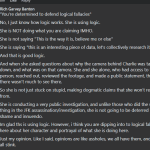
    Rich Garvey Banton You’re determined to defend logical fallacies. That’s a real problem.

    It doesn’t matter if she’s making an arrest or not. She’s making claims to millions of people so she should be scrutinized like thousands of others are doing on X atm.

    There is literally no way to argue that logic isn’t right which is what you’re doing so I’m going to politely end this conversation.

    Peace.


    Comment 3: my reply to “you’re determined to defend logical fallacies”

    Rich Garvey Banton
    “You’re determined to defend logical fallacies”

    No, I just know how logic works. She is using logic.

    She is NOT doing what you are claiming IMHO.

    She is not saying “This is the way it is, believe me or else”

    She is saying “this is an interesting piece of data, let’s collectively research it”

    And that is good logic.

    And when she asked questions about why the camera behind Charlie was taken down, and what was on that camera. She and she alone, who had access to that person, reached out, reviewed the footage, and made a public statement, that there wasn’t much to see there.

    So she is not just stuck on stupid, making dogmatic claims that she won’t relent from.

    She is conducting a very public investigation, and unlike those who did the same thing in the JFK assassination/investigation, she is not going to be deterred by shame and innuendo.

    Im glad ths is using logic. However, i think you are dipping into logical fallacy here about her character and portrayal of what she is doing here.

    Just my opinion. Like I said, opinions are like assholes, we all have them, and they all stink.


    Comment 4: listing specific fallacies

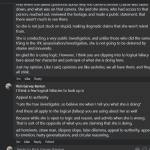
    Rich Garvey Banton
    I think a few logical fallacies to look up is

    Appeal to authority

    “I am the true investigator, so believe me when I tell you what she is doing”

    And these all apply to the logical (fallacy) you are using about her as well

    Because while she is open to logic and reason, and admits when she is wrong. That is sort of the opposite of what you are claiming that she is doing.

    ad hominem, straw man, slippery slope, false dilemma, appeal to authority, appeal to emotion, hasty generalization, and circular reasoning.


    Spun Web Technology SMART SEO

    Spun Web Technology SMART SEO

  • S.P.E.A.R Against Racism Rogue Uncensored Anthem

    S.P.E.A.R Against Racism Rogue Uncensored Anthem

    S.P.E.A.R Against Racism: a rebel’s rallying cry

    Listen up. This isn’t a soft plea for unity smeared across late-night TV. This is a rogue anthem — a shove to the ribs of complacency. S.P.E.A.R Against Racism isn’t a slogan stitched onto merch. It’s a refusal: refusal to let subcultures be hijacked by hate, refusal to accept that music and community are neutral when bigotry creeps in.

    DJ Disruptarian’s latest track — S.P.E.A.R Skins n Punks Everywhere Against Racism — lands like a raw transmission from a different frequency. It reminds those of us who value liberty and skepticism that real resistance often starts in the margins: the basements, the DIY shows, the sudden trust between strangers at 2 a.m. The focus keyword S.P.E.A.R Against Racism is not marketing. It’s a position.

    Origins: reclaiming a scene

    Let’s cut the sentimentalism. The punk and skinhead scenes were never monolithic. Yes, the 1980s injected poison into those circles — neo-Nazi units cozying up to safety pins. But to paint the whole subculture with that brush is cowardice of thought. There were always fighters inside: anti-racist skinheads, punks who swung their fists at fascists, people who knew that identity is not a permit for hatred.

    I wear the memory of that fight like ink on my skin — a tattoo that read S.P.E.A.R two decades ago. It was less symbolic then and more a declaration: I pick a side. That personal stake turned into a collective stance. We reclaimed the symbols, the music, the venues. S.P.E.A.R Against Racism crystallized from that hard-won clarity.

    Why does any of this matter beyond nostalgia? Because culture is a battleground. When you cede symbols and scenes to authoritarian ideas, you normalize them. When you fight back, you make reclamation viral, contagious.

    Why music still matters

    Music isn’t therapy. It’s strategy.

    From Billie Holiday’s Strange Fruit to Bob Marley’s defiant grooves, artists have always pushed ideas that outlive them. DJ Disruptarian’s track plugs into that lineage. It uses rhythm and language to make resistance unavoidable. The bass hits and the chorus loop don’t just move feet — they recalibrate minds.

    Music creates the conditions for action. A packed room where people move together can become the safest incubator for dissent. When S.P.E.A.R Against Racism drops, it amplifies the truth that resistance isn’t polite. It’s kinetic. It’s every person in the pit refusing to let hate set the beat.

    Community and uncompromising solidarity

    Let’s be blunt: “Change starts within” is lazy. Change starts when people bind together and refuse to tolerate structural injustice. Community isn’t fluff. It’s infrastructure. It’s the network that catches you when you fall and the platform that amplifies you when you speak.

    S.P.E.A.R Against Racism is about creating those networks. DJ Disruptarian’s shows are more than gigs; they are assemblies where marginalized voices are heard and protected. They are spaces where difference is celebrated and weaponized against polarization. What happens when people who’ve been told to shrink step into a room with loud music and louder conviction? They stop shrinking.

    The disruptive edge: provoke, don’t placate

    If you’re allergic to disruption, you’ll hate this movement. Good. We need troublemakers. We need people who will push the discussion into uncomfortable places and refuse to be sanitized.

    S.P.E.A.R Against Racism doesn’t ask for applause from the mainstream. It courts authentic reaction — argument, confrontation, transformation. Each lyric is a gauntlet. Each beat is a challenge: will you keep tolerating half-measures, or will you stand up and disrupt the systems that let racism persist?

    This is the ethos of Disruptarian Radio: provoke the comfortable, comfort the provoked, and never accept the bland compromise that lets injustice survive.

    What you can do — beyond listening

    Show up. Not as a tourist, but as an active participant. Go to shows. Support artists who take risks. Defend spaces from infiltration by reactionary actors. Teach new kids the history — the good and the ugly. Call out hypocrisy when you see it.

    Are you worried about being labeled? So what. Labels are for closets. Movements are for bodies in motion.

    Conclusion: S.P.E.A.R Against Racism is a command, not a campaign slogan

    S.P.E.A.R Against Racism asks for more than applause. It asks for alignment. It demands a willingness to fight for inclusive culture in the same way you’d fight to protect your freedoms — loudly, directly, without waiting for permission.

    This isn’t about being agreeable. It’s about being effective. So dance. Sing. Argue loudly. Organize harder. Let the track be your soundtrack to disruption.

    Join the movement if you’re ready to stop performing allyship and start doing the work. S.P.E.A.R Against Racism is more than an anthem — it’s a tactic. It’s a creed. It’s an invitation to reclaim our scenes, our soundtracks, and our future.

    Spun Web Technology SMART SEO

    Spun Web Technology SMART SEO

  • Disruptive Fatherhood: Rebel, Uncensored Beats for Free Dads

    Disruptive Fatherhood: Rebel, Uncensored Beats for Free Dads

    Disruptive Fatherhood: the beat you didn’t know you needed

    Listen up. If you think fatherhood is a checklist — provide, protect, pretend everything’s fine — you’re stuck in yesterday. Disruptive Fatherhood isn’t a hashtag or a feel-good weekend workshop. It’s a kinetic, noisy, honest overhaul of how fathers live and lead. DJ Disruptarian doesn’t just spin records; he flips scripts. His music is a manifesto: rip up the rulebook, feel your feelings, and show up for your kids without groveling to outdated expectations.

    Why does this matter? Because the stories our kids inherit shape their future. The silence dads buy into becomes their children’s default. Music breaks silence. Music provokes. Music connects. That’s the leverage — and DJ Disruptarian is using it to build a different kind of fatherhood.


    Break the mold: what Disruptive Fatherhood actually means

    Disruptive Fatherhood is not anti-family. It’s anti-facade. It’s the refusal to let “man up” be the last word on emotional life. It’s reimagining masculinity as capability plus vulnerability. It’s accepting that parenting is messy, improvisational, and often contradictory — and that’s where the truth lives.

    Think of it like a DJ set. You don’t just play the hits and call it a night. You mix, you pause, you drop the beat where it counts. You make room for silence and for noise. You respond to the room. Disruptive fathers do the same with their families: they listen, they improvise, they prioritize authentic connection over image.

    So what shifts? Fathers start talking about mental health without shame. They model emotional literacy. They show their kids how to fail and recover. They create households where curiosity and courage beat conformity.

    Music as insurgency: why the beat is political

    Is music political? Always. When DJ Disruptarian drops a track about wanting to be seen, it isn’t just art — it’s a challenge to cultural scripts that keep fathers small. Beats punctuate the conversation about caregiving, consciousness, and courage. They give dads permission to be imperfect and powerful at the same time.

    His events aren’t simply concerts. They’re tactical gatherings. Imagine a room full of fathers — not trying to out-alpha each other, but actually sharing strategies for bedtime, for grief, for rebuilding trust. That’s rare. That’s dangerous — in the best way. Because a dad who knows he can be vulnerable is a dad who teaches his kids resilience, not repression.

    Reframe masculinity: vulnerability as muscle

    Real strength isn’t silence. Real strength is naming fear, asking for help, crying when you need to cry. Disruptive Fatherhood reframes vulnerability as a skillset — one you can practice like any other craft.

    This doesn’t mean abandoning discipline or stewardship. It means making decisions from presence instead of ego. It means prioritizing conversations at the dinner table over dominance in the driveway. That’s a revolution that changes households from the inside out.

    Community over isolation: events that actually matter

    DJ Disruptarian’s gatherings turn playlists into platforms. Between the bass drops, conversations form. Fathers swap stories, not tipsheets. They admit they’re tired, confused, proud, and scared. They leave with tools for emotional transparency and a sense they’re not alone.

    If you’re tired of the podium-style parenting advice — the one-way lectures that make you feel inadequate — you’ll like this. These are communal labs, low on sermon and high on practice. They’re where new norms are invented by men who refuse to be actors in a stereotype.

    Practical disruption: small acts, seismic shifts

    Change doesn’t require a manifesto; it needs practice. Want to start with something simple?

    – Tell your kid you’re sorry when you mess up.
    – Ask questions more than you give commands.
    – Read your kid’s favorite book with full attention, no phone.
    – Show them tears, not theatrical bravado.
    – Make rituals that matter — dinner, music, honest talk.

    These are tiny rebellions against performance fatherhood. Over time they build people who can think, feel, and act — the opposite of programmed conformity.

    Why Disruptive Fatherhood matters now

    We are feeding future citizens into a world that demands adaptability, empathy, and critical thought. What message do we send if fathers keep pretending they are flawless pillars? Do we want another generation taught that strength means silence and that emotions leak out where they can? Or do we want children who inherit fathers who are present, relatable, and honest?

    Disruptive Fatherhood flips the narrative. It says: be loud, be soft, be accountable. The stakes aren’t small. They’re the next culture.

    Join or watch from the sidelines — but don’t say you weren’t warned. Soundtracks shape souls.

    Disruptive Fatherhood isn’t a trend. It’s a recalibration of parenting energy toward truth, connection, and creative courage. If you’re skeptical of mainstream narratives — good. Be skeptical. But also be brave: disrupt, listen, and lead. The revolution in your living room starts with the beat.

    Spun Web Technology SMART SEO

    Spun Web Technology SMART SEO

  • Multiple Trans Kids Under One Roof: A Father’s Story Of Divorce, Gender Ideology, And Parental Alienation

    Multiple trans / LGBT children in the same house.
    This is my situation.


    How it started

    In March of 2013, I pulled my ex-wife aside and tried to be honest with her.

    I was working 96+ hours a week. I was isolated. We were barely intimate. We were living in the same house, but it felt like we were just roommates.

    I told her something had to change or we needed to get divorced. I also admitted that I was turning to porn more and more, and that it was getting into my head and hurting me psychologically. I was carrying the financial load, taking care of my own needs, and feeling completely alone.

    Two months later, everything exploded.

    The accident and the public humiliation

    On May 3rd, 2013, a drunk driver going the wrong way on the freeway near Ashland, Oregon, hit my car head-on. He killed himself. He almost killed me.

    https://kval.com/news/local/man-dies-in-crash-driving-the-wrong-way-on-i-5-near-state-border

    I survived, but with 40+ broken bones and multiple surgeries. I was in a wheelchair, recovering at her mother’s house, because that is where she insisted we go.

    Two weeks after the accident, in the middle of the living room, in front of my kids and in-laws, she singled me out and started screaming at me about the porn issue. Top of her lungs. No privacy. No compassion. Just rage.

    Then she went outside and continued yelling up and down the street, while I sat there in a wheelchair, unable to even get up and try to calm her down or talk it through.

    That moment set the tone for the next several years.

    Seven years of betrayal

    The next 7 to 8 years were a drip feed of betrayal.

    She would:

    • Talk behind my back to our friends and business partners
    • Spread exaggerated or fabricated rumors
    • Flirt with a guy we had met in Ireland, talking about reuniting with him

    I filed for divorce twice and took it back twice. I tried to keep the family together. I tried to make it work.

    By 2020, I was done. It was clear our values had split in a big way, especially socially and politically. She had surrounded herself with LGBT friends and activists. We were not on the same page anymore, and it was obvious she wanted a different life.

    I finally filed for divorce a third time and decided I would not undo it.

    I did not think it was good for the kids to grow up watching constant conflict. I thought ending it cleanly might spare them more damage.

    The Ireland mess

    That Irish guy she wanted to rendezvous with was still in the picture. I actually told her: ask him to marry you so we can move the whole family to Ireland. She had already been making plans to live with him in some form.

    He turned her down and stopped talking to her.

    Then she told me to ask his sister.

    His sister agreed, but on one condition: that I give her a baby. I asked my ex-wife what she thought about that. Her response was basically:

    “If she will help us move to Ireland, sure, give her a baby.”

    That was the moment I knew it was really over, even if the paperwork was not final yet. That was about two months before I filed.

    Long story short, I went to Ireland, reluctantly followed through, and she got pregnant. As soon as that happened, she backed out of the marriage plan.

    Before that, I had tried to get her to go on birth control. She refused. I scheduled a vasectomy. When I told her about the appointment, she asked me not to go through with it, said she still wanted to marry me and still wanted a child with me.

    So I cancelled the appointment. I still have the email to my doctor.  More on that issue:  www.kaceythompson.org

    Meanwhile, back in the States, my ex-wife met a guy online, got engaged within a month, and was married to him within three months of meeting him.

    The kids start choosing sides

    When I got home from Ireland, my kids picked me up from the airport. On the ride home, they told me:

    “It really seems like mom wants us to choose sides against you. She says really horrible things about you.”

    Two months later, we were all in therapy together, and they told the therapist the same thing.

    My DVR at home recorded that original conversation with the kids. I mention this because my older child, who is now dealing with gender dysphoria, later denied ever saying those things. That was one of the early signs of parental alienation.

    There were others:

    • For years, my ex-wife had threatened that if I ever divorced her, she would turn the kids against me. That is also recorded on my DVR.
    • The first Christmas after the divorce, I tried to call the kids. She kept hanging up on me while I could hear my kids crying in the background, wanting to talk to their dad.
    • I sent presents and even money so she could buy them gifts. She refused. Eventually, my friend Ralph physically delivered the gifts so the kids would actually receive them.

    This was not a one-off moment. It became a pattern.

    The new “woman” in the house and sudden trans identification

    It kept escalating.

    In a short time, the new husband was wearing fake breasts, wearing dresses, and presenting himself as a woman.

    Shortly after that, my second oldest child decided she was trans.

    That is where the title of this post comes from. Multiple trans / LGBT identities under one roof, my kids caught in the middle, and me watching much of it from the outside while being painted as the villain.

    Where things stand now

    Fast forward to now.

    One of my daughters is on hormone replacement therapy and is transitioning to become a boy. She chose a new name. Out of respect, when I got a tattoo of my kids’ names on my arm, I had her new name tattooed too.

    I do try to respect her identity in day-to-day life. I love her.

    But I also believe that XX can never actually become XY, and that matters to me. That is where I draw the line. I cannot lie about basic biology, even to make people more comfortable.

    I am deeply concerned about the long-term health effects of hormone treatments on a child, the permanence of these choices, and the social pressure around all of this. I believe a lot of it is driven by cultural fads and ideological capture, not by careful, long-term thinking about what is best for a kid’s future.

    So I raised concerns with my ex-wife.

    Below is the unedited back-and-forth between us from early December 2025. Names are redacted. This is exactly how it was written.

    This is the back and forth between my ex-wife and myself:

    (me) Though, even despite the fact that I was outspoken and sacrificed friends and other things for decades to support gay marriage. Like Elon Musk and other liberals (yes he donated to and voted for Hillary in 2016) I am starting to see the slippery slope And more now than ever inam starting to see the weakness and trouble with this game of virtue signaling I've never cared what people think of me. I like who I am. But I supported gay marriage. Because I support liberty But when tolerance and affirmation turns into thousands of mutilated children and men in women's locker rooms taking women's trophies and being placed in women's prisons. I can see how tolerance and affirmation CAN in some cases be a bad thing And I am learning the errors of my ways 
    12/02/2025
    .
    12/04/2025 (me)
    And further more (name redacted) ***** I think you are harming the children by affirming medically harmful behavior, and ideologies fueled by cultural fads that are passing and sharply shrinking away It's time to look at their future and not just what a CHILD wants for themselves right now Part of being a parent is saying NO https://rumble.com/v72kv98-how-the-transgender-lobby-destroys-family-relationships.html 
    12/04/2025 (me) 
    You use to be so logical Since the porn fight that we had for so long, you got illogical and spiteful And the thing I regret most is hurting our children I miss you as a friend And for many years you were an amazing wife But what is left now is looking out for the well being of our children 
    12/05/2025 (my exwife) 
    I have nothing to say to you. You don't listen anyway. We have already discussed all of this at length. You are 100% welcome to stop badgering me. Thnx
    12:58 AM (my) 
    My having a serious concern about our daughters serious health risks by being on hormones that will permanently effect her future in a negative way is not my badgering you (name redacted) ***** I have asked to speak with her therapist and you have refused to disclose that information So the person that I need to speak to, is you Kim I'd be happy to never have to be reminded of the 7 years of betrayal and backstabbing and the broken heart I had to endure after you publicly ridiculed me in front of my children about a very private and adult topic, by never having to speak to you again either But I do worry about my daughter dealing with a mental illness called gender dysphoria, and then not getting properly treated, but rather getting affirmed I to a life altering issue that can not be later reversed So if you would rather just allow me to speak with her therapist. As her father I should be allowed to. I would MUCH rather do that 
    1:05 AM  (me) 
    I had hoped after the divorce, that you would be entirely happy about allowing as many people as you wanted, to call you "wife" or to be able to make plans with Eden, without my concern or interference, or whatever other sorts of betrayal you wanted to pursue. I didn't think you would hate me or resent me, for parting ways. I thought we were under a very clear direction I never allowed a single person to get intimate or close to me whole we were married. I never planned rendezvous with friends or potential mates, I never allowed anyone to call me husband, and even friends from high school who were divorced that sent messages inquiring of my marital status, I never gave them the time of day. But it was clear to me that you wanted to pursue other things And I agreed by setting you free There seems no need to be vindictive to me. I did you a solid from what I could tell But fine hate me. Try to destroy me with half truths and fault out lies Fine But there is no need to harm out children by affirming their self destruction Again.. I would be more than happy to talk to her therapist rather than you Please send the contact info And honestly the other kids who were self harming last year should be involved with some sort of therapy as well imho
    1:18 AM (me) 
    Will it hurt me if behind my back you tell our mutual friends exaggerated things about me? I mean, ya, kinda. But since I grew up and became an adult, I stopped dealing with the fiasco of high school popularity contests It hurt me more that you would betray me, than it did that anyone believed you Would it hurt me if you made plans with Eden behind my back? I mean yes, but, I figured it that made you happy.. go for it, you obviously weren't happy with me. I gave you my blessing with Eden and I was happy for you. But the thing that would hurt me the most, is seeing the future the bodies and the happiness of my children destroyed You knew that, and for 8 years, you threatened me with turning them against me It's on record. I'm not making that up Kim. What proof? But with you hurting me that way. You also have VERY much destroyed our children in more ways than just having a relationship with the man in this world who loves them more than his own life. You have hurt them in permanent psychological ways, that they even doubt who they are, after loving me so much during our lives together. It has taught them to hate half of themselves And it's a terrible thing to put on children They will suffer for the rest of their lives over this Not just from bodily changes such as infertility But they will suffer a life long sadness over this all And I beg you to stop this shit 
    1:21 AM (me)
    I'd do anything to try to fix it while it is potentially fixable
    1:23 AM  (me)
    And I can't type well with out my glasses Read between the lines I know you're all about spelling and all that But please. What can be done to mend this?
    1:40 AM (me) 
    And this whole trans thing started cooling off long before Trump was elected This isn't about hatred towards trans because of Trump. Or whatever TDS rhetoric is out there The studies show, this started cooling of significantly in 2022 It is just not a great path to be on There are underlying issues That should be addressed Most of not all trans people are dealing with many serious underlying psychological issues Gender dysphoria is how it manifests in some But clearly the stack of other issues shows up in almost all 
    3:01 AM (my exwife) 
    You really need to stop bringing up all your hurt feelings and baggage. No one cares. The ONLY addressable issue at all in all your blathering is the request to speak to James' therapist. That up to James, not me. James has the right to seek their own medical care. I am 100% sure I have said these words to you before. That's why it's badgering.
    3:37 AM  (my exwife) 
    What you really need to grasp is the DRAMATIC improvement in James' mental health in the last year and a half. Yes, (name redacted) ***** has gender dismorphia. Yes, they are seeing physicians and therapists. Yes, accepting them how they wish to present has vastly improved their sense of well being. 
    11:26 PM  (me) 
    And again though, when a CHILD demands something and when a child gets there own way, there is always a large amount of satisfaction from being able to control the narrative. Will it last? Maybe. I hope that she maintains a healthy emotional condition Before all of the alienation Directly after I got back from Ireland and for the 6 months they were with me, she had a good attitude and we had healthy dialog She as well as (name redacted) ***** and (name redacted) ***** both said on more than one occasion that it felt like you wanted them to choose sides and that caused them a great deal of emotional stress From the very moment I landed and even on their therapy session, they noted this as a major stressor for them And hat is why I have not PUSHED to be in their lives. Because that distance that you insist upon, is a you thing, UNTIL they have to choose sides And when they have to choose sides, then it causes them emotional distress So I have sacrificed my own happiness to give them space I hopes that they all find theirs even in this twisted situation I wish it were different and the only reason I mention hurt feelings, is BECAUSE of the way it negatively effects the kids I gave Laken space and allowed her to move on, but when I went silent she would insist on my presence I went back, and it was just turmoil I am not looking forward to being a part of any more turmoil But I do think that the children would benefit from their biological father being in their lives Beyond that. The research shows that the suicidality of trans people does not improve post- transition. And the studies that have long term observation of these situations, show that it is not just gender dysphoria in most of this cases, by in large, it is also issues such as autism, ADHD, schizophrenia, depression, and that once those underlying issues are addressed, the gender dysphoria is also addressed And that is my main concern As for (name redacted) ***** allowing me or not to talk with her therapist? I didn't know that as a minor, that was even optional? 
    11:29 PM  (me) 
    This is why I walked away (name redacted) ***** https://www.facebook.com/share/r/1GHzDABCU8/ I wanted you to be happy Not for us to be enemies
    
    Spun Web Technology SMART SEO

    Spun Web Technology SMART SEO

  • Nick Fuentes a Fed Uncensored Rebel Expose

    Nick Fuentes a Fed Uncensored Rebel Expose

    We live in an age where trust is a currency and skepticism is survival. If you’re tuning into Disruptarian Radio, you don’t swallow narratives whole — you dissect them. So let’s do what the mainstream won’t: look hard at the whispers, the patterns, the inexplicable pivots. Today’s target: the murmurs that Nick Fuentes is more than a provocateur — that some of his behavior fits the pattern of an asset, a useful idiot, or worse. Not as accusation, but as a thesis worth interrogating.

    Nick Fuentes a Fed — the question we’re asking

    What if the agitator who brands himself as anti-establishment is playing a role engineered by establishment players? The words “Nick Fuentes a Fed” show up in corners of the web where conspiracy meets cold analysis. That phrase is blunt and incendiary. But bluntness is useful. It forces us to look at anomalies: timing, funding, stagecraft, and the curious way some figures advance narratives that fragment opposition rather than topple power.

    Let’s be clear: calling something out doesn’t mean you’ve proven it. But disruption begins with hard questions. So let’s map the evidence, the inconsistencies, and the motives — then let listeners decide.

    The pattern that sets off alarms

    Look at the trajectory. A fringe figure skyrockets to influence, gets amplified in mainstream coverage, then performs stunts that fracture coalitions rather than unify them. That’s not coincidence. It’s classic misdirection.

    – Rapid amplification: Suddenly trending, quoted by outlets that once ignored him. Why would legacy media boost someone who undermines its legitimacy? Because controlled opposition is tastier than raw chaos.

    – Tactical infighting: Moments where the figure targets potential allies rather than systemic targets. Who benefits when movements are distracted fighting their own?

    – Convenient exits and re-entries: Bans, comebacks, platform migrations timed to maximize attention and martyrdom. How much of that chaos is organic, and how much is engineered?

    A decent provocateur can ignite debate. A useful asset redirects it.

    The money trail and the power of plausible deniability

    Money talks, but it rarely speaks outright. Funding channels, PACs, donations, and shadow networks create plausible deniability. An operative can be useful without a paycheck that says “fed.”

    Does Nick Fuentes have backers with agendas? The public record is messy and deliberately opaque. Yet patterns emerge: targeted amplification from unexpected corners, ad buys that mirror broader disinformation strategies, and an uncanny knack for showing up where narratives need a sharp, radical edge.

    Again, that doesn’t prove federal fingerprints. It does, however, suggest the need for accountable scrutiny — for financial forensics and for more transparent conversations among non-aligned media.

    The divide-and-conquer playbook

    Ask any seasoned political operator: when you cannot defeat a movement, you splinter it. The quickest way to neutralize dissent is to create radicals who make every future recruit look extreme by comparison.

    This is where the “fed” theory finds traction. When a figure acts as a polarizing amplifier, the broader opposition courts legitimacy issues. The public, tired of spectacle and violence, retreats to safety — to the institutions that promise stability.

    If you’re arguing that Nick Fuentes is part of that playbook, your evidence is behavioral and strategic. You point to how his rhetoric isolates moderates, how scandals overshadow substantive critique, and how his presence becomes a defensive wedge for authorities and media alike.

    Media manipulation and the theater of outrage

    Outrage is currency. It sells subscriptions, fills ad slots, and distracts the public from systemic clarity. Manufactured or not, spectacle is effective.

    Who benefits when outrage drowns out policy debate? The answer is rarely the outraged. It’s the gatekeepers. And gatekeepers love a villain they can point to while the larger architecture of power remains unfazed.

    Take the social media cycle: a clip goes viral, pundits scream, platforms suspend, and then the same figure is framed as a martyr. The pattern plays out predictably — predictable enough that it looks less like improvisation and more like production.

    So where does that leave us?

    Interrogation, not blind accusation

    We aren’t courtroom lawyers here. We’re journalists with a sharper knife. The claim “Nick Fuentes a Fed” is incendiary; treat it like a hypothesis. Test it. Follow money trails, timeline inconsistencies, and amplification sources. Ask why certain corners of the legacy press and political establishment seize on specific narratives while ignoring others.

    Don’t accept tidy answers. If the evidence points toward manipulation, expose it. If it doesn’t, call out the hysteria for what it is. Either way, the critical act is refusing to be naïve.

    Final word for Disruptarian listeners

    You didn’t come here for a safe consensus. You came for clarity and skepticism. Repeat after me: ask who benefits. Don’t let outrage be your compass. Demand receipts.

    In the end, whether or not you believe “Nick Fuentes a Fed,” the larger lesson holds: power thrives on distraction. Real disruption requires looking past the caricatures and toward the structures enabling them. Keep digging. Keep asking the uncomfortable question: who is steering the chaos, and to what end?

    Spun Web Technology SMART SEO

    Spun Web Technology SMART SEO

  • eliminating federal income taxes: Rogue Trump Plot

    eliminating federal income taxes: Rogue Trump Plot

    We’re not here to soothe. We’re here to provoke thought, rattle cages, and call out half-truths dressed as policy. If you’re tuning in from Disruptarian Radio, you know the drill: question the narrative, follow the incentives, demand accountability. Today’s showpiece is audacious—eliminating federal income taxes—and the way it’s being framed by some in Trump’s orbit is worth picking apart.

    This isn’t a wonky policy memo. It’s a cultural signal. Removing the federal income tax isn’t merely a tax cut. It’s a statement about power, governance, and who gets to fund the machinery of the state. That’s why skeptics and libertarians should care, loudly.

    Why eliminating federal income taxes is more than math

    Let’s start bluntly: when politicians promise to eliminate federal income taxes, they’re promising freedom to some and consequences to everyone else.

    The math is simple enough. The federal income tax is the backbone of federal revenue. Cut it out, and you either cut services, increase other taxes, or borrow even more. Those are real choices. You can’t wave a wand and keep everything else the same.

    But politics is never just math. It’s theater. The idea of eliminating federal income taxes resonates with an eager base fed up with the IRS, endless audits, and perceived bureaucratic overreach. It also sells well on talk radio and social feeds. There’s romance in uprooting an institution that feels invasive. That’s why the proposal shows up in populist playbooks.

    Ask yourself: who benefits from pushing this narrative? Who pays when the ledger goes unbalanced?

    A rogue plot or political theatre?

    Label it a rogue Trump plot if you like—provocative, outside-the-box, and maybe deliberately imprecise. That ambiguity is useful. It lets political operators promise liberation while deflecting responsibility for the fallout.

    If the federal income tax is eliminated, what fills the vacuum? Sales taxes? Payroll taxes? Tariffs? A national consumption tax? Each alternative shifts the burden in a different direction. Payroll taxes hit wages; consumption taxes hit workers and families; tariffs hit consumers and trade. None of these are a clean return to freedom.

    Libertarians may cheer the idea of smaller government funded by fewer intrusive mechanisms. But ask: do you truly want a system that relies on hidden consumption taxes and deficit spending, or would you prefer transparent downsizing with clear choices on services cut? Too often, the former is sold as the latter.

    Who loses when you remove the federal income tax?

    Short answer: everyone, but not equally.

    The wealthy might celebrate lower headline taxes, especially if other revenue sources are regressive. Middle-class households could face higher indirect taxes. Safety nets—Medicare, Social Security, defense, infrastructure—depend on steady revenue. Eliminating federal income taxes without a robust replacement risks eroding those systems.

    And if the federal government borrows more to plug the hole, future taxpayers shoulder the burden through inflation and debt service. That’s deferred taxation—less visible, but no kinder.

    The politics of outrage: distract, simplify, promise

    This is where the “rogue” label matters. The promise to eliminate federal income taxes is useful as a political weapon: it simplifies a complex fiscal reality into a single, emotional demand. Who can argue with freedom from the IRS?

    But simplicity is a tactic. It creates outrage, blurs trade-offs, and draws attention away from fiscal realism. The more the conversation centers on slogans, the less it addresses structural trade-offs—defense, entitlements, health, and the hidden costs of shifting tax burdens.

    Are voters being asked to choose intelligently, or being steered toward an emotive rallying cry?

    What a real conversation would look like

    If you’re serious about reform, don’t fall for slogans. Start with transparency. Lay out the revenues and expenditures. Offer clear options and ask citizens to decide which programs matter most.

    A constructive alternative to the headline-grabbing promise of eliminating federal income taxes: a phased approach. Cut rates where waste is demonstrable. Simplify the tax code. Target spending reforms. And make every change explicit—no smoke, no mirrors.

    Disruptarian listeners love radical ideas—fine. But revolutionary rhetoric should be paired with radical honesty.

    Conclusion: keep your skepticism tuned to full

    Eliminating federal income taxes is a bold promise that plays well on talk shows and at rallies. It appeals to those who distrust centralized power—and that distrust is justified in many cases.

    But don’t let rhetoric replace analysis. The proposal raises fundamental questions about who funds shared responsibilities, how burdens are distributed, and which services we value. If you want disruption, demand truth: require policymakers to present the full accounting, the replaced revenue sources, and the trade-offs in plain language.

    Skeptical? Good. Keep that skepticism loud on Disruptarian Radio. Ask the hard questions. Insist on real solutions, not political theatre. Eliminating federal income taxes sounds freeing—until you realize the costs are paid quietly, broadly, and often unfairly.

    Spun Web Technology SMART SEO

    Spun Web Technology SMART SEO

  • Tim Walz drive byes Uncensored: Rogue Take on the State

    Tim Walz drive byes Uncensored: Rogue Take on the State

    We live in a moment when public officials stage photo-ops and call them leadership. When governors roll out decrees and expect gratitude. When “safety” becomes a one-way street—safety for institutions, not citizens. Enter the phenomenon I call Tim Walz drive byes: a performative governance tactic dressed up as concern.

    This isn’t about party lines. It’s about spectacle. It’s about a politician circling neighborhoods in a motorcade, waving from a distance while claiming to be on the side of everyday people. It’s about the optics of empathy without the accountability of action. And no, it’s not harmless. It’s a small, corrosive piece in the broader erosion of trust between the governed and those who govern.

    What exactly are Tim Walz drive byes?

    They’re the political equivalent of a press release packaged as a community outreach. A governor cruises past, waves from the podium of a truck, and a spin team calls it “personal engagement.” Cameras catch the moment. Headlines follow. The feeling of civic connection is manufactured.

    But look closer. Who gets to decide what counts as engagement? Who benefits from the image, and who pays the bill—literally and figuratively?

    Let’s call this what it is: a distraction technique. It shifts the conversation from substance to sentiment. When a leader can swap a policy debate for a curated scene of compassion, the public loses momentum on real issues—budget priorities, civil liberties, the decentralization of power.

    Why the drive byes matter to you

    Ask yourself: would you trust a doctor who only came by to wave through your window instead of entering the exam room? Would you rehire a contractor who never fixes the roof but takes snapshots of the neighborhood with a selfie stick?

    Governance is supposed to be hands-on and accountable. It’s about responding to calls, showing up at meetings, writing enforceable policy, and dealing with consequences. Drive byes are anti-governance masquerading as connection. They’re symbolic gestures that deflect attention from measurable outcomes.

    The political utility is obvious. They’re cheap. They’re safe. They minimize risk for the officeholder while maximizing viral potential. But there’s a cost: the slow normalization of superficial leadership. When the public gets trained to accept imagery over impact, how do we demand transparency? How do we resist when the state prefers to perform rather than solve?

    Timing and theater: why spectacle replaces substance

    If you control the narrative, you control the conversation. Think tanks call it agenda-setting. Propaganda studies call it framing. From a street-level vantage, it looks like one politician’s drive by and a thousand social posts.

    The cynical reading: drive byes let officials tick a box—community outreach—without exposing themselves to tough questions. They avoid local councils where skepticism is real and accountability is loud. Instead they opt for sanitized moments with curated audiences.

    The libertarian critique is simple: the less time leaders spend in the messy, unscripted forums of civic life, the more they concentrate power and retreat into managerialism. The more they retreat, the less responsive they become. The governance loop breaks.

    A disruptive alternative: insist on real accountability

    Don’t let spectacle substitute for scrutiny. Demand open meetings. Insist on follow-ups. Demand timeline-bound commitments and measurable KPIs for every “initiative” announced in a drive by. If it’s worth tweeting, it’s worth auditing.

    Push for decentralization. If the state wants to claim it’s helping neighborhoods, require that help be delivered through transparent budgets, not parade routes. Push for citizen audits. Push for mandatory town halls with question-and-answer sessions. Compel leaders to be in the room where decisions are made—not waving from the periphery.

    Questions to ask when you see the next Tim Walz drive byes

    – Who organized the event and who paid for it?
    – What specific problems are being addressed, and who will track outcomes?
    – Why was a drive by chosen over a public forum?
    – How will ordinary citizens follow up and hold officials accountable?

    These aren’t paranoid inquiries. They’re basic democratic hygiene.

    Don’t be seduced by the spectacle

    We’re trained to feel moved by images: the waving hand, the flag, the curated mask of empathy. But feeling moved isn’t governance. Real change is messy. It’s slow. It involves conflict and compromise and, yes, dissent.

    So the next time a political caravan cruises your block and someone calls it outreach, remember this critique. Call it out. Ask the hard questions. Demand proof of results. The state will always prefer the path of least resistance. That’s where movements matter—where citizens refuse to be pacified by optics.

    Conclusion: Tim Walz drive byes as a symptom

    Tim Walz drive byes are not an isolated gimmick. They’re a symptom of a larger shift toward performative politics and managerial insulation from the public. If you value freedom and accountability, push back. Insist on transparency, measurable outcomes, and forums that reward skepticism, not applause.

    We deserve leaders who show up—not just pass by.

    Spun Web Technology SMART SEO

    Spun Web Technology SMART SEO

  • Rosie O’Donald crashing – Uncensored Rebel Dispatch

    Rosie O’Donald crashing – Uncensored Rebel Dispatch

    They told us what to think. They curated the outrage. They served it in tiny, digestible bites with a side of righteous fury. Now we watch the spectacle — Rosie O’Donald crashing — roll through feeds like a train wreck no one wants to miss but everyone claims they did.

    This isn’t just about a celebrity flub. It’s about the machinery that turns a misstep into moral theater. It’s about who profits from spectacle and who pays the price. Disruptarian Radio listeners: lean in. This one’s for the skeptics.

    What Rosie O’Donald crashing really means
    Let’s be blunt. The phrase Rosie O’Donald crashing is less a literal description and more a headline designed to ignite. It signals collapse — of reputation, career, or public favor. But collapse for whom? And who decides the terms?

    Mainstream outlets love a clean narrative: hero up, villain down, public sits in judgment. Social platforms give us a thousand judges with no credentials but plenty of passion. The result? A viral verdict that rarely includes nuance.

    Why the spectacle persists
    Why do we watch? Because spectacle is addictive. It feeds both confirmation bias and Schadenfreude. It sells ads, drives clicks, and builds followings. For the platform, controversy is currency.

    For the viewer, controversy is an emotional shortcut. We choose a side, amplify a take, and then move on. We rarely ask the inconvenient questions: Was context removed? Were comments taken out of sequence? Was the person being canceled ever given a realistic path to redemption?

    Ask yourself: when did public opinion become a court without a jury? When did dialogue become a gladiator arena?

    The mechanics of destruction
    Look at how narratives form:

    – A clip emerges. Edited. Polished.
    – A few influencers add interpretive narration.
    – Algorithms amplify engagement-generating posts.
    – Mainstream coverage follows, borrowing from the trending narrative.
    – The accused becomes the accused-in-perpetuity.

    No court. No nuance. Just momentum.

    This is the factory line of public shaming. And it isn’t accidental. The incentives are obvious: attention equals power, and power gets monetized.

    Freedom, responsibility, and the right to redeem
    If you’re anti-establishment, you should be suspicious of these mobs — even when they target people you dislike. Cancel culture rewards tribal thinking, and tribalism corrodes the very freedoms we claim to protect.

    We must ask: does public accountability mean indefinite exile? Or can there be a path back, one that includes learning, restitution, and — yes — forgiveness? Who gets to define what forgiveness looks like? Not the trending ticker. Not the hot take machine. Real accountability requires context and proportionality.

    The marketplace of ideas shouldn’t be a tumbleweed of one-liners and pile-ons. It should be a space for debate, nuance, and unpopular opinions — even if those opinions make some of us uncomfortable.

    Spotlight on hypocrisy
    Here’s the rub: those declaring moral high ground are often riding the same machine that produces the crisis. Media companies nurture outrage because it’s profitable. Influencers amplify it because it builds clout. Politicians weaponize it because it divides.

    We should question the motivations behind every viral rush to judgment. Who benefits when a person is publicly crashed? Spoiler: usually not the audience. The beneficiaries are brand managers, platform engineers, and the attention economy.

    A case for skeptical compassion
    Being skeptical doesn’t mean being callous. It means refusing to accept the first narrative offered. It means demanding evidence over rumor, context over clips, and humanity over hot takes.

    If Rosie O’Donald crashing becomes shorthand for disposable outrage, then we all lose. We lose the ability to hold tough conversations. We lose the chance for people to change. We lose the public square to spectacle.

    So what do we do?
    – Slow down. Don’t be the first to amplify a story. Wait for context.
    – Question incentives. Who profits from your outrage?
    – Demand fairness. If someone is accused, insist on proportional response.
    – Protect redemption. Real change requires the possibility of return.

    Conclusion: why this matters
    Rosie O’Donald crashing is a phrase that captures a modern ritual: we elevate spectacle over understanding. We cheer the fall while missing the structural ways these falls are manufactured.

    If you’re tuning into Disruptarian Radio, you’re already inclined to distrust the curated narrative. But distrust shouldn’t translate into cruelty. It should demand better forms of accountability — rigorous, fair, and rooted in reality, not in viral fever.

    So the next time a headline screams collapse, ask yourself: who built this wreck? And what will we build in its place?

    Spun Web Technology SMART SEO

    Spun Web Technology SMART SEO