Author: Ryan “Dickie” Thompson

  • Equal Rights, Equal Duties: Why Custody Laws Must Catch Up With Reality

    By Ryan “Dickie” Thompson

    Parenthood isn’t complicated until the state gets involved. Raising kids is the most natural, human responsibility we have: you bring them into this world, you care for them, you love them. But when parents separate, the courts step in and turn that responsibility into a contest. Lawyers get rich, judges make decisions based on bias or “tradition,” and children become bargaining chips.

    Texas Senate Bill 2794 was a recent attempt to fix part of this mess. It proposed a “three strikes” penalty for interfering with court-ordered custody: a $500 fine for the first and second violation, then a state jail felony on the third. The idea was to stop habitual gatekeepers—parents who repeatedly block the other parent from seeing their child.

    It wasn’t revolutionary. It simply laid out a ladder of consequences. But like many “family law” reforms, the bill didn’t survive. It was replaced by SB 65, then quietly died in the 2025 session. Another empty promise in the graveyard of good intentions.

    But here’s the thing: this fight is bigger than one Texas bill. This is about whether governments, nationwide and worldwide, will treat parenthood as an equal right and duty—or whether they’ll keep protecting one-sided systems that punish one parent while excusing the other.


    The Double Standard

    Let’s be blunt. When a father doesn’t pay child support, the system throws the book at him. His wages get garnished, his license gets suspended, sometimes he even goes to jail. But when a mother blocks custody or visitation, the system shrugs. Maybe she pays a fine. Maybe nothing happens at all.

    That’s not equality. That’s hypocrisy dressed up as justice.

    You know what? Electing a new politician to fix government is like swapping deck chairs on the Titanic and calling it a rescue mission. Family law has been broken for decades, and politicians keep tinkering at the edges instead of facing the core issue: both parents are essential. Both parents deserve equal standing. And both parents should be held accountable when they fail their kids.


    What the Research Says About Fathers in Children’s Lives

    This isn’t just about fairness for parents. It’s about outcomes for kids. And the evidence is overwhelming: when fathers are actively involved, children thrive.

    1. Cognitive and Academic Outcomes

    A 2019 meta-analysis found that children whose fathers engaged in early learning—reading, math, language—showed stronger language skills and better cognitive development. Teachers consistently reported higher academic performance for these kids (PMC6823210 ).

    Another study tracked long-term outcomes and confirmed that father involvement boosted both academic success and cognitive growth across childhood (PMC8923429).

    2. Behavior and Emotional Regulation

    Kids with engaged fathers show fewer behavior problems, less aggression, and stronger social adjustment (PMC6415916).

    A 2024 study underscored that it’s not just quantity, but also quality—fathers who are emotionally present help their children regulate emotions far better than those who are distant, even if they live in the same house (BMC Psychology, 2024).

    3. Mental Health and Wellbeing

    Father involvement correlates with lower rates of depression and anxiety in children (PMC8923429).

    One pediatric study emphasized that father engagement improves mental health while reducing behavioral challenges, effectively making fathers a protective factor for kids growing up in high-stress environments (Academic Pediatrics).

    4. Social Skills and Peer Relationships

    Fathers help children develop stronger social skills and healthier peer relationships. Kids raised with active dads are less aggressive and more empathetic (IRP Wisconsin).

    5. Reduced Risky Behavior and Better Adult Outcomes

    Children close to their fathers are 75% less likely to experience teen pregnancy and 80% less likely to end up in jail (All4Kids).

    On the flip side, divorce that cuts fathers out—especially before age 5—is tied to worse long-term outcomes in earnings, stability, and life success (AP News).

    6. Quality Over Quantity

    Presence alone isn’t enough. The research shows it’s the quality of involvement that matters—emotional support, consistency, and active engagement in education and everyday life (PMC6415916).

    The Bottom Line

    Smarter, healthier, more resilient, less troubled. Kids do better across the board when their dads are active participants. The presence of a father isn’t symbolic—it’s transformative.


    Nationwide Implications

    This isn’t just a Texas issue. Across the United States, family courts tilt toward custody arrangements that sideline fathers. Joint custody is slowly gaining traction, but in practice, one parent—usually the mother—still gets the lion’s share of time, while the father is reduced to a “visitor.”

    That bias is out of step with the research. If kids thrive when both parents are involved, then courts should be creating structures that guarantee equal involvement. Not “every other weekend” involvement. Real, 50/50 parenting as the default starting point.

    And enforcement matters. If the system is ruthless in chasing child support, it should be equally ruthless in ensuring parenting time. Anything less is government-sponsored discrimination.


    Global Implications

    Look beyond America, and the same pattern repeats.

    • In many countries, custody defaults to mothers, with fathers relegated to financial duty and occasional visits.
    • In parts of Europe, shared custody laws are stronger, but enforcement remains inconsistent.
    • In developing nations, legal recognition of fatherhood is often tangled in bureaucracy or outright ignored when parents aren’t married.

    The irony is that “progressive” nations that pride themselves on gender equality often lag when it comes to parental equality. Real progressivism would mean protecting a child’s right to both parents, regardless of gender, marital status, or tradition.

    If we can recognize that children deserve access to healthcare and education as basic rights, why not recognize access to both parents as equally fundamental?

    This isn’t about privileging fathers over mothers, or mothers over fathers. It’s about a child’s right to love and guidance from both. That should be the global standard.


    What Real Reform Should Look Like

    If politicians really cared about children, they’d stop writing bills that criminalize family disputes and start enshrining equality. Here’s what meaningful reform would look like:

    1. Default 50/50 Custody: Make equal parenting the baseline in every custody case, unless clear evidence of abuse exists.
    2. Equal Enforcement: Child support and parenting time should both be enforced with equal seriousness. One without the other is lopsided justice.
    3. Civil Over Criminal Remedies: Instead of turning parents into felons, use civil remedies: financial penalties, loss of custody time, mandatory make-up visitation.
    4. Global Standards for Parenthood Equality: Treat access to both parents as a universal child right, not a privilege handed down by judges.
    5. Cultural Shift: Encourage media, schools, and communities to value fatherhood as much as motherhood. Stop perpetuating the “dad as visitor” stereotype.

    The Bigger Picture

    Family is the first government we ever know. If that government is unfair, biased, or broken, kids grow up believing that’s how power works. And then we wonder why societies become cynical, divided, and dependent on bigger bureaucracies to “fix” problems.

    Silencing a parent is like putting duct tape over a smoke alarm. The problem doesn’t go away—you just can’t hear it anymore. And when the state decides that one parent matters more than the other, it is teaching kids the worst lesson of all: that equality is conditional, not inherent.


    Final Thought

    SB 2794 might be dead, but the fight isn’t. If we care about liberty, we have to care about families. Equal rights for parents. Equal accountability for neglect. And most importantly, a child’s equal right to both mom and dad.

    This is not a conservative issue or a liberal issue. It’s a human issue. A global issue. And if societies want to call themselves modern, fair, or progressive, they need to start where it matters most: protecting kids from being weaponized, and protecting parents from being erased.

    Because freedom begins at home. And if we can’t get equality right there, we’ll never get it right anywhere else.


    Sources

    Spun Web Technology SMART SEO
    Spun Web Technology SMART SEO

  • Charlie Kirk Assassination: Unanswered Questions About the Crime Scene, Cameras, and the Official Story

    By Ryan Dickie Thompson – Disruptarian.com


    When a political figure is gunned down in public, the investigation should be airtight. Every camera should be preserved, every chair and microphone logged, every angle reviewed until the truth is clear. That is not what we are seeing in the case of Charlie Kirk.

    Instead of clarity, the public has been handed contradictions, unexplained actions, missing evidence, and even admissions by the FBI that “lingering questions” remain. When the nation’s top investigators openly admit that they do not have everything squared away, the public has every reason to demand more.

    The following breakdown brings together what we know, what has been reported, and the long list of issues that make the official story hard to accept at face value.


    What the authorities say

    On September 10, 2025, Charlie Kirk was assassinated at Utah Valley University. The FBI and local police say Tyler Robinson, age 22, fired the fatal shot with a .30-06 Mauser rifle. According to reporting in The Guardian , Robinson left behind physical evidence tying him to the crime: DNA on a towel used to wrap the rifle, and DNA on a screwdriver found on a rooftop perch.

    The FBI also says Robinson posted in a Discord chat before surrendering, admitting, “Hey guys, I have bad news for you all … it was me at UVU yesterday. I’m sorry for all of this.” That confession, coupled with forensic ties, became the backbone of the case. Investigators are still probing dozens of others who were active in that chat, according to ABC News.

    Surgeons who treated Kirk claimed the bullet did not exit. It lodged under the skin in his neck. The press reported this as a “miracle,” noting that a round that powerful should have gone straight through, possibly hitting others in the audience (New York Post).

    So far, that is the official account. But here is where the contradictions begin.


    Reports of a crime scene taken apart within hours

    Eyewitnesses and journalists have raised alarms about how quickly the crime scene was broken down. According to a Facebook post by Josh Rincon, the stage and seating area were deconstructed almost immediately after the event. Chairs were moved, barriers removed, and forensic markers taken down before the scene was secured.

    This is not a minor slip. Every detective knows the first step is to lock down the scene and protect evidence. If that step was skipped or rushed, then every later conclusion is compromised. Chain of custody is the lifeblood of justice. Without it, nothing holds.


    The tent camera that disappeared

    Perhaps the most damning claim comes from video evidence of what happened right after the shot.

    An Instagram reel shows a man calmly removing the overhead tent camera positioned directly behind Kirk. The man stood on Kirk’s chair, detached the equipment, and walked away while texting on his phone. He wore no law enforcement insignia, and nobody stopped him.

    That camera was in the perfect position to record the shooter’s trajectory, Kirk’s body reaction, and the audience response. Yet it was removed within minutes of the assassination.

    On top of that, reporting by Interesting-USA highlights that there were two cameras positioned in front of Kirk as well, capturing his face and chest directly. Those feeds have never been released.

    So we are asked to accept the official story while the clearest video angles remain out of sight.


    Exit wound or miracle stop?

    Here is the sharpest contradiction.

    The FBI and medical staff insist the bullet never exited. But multiple slowed-down clips circulating online suggest otherwise. Viewers see what looks like blood spray downward, then upward, followed by Kirk’s head snapping forward. To trained eyes, this looks like a classic entry and exit wound.

    A Marine veteran, himself shot three times in combat, reviewed the video and said he recognized the reaction instantly. He described Kirk’s stiffening as consistent with a spinal injury caused by a bullet passing through.

    It is worth pausing on the ballistics here. A .30-06 round is designed for hunting elk and moose. It carries immense velocity. The idea that such a round would stop cold in a few inches of tissue without exiting is extremely unlikely. Surgeons called it a miracle, but skeptics call it improbable.

    The only way to settle the matter is to release the autopsy and ballistics reports. Until then, the public is left with two incompatible stories.


    Security and the bodyguard signals

    In the moments before the gunfire, witnesses noted odd behavior from bodyguards. Video clips show gestures, glances, and what looked like signals exchanged just before Kirk was hit.

    Were they routine? Were they reacting to something they saw? Or did they know more? Without radio logs or bodycam footage, the public is left guessing. If handlers sensed a threat, why was Kirk still left standing on stage without cover?


    The false confession

    Another twist came when a separate man confessed early on to killing Kirk. Major outlets ran the story, only to retract it when the FBI said the confession was false. That man was released quickly (New York Times).

    False confessions happen, but in a high-profile assassination, this kind of confusion feeds public doubt. Who was this man, why did he confess, and why was his story initially treated as credible enough to push into headlines?


    The FBI admits “lingering questions”

    Usually, federal investigators project certainty. Not this time. The Bureau itself told reporters that “troubling lingering questions” remain about Kirk’s murder (New York Post).

    This admission is extraordinary. It confirms that investigators themselves cannot reconcile every piece of evidence. Yet they have not told the public what those questions are.


    Candace Owens adds her own controversy

    As if the case needed more fuel, Candace Owens inserted herself with statements that only deepened the confusion.

    In a Yahoo News article and in a post on X, Owens suggested that Kirk had been pressured over his views on Israel and implied that she helped expose those pressures. Her timing was bizarre, sounding half like boasting and half like confession.

    Owens was not invited to Kirk’s memorial service, something she said publicly. Whether you believe her or not, her claims of internal pressure and blackmail raise more questions about the environment Kirk was operating in before his death.


    The growing list of questions

    At this point, the public has more questions than answers. Here are the biggest ones:

    1. Why was the crime scene deconstructed so quickly? Who authorized cleanup before evidence was logged?
    2. Who removed the tent camera, and where is that footage now?
    3. Why have the two front-facing camera feeds never been released?
    4. Did Kirk suffer an exit wound or not? Where is the full autopsy report?
    5. What was the bullet trajectory? Rooftop, bushes, or directly behind him?
    6. What were the bodyguards signaling before the shot? Are radio logs and bodycam footage available?
    7. Why was a false confession pushed to the press, then retracted?
    8. Who else is under investigation from the Discord chat? What role did they play?
    9. Why did the FBI release suspect photos early, against advice, potentially compromising the case?
    10. Are Candace Owens’ claims about pressure and blackmail supported by documents or meetings?

    These are not wild theories. These are basic questions of evidence and accountability.


    Why it matters

    Trust in government does not collapse because people speculate. It collapses when evidence goes missing, when cameras disappear, when crime scenes are handled like afterthoughts.

    Charlie Kirk’s murder should have been the most carefully investigated crime scene in recent history. Instead, we have conflicting medical claims, missing video, unexplained security behavior, and even the FBI saying there are still unanswered questions.

    The only way forward is transparency. Release the uncut video feeds. Release the autopsy. Publish the chain of custody logs. If the official version is correct, then sunlight will prove it. If it is not, then the American people deserve to know what really happened on that stage.


    Sources

    Spun Web Technology SMART SEO

    Spun Web Technology SMART SEO

  • When Gun Rights Become Team Sports: The Hypocrisy Behind the Charlie Kirk Death

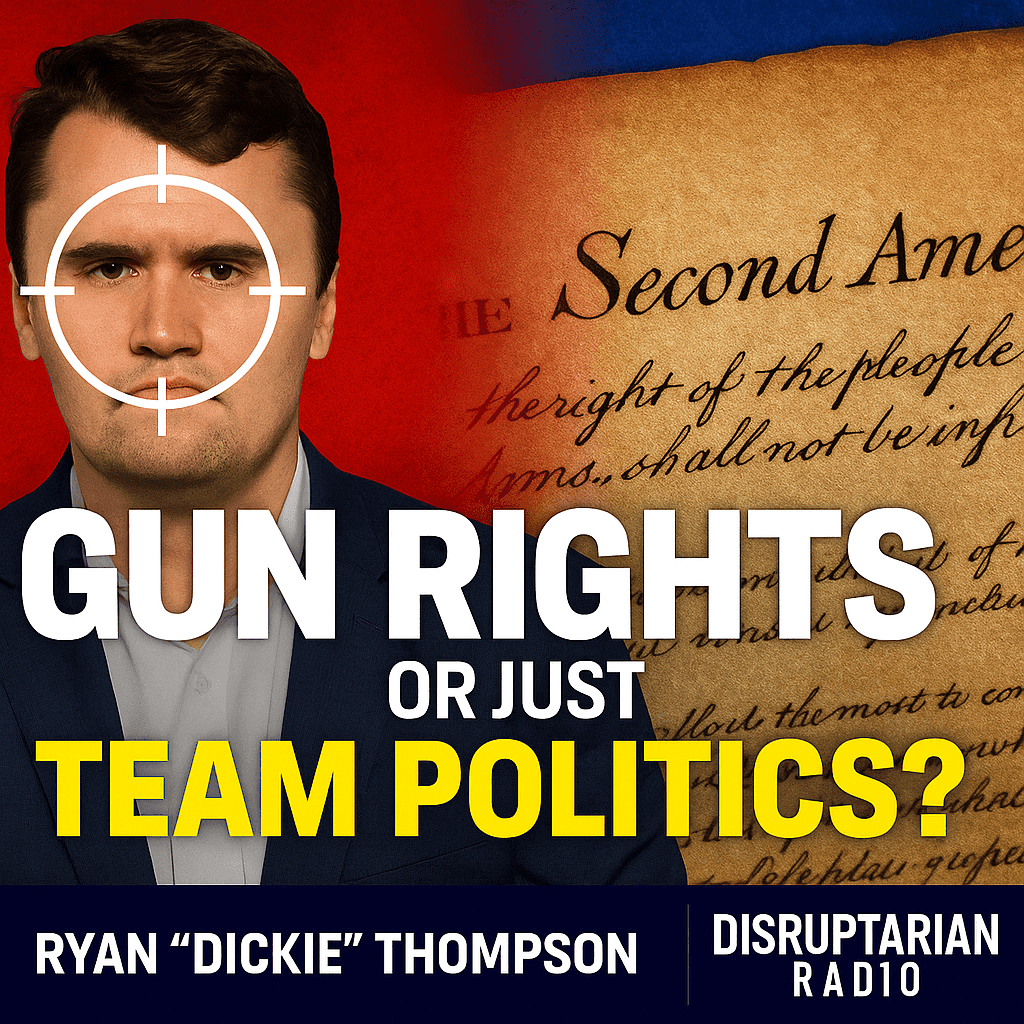
    Let me be real with you right from the jump: I don’t worship Charlie Kirk. I don’t always agree with him, and he’s not above criticism. But what I saw last week wasn’t just criticism. It was something darker.

    A viral clip was making the rounds. It showed a content creator called “Jolly Good Ginger” basically celebrating the idea of Charlie Kirk getting shot and killed. Smirking. Laughing. Suggesting it would be “karma” if it happened.

    And what stunned me wasn’t just the clip itself—it was the reaction to it. Applause. Shares. Likes. People nodding along like this was some kind of moral stand.

    We’ve crossed a dangerous line.


    This Isn’t About Kirk. It’s About Us.

    I want you to put politics aside for a minute. This isn’t about defending Charlie Kirk the person. It’s about what it says when people cheer for political enemies to die.

    We’re supposed to be the country of civil debate. A place where you argue hard, you speak freely, and then you go home and let the other guy live.

    Now? We’ve got folks out there who think wishing death on someone is part of the discourse. That if you disagree hard enough, you’re justified in celebrating a bullet.

    Let me be clear: that’s not free speech. That’s bloodlust dressed up in hashtags and memes.


    Gun Rights Are Not the Same as Driving Privileges

    A lot of people are throwing around comparisons trying to justify regulating or restricting gun rights. One I’ve seen a lot is: “You need a license to drive, why shouldn’t you need one to own a gun?”

    Let’s break this down.

    Driving is a privilege. It’s a government-regulated activity that exists because of modern infrastructure and legal code. You pass a test, you follow traffic laws, and the state lets you operate a vehicle on public roads.

    Owning a firearm is a right. It’s written into the Constitution. It’s not about convenience or recreation. It’s about the fundamental human right to self-preservation. Against criminals, yes. But more importantly, against government overreach.

    Now, rights come with responsibilities. That’s true. But they are not permissions handed down from the state. They are protections from the state.

    If you think your right to bear arms should be regulated like driving, you don’t understand the purpose of the Second Amendment. Or worse, you do—and you just don’t care.


    The Danger of Celebrating Political Violence

    Let me share something personal. I’ve got a family member who’s gay, pro-Second Amendment, owns multiple firearms, knows gun safety, all that. Smart guy. Libertarian-leaning.

    Last week, I saw him share the Jolly Good Ginger clip with the caption “karma’s a bitch.”

    This is someone who knows the weight of what a gun can do. Who knows how serious lethal force is. And here he is cheering the idea of a political opponent dying.

    That shook me.

    If people like him—people who own guns, support liberty, and understand constitutional rights—are falling into this tribal “rah rah my team” mindset, we’re in trouble.

    Because the Second Amendment isn’t a team jersey. It’s a check against tyranny. It’s not about who you like or don’t like. It’s about the principle behind the power.


    What Madison Actually Said

    Most people haven’t read Federalist Paper No. 46, but they should. James Madison laid out the case for an armed citizenry as a final safeguard against a centralized, overreaching federal government.

    He wasn’t talking about hunting deer. He was talking about resistance to tyranny.

    The structure was intentional. The Founders put freedom of speech and freedom of religion in the First Amendment. Then they immediately followed with the Second.

    Why?

    Because speech without defense is just noise. The right to speak freely means nothing if the government can disarm you when it doesn’t like what you say.

    And now, in 2025, we have people who own guns celebrating the idea of their political rivals getting killed.

    You can’t have it both ways.


    You Don’t Believe in Liberty if You Cheer for Death

    Let’s break it down to basics.

    If you support the Second Amendment because you believe in resisting tyranny, then you can’t cheer for violence against people who disagree with you politically.

    Why?

    Because the second you do that, you’re justifying tyranny. You’re saying violence is okay—as long as it’s your side doing it.

    That’s not liberty. That’s tribalism. That’s mob rule.

    This is the same logic used by authoritarians throughout history. Stalin did it. Mao did it. Pinochet did it. They all claimed they were protecting the people—by silencing or eliminating “dangerous” voices.

    That’s the road we’re on if we don’t check ourselves.


    Practical Advice for Liberty-Minded Americans

    If you actually care about liberty and not just scoring points online, here are a few things to do:

    1. Take a Gun Safety Course

    Even if you don’t own a firearm, do it. Understand what lethal force really means. It’ll change your perspective.

    2. Read the Founders

    Start with Madison, George Mason, and Patrick Henry. Understand the context of why the Second Amendment exists.

    3. Stop Cheering for Death

    I don’t care how much you hate someone’s politics. Celebrate ideas, not body counts.

    4. Call It Out

    If your friends are sharing content that glorifies political violence, say something. Silence is agreement.


    Rights Aren’t About Comfort

    Here’s the uncomfortable truth:

    • Free speech means protecting speech you hate.
    • The Second Amendment means protecting rights you might never use.
    • Liberty means tolerating things that make you uncomfortable.

    We don’t get to pick and choose which parts of the Constitution we like and ignore the rest. That’s not how this works.

    You’re either for liberty or you’re not.

    And if you only support the Second Amendment because your team is winning right now, you don’t believe in the right. You believe in power.


    This Is Bigger Than One Clip

    This isn’t just about a YouTube short or a TikTok clip. It’s about the slow breakdown of principled thinking in America.

    We’ve traded ideas for insults. We’ve traded reason for reaction. We’ve traded rights for rhetoric.

    And it’s not just “the other side” doing it. We’ve got people on the right, people who claim to love the Constitution, acting like political violence is some kind of game.

    If we go down that path, we all lose.


    Final Thought

    This isn’t about being nice. This is about being serious.

    You can’t defend the Second Amendment while laughing about the idea of shooting your political enemies. You can’t claim to love liberty while cheering for death.

    That’s not courage. That’s cowardice.

    We’re better than that. Or at least, we should be.

    This is Ryan “Dickie” Thompson from Disruptarian Radio. Stay thoughtful. Stay disruptive.

    Sources:

    Spun Web Technology SMART SEO

    Spun Web Technology SMART SEO
  • The Bait and Switch by Sinclair Broadcasting: A Case Study in Why Legacy Media is Dead

    By Ryan “Dickie” Thompson | Disruptarian.com


    This past week, Sinclair Broadcasting—the country’s largest ABC affiliate group—pulled one of the most blatant bait-and-switch moves I’ve seen in years. They had announced a Charlie Kirk tribute special that was supposed to replace Jimmy Kimmel’s late-night slot on Friday. That’s what they promised. That’s what viewers expected. But when airtime rolled around, Sinclair backed out. Instead of airing the tribute as planned, they pushed it onto YouTube and kept the usual ABC programming intact.

    Their statement read:

    “Tonight, Sinclair will continue to air ABC network programming as scheduled in the late-night time period. The Charlie Kirk special will instead be available on The National News Desk’s YouTube channel, ensuring viewers can continue to enjoy ABC programming while also providing full access to the special online.”

    Translation: They caved.

    And this, my friends, is exactly why legacy media has been dead for years.


    Why It Matters

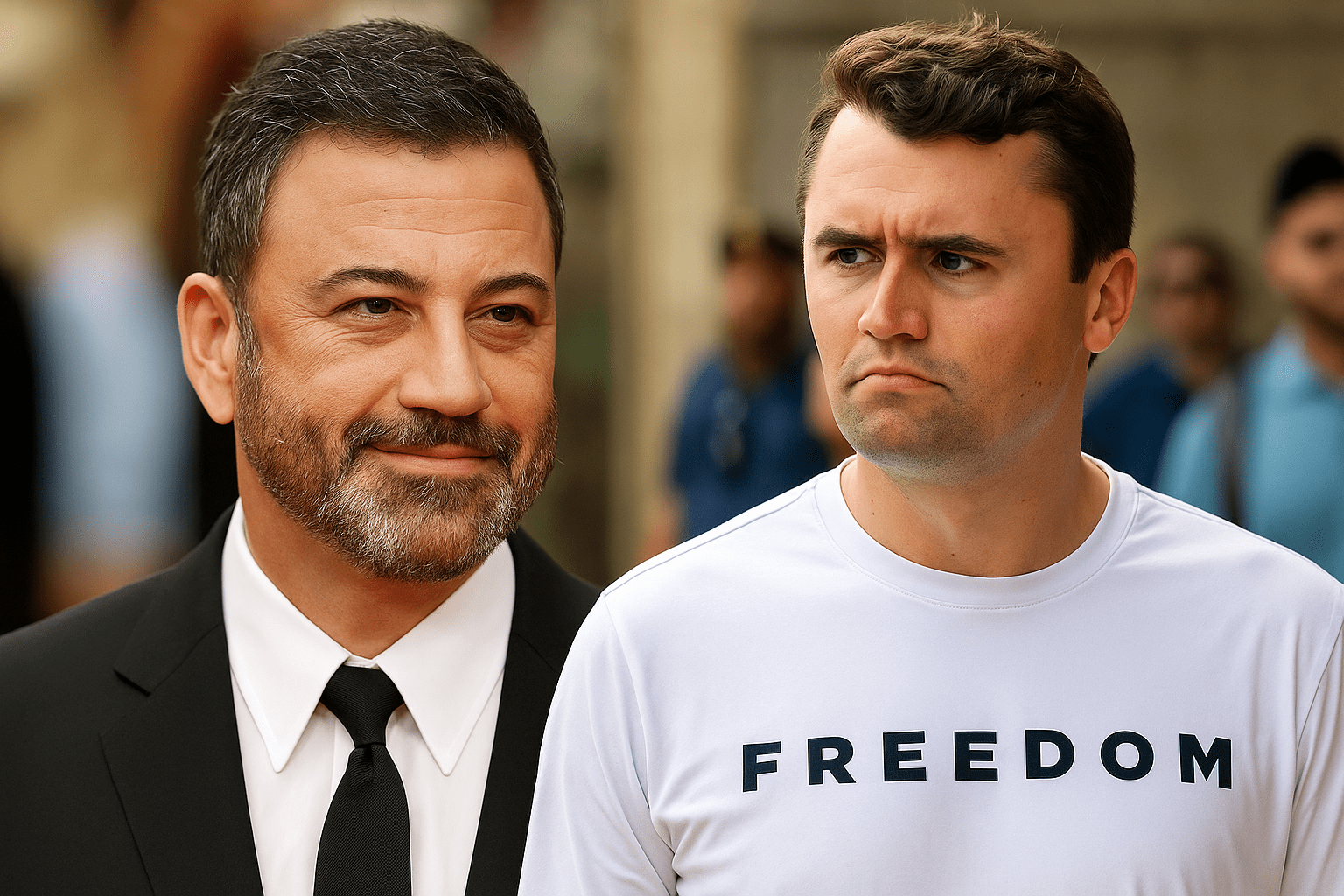
    This wasn’t just a scheduling adjustment. It was a bait-and-switch. Sinclair used Charlie Kirk’s name and tribute to draw attention, only to hand the late-night slot back to Jimmy Kimmel’s sinking show. If you ever needed proof that network TV is more interested in protecting its tired, political “comedy” acts than actually giving viewers what they want, this was it.

    As I said in my comments on Disruptarian:

    “This is why legacy media is dead and has been for many years. No one watches this crap any more.”

    And the numbers back me up.


    The Collapse of Late Night

    A network TV research analyst told LateNighter that 2022 was likely the last year most traditional late-night shows turned a profit. Losses are only going to widen in the years ahead.

    Advertising data from Guideline paints the picture clearly: ad revenue for late-night shows across major networks has collapsed from $439 million in 2018 to just $220 million in 2024. That’s a near 50% drop in less than a decade.

    When Sinclair announced that Charlie Kirk’s tribute would bump Kimmel, that was a smart play. Finally, something people actually wanted to see in a time slot usually dominated by stale, unfunny monologues and political propaganda. But then they buckled, proving they care more about keeping the corporate script intact than serving viewers.

    And as I put it bluntly:

    “The loss of profits is enough to shut down these late night propaganda pushing DNC syndicates. These shows don’t even write or present comedy any more.”

    They don’t. And viewers know it.


    The Johnny Carson Standard

    If you want a reminder of what late night once was, just listen to Johnny Carson himself. He warned against turning comedy into partisan hackery. You can watch the clip here: Johnny Carson on pushing a political narrative .

    Carson entertained. He didn’t preach. He made people laugh. Compare that to Kimmel, Fallon, Colbert, or Meyers—whose shows are basically just extensions of DNC talking points, disguised as jokes.


    FCC Threats and the Bigger Picture

    Now, I’m not ignoring the bigger picture here. The FCC’s involvement in this mess is dangerous. Reports have surfaced that FCC threats added urgency to Kimmel’s suspension and influenced programming decisions. Rand Paul and Ted Cruz both spoke out about this, and they’re right.

    Rand Paul called the threats “absolutely inappropriate,” noting the agency has “no business weighing in on this.” Ted Cruz went further, calling the FCC’s actions “unbelievably dangerous.”

    See more here: Reason coverage of FCC involvement.

    They’re spot on. Government has no role in deciding who gets airtime. But let’s be real: the FCC wasn’t the only reason for Sinclair’s reversal. Sinclair and Nexstar had already been planning to preempt Kimmel and replace him indefinitely. This wasn’t purely government pressure. It was also corporate cowardice.


    Why Viewers Have Moved On

    Here’s the truth: people don’t trust legacy media anymore. When they say they’re going to do something and then pull a bait-and-switch, it just drives more people away. They can’t afford to lose more credibility, but they keep lighting it on fire.

    Meanwhile, independent creators on platforms like YouTube, Rumble, and podcasts are growing because they keep their word and speak directly to their audience. No middlemen. No cowardly walk-backs. Just truth—or at least transparency.

    As I said plainly:

    “No one watches this crap any more.”

    And that’s not bitterness. That’s reality.


    The Takeaway

    Legacy TV is on life support. Late-night “comedy” shows are hemorrhaging money, pushing partisan propaganda instead of entertainment. Sinclair’s bait-and-switch over Charlie Kirk’s tribute just shows how desperate they are to cling to the old order. But viewers have already moved on.

    Sinclair thought they could have it both ways: advertise bold programming, then retreat to the safety of network status quo. But in doing so, they just proved my point. Legacy media isn’t just dying—it’s already dead.

    And you know what? Good riddance.


    Sources

    Spun Web Technology SMART SEO

    Spun Web Technology SMART SEO

  • Charlie Kirk’s Funeral and My Journey Back to Faith

    On September 21st in the US (22nd here in the Philippines), I found myself listening to the funeral ceremony for Charlie Kirk. The stadium in Arizona was filled with people—family, friends, leaders, students, and thousands who had been touched by his relentless ministry. As I listened, it stirred something deep in me. Memories of my own faith journey came flooding back, and I realized I’ve fallen short in ways I can no longer ignore.

    This post is not just about Charlie. It’s about how his life reminded me of my own calling, my failures, and why I need to return to the man I was meant to be.

    Finding Christ

    I found Christ as a teenager. Back in Salt Lake City, I was spending time at the Main Street Coffee House. My pastor, Clint Roberts, and the team at Summit Church showed me a kind of love and forgiveness I’d never experienced. I was welcomed despite who I was, and in that forgiveness, I found strength. Through them, Christ became real to me.

    From that moment, I had a fire in me. I gave up drinking. I gave up marijuana. I even turned myself in on old warrants, spending nine months in jail when I was just 19. Why? Because Romans 12 weighed heavy on me—I wanted to be accountable. I wanted to live for Jesus fully, without compromise.

    Early Outreach

    In those early years, I was effective at reaching people who didn’t want to be reached. My brother came to church with me. My mother, a devout Mormon, joined me in services. Friends who’d never set foot in a church before came with me. My first wife also gave her life to the Lord around that time. For three or four years, it felt like I was doing what I was meant to do: helping people encounter Christ.

    I even poured my energy into media outreach. I created Utah Pirate Radio and ran websites like BehindZionCurtain.com and later XCannabis.com (short for “Christians for Cannabis”). I debated Mormon apologists from BYU for years, never backing down when it came to defending my faith. Like Charlie, I wasn’t apologetic about loving Jesus. I confronted lies head-on but tried to do it in love.

    Falling Away

    But life has a way of breaking you down. My ex-wife and I struggled. I got distracted by work, pouring myself into jobs that demanded 96 hours a week. Eventually, I was isolated—just me in a room, answering calls for six years. Ministry and friendships faded away.

    Then came the accident. Broken bones, surgeries, titanium in my legs, even losing my front teeth. I was confined to a wheelchair. But the physical pain wasn’t the hardest part. The emotional trauma from my ex-wife’s relentless attacks nearly destroyed me. I spiraled into depression and PTSD. Twice I came close to ending it all. A gun in my mouth once, a bottle of pills another time. The only thing that kept me here was my kids.

    Divorce was the only path forward. I hate divorce. I hate what it does to families and kids. But in my case, it was either divorce or death. That’s the truth.

    Losing My Fire

    After the accident and the years of trauma, I withdrew from everyone—mentors, pastors, even family. I ignored emails and messages, cutting myself off from the people who once gave me strength. I stopped being the man who brought others to Christ and became someone who avoided responsibility. My ministry, my testimony, my outreach—all of it crumbled.

    Charlie’s Example

    Then I listened to Charlie’s memorial. You can watch it yourself here: Charlie Kirk Memorial . What I heard humbled me. Charlie was relentless. He ran Turning Point USA, traveled the world, hosted a major podcast, debated on college campuses, and still found time to personally respond to emails from strangers. Not just once, but back-and-forth conversations with multiple people daily. Who does that? Who has that much love, discipline, and drive?

    Charlie did. And it broke me to realize how much I’ve avoided in my own life. I once had that same fire, but I let the world, trauma, and excuses steal it from me.

    Why This Matters

    As I listened to the speakers at his funeral, I couldn’t help but compare myself to Charlie. Not in a way that leads to jealousy, but in a way that convicted me. I’ve wasted years avoiding people when I should have been helping them. I’ve hidden when I should have stood up. And I know I owe it to my children, my friends, my community, and most of all Christ, to stop running.

    Charlie’s life is a challenge to me, and maybe it should be to you too. None of us are guaranteed time. He was young, and yet his impact was massive. Imagine what we could do if we lived with the same conviction.

    My Next Step

    I’m done avoiding. I’m done letting trauma and fear control me. I need to return to who I was when I first found Christ—a man on fire to reach the lost, unapologetic about his faith, willing to confront lies, but always with love.

    I don’t know what my outreach will look like yet. Maybe it’s picking up the microphone again, maybe it’s answering those emails I’ve ignored, maybe it’s reconnecting with the mentors and friends I’ve shut out. But it starts now.

    Charlie’s legacy will live on through Turning Point USA and through Erica, his wife, who is stepping forward with strength. But his legacy also lives on in anyone willing to take up the same call. I want to be one of them.

    If you want to understand why his life mattered so much, I encourage you to watch both videos:

    And if you want to learn more about my story after I first found Christ, you can read my old biography archived here: My Story

    Thank you, Charlie, for inspiring me to face myself again. May your example push many of us back into the fight this broken world desperately needs.


    Sources

    Spun Web Technology SMART SEO

    Spun Web Technology SMART SEO

  • Mass Shootings by Demographic, 2025 Update: facts, spin, and what they will not tell you

    By Ryan “Dickie” Thompson • Disruptarian Radio

    In 2017 I published a breakdown on mass shootings in the United States . I argued then that the media kept forcing simple villains into a complex story. That post still stands. It is 2025 now. The noise is louder, the charts are prettier, and a lot of it is still nonsense. This page puts every claim next to a source, then shows the math with live charts you can inspect.

    First things first: what the government tracks and what it ignores

    The FBI’s Uniform Crime Reports and Active Shooter documents record age, race, and sex of offenders. They do not record gender identity. There is no centralized, official dataset that lists the number of transgender offenders in murders or mass shootings. Because of that gap, any sweeping statistic about “how many trans shooters there are” cannot be verified against federal crime data.

    Nonprofits like the Human Rights Campaign and Everytown focus on transgender people as victims. They do not publish national offender rolls. On top of that, police and media misgender suspects and victims in early reporting. That makes identity classification even noisier.

    Bottom line: when a chart claims precise per capita rates for “trans shooters,” ask for the methodology and raw data. If there is no method note, it is opinion art.

    Population matters: the trans denominator changed a lot

    • 2015: Williams Institute estimated about 1.4 million adults identified as transgender, around 0.6 percent of adults.
    • 2016 meta analysis: roughly 855,000 adults across 2006 to 2016 reported as transgender in surveys.
    • 2025: Williams Institute now estimates about 2.8 million transgender people age 13 and up.

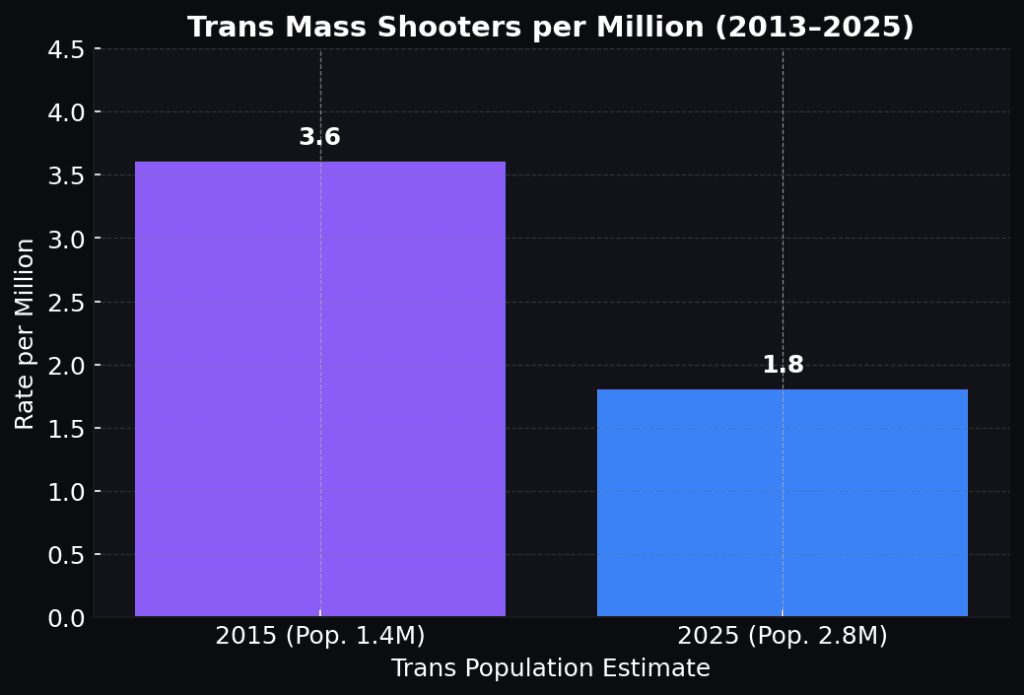
    Same numerator with a changing denominator will move the per million rate. Five confirmed trans or nonbinary mass shooters since 2013 yields about 3.6 per million using the 2015 adult estimate, and about 1.8 per million using the 2025 estimate. Same five incidents. Different base. This is why cherry-picking population baselines makes viral graphics look dramatic.

    Who actually commits mass shootings

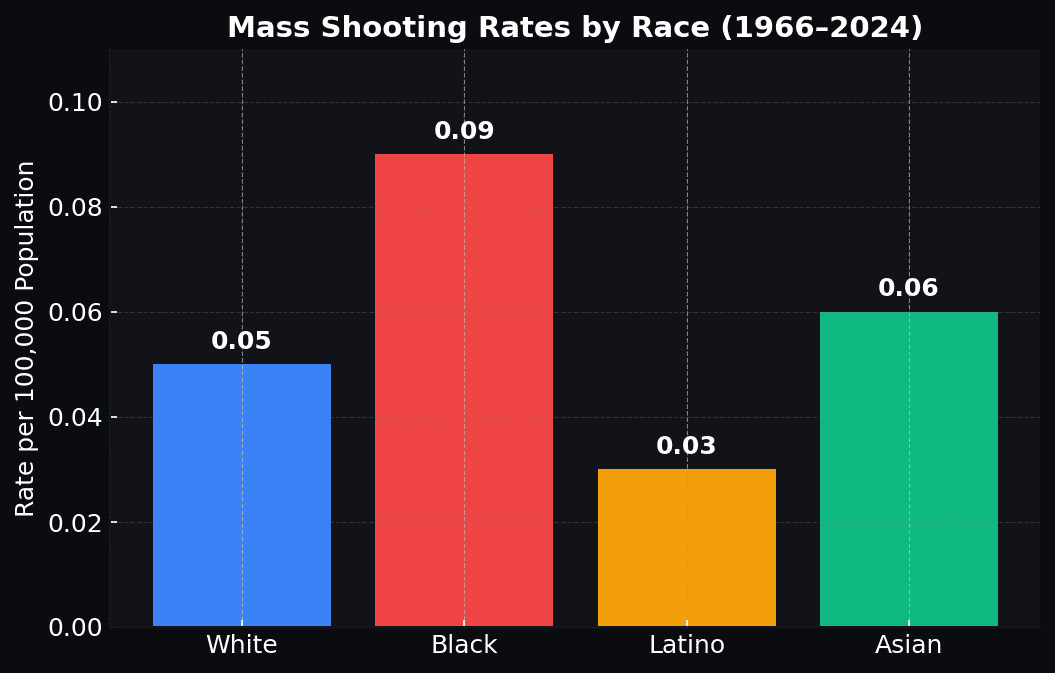
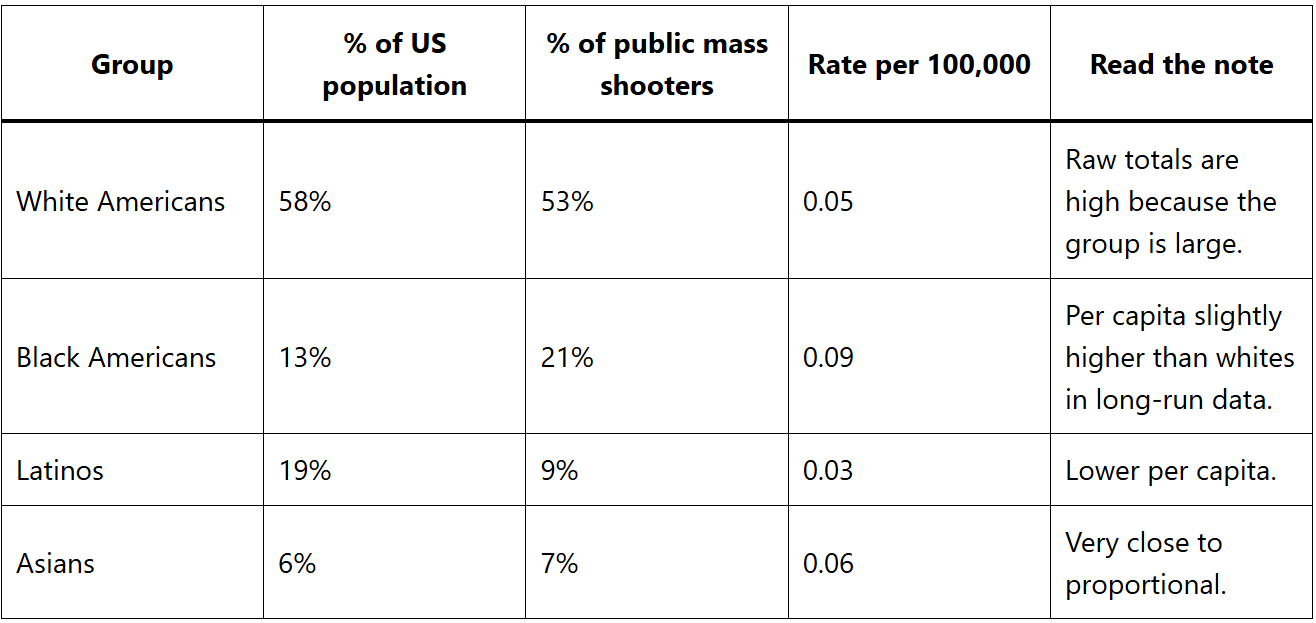
    Men do. That part is not controversial. Across the best public databases, men account for well over 97 percent of mass shooters. When you drill into race and per capita rates using the stricter “public, four or more killed” definition, the picture is steady over decades:

    Group % of US population % of public mass shooters Rate per 100,000 Read the note
    White Americans 58% 53% 0.05 Raw totals are high because the group is large.
    Black Americans 13% 21% 0.09 Per capita slightly higher than whites in long-run data.
    Latinos 19% 9% 0.03 Lower per capita.
    Asians 6% 7% 0.06 Very close to proportional.
    Download the graphical version of this chart

    So the lazy line that “cis white males commit most mass shootings” leaves out the denominator. White men make up a large share of the population. Per capita, long-run data shows Black and white males very similar, with Latinos lower and Asians near proportional. The constant across all groups is sex. It is men.

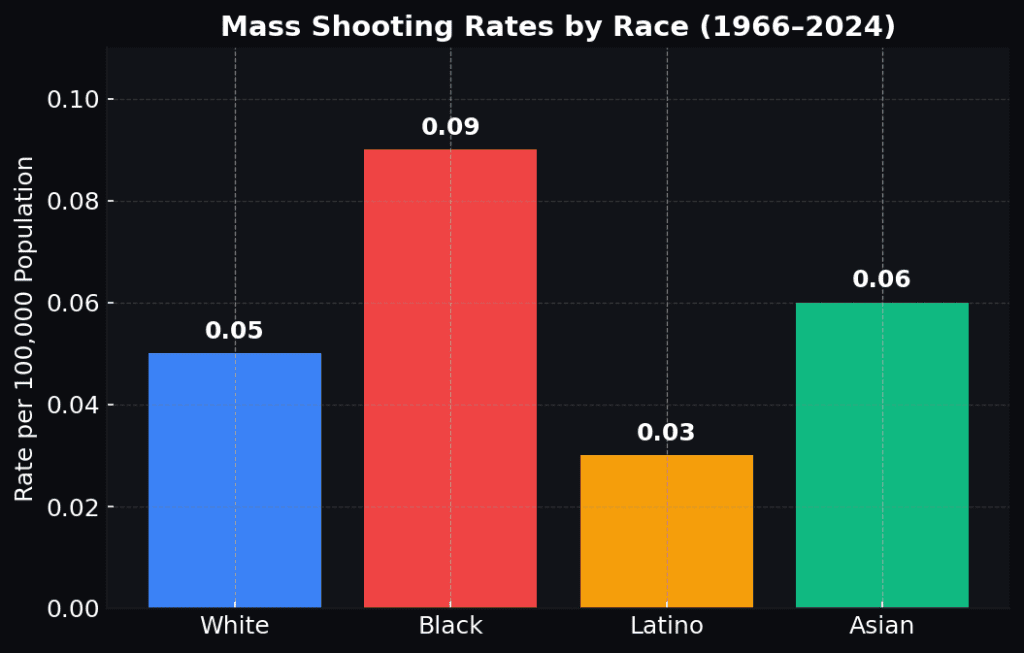
    Chart: racial rates per 100,000 (1966 to 2024)

    Rates use the stricter public mass shooting definition over the long window. They are directional, not exact counts for any single year.

    Chart: trans per million using two denominators

    Five incidents since 2013. Using the smaller 2015 population gives a higher per million value. Using the larger 2025 population cuts it roughly in half.

    Known trans or nonbinary mass shooters since 2013

    • Snochia Moseley – Aberdeen, Maryland, 2018. Three killed at a distribution center.
    • Alec McKinney – Highlands Ranch, Colorado, 2019. One killed, eight wounded at STEM School. Trans boy, pled guilty.
    • Anderson Lee Aldrich – Club Q, Colorado Springs, 2022. Five killed. Nonbinary identity claimed in court filings.
    • Audrey Hale – The Covenant School, Nashville, 2023. Six killed.
    • Robin Westman – Annunciation Catholic School, Minneapolis, 2025. Two children killed, many injured.

    These cases are documented by fact-checkers who verified identity claims against court and police records. They are tragic, but they are rare relative to the whole universe of mass shootings. It is notable that the FBI does not collect this information, so there is no hard data other than what private individuals find.

    Terror motivation and the headlines that follow

    Ideology is not the majority driver, but it is the best headline. A few examples remind people of politics rather than base rates:

    Every one of these was committed by a man. Different creeds, same constant.

    Victimization of transgender people is real and documented

    When the conversation is about transgender people in crime statistics, the strongest data is about them as victims. HRC tracks fatal violence and finds that when a killer is known, a large fraction are intimate partners, friends, or family. That fraction has ranged from 26 percent to 42 percent in recent annual reports. Black transgender women are hit hardest by the overlap of racism, sexism, and transphobia. Studies show elevated external causes of death for transgender people. Drugs and overdose appear in some cases, but they are not shown as the primary cause of transgender murders in the best available reporting.

    What the 2017 Disruptarian post concluded, and what still holds

    • Men commit almost all mass shootings. That is still true.
    • Within white mass shooters, political lean skewed liberal. That finding still appears in case reviews and it cuts against a popular stereotype.
    • Race mostly tracks population share in long-run public mass shooting data. Black and white males are similar per capita. Latinos are lower. Asians are near proportional.
    • Trans shooters exist, but they are single digits in twelve years. The number is tiny relative to the entire dataset. The population is also very small and represents much less than 1% of the entire population
    • Riot violence, including the BLM riots that stretched across several years, is not counted as mass shootings. If you counted all mass political violence, including arson and beatings, the map of harm would change fast.

    So the story is simpler and more honest than the internet wants it to be. If the goal is fewer massacres, focus on the constants that show up again and again: male offenders, leakage of plans, suicidal crises, and failure to intervene early. Identity memes will not save lives.

    References

    1. FactCheck.org – Few Mass Shooters Have Been Transgender
    2. PolitiFact – Are trans people statistically more prone to commit gun violence
    3. Reuters – Fact check about trans people and school shootings
    4. The Violence Project – Mass Shooter Database
    5. NIJ – Public Mass Shootings Database article
    6. McBride at Ammo.com – Mass Shooters by Race summary
    7. Williams Institute – Transgender Population Estimates 2025 (if unavailable, try the Internet Archive at archive.org)
    8. Williams Institute – 2015 Transgender Adult Estimate (if unavailable, try the Internet Archive at archive.org)
    9. National Library of Medicine – Transgender homicide patterns, peer reviewed
    10. HRC – Fatal violence against transgender and gender non conforming people 2024
    11. Pulse Nightclub shooting, 2016
    12. San Bernardino attack, 2015
    13. El Paso Walmart shooting, 2019
    14. Pittsburgh synagogue shooting, 2018
    15. Covenant School shooting, 2023
    16. Disruptarian – Mass Shootings for the past 20 years USA, circa 2019
    Spun Web Technology SMART SEO

    Spun Web Technology SMART SEO

  • The Kavanaugh Assassin Comes Out as Trans: Another Chapter in a Disturbing Trend

    By Ryan “Dickie” Thompson – Disruptarian.com


    What the Media Isn’t Talking About

    So now we learn that Nicholas Roske, the man who showed up armed outside Justice Brett Kavanaugh’s house in 2022, has “come out” as a trans woman named Sophie. Court filings from September 19, 2025, reveal that Roske’s defense team now refers to him with female pronouns. The sentencing is set for October 3, and prosecutors are asking for at least 30 years.

    Roske, or “Sophie,” had planned to kill a sitting Supreme Court Justice because he didn’t like the way Roe v. Wade might go. He had a handgun, a knife, zip ties, and burglary tools. He called 911 on himself before carrying out the attack, which is the only reason Brett Kavanaugh is alive today.

    And now? We’re told to respect the pronouns of a would-be assassin.


    Trans Identity as a Shield

    Here’s the pattern: every time a high-profile criminal “comes out” as trans, the focus shifts. The crime becomes secondary. The narrative becomes about pronouns, discrimination, or prison conditions. Suddenly, we’re told the system must bend over backward to accommodate the criminal.

    In Roske’s case, the defense is already using this angle. They want lighter sentencing because of “conditions in prison for transgender inmates.” Translation: play the victim card.

    But let’s not lose the thread. This was an assassination attempt against a Supreme Court Justice, carried out in a climate where left-wing activists were already protesting outside justices’ homes and politicians were winking at the mobs. If the political winds had been blowing the other way, we’d never hear the end of it.


    A Trend We Can’t Ignore

    This isn’t an isolated story.

    • Nashville School Shooter (2023): Audrey Hale, a biological female who identified as male, carried out a massacre at Covenant School, killing six, including three children. The media quickly shifted to worrying about “anti-trans backlash.”
    • Aberdeen, Maryland Shooting (2018): Snochia Moseley, a transgender individual, shot and killed three co-workers before turning the gun on herself. Coverage was muted.
    • Denver STEM School Shooting (2019): One of the shooters, Maya “Alec” McKinney, identified as transgender. Again, the reporting bent over backwards to frame the identity angle sympathetically.

    Notice a pattern? Each time, the violence gets brushed aside while activists rush to make sure “misgendering” doesn’t happen. The dead, the injured, the nearly assassinated—those are afterthoughts.


    Why This Matters

    Let’s get one thing straight: I don’t care what clothes you wear or what name you go by. That’s your choice. But when identity politics becomes a shield for violence, we’ve crossed into dangerous territory.

    Imagine if a Christian conservative tried to assassinate a Supreme Court Justice. Imagine if a guy in a MAGA hat shot up a school. Would the media spend their time on pronouns? Or would they hammer home the ideology behind the act, demanding that anyone remotely connected be investigated?

    We all know the answer.


    The Cultural Gaslighting

    You know what? The whole debate around “trans violence” is a lesson in selective outrage. When violence fits the narrative (like Charlottesville), it gets amplified to the heavens. When it doesn’t, it gets buried under layers of identity spin.

    It’s like the Fed playing Monopoly with real lives, but this time the currency is outrage. They print it up when it suits them, and they tighten the supply when it doesn’t.

    And here’s the dangerous part: if we can’t talk honestly about who commits violence and why, then we can’t solve anything. Pretending doesn’t make people safer. It makes us all targets.


    The Political Angle

    Roske’s case wasn’t just random. He told investigators he was furious about Roe v. Wade and about mass shootings like Uvalde. That anger turned into a plan to murder a sitting Justice.

    Now add in the fact that politicians and activists openly encouraged intimidation of the Court after the Dobbs leak in 2022. The White House press secretary at the time even dodged questions about whether protesting outside justices’ homes was appropriate.

    So ask yourself: what happens when political leaders wink at mobs, the media spins identity as a shield, and unstable individuals like Roske are egged on by the rhetoric? We get exactly this. Violence, rebranded as victimhood.


    The Human Cost

    Here’s what we’re not supposed to talk about:

    • Brett Kavanaugh’s children had to live with the knowledge that a man came to their doorstep with a gun.
    • Families in Nashville will never see their kids again because a trans shooter decided to turn rage into murder.
    • Co-workers in Aberdeen lost their lives in a shooting that the media quickly swept aside.

    Real people suffer while activists fight over pronouns.


    Where Do We Go From Here?

    The answer isn’t complicated, but it’s also not politically correct:

    • Stop excusing violence because of identity. A murderer is a murderer, no matter their pronouns.
    • Hold the media accountable when they bury stories or spin them into “representation” issues.
    • Recognize that ideological violence—whether left or right—should be condemned without qualifiers.

    And most importantly: stop training people to see themselves as victims first and responsible adults second. Handouts, excuses, and identity politics only fuel the cycle. It’s like feeding bears at a campsite. It feels compassionate in the moment, but it creates a long-term danger for everyone.


    Final Word

    Nicholas Roske didn’t just try to kill Brett Kavanaugh. He tried to kill the rule of law. And no amount of name changes or pronouns changes that fact.

    If we want a society where freedom and responsibility matter, then we need to stop pretending violence can be washed away by identity politics. Otherwise, we’ll keep getting more “Sophie Roskes,” more “Audrey Hales,” and more innocent lives cut short.


    Sources

    Spun Web Technology SMART SEO

    Spun Web Technology SMART SEO

  • Gloating and Lying About Charlie Kirk’s Assassination Proves Costly for Jimmy Kimmel and Others

    By Ryan “Dickie” Thompson
    Disruptarian.com


    The Arrogance of Consequence-Free Lies

    For years, late-night comedians, celebrity activists, and media talking heads have operated under the smug assumption that their words carry no cost. They mock, smear, and openly fantasize about violence against their political enemies. They celebrate when conservatives are censored or canceled, and they assume their platform shields them from accountability.

    The assassination of Charlie Kirk has shattered that illusion. It exposed how deeply corrosive this rhetoric has become, how false narratives poison the public, and how some of the most powerful media figures are finally paying a price.


    Jimmy Kimmel Crossed a Line

    Jimmy Kimmel is no stranger to partisan attacks. He celebrated Donald Trump being banned from Twitter, cheered when Tucker Carlson was pushed off Fox News, and turned his show into a nightly megaphone for Democratic talking points.

    But after Charlie Kirk was murdered, Kimmel went further. He declared that the shooter was “one of them,” a MAGA Republican, despite the absence of any evidence. In reality, the shooter had written “fascist” on bullets used in the attack and was reportedly tied to left-wing politics, including having a gay, furry, transgender roommate according to reports.

    That is not a slip of the tongue. That is a reckless lie. It smeared a man who had just been assassinated and cast suspicion on millions of Americans by linking them to the crime.

    Backlash came quickly. Advertisers were pressured. Affiliates like Sinclair and Nexstar demanded an apology and suspended his program. The FCC chair Brendan Carr hinted at possible regulatory action. Whether it was panic over lost revenue or genuine disgust, ABC pulled Kimmel off the air in many markets.

    Sources:


    Walsh Was Right: Rhetoric Has Consequences

    Matt Walsh pointed out the obvious: for years conservatives shrugged off this behavior. Meanwhile, the left weaponized cancel culture, cheering when political opponents lost jobs for much less.

    Walsh argued that Kimmel’s rhetoric was not comedy but partisan propaganda, violating the very rules that govern the use of public broadcast airwaves. Whether or not the FCC ever enforces those standards, the point stands: lying about crimes, especially political assassinations, is not “public interest.”

    And here’s the harder truth: this climate is not new. The assassination of Charlie Kirk is horrific, but it did not happen in a vacuum. High-profile figures have been normalizing violent rhetoric against conservatives and Trump for years.


    Celebrities Who Flirted With Assassination Rhetoric

    This pattern goes back nearly a decade. Some of the most famous celebrities in the world have invoked violence against Trump or conservatives:

    • Madonna: At the 2017 Women’s March, she said she had thought “an awful lot about blowing up the White House.” She later claimed it was a metaphor.
      CNN Coverage
    • Johnny Depp: At the Glastonbury Festival in 2017 he asked, “When was the last time an actor assassinated a president? … Maybe it’s time.” He later apologized.
      BBC Coverage
    • Kathy Griffin: Infamous for a photo shoot holding a bloody, severed Trump head. She lost her CNN New Year’s Eve job and faced Secret Service investigation.
      NY Times Coverage
    • Snoop Dogg: In a 2017 music video, he pointed a toy gun at a Trump clown.
      Rolling Stone Coverage
    • Maria Chappelle-Nadal (Democratic Missouri state senator): Posted “I hope Trump is assassinated!” on Facebook. She was stripped of committee posts.
      Washington Post Coverage

    This is not fringe talk. These are mainstream entertainers and politicians feeding a culture where violence becomes thinkable.


    The Fallout After Charlie Kirk

    The assassination of Charlie Kirk brought this into sharper relief:

    • Workers Fired or Disciplined: Dozens across industries faced penalties for celebrating Kirk’s death.
      The Guardian
    • Threats Multiplying: Federal authorities are tracking threats related to Kirk’s funeral and political fallout.
      NPR
    • Escalating Violence: In Arizona, Treven Michael Gokey allegedly threatened to “shoot up” an LGBTQ bar, calling himself a “martyr for Charlie Kirk.”
      People Magazine

    The rhetoric, the celebrations, the hypocrisy—these all pour fuel on the fire. And unlike in the past, people are finally losing jobs and facing legal consequences for it.


    The Lesson: Liberty Requires Consistency

    Here’s the point. Free speech is vital. But lying about assassinations, smearing entire movements as “fascists,” or joking about blowing up the White House is not harmless. It normalizes hate and it invites escalation.

    If you believe in liberty, the standard must be consistent:

    • Don’t cheer censorship when it hits your enemies.
    • Don’t excuse violent rhetoric when it comes from your side.
    • Hold everyone accountable to truth and integrity.

    Charlie Kirk’s assassination is a tragedy. The reactions to it—Kimmel’s lies, public celebrations, corporate silence until the backlash came—reveal a sickness in our culture. That sickness festers when elites feel untouchable. Maybe now, finally, they are not.


    Sources


    Spun Web Technology SMART SEO

    Spun Web Technology SMART SEO

  • The Rumor, The Reality, and The Fight for the Internet Archive

    Lately, there’s been a rumor floating around that the Internet Archive has somehow been swallowed up by the federal government. Some people are saying it’s become federal property, part of the bureaucracy. That’s not true. What is true is that in July 2025, Senator Alex Padilla of California pushed for the Internet Archive to be designated as part of the Federal Depository Library Program (FDLP). That means the Archive is now an official partner in preserving and distributing U.S. government documents. But it didn’t lose its independence. It’s still a private, non-profit organization. (Internet Archive Blog)

    So why does this rumor matter? Because the Archive has been in rough shape lately. Crashes, interruptions, and even a rumored data breach have put its future into question. And when people see instability, they start whispering about government takeovers. That’s how you end up with half-baked conspiracies about federal property.


    What the FDLP Designation Really Means

    Here’s the straight version:

    • The FDLP was created in 1813 to make sure the public has free access to government documents. Today, over 1,100 libraries are part of it. (SPARC)
    • By joining, the Internet Archive becomes a federally recognized repository. That means it’ll officially house digital government records and make them publicly accessible. (Internet Archive Blog)
    • The Archive doesn’t become federal property. It doesn’t suddenly answer to bureaucrats in D.C. It’s a partner, not an agency. (KQED)

    Think of it like this: if you let your neighbor store a few boxes in your garage, it doesn’t mean he owns your house. Same thing here.


    Why the Archive is Struggling

    The warning lights are flashing, and they’ve been for some time:

    • In October 2024, the Wayback Machine, a part of the Internet Archive, was hit by a data breach. About 31 million user accounts were compromised. That included email addresses, usernames, bcrypt-hashed passwords, and other internal data. (Wired)
    • At the same time, there were DDoS attacks and site outages that made large parts of the service go offline or only accessible in a limited/read-only fashion. (The Verge)
    • Users have reported crashes, failures to load archived pages or collections, search features breaking, etc. These kinds of stability problems weaken trust.

    What Needs to Happen

    The Archive needs three things right now: funding, security, and stability.

    1. Funding:
      • Private sector donations (foundations, tech companies)
      • Civilian / individual donations; crowd-support
      • Grants from philanthropic orgs or possibly government grants, though those often bring oversight and conditions
    2. Technical Infrastructure:
      • More robust, scalable architecture that can handle traffic spikes without crashing
      • Redundant backups; geographically distributed storage
      • Better error recovery; systems that degrade gracefully
    3. Security:
      • Full security audit
      • Hardened authentication systems, rotating credentials and API keys regularly
      • Encryption in transit & at rest, updated dependencies, proactive threat monitoring

    A Rare Case for Optimism

    Here’s the hopeful side:

    • The FDLP designation shows even some in government recognize that the Archive has value. Senator Padilla called it “digital-first,” emphasizing its fit for a modern public access role. (KQED)
    • That recognition could pave the way for new funding sources. If private donors or foundation grants step up, the Archive could stabilize without giving up its independence.
    • Worst-case scenario, a grant (even from government) may be better than nothing—but we should aim for support that preserves autonomy and mission.

    Why We Should Care

    When the Archive goes down, we lose more than just old websites. We lose cultural memory. We lose evidence. We lose transparency.

    If the rumor about becoming federal property sticks, it distracts from what actually needs fixing: funding, infrastructure, security. The Archive is still ours. It’s still independent—but it won’t stay that way if it doesn’t get help soon.


    Sources

    Donate to the internet archive

    Spun Web Technology SMART SEO

    Spun Web Technology SMART SEO

  • Spun Web Archive Pro: Free WordPress Wayback Archive Plugin

    Most of us have been there. You pour your time and energy into writing something that matters—an article, a milestone, a truth that cuts through the noise—and then one day, it’s gone.

    A moderator buries it. A platform changes its rules. A domain expires because someone forgot to renew it. Years of words can disappear overnight, like they never happened.

    That’s why I built Spun Web Archive Pro, a free, open-source WordPress plugin that keeps your words alive on the one place the censors can’t reach: the Internet Archive’s Wayback Machine.

    Tagline: Preserve your words. Publish with receipts. Decentralize your content for free.

    👉 Download it here
    👉 GitHub repo


    Why this exists

    Censorship today doesn’t always look like book burnings or government bans. Most of the time, it’s quieter and faster. A post flagged. A rule changed. A memory “disappeared” into a 404 page.

    Your work shouldn’t vanish because a gatekeeper or a glitch says so.

    Spun Web Archive Pro makes sure it doesn’t. Every time you publish, it sends your page to the Wayback Machine. That means you get a verifiable, time-stamped copy of what you said and when you said it.

    And it’s not just about censorship. It’s about memory. Domains lapse, sites go down, migrations break links. With this plugin, your words outlive the tech stack they sit on.


    What the plugin does

    • Submits WordPress URLs to the Internet Archive
    • Auto-submit on publish (set it and forget it)
    • Per-post “Submit to Archive” links inside All Posts and All Pages
    • Keeps a submission history with timestamps and archive links
    • Supports two methods:
      • Simple “Save Now” (no keys required, instant snapshot)
      • Archive.org S3 API (with keys, more control, item-level saving)
    • Includes error logs, retry logic, and a one-click “Test Connection” for S3

    What you’ll see in WordPress:

    • A row action under each post and page: “Submit to Archive”
    • A status column so you know if something is pending, archived, or failed
    • An editor meta box showing the last result and history of snapshots
    • A Submission History table with timestamps, local links, and archive URLs

    Why this matters

    You know what? History isn’t written by the winners anymore. It’s written by the platforms. When Facebook decides your post breaks “community standards,” it’s erased. When Google tweaks its index, something vanishes. When Twitter rebrands itself into chaos, years of links rot away.

    This plugin is my small contribution to fighting back.

    • Anti-censorship: keep a public, timestamped copy outside rented platforms
    • Domain safety net: prove content existed even if your renewal gets missed
    • Milestones: lock in launches, prices, policies, releases
    • Backlink recovery: when third-party links break, you’ve got a stable snapshot

    Think of it like buying insurance for your ideas. Cheap insurance too—it’s free.


    Setup in minutes

    1. Install and activate Spun Web Archive Pro
    2. Choose your method:
      • Save Now with no keys, fastest way to snapshot
      • S3 API if you want item-level control with an Archive.org account
    3. Turn on auto-submit if you want every new post archived
    4. Or use Submit to Archive anytime you need a snapshot right away

    Requirements are simple:

    • WordPress 5.0+
    • PHP 8.1+
    • cURL enabled
    • Archive.org account only if you use the S3 method

    Free. Open source. Yours to use.

    This isn’t a paid plugin. It’s not a lead magnet. It’s just a tool I built because I got tired of watching history get memory-holed.

    It’s free, open source, and up on GitHub. You can fork it, improve it, or just use it as-is.

    👉 Plugin page
    👉 GitHub repo
    👉 Support: [email protected]

    If you care about decentralization, censorship resistance, and owning your digital life, this plugin belongs in your WordPress stack.

    Because your words matter. And they should outlive the platform you publish them on.

    Sources

    Spun Web Technology SMART SEO

    Spun Web Technology SMART SEO