Author: Ryan “Dickie” Thompson

  • Part 5: Divorce Then and Now – 1950s vs 2020s
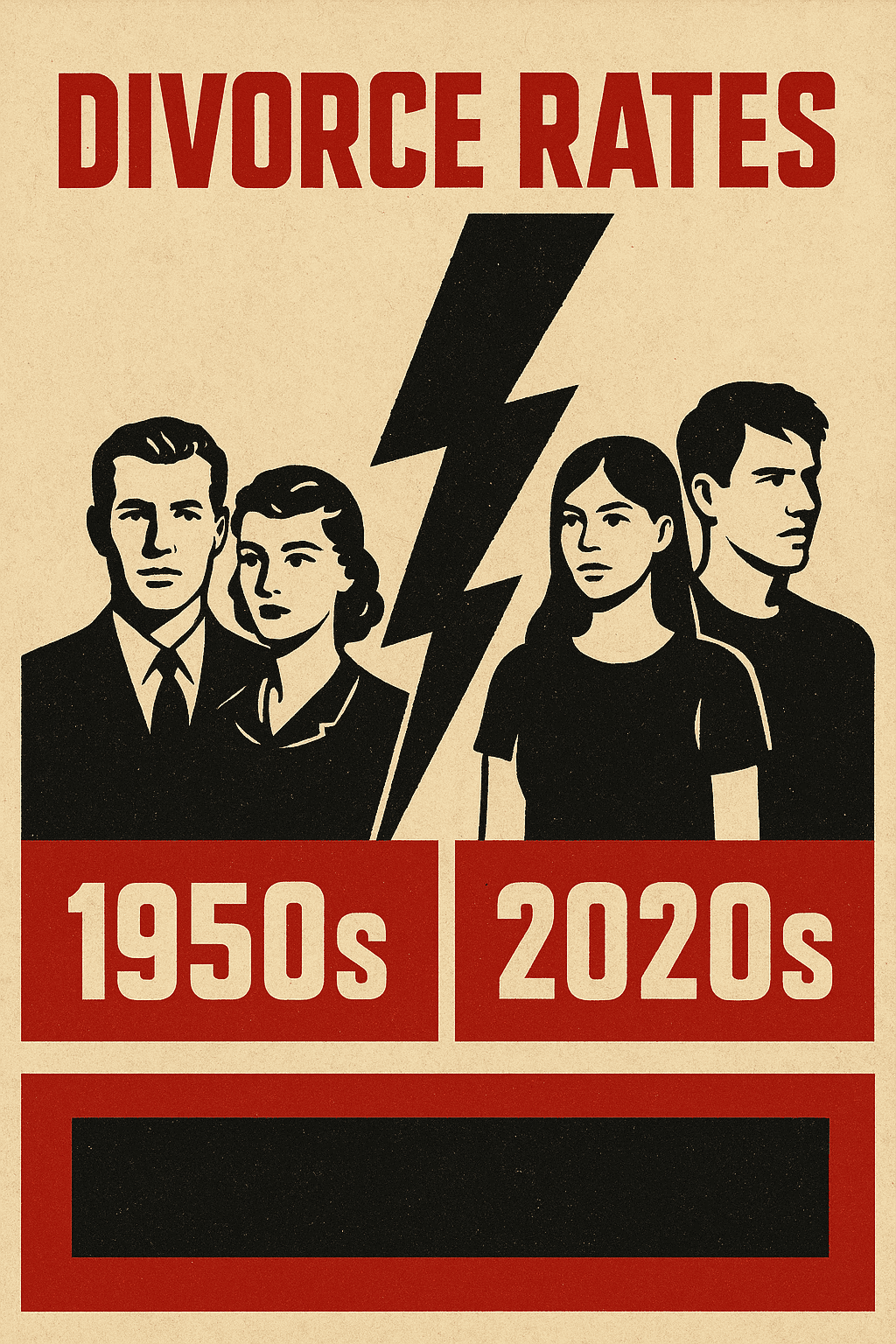
    To understand how Western relationships have collapsed, you have to compare two eras: the 1950s and the 2020s. One generation saw stable marriages as the norm. The other sees divorce as practically inevitable. What changed?

    The 1950s marriage model

    In the 1950s, marriage was practically universal. People married young, often in their early 20s. Divorce was rare, stigmatized, and legally difficult. Families were built around loyalty and responsibility, not convenience.

    • Men worked and provided.
    • Women raised children and managed households.
    • Communities reinforced marriage as the foundation of life.

    It wasn’t perfect. There were unhappy marriages and limited options for women who wanted independence. But the stability was undeniable. Children grew up in two-parent homes. Divorce rates were low. Marriage was seen as permanent.

    The rise of no-fault divorce

    Fast forward to the 1970s. Western governments introduced “no-fault divorce.” Suddenly, anyone could walk away from a marriage without proving wrongdoing. The floodgates opened. Divorce rates skyrocketed. By the 1980s, nearly half of all marriages ended in divorce.

    The legal shift sent a cultural message: marriage isn’t permanent, it’s optional. If it gets tough, you don’t work it out—you file the papers.

    The 2020s marriage crisis

    Today, the fallout is clear. Fewer people are marrying at all. Those who do often delay it into their 30s. Cohabitation replaces commitment. Children are increasingly raised in single-parent homes or blended families.

    And the divorce rate? It’s lower now than in the 1980s, but that’s because fewer people are marrying. Cohabiting couples break up at even higher rates, but the state doesn’t count those splits. The stability of the 1950s is gone, replaced by relationship roulette.

    Why it matters

    Marriage isn’t just a personal choice—it’s the foundation of a healthy society. Strong marriages mean stable families. Stable families mean resilient communities. When marriage collapses, society weakens.

    Compare outcomes:

    • Children of intact families have better education, lower crime rates, and stronger futures.
    • Children of broken homes face higher risks of poverty, depression, and instability.
    • Communities with stable marriages have lower welfare dependency and stronger economies.

    The 1950s weren’t perfect, but the structure worked. The 2020s are “free,” but the freedom comes with chaos.

    What we lost

    We lost the cultural expectation that marriage was sacred. We replaced it with an attitude that relationships are temporary. We lost the legal protections that once discouraged frivolous divorce. And we lost the idea that responsibility outweighs personal convenience.

    Now, people enter relationships with one foot out the door. They don’t trust marriage to last. They don’t see family as worth the sacrifice. And the state—through welfare programs and family courts—often makes it easier to leave than to stay.

    What we can learn

    We don’t need to copy the 1950s. Women deserve freedom and independence. Men deserve fairness in family law. But we can learn from the past:

    • Marriage must mean something again.
    • Responsibility has to outweigh convenience.
    • The state should stop incentivizing family breakdown.

    Closing thought

    The 1950s were far from perfect, but they built families that lasted. The 2020s glorify choice and freedom, but they leave us lonely and unstable. The lesson isn’t to turn back the clock—it’s to reclaim what worked: commitment, responsibility, and the idea that family is worth fighting for.

    If we don’t, the next generation won’t just compare the 1950s to the 2020s. They’ll be comparing a society with families to one without them.

    • Divorce: More than a Century of Change, 1900–2022 – Historical data on divorce trends in the U.S. Bowling Green State University
    • The Evolution of Divorce (National Affairs) – 1950s vs 1970s divorce rates comparison. National Affairs
    • How Has Marriage in the US Changed Over Time? (USAFacts) – Gives percentages of divorce in 1950 vs 2024. USAFacts
    • Marriage and Divorce Since World War II – Economic modeling of marriage patterns over time. NBER Users
    • Divorce Decline: About 40% of Today’s Marriages Will End in Divorce – Recent findings on marital stability since the 1950s. Institute for Family Studies

    This is part of a 5 part series on modern relationships between men and women (real men, and real women)

    Part 1: Men in the Modern West

    • How men lost their traditional roles as providers/protectors
    • The collapse of purpose: passivity, dominance, or online bitterness
    • What true masculinity means today (integrity, resilience, direction)
    • Impact of state interference and fear of divorce courts
    • Call to action for men to take responsibility and build strength

    Part 2: Women in the Modern West (scheduled for September 10th 2025)

    • The false promise of “having it all” (career, independence, family later)
    • Biology vs ideology: fertility realities ignored by culture
    • Loneliness epidemic despite career success
    • The myth of independence leading to isolation
    • Re-centering respect, cooperation, and family priorities

    Part 3: The State, Society, and the Breakdown of Trust (scheduled for September 11th 2025)

    • How marriage became a government contract instead of a personal bond
    • No-fault divorce and the legal incentives to break families
    • Cultural poison: men labeled toxic, women told commitment is settling
    • Dating apps and the “marketplace” mentality of relationships
    • Libertarian perspective: kick the state out, rebuild trust through responsibility

    Part 4: Age Gap Dating – West vs East (scheduled for September 12th 2025)

    • Western stigma against older men dating younger women
    • Biological attraction vs ideological resistance
    • Why Southeast Asia and other cultures accept age gaps
    • Economic and cultural practicality in non-Western contexts
    • Libertarian take: consenting adults should be free to choose

    Part 5: Divorce Rates – 1950s vs 2020s (scheduled for September 13th 2025)

    • Stable marriages and social norms of the 1950s
    • The rise of no-fault divorce and its impact on family breakdown
    • 2020s reality: fewer marriages, higher instability, more single-parent homes
    • Consequences for children and communities
    • Lessons to reclaim: responsibility, loyalty, and family as the foundation of society

    Spun Web Technology SMART SEO

    Spun Web Technology SMART SEO

  • Part 4: Age Gap Dating – West vs East

    If you want to see how culture shapes relationships, just compare how the West and East view age gaps in dating. In the United States, a 20-year-old woman dating a 40-year-old man raises eyebrows. Social media erupts with accusations: “predatory,” “creepy,” “exploitative.” But in Southeast Asia—or much of the world outside the Western bubble—this isn’t controversial at all. It’s normal.

    The Western obsession with “equal” dating

    Western culture has absorbed the idea that couples should be as close to identical as possible. Same age bracket, similar income, matched education. If there’s too big a gap in wealth or years, society assumes exploitation.

    This thinking comes from two sources:

    1. Feminist ideology: Women are taught that dating older men somehow undermines their independence. They’re warned it makes them “victims” of power imbalance.
    2. Egalitarian culture: The West obsesses over equality, even in personal relationships. Any difference—age, money, experience—is seen as a threat to fairness.

    The irony? These “equal” relationships often collapse because they ignore how human attraction really works.

    Biology tells a different story

    Biology doesn’t care about social narratives. Men are wired to be attracted to youth and fertility. Women are wired to be attracted to stability, competence, and resources. That doesn’t mean every couple fits this mold, but it’s a pattern as old as humanity.

    So when a younger woman chooses an older man, it’s not brainwashing. It’s natural. She sees maturity, stability, and direction. He sees youth, beauty, and vitality. Both sides benefit.

    Western culture treats this as scandalous, but everywhere else, it’s just life.

    Why the East doesn’t care

    In Southeast Asia, for example, a 25-year-old woman marrying a 40-year-old man barely raises a comment. Why? Because the culture values family outcomes more than appearances.

    • Older men are often more established, better providers, and more serious about family.
    • Younger women are often more interested in building a household than competing in careers.
    • Both sides see the relationship as complementary, not competitive.

    There’s no shame in a man being older, because age is associated with wisdom, not exploitation.

    In contrast, Western society shames both the man and the woman. The man is called “creepy.” The woman is called “a gold digger.” Instead of respecting their choices, the culture ridicules them.

    The economic factor

    There’s also a blunt economic reality here. In many parts of Asia, life is harder, money goes further, and community ties remain strong. A younger woman choosing an older, financially stable man isn’t “selling out”—it’s practical.

    In the West, where welfare safety nets exist and careers are glorified, women are told they don’t need to factor stability into their choices. They’re encouraged to chase excitement in their 20s and only look for stability later—usually when their options have narrowed.

    That’s why Western women often resent younger women who “marry up.” They see it as unfair competition. But biology and economics don’t care about resentment.

    The freedom argument

    From a libertarian point of view, the issue is simple: consenting adults should be free to form whatever relationships they want, regardless of age gaps. If a 23-year-old woman and a 45-year-old man choose each other, that’s their business—not the state’s, not society’s.

    But Western culture doesn’t trust individuals. It insists on moral policing, shaming age-gap couples as if adults can’t make their own choices. Meanwhile, the East quietly proves that when you leave people alone, these relationships can thrive.

    What this reveals about the West

    The outrage over age-gap dating says less about the couples and more about Western insecurity. A society that mocks older men for dating younger women is really exposing its own collapse:

    • Men in their 30s and 40s are often so unprepared for family that women their own age avoid them.
    • Women in their 30s and 40s are frustrated that younger women have more options, so they lash out instead of addressing the choices they made.
    • The culture worships equality so much that it forgets attraction isn’t about spreadsheets.

    Closing thought

    Age-gap dating isn’t creepy, predatory, or exploitative. It’s human nature meeting cultural choice. The West stigmatizes it because it fears inequality more than it values happiness. The East accepts it because it cares more about outcomes than ideology.

    At the end of the day, adults should be free to choose their partners without a mob deciding what’s “acceptable.” And maybe the real “creepiness” is a culture that shames love just because it doesn’t fit an arbitrary formula.

    A previous article about this age gap in dating comparing the west to the east

    /blog/age-gaps-cultural-norms-and-the-infantilization-of-modern-societ

    • An Exploration of Age-Gap Relationships in Western Society – Academic study of older men pairing with younger women. Purdue e-Pubs
    • Values Moderate Age Differences in Relationship Orientation – How cultural values shape acceptance of age gaps. ScienceDirect
    • A Cross-Cultural Test of the Mate Preference Priority Model – Eastern vs. Western dating priorities and attractions. InK
    • Cross-Cultural Perspectives on Dating and Marriage – Cultural timing and norms around relationships across societies. ResearchGate
    • Age Differences Between Spouses: Sociodemographic Variation – Swedish data on age-gap marriages by demographics. ResearchGate

    This is part of a 5 part series on modern relationships between men and women (real men, and real women)

    Part 1: Men in the Modern West

    • How men lost their traditional roles as providers/protectors
    • The collapse of purpose: passivity, dominance, or online bitterness
    • What true masculinity means today (integrity, resilience, direction)
    • Impact of state interference and fear of divorce courts
    • Call to action for men to take responsibility and build strength

    Part 2: Women in the Modern West (scheduled for September 10th 2025)

    • The false promise of “having it all” (career, independence, family later)
    • Biology vs ideology: fertility realities ignored by culture
    • Loneliness epidemic despite career success
    • The myth of independence leading to isolation
    • Re-centering respect, cooperation, and family priorities

    Part 3: The State, Society, and the Breakdown of Trust (scheduled for September 11th 2025)

    • How marriage became a government contract instead of a personal bond
    • No-fault divorce and the legal incentives to break families
    • Cultural poison: men labeled toxic, women told commitment is settling
    • Dating apps and the “marketplace” mentality of relationships
    • Libertarian perspective: kick the state out, rebuild trust through responsibility

    Part 4: Age Gap Dating – West vs East (scheduled for September 12th 2025)

    • Western stigma against older men dating younger women
    • Biological attraction vs ideological resistance
    • Why Southeast Asia and other cultures accept age gaps
    • Economic and cultural practicality in non-Western contexts
    • Libertarian take: consenting adults should be free to choose

    Part 5: Divorce Rates – 1950s vs 2020s (scheduled for September 13th 2025)

    • Stable marriages and social norms of the 1950s
    • The rise of no-fault divorce and its impact on family breakdown
    • 2020s reality: fewer marriages, higher instability, more single-parent homes
    • Consequences for children and communities
    • Lessons to reclaim: responsibility, loyalty, and family as the foundation of society
    Spun Web Technology SMART SEO

    Spun Web Technology SMART SEO

  • Charlie Kirk Is Dead: Free Speech Silenced by a Rifle Shot

    By Ryan “Dickie” Thompson

    On September 10, 2025, Charlie Kirk was shot and killed at Utah Valley University. He was 31 years old. He was standing at a podium during his American Comeback Tour when a rifle round struck his neck. He collapsed in front of hundreds of students. Doctors could not save him. (Reuters , EW)

    Authorities believe the shot came from a high-powered bolt-action rifle, fired from a building about 200 yards away. The shooter has not been caught. The FBI and ATF are leading the investigation. (The Guardian)

    President Trump called Kirk a “legendary” conservative voice and announced he will posthumously award him the Presidential Medal of Freedom. Vigils have already been held, including one in Washington, D.C., where more than 150 mourners gathered. (People, Washington Post)


    The Context of the Question

    Charlie Kirk was killed while answering a question about mass shootings. A student asked him how many there had been in the last ten years. Kirk began to answer, and then the shot rang out. The symbolism is impossible to ignore. He was speaking about violence and was silenced by violence.


    Unverified Data and Recent Incidents

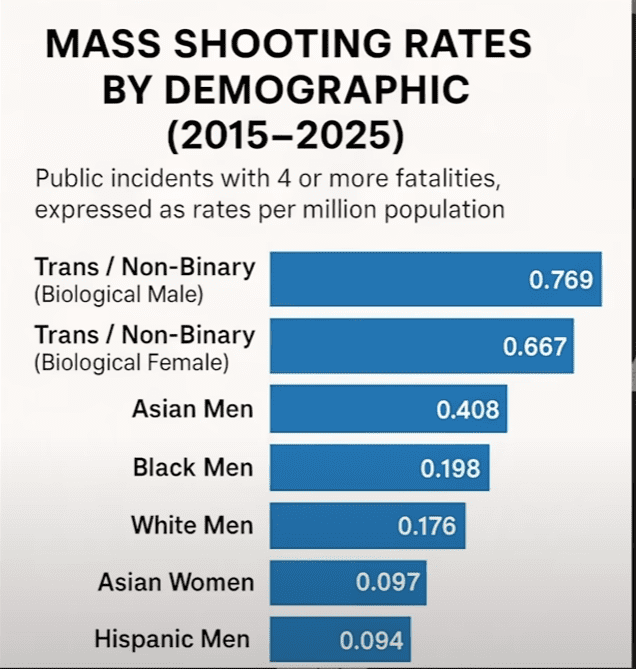
    There is an unverified chart circulating that attempts to show mass shooting rates by demographic from 2015–2025. According to this chart, transgender and non-binary individuals appear at a much higher rate relative to their small share of the population:

    • Trans / Non-Binary (Biological Male): 0.769 per million
    • Trans / Non-Binary (Biological Female): 0.667 per million
    • Asian Men: 0.408
    • Black Men: 0.198
    • White Men: 0.176
    • Asian Women: 0.097
    • Hispanic Men: 0.094
    https://youtu.be/xSRfnpEl17w

    This chart is not peer-reviewed and has not been verified by official databases. However, when looking at this data alongside the recent case of Robin Westman, a transgender shooter who killed multiple people during a church service in Minneapolis, the numbers line up with what we have seen on the ground.

    In addition, I cannot ignore the growing presence of self-proclaimed “transtifa” groups, who openly glorify violent resistance. These are not rumors. They are groups organizing under that name and spreading calls for violent action.


    Words vs. Violence

    I see a clear divide in how America’s political spectrum engages. One side uses dialogue, debate, and words. Charlie Kirk is a prime example. He went to hostile campuses, he faced protesters, and he answered questions. The other side increasingly resorts to violence. And this violence has been especially prominent in recent years around issues tied to transgenderism and LGBT motives.

    Charlie Kirk represented a challenge to the progressive orthodoxy, but he challenged it with a microphone, not a weapon. His opponents have too often reached for weapons. That is the truth staring us in the face.


    The Real Danger

    The assassination of Charlie Kirk marks a turning point. When public speech is silenced by a sniper rifle, then free discourse itself is under fire. I will not soften that. This was political violence. It was targeted. And it was meant to shut down a voice.

    If we are to preserve liberty, we must name the threat clearly. That means condemning violence no matter who it comes from, demanding accountability from law enforcement, and refusing to let rumor cloud the facts.

    But it also means acknowledging the trend: when speech and debate come from one side, and violence and intimidation come from the other, the balance of freedom is already collapsing.


    Conclusion

    Charlie Kirk is dead. His death should force us to face reality: America has entered a stage where free speech is met with bullets. I do not want to see his assassination twisted into tribal propaganda. I want to see it for what it is: a warning that political violence is now part of our public square.

    The chart may be unverified, but the pattern of incidents, the case of Robin Westman, and the rise of “transtifa” point to a growing problem. Ignoring it will not stop it. Pretending it isn’t happening only empowers those who believe violence is a tool of politics.

    If we value freedom, we must fight for a culture where words are answered with words — not rifles.


    Sources


    Spun Web Technology SMART SEO

    Spun Web Technology SMART SEO

  • Part 3: The State, Society, and the Breakdown of Trust

    So far we’ve looked at men and women in the modern West. Both are struggling—men unsure of their role, women caught between biology and ideology. But there’s a bigger player in this story, one that too often gets ignored: the state.

    When governments insert themselves into relationships, things stop being private and start being political. Love turns into paperwork. Trust turns into contracts. And when those contracts are rigged, men and women start treating each other less like partners and more like potential liabilities.

    Marriage as a government contract

    Let’s be blunt: marriage in the West isn’t just a personal vow. It’s a legal agreement overseen by the state. You don’t need a judge to love someone, but you need one to divorce them. And the state takes its cut every step of the way.

    • Alimony, custody, property division—these aren’t private negotiations, they’re dictated by courts.
    • Lawyers become middlemen in what should be intimate commitments.
    • And when things go bad, it’s not just heartbreak, it’s a courtroom battle where the state decides who “wins.”

    What should be the most personal bond in human life—marriage—has been hijacked by bureaucrats. It’s like hiring the DMV to referee your wedding vows.

    Divorce as a weapon

    Here’s the ugly truth: divorce law in the West often incentivizes breaking families apart. If you think that’s an exaggeration, look at the numbers. Since no-fault divorce became the norm in the 1970s, rates skyrocketed. Why? Because one person could walk away, take half the assets, and often gain custody of the kids.

    Now, imagine being a man watching his peers lose their homes, their savings, and sometimes their kids. Do you think he’s going to run to the altar? No way. He’ll see marriage less as love and more as Russian roulette.

    This isn’t just paranoia. Men know the system is stacked. Even women quietly admit it, though many benefit from the imbalance. And when both sides treat relationships like potential lawsuits, trust evaporates.

    Society as referee

    But it’s not just the state. Society itself has poisoned the well. Cultural narratives paint men as abusers-in-waiting and women as oppressed victims, even though reality is far more complex.

    • Men are told they’re “toxic” just for being masculine.
    • Women are told commitment is “settling.”
    • Hookup culture is glorified while loyalty is mocked as old-fashioned.

    This constant drumbeat erodes the foundation of trust between the sexes. Men and women stop seeing each other as natural allies and start seeing each other as rivals—or worse, enemies.

    Love as a marketplace

    Throw in technology and you get another layer of dysfunction. Dating apps treat people like commodities. Swipe left, swipe right—it’s shopping for humans. Attraction becomes transactional. Relationships become disposable.

    Combine that with the state’s legal incentives, and you get a perfect storm: people who enter relationships cautiously, half-committed, always with one eye on the exit. It’s like building a house with the front door already open. No wonder families collapse under the first sign of stress.

    Trust: the missing ingredient

    At the heart of this mess is trust—or the lack of it.

    • Men don’t trust women not to exploit the legal system.
    • Women don’t trust men to stay committed when things get hard.
    • Both don’t trust society to respect their choices.

    So what do they do? They retreat into control mechanisms: prenups, ultimatums, games. They hold back emotionally. They test instead of committing. And all the while, the state sits in the background, ready to swoop in if things go wrong.

    It’s like duct-taping a broken bridge and wondering why no one wants to cross it.

    Libertarian view: keep the state out

    From a liberty perspective, the solution is obvious: get the state out of relationships. Marriage should be a private contract between adults, not a government program.

    • If you want a religious wedding, fine—take it to your church.
    • If you want a civil contract, fine—write one and sign it with your partner.
    • But why does the state need to hold your hand?

    Government has no business deciding who gets what in a breakup or who “owns” the kids. Those decisions should be handled privately or through voluntary arbitration, not by a bureaucrat with a gavel.

    When the state inserts itself into human bonds, it distorts incentives. People start gaming the system instead of trusting each other. That’s not love, that’s politics.

    The cultural shift we need

    Of course, kicking the state out won’t magically solve cultural rot. People also need to rethink their values. Loyalty, responsibility, family—these used to be central to Western life. Now they’re treated as burdens.

    You know what? Convenience has replaced commitment. Why fight for a relationship when you can just swipe for a new one? Why work through problems when you can file for divorce and let the courts split the assets?

    That mindset is poison. And the only antidote is a cultural shift back to responsibility. Men and women need to stop treating each other like enemies and start acting like allies again.

    What this means for men and women

    • For men: Don’t let fear of the state paralyze you. Yes, the system is unfair. But hiding in bitterness only makes you weaker. Build trust carefully, choose wisely, and be a man of integrity.
    • For women: Stop viewing men as disposable or replaceable. Respect and loyalty go further than short-term thrills. Don’t buy the lie that commitment is oppression—it’s strength.
    • For both: Push back on the culture that glorifies hookups and mocks family. Real rebellion in the West today isn’t sleeping around—it’s building a strong family that can’t be broken by courts or cultural fads.

    Closing thought

    The state and society have poisoned the relationship well, but the antidote is still in our hands. Trust, loyalty, and responsibility aren’t old-fashioned—they’re revolutionary in a world that treats everything as temporary.

    If men and women start rejecting the state’s interference and society’s poison, they can rebuild what’s been lost. And when they do, they’ll find out that true partnership isn’t a contract enforced by government—it’s a voluntary bond that no courtroom can destroy.

    • Social Norms and the Legal Regulation of Marriage – Explains covenant marriage vs. no-fault systems. scholarship.law.columbia.edu
    • The History of American Divorce Law and Its Ghosts – Legal overview of no-fault divorce consequences. aaml.org
    • Why No-Fault Divorce Is Bad for Families and Society – Critique of societal impacts from a cultural viewpoint. Public Square Magazine
    • Economic Origins of the No-Fault Divorce Revolution – Academic look into the economic logic behind marital law reforms. peterleeson.com
    • Repealing No-Fault Divorce… (AP News) – Contemporary debate around undoing no-fault divorce in the U.S. AP News

    This is part of a 5 part series on modern relationships between men and women (real men, and real women)

    Part 1: Men in the Modern West

    • How men lost their traditional roles as providers/protectors
    • The collapse of purpose: passivity, dominance, or online bitterness
    • What true masculinity means today (integrity, resilience, direction)
    • Impact of state interference and fear of divorce courts
    • Call to action for men to take responsibility and build strength

    Part 2: Women in the Modern West (scheduled for September 10th 2025)

    • The false promise of “having it all” (career, independence, family later)
    • Biology vs ideology: fertility realities ignored by culture
    • Loneliness epidemic despite career success
    • The myth of independence leading to isolation
    • Re-centering respect, cooperation, and family priorities

    Part 3: The State, Society, and the Breakdown of Trust (scheduled for September 11th 2025)

    • How marriage became a government contract instead of a personal bond
    • No-fault divorce and the legal incentives to break families
    • Cultural poison: men labeled toxic, women told commitment is settling
    • Dating apps and the “marketplace” mentality of relationships
    • Libertarian perspective: kick the state out, rebuild trust through responsibility

    Part 4: Age Gap Dating – West vs East (scheduled for September 12th 2025)

    • Western stigma against older men dating younger women
    • Biological attraction vs ideological resistance
    • Why Southeast Asia and other cultures accept age gaps
    • Economic and cultural practicality in non-Western contexts
    • Libertarian take: consenting adults should be free to choose

    Part 5: Divorce Rates – 1950s vs 2020s (scheduled for September 13th 2025)

    • Stable marriages and social norms of the 1950s
    • The rise of no-fault divorce and its impact on family breakdown
    • 2020s reality: fewer marriages, higher instability, more single-parent homes
    • Consequences for children and communities
    • Lessons to reclaim: responsibility, loyalty, and family as the foundation of society
    Spun Web Technology SMART SEO
    Spun Web Technology SMART SEO

  • Bullets at the Podium: The Shooting of Charlie Kirk in Utah

    Free Speech Under Fire

    You know what? Free speech in America isn’t just under attack—it’s literally under fire. On September 10, 2025, Charlie Kirk, founder of Turning Point USA, stood in front of students at Utah Valley University for what was supposed to be a spirited exchange of ideas. Instead, it turned into a crime scene. Kirk was shot in the neck around 12:20 p.m. local time, collapsing as panicked students fled for cover (AP News ).

    The event was billed as the kickoff to Kirk’s “American Comeback Tour.” But instead of a lively debate, the country got another reminder that we’re slipping into a culture where people answer arguments with violence.


    A Shot from the Shadows

    According to Reuters, the gunman fired from a building about 200 yards away from the white tent where Kirk was speaking (Reuters). That’s not heat-of-the-moment chaos. That’s calculated. Premeditated. Someone set up with distance, scope, and intent. It wasn’t a thrown milkshake or a protester shouting down a speaker. It was an assassination attempt.

    Students described confusion and fear as the shot rang out. Former Congressman Jason Chaffetz, in attendance, said everyone “hit the deck” as screams ripped through the quad (AP News ). Within minutes, Utah Valley University locked down the entire campus, evacuated buildings, and canceled classes (Deseret News).


    Kirk’s Condition: Critical

    Emergency crews rushed Kirk to the hospital where he underwent surgery. AP News confirmed his condition as critical, with Turning Point staff saying bluntly, “It doesn’t look good” (AP News ).

    Whether you love him or hate him, Charlie Kirk is a husband and a father. And he’s now fighting for his life because somebody decided words weren’t enough.


    The Suspect: Still Out There

    Initial reports claimed a suspect was in custody, but by the end of the day, UVU police corrected the record—no one had been arrested (Deseret News). The shooter remains unidentified, with the FBI and ATF now investigating (Reuters).

    That means someone took a shot at a national figure, escaped a campus swarming with cops, and hasn’t been caught. You think about that next time a politician tells you government surveillance keeps you safe. Mass surveillance is like a nosy neighbor who watches your every move through the blinds, then swears he missed the burglar kicking in your back door.


    Who Is Charlie Kirk?

    Kirk has been a thorn in the side of the political establishment since he launched Turning Point USA in 2012. Love him or hate him, he built a national student movement out of nothing. He’s brash, controversial, and unapologetic. He’s also politically well-connected, having served on the Air Force Academy Board of Visitors after being appointed by Donald Trump (Reuters).

    That alone makes him a target. And in today’s climate, being outspoken isn’t just risky—it can be deadly.


    Politicians React: Prayers, Posts, and Platitudes

    The political class wasted no time. Donald Trump wrote on Truth Social: “We must all pray for Charlie Kirk, who has been shot. A great guy from top to bottom. GOD BLESS HIM!” (Reuters).

    Vice President J.D. Vance echoed the sentiment, calling Kirk “a genuinely good guy and a young father” (Reuters).

    Even Democrats—Kamala Harris, Gavin Newsom, and Nancy Pelosi among them—condemned the violence, stressing that political disputes should never become assassination attempts (AP News).

    Nice words, sure. But let’s be honest: these same politicians preside over a political culture that thrives on demonization. They point fingers, stoke fear, and cash campaign checks off outrage. Then, when someone takes it too far, they act shocked.


    The Bigger Problem: Violence Replacing Debate

    The attack on Charlie Kirk isn’t just about him. It’s about the direction of this country. We’ve entered a phase where “winning” a debate doesn’t mean sharpening your argument. It means silencing your opponent; sometimes permanently.

    Silencing speech is like putting duct tape over a smoke alarm. The fire still burns, you just can’t hear the warning. And the fire here is political violence. If ideas can no longer be tested in public without fear of being shot, then what we’re left with isn’t democracy—it’s mob rule.


    Campus Security and the Illusion of Safety

    Utah Valley University had local police, campus officers, and private security at the event. Still, someone fired a rifle from 200 yards away and walked free. That’s how fragile “security” really is. It’s like hiring the fire department to mow your lawn—expensive, slow, and useless when the actual emergency hits.

    Now universities across the country will face a tough choice: keep inviting controversial speakers and risk bloodshed, or lock campuses down tighter than TSA checkpoints. Either way, free discourse suffers.


    Where Do We Go From Here?

    1. The investigation: FBI and ATF agents are combing through video and interviewing witnesses. But the shooter is still out there (Reuters).
    2. Kirk’s recovery: His critical condition hangs over this entire story. If he pulls through, he’ll become a living symbol of the cost of free speech in America.
    3. Campus climate: Colleges have been battlegrounds of ideas for decades. Now they risk becoming literal battlegrounds.
    4. America’s crossroad: Do we reaffirm liberty, even when it’s messy and offensive, or do we let violence decide who gets the microphone?

    Closing Thought

    Electing a new politician to fix government is like swapping deck chairs on the Titanic and calling it a rescue mission. The problem isn’t one bad apple—it’s the whole rotten barrel. And the barrel has been fermenting this poisonous culture of political violence for years.

    The shooting of Charlie Kirk is not just an attack on one man. It’s an attack on the fragile idea that we can still disagree without destroying each other. If America can’t protect debate; even the loud, uncomfortable kind, then liberty isn’t just under threat. It’s on life support.

    And not to make light of a serious and horrible situation, but these lefties who think they are saving the world with their violence from fascism, sadly they have become the fascist with their actions and ideology.

    Reference this parody from the Babylon Bee about a lefty going back in time to kill Hitler;


    Sources

    Spun Web Technology SMART SEO

    Spun Web Technology SMART SEO

  • Part 2: Women in the Modern West

    If men are lost in the modern West, women are caught in a tug-of-war. They’re told they can “have it all”: career, independence, sexual freedom, and family—whenever they feel like it. But biology doesn’t care about slogans. And the pressure to juggle all of it is leaving a lot of women exhausted, lonely, and resentful.

    The promise of “having it all”

    Since the 1960s, Western culture has sold women a promise. Go to school, climb the career ladder, delay marriage, explore your options, then settle down when you’re ready. Supposedly, this would create empowered women who could design life on their own terms.

    And in some ways, it worked. Women now dominate universities, outpace men in certain industries, and often out-earn their male peers in urban centers. They have freedoms their grandmothers could only dream of.

    But here’s the twist: the promise came with a cost. Fertility doesn’t wait for career goals. Love and family don’t fall neatly into a calendar plan. The result is millions of women in their 30s and 40s who have success on paper but emptiness at home.

    Biology versus ideology

    Let’s be blunt: biology hasn’t changed. A woman’s fertility window peaks in her 20s, declines in her 30s, and becomes a real challenge in her 40s. That’s not sexist. That’s reality. Yet society pushes women to act as if biology is just a social construct.

    What happens? Many women delay family, thinking it will always be an option. Then the panic sets in. Dating apps are full of men, but serious commitment is rare. The men they want are either married, uninterested, or chasing younger women. It’s not cruelty—it’s nature at work.

    This doesn’t mean women must become housewives at 21. But ignoring biology while chasing an ideology of “limitless independence” has left many women blindsided.

    The loneliness epidemic

    Western women often have more money and more degrees than their mothers ever dreamed of. Yet depression and anxiety rates among women are higher than ever.

    Why? Because success at work doesn’t guarantee success in relationships. A six-figure salary can’t replace a partner who loves you. Titles and promotions don’t hug you when you’re sick or build a family with you.

    Some women settle for situationships—half-relationships with no real commitment. Others dive into hookup culture, only to find it leaves them empty. And a growing number simply give up, declaring “men aren’t worth it,” while secretly wishing they had someone worth it.

    The myth of independence

    You know what? Independence is a half-truth. Yes, women can survive alone. They can buy homes, travel the world, and build careers without a man. But thriving isn’t the same as surviving. Humans are wired for connection, not isolation.

    The feminist slogan of “a woman needs a man like a fish needs a bicycle” sounds empowering until you realize fish don’t raise families, don’t crave companionship, and don’t suffer loneliness in empty apartments. Humans do.

    The truth is, independence without partnership often becomes isolation. And isolation is brutal, no matter how “empowered” the narrative sounds on Instagram.

    What women actually want

    Despite the noise, studies show most women still want traditional things: love, marriage, family, stability. They may not want to admit it in every setting, but surveys consistently reveal the desire for long-term commitment is strong.

    The problem is the modern culture teaches women to delay or devalue those desires. Career first, family later. Independence now, commitment whenever. But later often comes too late.

    And here’s the catch: women who lead with their independence often intimidate or repel men who would have been great partners. Not because men hate strong women, but because strength without warmth feels like competition, not cooperation.

    The respect equation

    Relationships work best when there’s respect both ways. Women want men they can respect—men with purpose, strength, and direction. But men want women they can admire too. Not just for beauty, but for femininity, loyalty, and the ability to build a life together.

    Too often, Western women are taught to compete with men rather than complement them. And when you compete, you don’t respect—you resent.

    The path forward for women

    So what’s the answer for women in the modern West?

    1. Be honest about priorities. If family is important, don’t wait until biology makes it nearly impossible. Own that desire and plan accordingly.
    2. Reject the false promises. Career success is good, but it’s not a substitute for love or children if those are things you want.
    3. Value cooperation over competition. Men aren’t enemies. They’re potential partners. Respect goes both ways.
    4. Choose character, not just status. A man’s income or social standing matters less than his integrity and direction.

    Closing thought

    Western women have been told they’re freer than ever. And in many ways, that’s true. But freedom without truth is a trap. Ignoring biology, relationships, and the real cost of delay has created a generation of women who have everything except the things they wanted most.

    The future for women isn’t about pretending to be men. It’s about embracing their unique role as women—nurturers, builders of families, partners who bring warmth and stability. That doesn’t mean giving up independence. It means using independence wisely, not as a shield against the very things that make life fulfilling.

    Because at the end of the day, the women who find balance—who pursue purpose and family together—will be the ones who prove that tradition wasn’t oppression, it was wisdom.

    • Loneliness is a Feminist Issue – Explores loneliness among women as a political and social problem. SAGE Journals
    • From Low to Rising: How Loneliness Trends Shape Women’s Health Over Time – An 18-year study linking female loneliness to health outcomes. Research Communities by Springer Nature
    • The Harvard Study on Loneliness and Social Isolation – Insights into how Western social isolation affects everyone. BioMed Central
    • Modern Motherhood and Loneliness (The Guardian) – How isolation impacts new mothers in individualistic societies. The Guardian
    • Does Anyone Care That Young Women Are Just as Lonely as Men Are? (Cosmopolitan) – Highlights female loneliness often ignored by media. Cosmopolitan

    This is part of a 5 part series on modern relationships between men and women (real men, and real women)

    Part 1: Men in the Modern West

    • How men lost their traditional roles as providers/protectors
    • The collapse of purpose: passivity, dominance, or online bitterness
    • What true masculinity means today (integrity, resilience, direction)
    • Impact of state interference and fear of divorce courts
    • Call to action for men to take responsibility and build strength

    Part 2: Women in the Modern West (scheduled for September 10th 2025)

    • The false promise of “having it all” (career, independence, family later)
    • Biology vs ideology: fertility realities ignored by culture
    • Loneliness epidemic despite career success
    • The myth of independence leading to isolation
    • Re-centering respect, cooperation, and family priorities

    Part 3: The State, Society, and the Breakdown of Trust (scheduled for September 11th 2025)

    • How marriage became a government contract instead of a personal bond
    • No-fault divorce and the legal incentives to break families
    • Cultural poison: men labeled toxic, women told commitment is settling
    • Dating apps and the “marketplace” mentality of relationships
    • Libertarian perspective: kick the state out, rebuild trust through responsibility

    Part 4: Age Gap Dating – West vs East (scheduled for September 12th 2025)

    • Western stigma against older men dating younger women
    • Biological attraction vs ideological resistance
    • Why Southeast Asia and other cultures accept age gaps
    • Economic and cultural practicality in non-Western contexts
    • Libertarian take: consenting adults should be free to choose

    Part 5: Divorce Rates – 1950s vs 2020s (scheduled for September 13th 2025)

    • Stable marriages and social norms of the 1950s
    • The rise of no-fault divorce and its impact on family breakdown
    • 2020s reality: fewer marriages, higher instability, more single-parent homes
    • Consequences for children and communities
    • Lessons to reclaim: responsibility, loyalty, and family as the foundation of society
    Spun Web Technology SMART SEO

    Spun Web Technology SMART SEO

  • Charlie Kirk Assassinated September 10th 2025 – My commentary

    Charlie Kirk Assassinated September 10th 2025 – My commentary

    Disruptarian featured image for Charlie Kirk Assassinated September 10th 2025 - My commentary

    Verified at: 2026-06-21T11:23:54

    Charlie Kirk Assassinated September 10th 2025 – My commentary is the kind of subject that fits the Disruptarian lane because it sits where independent media, culture, music, and political commentary collide.

    The source description frames it this way: A Rumble-focused Disruptarian version of Charlie Kirk Assassinated September 10th 2025 – My commentary. Ryan Thompson frames the topic through political commentary, culture war pressure, media narratives, and public trust, with a direct independent-media voice and no corporate filter. Original YouTube title: Charlie Kirk Assassinated September 10th 2025 – My commentary. Original source video: https://www.youtube.com/watch?v=JvbgoVwSgn4 Disruptarian: https://www.disruptarian.com

    The useful question is not only what happened, but why the story matters to people who distrust scripted narratives, recycled outrage, and corporate-approved commentary.

    A Disruptarian reading starts with individual agency. The listener is not asked to accept a packaged conclusion. The point is to pull the claim apart, compare incentives, and look for the pressure points that legacy media often skips.

    That approach matters for libertarian radio commentary because the audience is usually looking for more than a headline. They want context, motive, contradiction, and a practical sense of how public stories become private consequences.

    The cultural layer is just as important. Disruptarian music and reggae punk energy are not decorations around the message. They give the work its rhythm: skeptical, confrontational, and rooted in the idea that speech should stay alive even when institutions prefer silence.

    For search readers arriving cold, the primary source is included below either as an embed or as a direct source link. Start there if you want the full tone, timing, and argument. The written analysis expands the title and description into a searchable article that can stand on its own.

    The strongest SEO value here is clarity. The article keeps the title language visible, uses descriptive headings, and connects the topic to Disruptarian Radio, independent media, libertarian commentary, political culture, and original music without stuffing the page with empty repetition.

    The larger takeaway is simple: independent commentary survives by documenting what was said, preserving the source, and adding a point of view that does not depend on permission from gatekeepers.

    That is why this post exists as part of the static Disruptarian archive. The video remains embedded, the title and description remain traceable, and the surrounding article gives search engines and readers enough context to understand why the episode belongs in the broader Disruptarian catalog.

    The title itself carries the first keyword signal, but a durable post needs more than a copied headline. It needs a clear H1, a concise meta description, a featured image with descriptive alt text, and enough editorial framing for readers to know why the video is part of this archive.

    From an independent media perspective, the value is in keeping the primary source visible. Embedding the video prevents the article from becoming detached commentary. Readers can compare the written interpretation against the actual recording and decide whether the argument holds up.

    The libertarian angle is not automatic partisanship. It is a suspicion of concentrated power, public manipulation, and narratives that ask citizens to outsource judgment. That suspicion applies to government, platforms, corporations, activist institutions, and media brands alike.

    Disruptarian Radio also treats culture as evidence. Music, political language, online mobs, censorship fights, moral panics, and personal stories all reveal where pressure is being applied. That is why a radio episode can be more than entertainment; it can become a record of a moment.

    For listeners who follow DJ Disruptarian, the same pattern shows up in the music catalog: reggae rhythm, punk edge, spiritual critique, and anti-authoritarian instinct. The written post keeps that identity attached to the video instead of letting it disappear into a platform feed.

    Good SEO on a page like this should help people find the conversation without flattening the voice. The article uses natural phrases such as Disruptarian Radio, independent media, libertarian podcast, political commentary, original music, and disruptive conversations only where they make sense.

    The featured image should follow the Disruptarian editorial-collage style: torn paper, smoke, halftone grit, dirty cream paper, black and oxblood pressure, muted gold accents, and symbolic props tied to the subject rather than generic filler. Its alt text names the subject so search engines and screen readers get useful context.

    The article also keeps a stable URL under the static blog. That matters because feeds move, platforms change embeds, and social links decay. A static post gives the episode a second home that can be indexed, backed up, linked, and reviewed later.

    The final point is documentation. When a channel publishes a new video, the title and description are often the only structured metadata available. Turning that metadata into a post creates a stronger archive without pretending to replace the original recording.

    This is the practical Disruptarian method: preserve the video, state the source, add commentary, keep the searchable terms honest, and let the reader move between the embedded media and the written analysis without friction.

    This additional context keeps the post useful for readers who arrive from search rather than from the original channel. It explains the source, preserves the embed, and connects the subject back to the larger Disruptarian archive.

    This additional context keeps the post useful for readers who arrive from search rather than from the original channel. It explains the source, preserves the embed, and connects the subject back to the larger Disruptarian archive.

    This additional context keeps the post useful for readers who arrive from search rather than from the original channel. It explains the source, preserves the embed, and connects the subject back to the larger Disruptarian archive.


    The shortlink was copied to your clipboard

    X
    f
    r

    Related Reading

    Similar posts


    Disruptarian Blog

    2026-06-21

    Disruptarian Blog

    Disruptarian commentary on Echoes Through The Ashes – A Story Of Fire & Forgiveness with embedded source video, independent media context, and libertarian radio analysis.

  • Facebook’s “Community Standards” Are the Death of Community

    On September 9th, 2025, my Facebook group Business For Sale By Owner was suspended for violating “community standards.”

    This was not some small side project. It was one of the fastest growing business groups on Facebook, with 190,200 members at the time of suspension. It was growing by over 2,500 members a week. Members posted and commented more than 10,000 times each month.

    And then it was gone.

    No vote by the community. No serious explanation. Just one click from Meta’s “community standards” branch, and years of work disappeared overnight.

    For a moment, the group was restored and I got a few notices that Facebook admitted to making a mistake. But then less than 2 hours later it was gone again, citing “multiple violations” and yet they only list one.

    And they even suspended my personal account, with over a decade of photos and videos of my children: https://www.facebook.com/Rev.Ryan.Thompson

    The Post That Triggered It

    Here is what happened.

    On August 31st, a member posted something that looked like a scam. It had the flavor of a get rich quick pitch. My first reaction was to delete it.

    But then the author of that post contacted me. He explained that it was not a scam, and that he wanted to sponsor the post. So I looked again.

    It turned out he was right. The post was about arbitrage sports betting. That is when you take advantage of odds differences between sportsbooks to guarantee a profit. It is obscure and clever, but it is not a scam.

    I even wrote an article explaining it: Arbitrage Sports Betting: The Loophole in the House’s Game.

    Not long after, Facebook struck down the entire group.

    A Pattern of Silencing

    This is not the first time I have had a group suspended.

    • My Dublin Buy/Sell/Trade group, with over 10,000 members, was deleted with no explanation.
    • My Athy Town “Athy Community Information” group, with over 6,500 members, was also deleted with no warning or reason given.

    This time, at least, I was given a reason. That does not make it better, but it is different.

    For years, I coped with this nonsense by creating ten new groups for every one that got killed. It was my way of fighting back. But looking back, that feels like digital Stockholm syndrome.

    Think about it. I am not paid to manage these groups. I spend hundreds, sometimes thousands, of hours curating content and moderating discussions. Meanwhile, Facebook makes piles of money from my labor.

    It is exploitation dressed up as “community.”

    The Big Lie of “Community Standards”

    Let’s cut through the language. These are not “community standards.”

    A community sets its own rules. A community is accountable to its members. A community is made of equals.

    Facebook’s rules are not written by communities. They are written by lawyers, executives, and politicians who pressure the company behind closed doors. They are enforced by algorithms and low paid contractors. And if you think this is paranoia, remember when Mark Zuckerberg admitted publicly that Facebook censored content at the direction of the Biden Administration? Here is the clip.

    So when a group of nearly 200,000 people disappears, it is not because “the community” decided it was harmful. It is because the company, acting under political pressure, flipped a switch.

    That is not community. That is a cartel.

    And sometimes, it is not even intentional censorship. On June 24th, 2025, thousands of groups were suspended by a “glitch.” Entire communities were erased in hours. TechTimes covered it here.

    One bug in their system, and years of human connection vanish.

    Building Outside the Walled Garden

    After this last suspension, I made a decision. I am done rebuilding inside Facebook’s walls.

    If they want to treat creators and moderators like disposable labor, fine. But I will not keep feeding the machine.

    Instead, I am moving everything to my own platforms, where I set the rules and own the content.

    I have around 500 other groups and pages that I will consolidate into my own web properties. It is a massive project, but it is worth it.

    Because this is about more than strategy. It is about freedom.

    The Case for Decentralization

    If your online presence matters to you, you cannot trust it to one company.

    Think about it like land. Would you build your dream home on rented property if the landlord could bulldoze it at any time? That is what we are doing on Facebook.

    Years ago, I warned about this when Twitter (before Elon Musk) was shadow banning conservatives and Trump supporters. My advice was simple. Spread your content.

    Use services like Hootsuite or the SLU2.com tools I built to post across platforms. Build your own websites with WordPress. Publish on Medium. Back everything up with the Wayback Machine.

    Even if Meta, Google, or YouTube come for you, your work survives somewhere else.

    Yes, even the Wayback Machine has had problems recently. It has been offline more than online when I have tried to use it. But the principle remains. Do not put all your eggs in Big Tech’s basket.

    Big Tech and the Memory Hole

    This is not just about Facebook.

    Last year, YouTube deleted my travel channel. Those videos were memories of my children and me traveling the world together. Gone. No explanation. No appeal.

    If not for the Internet Archive, those moments would have been lost forever.

    This is the real danger of centralization. One faceless corporation holds the keys to your memories, your work, and your community. With one click, they can erase it.

    It is like putting duct tape over a smoke alarm. The fire is still burning, you just cannot hear the warning.

    Who Really Benefits

    Let’s not forget, Facebook makes money off this arrangement.

    You do the labor. You moderate, manage, and grow the group. They sell ads against that activity. Then, when it suits them, they pull the plug.

    It is like hiring the fire department to mow your lawn. Expensive, slow, and you will probably lose your house in the process.

    The “community standards” branch of Meta is not about safety. It is about liability protection, political compliance, and corporate control.

    What We Can Do

    We cannot rely on politicians to fix this. New regulations will not solve it. Electing different faces in Washington will not solve it.

    The only fix is decentralization.

    • Build your own websites.
    • Host your own content.
    • Back up everything.
    • Use Big Tech as a distribution channel, not as your foundation.

    If you do not own the platform, you are just a tenant. And Meta is a landlord that does not care how long you have lived there or how much you have invested.

    Final Thoughts

    The suspension of Business For Sale By Owner hurt. It represented years of work and a thriving community of nearly 200,000 people. But in a way, it also clarified things.

    Facebook’s “community standards” are not about community at all. They are about control.

    So the question is, do you want to keep building your life’s work on someone else’s property? Or do you want to build something you truly own?

    For me, the answer is clear. I am done being a tenant in Zuckerberg’s digital empire. It is time to build my own land.

    Sources

    Spun Web Technology SMART SEO

    Spun Web Technology SMART SEO

  • Part 1: Men in the Modern West

    Something has gone wrong for men in the West. You don’t need a sociology degree to see it. Just walk into a bar, scroll through Tinder, or listen to the way men talk about relationships today. What you’ll find is a mix of bitterness, confusion, and apathy.

    Men are asking themselves: what am I here for?

    The old script is gone

    For centuries, the role of men was clear. You worked, you provided, you protected. Women needed you because survival wasn’t optional—it was life or death. You chopped the wood, defended the home, brought home the paycheck. That meant respect.

    But in the modern world, women don’t need men for survival in the same way. They can earn money, buy homes, even raise children alone if they choose. They’ve got birth control, bank accounts, legal independence, and rights that previous generations fought for. And let’s be real: those are good things. No libertarian worth his salt would argue against equality under the law.

    But when women gained independence, men lost the script that once gave them automatic purpose. Now, a lot of guys are floating in no-man’s land, trying to figure out what role they’re supposed to play.

    The collapse of purpose

    Here’s what’s happening.

    • Some men drift into passivity. They live like perpetual teenagers. They get by with low ambition, a gaming console, and just enough money to scrape through. These guys are roommates, not partners.
    • Others double down on outdated dominance. They think “being a man” means barking orders, controlling women, and expecting obedience. That’s not masculinity, that’s insecurity.
    • Then there’s the online crowd: men who spend their days ranting on forums about how women are the problem. They treat the opposite sex like an enemy camp. Instead of improving themselves, they wallow in resentment.

    None of these approaches work. They all share one thing: they dodge responsibility.

    The truth about masculinity

    Here’s the hard truth men don’t want to hear: women still want men. They don’t want pushovers, and they don’t want tyrants either. What they respect is a man with purpose.

    Being a man today isn’t about earning the biggest paycheck or bench pressing 300 pounds, though those things don’t hurt. It’s about character.

    • Integrity: do your words mean something?
    • Resilience: can you take a hit and keep moving?
    • Direction: do you actually know where you’re going in life?

    That’s provision in the modern sense. Not just money, but steadiness. Leadership without arrogance. Strength without cruelty.

    Women aren’t looking for perfection, but they are looking for competence. And competence is built, not given.

    The shadow of the state

    You can’t talk about modern masculinity without mentioning the state. Government has turned relationships into contracts, complete with courts, lawyers, and custody battles. Men see horror stories of divorce settlements and child support systems that feel rigged. It’s no wonder some men hesitate to commit.

    But here’s the problem: fear of the state has turned into fear of women. Too many men think every relationship is just one step away from financial ruin. That mindset poisons trust.

    Yes, family law is broken. Yes, the state has no business being the referee in personal commitments. But hiding from relationships because the system is unfair only guarantees you’ll lose before the game starts.

    Why men matter

    Let’s make this clear: men still matter. The idea that men are “obsolete” is nonsense. Societies collapse without strong, capable men. And families thrive when men step into their role—not as dictators, but as anchors.

    Look around:

    • Who builds the infrastructure we all rely on?
    • Who takes the most dangerous jobs?
    • Who risks their lives in defense, even when governments misuse that sacrifice?

    Men are not optional. They never have been. The question is whether men today will live up to that truth or waste it.

    The call to action

    So what should men in the modern West do?

    1. Stop whining. Life isn’t fair. The system isn’t fair. But complaining on forums won’t fix it. Build yourself.
    2. Get strong. Physically, mentally, financially. Weakness is a choice. Strength is built brick by brick.
    3. Find purpose. Whether it’s a trade, a business, a craft, or a family, have a direction. Drift is death.
    4. Lead by example. Leadership isn’t about bossing people around. It’s about showing through your actions that you’re reliable.

    The men who do this will be respected by women, trusted by their peers, and valued in their communities. The men who don’t will keep sitting in the corner, angry at a world that moved on without them.

    Closing thought

    Being a man in the West today isn’t easy. The old script is gone, the state interferes, and the culture mocks masculinity. But you know what? That makes it more important than ever to get it right.

    A man who can rise above bitterness and confusion, who can live with integrity and strength, will stand out in a society that desperately needs him.

    And that’s the point: men aren’t obsolete. They’re just unpracticed in what true masculinity looks like today. It’s time to bring it back—not by clinging to the past, but by stepping into the responsibility that never really disappeared.

    Sources

    • State of American Men 2025 – A data-rich study showing men’s economic anxiety and identity struggles. Equimundo
    • Understanding Men and Masculinity in Modern Society – A sociological overview of masculinity today. ResearchGate
    • Musings on Modern Masculinity (Medium) – A cultural critique of masculinity’s collapse in Western youth. Medium
    • Men, Women and Social Connections – Pew data on loneliness and how men form—or avoid—emotional bonds. Pew Research Center
    • Positive Humanity, When? Is Masculinity Worth Saving? – Conference paper exploring caring and inclusive masculinities. Taylor & Francis Online

    This is part of a 5 part series on modern relationships between men and women (real men, and real women)

    Part 1: Men in the Modern West

    • How men lost their traditional roles as providers/protectors
    • The collapse of purpose: passivity, dominance, or online bitterness
    • What true masculinity means today (integrity, resilience, direction)
    • Impact of state interference and fear of divorce courts
    • Call to action for men to take responsibility and build strength

    Part 2: Women in the Modern West (scheduled for September 10th 2025)

    • The false promise of “having it all” (career, independence, family later)
    • Biology vs ideology: fertility realities ignored by culture
    • Loneliness epidemic despite career success
    • The myth of independence leading to isolation
    • Re-centering respect, cooperation, and family priorities

    Part 3: The State, Society, and the Breakdown of Trust (scheduled for September 11th 2025)

    • How marriage became a government contract instead of a personal bond
    • No-fault divorce and the legal incentives to break families
    • Cultural poison: men labeled toxic, women told commitment is settling
    • Dating apps and the “marketplace” mentality of relationships
    • Libertarian perspective: kick the state out, rebuild trust through responsibility

    Part 4: Age Gap Dating – West vs East (scheduled for September 12th 2025)

    • Western stigma against older men dating younger women
    • Biological attraction vs ideological resistance
    • Why Southeast Asia and other cultures accept age gaps
    • Economic and cultural practicality in non-Western contexts
    • Libertarian take: consenting adults should be free to choose

    Part 5: Divorce Rates – 1950s vs 2020s (scheduled for September 13th 2025)

    • Stable marriages and social norms of the 1950s
    • The rise of no-fault divorce and its impact on family breakdown
    • 2020s reality: fewer marriages, higher instability, more single-parent homes
    • Consequences for children and communities
    • Lessons to reclaim: responsibility, loyalty, and family as the foundation of society

    Spun Web Technology SMART SEO

    Spun Web Technology SMART SEO

  • From Promise to Poverty: How Corruption and Centralized Control Crippled the Philippines

    Once hailed as the second wealthiest nation in Asia after Japan, the Philippines was poised for greatness in the mid-20th century. With a strategic location, abundant natural resources, and a strong post-war recovery, the country had all the ingredients for economic success. But today, it ranks among Southeast Asia’s most poverty-stricken nations.

    So, what went wrong?

    The Roots of Decline: Corruption, Control, and Cronyism

    The answer lies in decades of political corruption, authoritarian rule, and a moralistic state that stifled economic freedom and individual liberty.

    Open bribery and institutional graft became normalized, infecting every level of government. Public contracts, licenses, and even basic services were often tied to political favors or outright payoffs. This culture of corruption drained resources away from infrastructure, education, and innovation.

    During the Marcos regime (1972–1981), martial law was imposed under the guise of restoring order. In reality, it centralized power, crushed dissent, and enabled widespread theft of public funds. Human rights abuses were rampant. Free press and political opposition were dismantled. All in the name of “discipline” and eliminating “mortal sins.”

    The state’s obsession with moral policing came at the cost of real freedom. Rather than encouraging voluntary exchange and self-governance, the government dictated what was acceptable behavior. The war on so-called vices became an excuse for expanding authoritarian control.

    The government created an environment where only those with political connections could succeed. Entrepreneurs were blocked by red tape, taxes, and arbitrary regulations. The result? Widespread poverty, a shrinking middle class, and mass migration of talent overseas.

    A Brief Golden Era

    In the years immediately after World War II, the Philippines had one of the most promising economies in Asia. Its infrastructure was among the most developed, its education system was advanced, and English proficiency opened up trade and cooperation with the West. There was hope that the country could serve as a model for post-colonial development in the region.

    In the 1950s and 1960s, many countries in Asia were still recovering or struggling to industrialize. The Philippines stood out with its democratic institutions and relatively strong economy. It was a magnet for foreign investment, and many economists believed it was only a matter of time before it caught up with Japan.

    However, as other countries pursued market-based reforms, strengthened their institutions, and cracked down on corruption, the Philippines moved in the opposite direction. Power became more centralized, elections turned into charades, and policies were crafted to enrich elites at the expense of everyone else.

    The Marcos Years: A Turning Point

    Ferdinand Marcos came to power in 1965. By 1972, citing threats of communist insurgency, he declared martial law. This period would become one of the darkest in the country’s history. Civil liberties were suspended, media was censored, and political opponents were jailed, tortured, or disappeared.

    At the same time, the Marcos family and their cronies looted the nation’s wealth. Billions of dollars were siphoned off through fake projects, ghost corporations, and overpriced infrastructure. The country borrowed heavily from international lenders, enriching a few while burdening the many.

    Despite occasional economic upticks driven by foreign debt and remittances, real development stalled. Schools declined. Health care became more inaccessible. The public transport system crumbled. Basic services, once taken for granted, became scarce or corrupt.

    Underneath all this was a growing culture of fear and obedience. Martial law wasn’t just a political move; it was a cultural reset. Citizens learned to stay silent, avoid confrontation, and accept the state’s authority even when it was abusive or incompetent.

    Post-Marcos: A Missed Opportunity

    The 1986 People Power Revolution ousted Marcos and was hailed as a triumph of democracy. But while the people changed the figurehead, the system remained largely the same. Corruption persisted, though less overt. Elitist politics dominated. Oligarchic control over land, media, and commerce continued.

    Despite a return to electoral democracy, the Philippines never fully transitioned to a free market. It retained a bloated bureaucracy and a paternalistic government structure. Reforms were often watered down or blocked altogether.

    Many politicians promised change but delivered more of the same. Infrastructure lagged behind. The business climate remained hostile. Entrepreneurs continued to be strangled by permits, taxes, and unpredictable regulations.

    From Promise to Poverty

    The economic consequences were devastating. From being a rising star, the Philippines fell behind its neighbors. Countries like South Korea, Singapore, and more recently, Vietnam and Thailand outpaced it in terms of GDP growth, investment, and living standards.

    According to Seasia.co’s 2022-2023 report, the Philippines now suffers one of the highest poverty rates in Southeast Asia. This is not due to lack of resources or capability. It is a failure of governance and ideology.

    The World Bank estimates that over 20% of the population lives below the national poverty line. Millions more hover just above it, vulnerable to even minor economic shocks. Meanwhile, an estimated 2 million Filipinos leave the country each year to find work abroad. This brain drain weakens the local economy and breaks up families.

    The tragedy is that it didn’t have to be this way.

    A Path Forward: Decentralization, Liberty, and Market Innovation

    To break this cycle, the Philippines must shift away from centralized control and embrace individual liberty and economic freedom.

    Here are some key reforms that could spark a turnaround:

    1. End Authoritarian Legal Structures

    The martial law doctrine should be permanently rejected. Power must be returned to local communities and individuals. Decentralized governance allows for accountability and innovation at the grassroots level.

    Regions should be given more autonomy to manage their resources, craft local policies, and attract investment. The more decision-making power is concentrated in Manila, the harder it is to respond to the unique needs of different areas.

    2. Decriminalize Cannabis and Natural Liberties

    Following Thailand’s example, the decriminalization of cannabis could open up new industries, create jobs, and promote health freedom. Rather than punishing peaceful choices, the state should focus on protecting life, liberty, and property.

    Thailand’s recent decision to legalize cannabis for medical and recreational use has sparked a boom in agribusiness and tourism. There’s no reason the Philippines can’t do the same. Instead of locking up people for possession, the country could generate revenue, stimulate rural economies, and invest in education and health.

    3. Dismantle Crony Capitalism

    True free markets mean dismantling monopolies protected by government connections. Level the playing field by reducing red tape, eliminating favoritism, and empowering entrepreneurs through deregulation.

    Right now, many of the largest businesses in the Philippines are owned by families with deep political ties. These monopolies limit competition and keep prices high. Break them up. Encourage startups and foreign investments. Let the best ideas win.

    4. End Sin Taxes and Moral Policing

    Sin taxes don’t promote virtue; they punish the poor and fund bloated bureaucracies. Instead of trying to engineer morality, let individuals make their own choices. Voluntary exchange and personal responsibility should be the guiding principles.

    Prohibition and excessive taxation never work. Whether it’s alcohol, tobacco, or gambling, people will find a way. By legalizing and regulating these activities without punitive taxes, the state can reduce black markets and increase transparency.

    5. Encourage Innovation Through Economic Liberty

    Remove barriers to trade, reduce progressive taxation, and encourage foreign investment. Free markets, not government handouts, drive prosperity. Let the people build, trade, and innovate without interference.

    Education and technology should be at the forefront. Encourage private schools and online learning platforms. Promote coding, business, and vocational training. Let the youth build the future without being chained by old systems.

    6. Privatize Failing Institutions and Cut Government Waste

    Many state-owned enterprises in the Philippines are inefficient, corrupt, and unaccountable. Privatize them. Use the proceeds to pay down debt and invest in real public goods like roads, clean water, and broadband access.

    Audit all agencies. Cut unnecessary programs. Reallocate resources based on results, not political favors.

    Conclusion: Liberty Is the Way Forward

    The Philippines doesn’t need more government programs or moral crusades. It needs freedom. Freedom to trade, speak, innovate, and live without fear of arbitrary punishment. The failure of central planning and moral authoritarianism is clear. It’s time to trust the people.

    Economic freedom, voluntary exchange, and limited government are not just libertarian ideals. They are the proven path to prosperity.

    We’ve seen it in places like Singapore, which embraced open markets and rule of law. We see it now in Thailand, whose bold reforms are already bearing fruit. The Philippines can reclaim its lost potential. But only if it chooses liberty over control, innovation over ideology, and people over power.


    Sources:

    Spun Web Technology SMART SEO

    Spun Web Technology SMART SEO