Browse merch

Author: Ryan “Dickie” Thompson

  • Mommy Tells Me I’m a Girl: A Father’s Fight Against Childhood Gender Transition

    By Ryan Thompson, Disruptarian.com

    April 10, 2025

    In a heart-wrenching interview with Soft White Underbelly, Jeff Younger shares his decade-long struggle against the medical transition of his young son—a battle that exemplifies the growing tension between parental rights and an increasingly aggressive gender ideology.

    Younger’s story began when his twin sons were just toddlers. His then-wife, a pediatrician, started telling one of their sons, James, that he was a girl. What followed was a nightmare of family court manipulation, political influence, and the systematic removal of a father from his children’s lives—all because he refused to participate in what he views as harm to his child.

    “Imagine you have children that you’re close with, and you’re put in a chair, and a judge brings your children into the room and initially threatens to sexually mutilate them,” Younger describes. “And you have to sit there and remain totally calm in the slow-motion sexual abuse of your child.”

    The first alarm bells rang when Younger’s son was only three years old. He recorded a video (now available on YouTube under “Mommy says I’m a girl”) where his young son explained that his mother had told him he was a girl. According to Younger, his ex-wife would put their son in timeout saying, “Don’t be a boy. The monsters only eat boys,” and began socially transitioning him shortly after.

    What’s particularly disturbing about this case is that James reportedly never presented as a girl with anyone but his mother. With his father, at church, with friends, he dressed as a boy and used his birth name. When asked why he presented as a girl with his mother, the child reportedly said, “Mommy doesn’t love me if I’m not a girl.”

    Most alarming was Younger’s discovery in medical records that his ex-wife and a pediatrician were planning to chemically castrate James at age eight or nine—years before puberty would naturally begin. This discovery launched Younger into a six-year battle to outlaw such procedures in Texas, which he eventually won, though at tremendous personal cost.

    The family court system, according to Younger, served as the mechanism through which his parental rights were systematically stripped away. After winning a jury trial for 50/50 custody in 2019, Younger describes how a new judge transferred his case and gradually eliminated his access to his children through a series of manipulative legal maneuvers.

    “They give you an order that you can’t follow,” Younger explains about family court tactics. “They try to find out what the father can’t do or won’t do, and then they construct orders which force him to violate the orders, and then they take his kids from him.”

    For Younger, the line was drawn at three principles: never hurting his son, never morally miseducating his son, and never letting his resources be used to hurt his son. When supervised visitation required him to use a female name and pronouns for his son—which Younger believes would harm his child—he refused, creating the pretext for further restrictions.

    Eventually, the Texas courts allowed his ex-wife to relocate with the children to California, where laws not only permit but in some cases mandate gender-affirming care. While Younger believes his son is currently on puberty blockers, he hopes that recent federal executive action may prevent more invasive interventions like cross-sex hormones.

    “Every child that goes onto cross-sex hormones, 100% of them go to surgery,” Younger claims, highlighting the stakes of his continued fight.

    The political dimensions of this case are striking. Younger alleges that powerful donors and organizations on both sides of the political spectrum have actively worked to promote childhood gender transitions. He specifically points to Republican mega-donor Paul Singer, founder of the Human Rights Campaign, as a major force behind the movement, explaining why Younger faced such strong opposition even in conservative Texas.

    His case reveals how family courts can become weaponized against parents who oppose the medical transition of their children. Court-appointed counselors reportedly asked leading questions of his sons, trying to establish that Younger was “authoritarian,” while his ex-wife’s characterization of him as “misogynistic” was accepted without scrutiny.

    Most disturbingly, Younger now faces the prospect of imprisonment for his stance. “The state of California says that I have to pay for the chemical and physical castration of my son as child support,” he explains. “I’m not going to pay that child support. I’m not going to pay anything to hurt my son, and that means I’ll be going to prison.”

    Despite the tremendous emotional toll, Younger maintains a remarkable calm and focus on the long game. “No matter what happens to James, there’s nothing that he can do, no mistake he can make that’s so bad he can’t get to heaven,” he reflects, revealing the spiritual foundation that has sustained him.

    His approach to managing despair comes from his father’s boxing advice: when everything seems hopeless, just make your situation 1% better. “When I’m down, I just get to work and make the situation 1% better for James,” whether through writing letters, speaking with officials, or advising other parents facing similar situations.

    Younger’s story represents a growing pattern across the country where parents who oppose the medical transition of their children face severe legal consequences. His case demonstrates how the institutions designed to protect children can be manipulated to override parental concerns when those concerns conflict with prevailing ideological trends.

    For parents facing similar battles, Younger’s advice is straightforward: document everything, avoid signing court orders that surrender your rights, and maintain your principles even under extreme pressure. Most importantly, “save James, save thousands of children,” as he puts it—recognizing that his fight extends beyond his own family.

    As Parental Alienation Awareness Day approaches on April 25-26, Younger’s story reminds us that children benefit from maintaining relationships with both parents, and that family courts should protect rather than sever these bonds. His ongoing fight—now focused on keeping his son off cross-sex hormones and changing laws in California—represents a father’s refusal to abandon his child, regardless of the personal cost.

    In a nation increasingly divided on fundamental questions about human identity and child development, Younger’s case may prove to be, as he puts it, “the Fisher point…the issue which defines all of the other differences.” For parents caught in similar struggles, his resilience offers both warning and inspiration.

    Spun Web Technology SMART SEO

    Spun Web Technology SMART SEO

  • Truth, Integrity, and Living Legacy: Disruptarian Podcast 4725

    Truth, Integrity, and Living Legacy: Disruptarian Podcast 4725

    Disruptarian featured image for Truth, Integrity, and Living Legacy: Disruptarian Podcast 4725

    Verified at: 2026-06-22 7:49:28

    Truth, Integrity, and Living Legacy: Disruptarian Podcast 4725 is the kind of subject that fits the Disruptarian lane because it sits where independent media, culture, music, and political commentary collide.

    The source description frames it this way: Ryan Thompson records a long-form Disruptarian Podcast episode on truth, integrity, legacy, and the responsibility to build something that outlives the moment. This Rumble version frames the discussion around character, memory, family, independent media, and the kind of record a person leaves behind. Original YouTube title: Disruptarian Podcast 4725 Truth Integrity and Living Legacy Source: https://www.youtube.com/watch?v=TwD3mqbOe3k Disruptarian: https://www.disruptarian.com

    The useful question is not only what happened, but why the story matters to people who distrust scripted narratives, recycled outrage, and corporate-approved commentary.

    A Disruptarian reading starts with individual agency. The listener is not asked to accept a packaged conclusion. The point is to pull the claim apart, compare incentives, and look for the pressure points that legacy media often skips.

    That approach matters for libertarian radio commentary because the audience is usually looking for more than a headline. They want context, motive, contradiction, and a practical sense of how public stories become private consequences.

    The cultural layer is just as important. Disruptarian music and reggae punk energy are not decorations around the message. They give the work its rhythm: skeptical, confrontational, and rooted in the idea that speech should stay alive even when institutions prefer silence.

    For search readers arriving cold, the primary source is included below either as an embed or as a direct source link. Start there if you want the full tone, timing, and argument. The written analysis expands the title and description into a searchable article that can stand on its own.

    The strongest SEO value here is clarity. The article keeps the title language visible, uses descriptive headings, and connects the topic to Disruptarian Radio, independent media, libertarian commentary, political culture, and original music without stuffing the page with empty repetition.

    The larger takeaway is simple: independent commentary survives by documenting what was said, preserving the source, and adding a point of view that does not depend on permission from gatekeepers.

    That is why this post exists as part of the static Disruptarian archive. The video remains embedded, the title and description remain traceable, and the surrounding article gives search engines and readers enough context to understand why the episode belongs in the broader Disruptarian catalog.

    The title itself carries the first keyword signal, but a durable post needs more than a copied headline. It needs a clear H1, a concise meta description, a featured image with descriptive alt text, and enough editorial framing for readers to know why the video is part of this archive.

    From an independent media perspective, the value is in keeping the primary source visible. Embedding the video prevents the article from becoming detached commentary. Readers can compare the written interpretation against the actual recording and decide whether the argument holds up.

    The libertarian angle is not automatic partisanship. It is a suspicion of concentrated power, public manipulation, and narratives that ask citizens to outsource judgment. That suspicion applies to government, platforms, corporations, activist institutions, and media brands alike.

    Disruptarian Radio also treats culture as evidence. Music, political language, online mobs, censorship fights, moral panics, and personal stories all reveal where pressure is being applied. That is why a radio episode can be more than entertainment; it can become a record of a moment.

    For listeners who follow DJ Disruptarian, the same pattern shows up in the music catalog: reggae rhythm, punk edge, spiritual critique, and anti-authoritarian instinct. The written post keeps that identity attached to the video instead of letting it disappear into a platform feed.

    Good SEO on a page like this should help people find the conversation without flattening the voice. The article uses natural phrases such as Disruptarian Radio, independent media, libertarian podcast, political commentary, original music, and disruptive conversations only where they make sense.

    The featured image should follow the Disruptarian editorial-collage style: torn paper, smoke, halftone grit, dirty cream paper, black and oxblood pressure, muted gold accents, and symbolic props tied to the subject rather than generic filler. Its alt text names the subject so search engines and screen readers get useful context.

    The article also keeps a stable URL under the static blog. That matters because feeds move, platforms change embeds, and social links decay. A static post gives the episode a second home that can be indexed, backed up, linked, and reviewed later.

    The final point is documentation. When a channel publishes a new video, the title and description are often the only structured metadata available. Turning that metadata into a post creates a stronger archive without pretending to replace the original recording.

    This is the practical Disruptarian method: preserve the video, state the source, add commentary, keep the searchable terms honest, and let the reader move between the embedded media and the written analysis without friction.

    This additional context keeps the post useful for readers who arrive from search rather than from the original channel. It explains the source, preserves the embed, and connects the subject back to the larger Disruptarian archive.

    This additional context keeps the post useful for readers who arrive from search rather than from the original channel. It explains the source, preserves the embed, and connects the subject back to the larger Disruptarian archive.

    This additional context keeps the post useful for readers who arrive from search rather than from the original channel. It explains the source, preserves the embed, and connects the subject back to the larger Disruptarian archive.


    The shortlink was copied to your clipboard

    X
    f
    r

    Related Reading

    Similar posts


    Disruptarian Blog

    2026-06-21

    Disruptarian Blog

    Disruptarian commentary on A Tribute and an Apology: A Father’s Final Words, A Son’s Last Stand with embedded source video, independent media context, and libertarian radio analysis.

  • Breaking the Silence: My Journey Through Parental Alienation

    By Ryan Thompson, Disruptarian.com

    As we approach Parental Alienation Awareness Day on April 25th and 26th, 2025, I find myself reflecting on my own journey through one of the most painful experiences a parent can face. Parental alienation—the systematic effort to damage a child’s relationship with a loving parent—remains largely hidden in the shadows of family court systems worldwide, despite affecting countless families.

    The Beginning of My Story

    In May 2015, I created an online group dedicated to documenting cases of parental alienation . This wasn’t a random interest or casual advocacy—it was born from my growing fear that the threats I’d been hearing from my then-wife might become reality. “I’ll turn the kids against you if you divorce me,” she had warned during our deteriorating relationship. Despite these warnings, I held onto hope that reconciliation was possible, that the loving relationship we once shared could be restored.

    That hope gradually faded as our marriage continued to unravel. Between 2014 and 2020, I filed for divorce three times—first in Idaho, then twice in Hawaii—finally completing the process in February 2020. During this period, my son briefly relocated with me to Seattle for about four months, until the pandemic forced us to change our plans.

    When Alienation Takes Root

    The true crisis point came when I discovered that my ex-wife had begun painting a distorted picture of me to our mutual friends. Despite my efforts as an engaged father—changing countless diapers, feeding our children, working from home to provide support, and maintaining multiple jobs to ensure financial stability—I was suddenly characterized as “misogynistic” and uninvolved in household responsibilities.

    While these accusations were personally hurtful, what truly cemented my decision to proceed with divorce was when she began attributing similar attitudes to our son. She claimed he had refused to clean his room, allegedly saying he “didn’t have to because he had sisters.” When I questioned him about this incident, he denied saying it. Knowing my son’s character—his honesty, his diplomatic nature, his ability to see multiple perspectives—I believed him.

    What likely happened was a typical teenage moment of resistance (“No, how about my sisters do it, I’m busy”) that was reframed and weaponized as evidence of developing misogyny. This subtle distortion represents the insidious nature of parental alienation—taking normal childhood behaviors and recontextualizing them to fit a narrative that serves the alienating parent’s goals.

    The Transformation

    Over time, I’ve witnessed profound changes in my children. My son, once a cape-wearing, energetic boy who embodied traditional “boy” energy, has undergone a significant transformation in his personality and self-expression. My daughter has begun taking testosterone as part of gender-affirming care. While I support my children’s authentic journeys of self-discovery, I cannot help but question the timing and context of these changes, occurring in an environment that I believe has systematically undermined my relationship with them.

    The home environment my children now inhabit is significantly different from the one we shared during our marriage. Their stepparent has introduced different values and lifestyle choices than those we had established during our marriage. This isn’t inherently problematic—families evolve and change—but when combined with active alienation tactics, it creates a perfect storm for parental estrangement.

    The Broader Context of Parental Alienation

    Parental alienation isn’t just about high-conflict divorces or custody battles. It reflects deeper societal tensions about family structures, gender roles, and children’s autonomy. When wielded as a weapon in divorce, it becomes particularly destructive, causing lasting psychological harm to children caught in the middle.

    Research has consistently shown that children benefit from maintaining healthy relationships with both parents after divorce, barring situations of abuse or neglect. Yet parental alienation disrupts this possibility, forcing children to reject a previously loved parent based on manipulated perceptions.

    As we recognize Parental Alienation Awareness Day this April 25th and 26th, 2025, we must acknowledge that this issue transcends political divides. It’s not about conservative versus progressive values, but about children’s fundamental right to love and be loved by both parents.

    Moving Forward with Hope

    Despite the challenges I’ve faced, I’ve maintained documentation of my experiences—not to dwell on the past, but to preserve the truth for my children. I believe that someday, when they’re older and able to process these complex dynamics, they’ll have access to another perspective on our family story.

    I’ve chosen to remain present in their lives, however peripherally I’m allowed to be, rather than remove myself entirely. This decision wasn’t easy. The pain of being systematically pushed out of your children’s lives can feel unbearable. There were times when suicidal thoughts darkened my horizon, but I persisted for one reason: my children might need me someday.

    If you’re experiencing parental alienation, know that you’re not alone. The isolation can feel overwhelming, but there are resources available:

    The most important thing is to never give up hope. Children grow up. Their understanding evolves. Their capacity for critical thinking develops. What seems like permanent estrangement today may transform into healing tomorrow.

    As we mark Parental Alienation Awareness Day this year, I invite you to learn more about this issue, to support affected families, and to advocate for family court reforms that recognize and address parental alienation for what it is—a form of emotional abuse that harms children and parents alike.

    For those walking this difficult path: stay strong. Your truth matters. Your love matters. And someday, your children may come to understand that.

    Ryan Thompson is the founder of Disruptarian.com, where he advocates for awareness of complex social issues, including parental alienation.

    Spun Web Technology SMART SEO

    Spun Web Technology SMART SEO

  • Trump & Musk’s First 100 Days: A Libertarian Revolution in Action

    By Ryan Thompson, The Punk Rock Libertarian

    In our latest episode of Disruptarian Radio, I sat down with our brilliant Seattle-based political correspondent Alexandra to dissect what many libertarians have been cautiously celebrating: the first 100 days of Trump’s return to office and Elon Musk’s unprecedented role in government. The conversation revealed something that mainstream media consistently misses—beneath the bombastic tweets and media frenzy lies a genuine shift toward libertarian principles that deserves our attention.

    The Non-Aggression Foundation

    Before diving into policy specifics, we established the crucial libertarian lens through which we’d evaluate these two disruptors: the Non-Aggression Principle (NAP). This cornerstone of libertarian philosophy is elegantly simple yet profoundly revolutionary—no person or group, including government, has the right to initiate force, fraud, or coercion against another person or their property.

    As Alexandra brilliantly distilled it: “Don’t hurt people and don’t take their stuff.” This straightforward principle gives us the perfect framework to assess whether Trump and Musk are genuinely advancing liberty or just offering more of the same statist policies in different packaging.

    Peace Through Strength: Trump’s Foreign Policy Revolution

    Perhaps the most striking libertarian alignment in Trump’s first 100 days has been his foreign policy approach. While establishment politicians from both parties have consistently expanded American military intervention across the globe—with Obama starting or escalating conflicts in seven different countries—Trump has maintained his “peace through strength” doctrine.

    Rather than bombing countries into submission, Trump has reopened diplomatic channels with Russia, applied economic pressure on China without military threats, and returned to direct engagement with North Korea. This represents a fundamental break from the military-industrial complex that has dominated American foreign policy for decades.

    As Alexandra noted during our discussion, “Trump’s approach is about having the strongest military in the world and using that strength to avoid wars, not start them.” For libertarians who have long advocated for non-interventionism, this shift represents a significant step toward reducing America’s role as “world police” and respecting the sovereignty of other nations.

    Economic Liberty: Deregulation and Market Freedom

    When it comes to economic policy, Trump’s first 100 days have maintained the momentum from his previous term. His “two regulations out for every new one in” policy has continued dismantling the regulatory state that strangles small businesses and innovation.

    What’s particularly notable from a libertarian perspective is how these deregulatory efforts benefit everyday Americans, not just corporate interests. By rolling back restrictive EPA regulations, energy costs have decreased for average families. By reducing the bureaucratic burden on businesses, more capital becomes available for expansion, hiring, and innovation.

    The push to make previous corporate tax cuts permanent while extending tax relief to middle-class families aligns with the libertarian view that taxation—especially on labor—is fundamentally immoral. As Alexandra powerfully argued, “Income tax is claiming ownership over part of your productivity, your life energy. It’s essentially partial slavery.”

    Musk: The Libertarian Disruptor Within

    Perhaps the most fascinating aspect of our analysis centered on Elon Musk’s unprecedented role heading the Department of Government Efficiency. Rather than being absorbed by the Washington bureaucracy, Musk has become a wrecking ball to it—identifying billions in wasteful spending while bringing radical transparency to government operations.

    What makes Musk’s approach distinctly libertarian is his fundamental questioning of government’s role. As Alexandra observed, “He’s not becoming part of the system. He’s dismantling it from within.” His habit of publicly exposing ridiculous government programs and naming the bureaucrats responsible represents a level of accountability that Washington has never experienced.

    Musk’s commitment to free speech principles—demonstrated first at Twitter/X and now within government—further reinforces his libertarian credentials. By exposing how federal agencies pressured social media companies to silence certain voices, he’s confronting one of the most insidious threats to liberty in our digital age.

    The Immigration Nuance

    Our discussion also tackled the thorny issue of immigration—where libertarian principles often face practical tensions. In an ideal libertarian world, the free movement of people would be as sacred as the free movement of goods. However, as Alexandra articulated, the reality of forced taxation and massive entitlement systems creates a contradiction.

    “American citizens are forced—under threat of imprisonment—to pay into systems like Social Security, Medicare, and welfare programs their entire working lives. Then immigrants can immediately access many of these same benefits without having paid into the system,” she explained.

    Trump and Musk’s approach to immigration, while not perfectly libertarian, represents a pragmatic recognition of this tension. By prioritizing control over who can access benefits while working toward economic systems that reduce dependency on government, they’re taking steps toward a more sustainable version of immigration liberty.

    Direction Over Perfection

    Perhaps the most important takeaway from our discussion was the recognition that libertarianism in action isn’t about ideological purity—it’s about direction. As Alexandra persuasively argued, “Liberty isn’t about some kind of perfect purity test that everyone fails. It’s about whether we’re moving toward more freedom or less freedom.”

    When compared to historical libertarian figures like Ron Paul or Barry Goldwater, Trump and Musk certainly fall short of ideological perfection. They’re not calling to end the Federal Reserve or abolish income tax outright. But they are consistently pushing against the tide of government expansion when nearly every other political figure is arguing for more state control.

    The Path Forward

    As we wrapped up our discussion, Alexandra offered a challenge to libertarian-minded listeners who might be skeptical about supporting these imperfect allies: “Politics is messy, and change happens incrementally. So if you care about liberty, support the people moving us toward more freedom, even if they don’t check every box on your libertarian wish list.”

    This pragmatic approach to advancing liberty deserves serious consideration. While purists might scoff at the compromises and contradictions in Trump and Musk’s approaches, the direction they’re pushing—toward smaller government, greater individual freedom, and reduced bureaucratic control—represents the most significant advance for libertarian principles in modern American politics.

    As we continue monitoring their actions in the coming months, we’ll be watching budget negotiations, regulatory reforms, and bureaucratic restructuring for signs of continued commitment to liberty principles. The resistance from the entrenched administrative state will be fierce, but for the first time in decades, we have powerful figures willing to challenge the status quo and push America toward greater freedom.

    In a political landscape where true liberty is rarely on the menu, Trump and Musk are serving up something revolutionary—even if it’s not the perfect libertarian feast some might demand.

    Ryan Thompson is the host of Disruptarian Radio and founder of Disruptarian.com, where he covers politics, culture, and technology from a libertarian perspective.

    Spun Web Technology SMART SEO

    Spun Web Technology SMART SEO
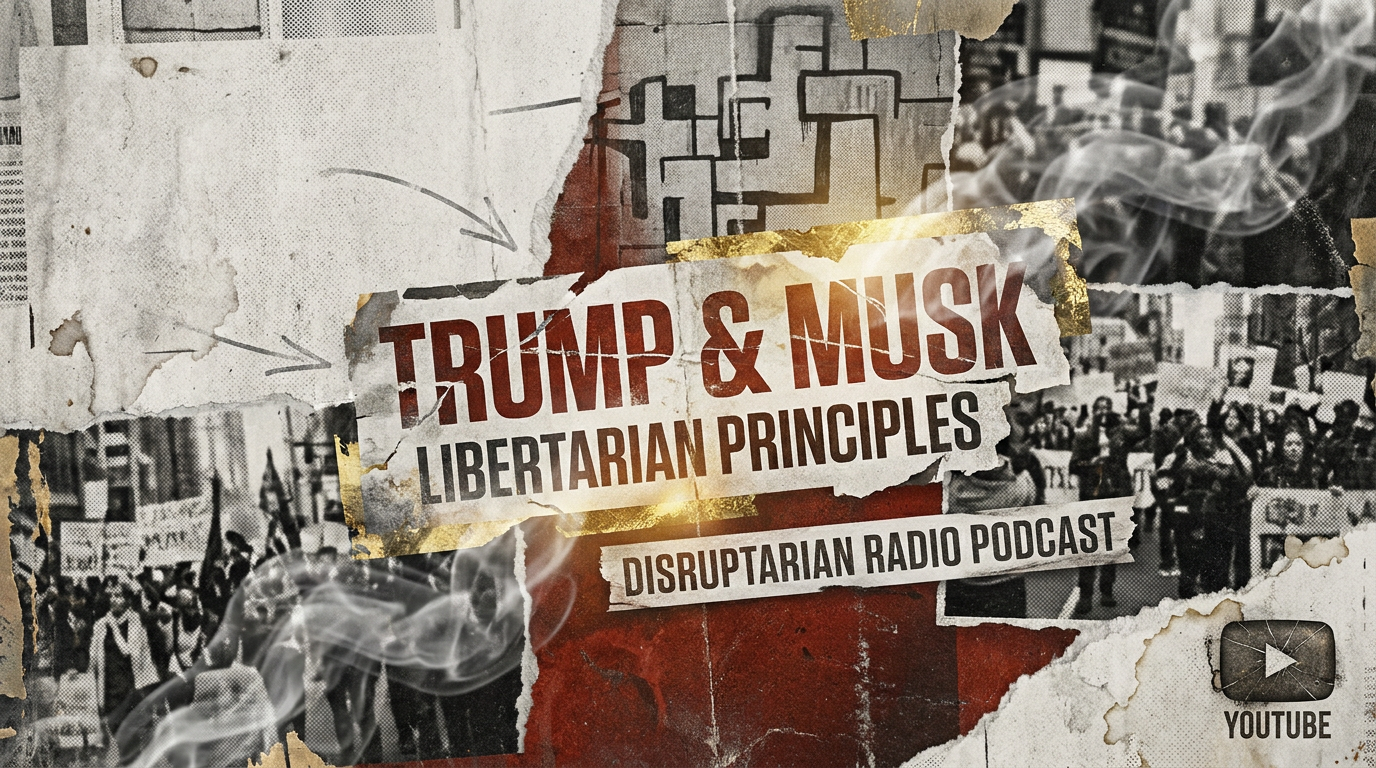
  • Trump, Musk, and Libertarian Principles Analyzed

    Trump, Musk, and Libertarian Principles Analyzed

    Disruptarian featured image for Trump, Musk, and Libertarian Principles Analyzed

    Verified at: 2026-06-22 7:57:51

    Trump, Musk, and Libertarian Principles Analyzed is the kind of subject that fits the Disruptarian lane because it sits where independent media, culture, music, and political commentary collide.

    The source description frames it this way: Ryan Thompson analyzes Donald Trump and Elon Musk through libertarian principles: speech, markets, state power, personal freedom, and where populist politics collides with limited-government ideals. This Disruptarian episode separates personality from principle and asks what liberty actually requires. Original YouTube title: Trump And Musk Libertarian Principles Analyzed Source: https://www.youtube.com/watch?v=p4MUVZK_7JM Disruptarian: https://www.disruptarian.com

    The useful question is not only what happened, but why the story matters to people who distrust scripted narratives, recycled outrage, and corporate-approved commentary.

    A Disruptarian reading starts with individual agency. The listener is not asked to accept a packaged conclusion. The point is to pull the claim apart, compare incentives, and look for the pressure points that legacy media often skips.

    That approach matters for libertarian radio commentary because the audience is usually looking for more than a headline. They want context, motive, contradiction, and a practical sense of how public stories become private consequences.

    The cultural layer is just as important. Disruptarian music and reggae punk energy are not decorations around the message. They give the work its rhythm: skeptical, confrontational, and rooted in the idea that speech should stay alive even when institutions prefer silence.

    For search readers arriving cold, the primary source is included below either as an embed or as a direct source link. Start there if you want the full tone, timing, and argument. The written analysis expands the title and description into a searchable article that can stand on its own.

    The strongest SEO value here is clarity. The article keeps the title language visible, uses descriptive headings, and connects the topic to Disruptarian Radio, independent media, libertarian commentary, political culture, and original music without stuffing the page with empty repetition.

    The larger takeaway is simple: independent commentary survives by documenting what was said, preserving the source, and adding a point of view that does not depend on permission from gatekeepers.

    That is why this post exists as part of the static Disruptarian archive. The video remains embedded, the title and description remain traceable, and the surrounding article gives search engines and readers enough context to understand why the episode belongs in the broader Disruptarian catalog.

    The title itself carries the first keyword signal, but a durable post needs more than a copied headline. It needs a clear H1, a concise meta description, a featured image with descriptive alt text, and enough editorial framing for readers to know why the video is part of this archive.

    From an independent media perspective, the value is in keeping the primary source visible. Embedding the video prevents the article from becoming detached commentary. Readers can compare the written interpretation against the actual recording and decide whether the argument holds up.

    The libertarian angle is not automatic partisanship. It is a suspicion of concentrated power, public manipulation, and narratives that ask citizens to outsource judgment. That suspicion applies to government, platforms, corporations, activist institutions, and media brands alike.

    Disruptarian Radio also treats culture as evidence. Music, political language, online mobs, censorship fights, moral panics, and personal stories all reveal where pressure is being applied. That is why a radio episode can be more than entertainment; it can become a record of a moment.

    For listeners who follow DJ Disruptarian, the same pattern shows up in the music catalog: reggae rhythm, punk edge, spiritual critique, and anti-authoritarian instinct. The written post keeps that identity attached to the video instead of letting it disappear into a platform feed.

    Good SEO on a page like this should help people find the conversation without flattening the voice. The article uses natural phrases such as Disruptarian Radio, independent media, libertarian podcast, political commentary, original music, and disruptive conversations only where they make sense.

    The featured image should follow the Disruptarian editorial-collage style: torn paper, smoke, halftone grit, dirty cream paper, black and oxblood pressure, muted gold accents, and symbolic props tied to the subject rather than generic filler. Its alt text names the subject so search engines and screen readers get useful context.

    The article also keeps a stable URL under the static blog. That matters because feeds move, platforms change embeds, and social links decay. A static post gives the episode a second home that can be indexed, backed up, linked, and reviewed later.

    The final point is documentation. When a channel publishes a new video, the title and description are often the only structured metadata available. Turning that metadata into a post creates a stronger archive without pretending to replace the original recording.

    This is the practical Disruptarian method: preserve the video, state the source, add commentary, keep the searchable terms honest, and let the reader move between the embedded media and the written analysis without friction.

    This additional context keeps the post useful for readers who arrive from search rather than from the original channel. It explains the source, preserves the embed, and connects the subject back to the larger Disruptarian archive.

    This additional context keeps the post useful for readers who arrive from search rather than from the original channel. It explains the source, preserves the embed, and connects the subject back to the larger Disruptarian archive.

    This additional context keeps the post useful for readers who arrive from search rather than from the original channel. It explains the source, preserves the embed, and connects the subject back to the larger Disruptarian archive.


    The shortlink was copied to your clipboard

    X
    f
    r

    Related Reading

    Similar posts


    Disruptarian Blog

    2026-06-22

    Disruptarian Blog

    Disruptarian commentary on Get Woke, Go Broke: Musk, DEI Spending, and Foreign Aid Politics with embedded source video, independent media context, and libertarian radio analysis.

  • Trump & Musk: Disrupting the State—A Libertarian Video Commentary

    Trump & Musk: Disrupting the State—A Libertarian Video Commentary

    Disruptarian editorial collage: torn paper, protest silhouettes, split Trump and Musk over broken Capitol, megaphones, chains, and anti-corporate symbols.

    Source: Disruptarian Radio: Trump & Musk’s First 100 Days – A Libertarian Analysis | Published: April 6, 2025


    “If you want to understand the future of liberty, don’t look to the establishment—look at who’s breaking the rules and burning the paperwork.”

    The latest episode of Disruptarian Radio is a wakeup call for anyone still hypnotized by the left-right puppet show. Hosted by Ryan and with sharp insights from Alexandra (Seattle-based political correspondent), this video podcast goes deep on the first 100 days of the Trump/Musk administration—an unholy alliance or a shot of adrenaline for liberty? That’s the question.

    This isn’t cheerleading. It’s Disruptarian: raw, source-driven, and unafraid of contradiction. Let’s break down what this podcast actually covers, what’s defensible from the record, and where we see the real sparks for freedom—plus where the libertarian purists may be missing the plot.

    The Ground Rules: Non-Aggression As the North Star

    The conversation opens with a clear anchor: the Non-Aggression Principle (NAP). Libertarians, anarchists, and anti-authoritarians recognize this as the foundational ethic: no person or group—government, corporation, or mob—has the right to initiate force, fraud, or coercion against another or their property. Everything else is commentary. Alexandra and Ryan use this as their measuring stick for Trump and Musk’s early moves.

    Trump’s Foreign Policy: Peace Through Strength or Imperial Maintenance?

    Libertarians have always been skeptical—hell, openly hostile—toward U.S. empire and interventionist foreign policy. Trump’s “America First” rhetoric and stated desire for “peace through strength” gets some scrutiny here:

    • Fact: Trump’s administration (in both terms pre-2025 and this new hybrid era) has made moves to draw down U.S. troop levels abroad, but not to zero. Military-industrial interests still loom large.
    • Analysis: Alexandra notes that while Trump’s approach is less reckless than the neocon playbook, it’s “directionally libertarian” but not pure non-intervention. Real libertarians (think Ron Paul, not Rand) want the troops home, the bases closed, and the CIA budget shredded.
    • Disruptarian Take: Any reduction in global militarism is a win, but peace through strength is still a statist compromise. The podcast doesn’t let this slide but recognizes it as progress over endless war.

    Deregulation & Tax: Smashing Bureaucracy or Shuffling the Deck?

    One of Trump’s recurring claims is that he’s the “deregulator-in-chief.” This time, with Elon Musk in the mix (appointed head of the new Department of Government Efficiency), there’s real disruption afoot. The podcast spotlights:

    • Fact: Executive orders have slashed red tape, particularly in energy, manufacturing, and small business sectors.
    • Fact: Proposals for flatter, simpler tax codes and the elimination of certain payroll taxes have made their way to Congress.
    • Alexandra’s View: These are steps toward freeing markets and reducing government burden, both core libertarian goals—but the podcast notes the devil is in the details. Deregulation that simply swaps one corporate cartel for another isn’t true liberation.
    • Disruptarian Angle: What matters is who benefits: If big players get a freer hand while the state keeps crushing the little guy, it’s just oligarchy in a new suit. The podcast calls out “deregulation theater” versus real decentralization of power.

    Musk: Disruptor in the Bureaucracy

    Elon Musk’s presence in government is the most punk-rock, unpredictable, and controversial element here. The podcast spends time unpacking:

    • Fact: Musk has initiated internal audits, transparency pushes, and open challenges to entire federal agencies (especially those that slow down innovation).
    • Analysis: Alexandra draws a line between Musk’s anti-bureaucratic instincts and classic libertarian skepticism of centralized power. But Musk is no Rothbardian—his style is technocratic, not strictly anti-state.
    • Disruptarian Voice: Is Musk the fox in the henhouse, or just another billionaire making the rules? The podcast doesn’t resolve this but insists: attacking bureaucracy from within beats another round of status quo.

    Immigration, Borders & The Welfare State: Libertarian Contradictions

    No issue exposes libertarian fault lines like borders and migration. Ryan and Alexandra don’t dodge it:

    • Fact: Trump’s administration has maintained a “border security first” approach, but with new pilot programs for streamlined legal immigration for skilled workers and refugees.
    • Libertarian Dilemma: Alexandra nails it: “Open borders are only coherent if you abolish the welfare state.” Otherwise, you create a magnet for dependency and resentment. The podcast points to this as a real-world conflict for liberty-minded policymakers.
    • Disruptarian Critique: There’s no silver bullet, and anyone pretending otherwise is selling utopia. The podcast values incremental moves—less bureaucracy, more legal pathways—but warns against both fortress mentality and reckless globalism.

    Taxation: Still Theft

    One of the sharpest segments hits on the moral and economic core of libertarianism: taxation as coercion.

    • Fact: Payroll tax reductions and simplified income tax brackets are on the table.
    • Libertarian Principle: Any tax on labor is immoral, full stop. The podcast quotes Rothbard and Ron Paul on this point, reminding listeners that even ‘better’ taxes are still an affront to self-ownership.
    • Analysis: Ryan and Alexandra argue for directional progress—reduce the tax burden, starve the beast, but never pretend that the state’s hand in your pocket is justified.

    Comparisons: Trump/Musk vs. Ron Paul & Barry Goldwater

    The podcast brings in historical context. Neither Trump nor Musk are “perfect libertarians”—and the hosts are clear-eyed about this. But compared to the average warmonger or technocrat, they at least tip the scales toward decentralization and individual autonomy.

    • Fact: Ron Paul and Barry Goldwater were true radicals for liberty in their time—often marginalized for their stances against war, the Fed, and state overreach.
    • Analysis: Trump and Musk are not as ideologically pure, but they represent a break from business as usual. Alexandra argues that seeking “directional” progress—more freedom, less state—is more important than policing purity.

    Takeaways: Direction Over Perfection

    This is where the podcast’s Disruptarian ethos shines. The hosts call on liberty-minded listeners to:

    • Value progress toward liberation over impossible purity tests.
    • Attack bureaucracy, centralization, and forced wealth transfer wherever they hide.
    • Stay vigilant—never trust power, even when it speaks your language.
    • Stay educated: The podcast ends with a reading list—Thomas Sowell, Ron Paul, and Peter McWilliams are recommended for deeper understanding.

    Disruptarian Final Word

    Disruptarian Radio isn’t here to sanctify Trump or Musk, nor to excuse their missteps. The point is to document the cracks in the system, the power struggles, the messy reality of pushing liberty in a hostile world. Libertarian principles remain the bar—but the path to get there isn’t straight, and it sure as hell isn’t clean.

    As always: question everything, document the facts, and never let the bastards tell you incremental freedom isn’t worth fighting for.

    Watch the full podcast: Trump And Musk Libertarian Principles Disruptarian Radio Podcast


    The shortlink was copied to your clipboard

    X
    f
    r

    Related Reading

    Similar posts

  • Trump And Musk Libertarian Principles Disruptarian Radio Podcast

    Trump And Musk Libertarian Principles Disruptarian Radio Podcast

    Disruptarian featured image for Trump And Musk Libertarian Principles Disruptarian Radio Podcast

    # Disruptarian Radio: Trump & Musk's First 100 Days – A Libertarian Analysis In this episode of Disruptarian Radio, host Ryan and political correspondent Alexandra from Seattle dive into a libertarian analysis of President Trump and Elon Musk's first 100 days in office. They begin by establishing the Non-Aggression Principle (NAP) as the foundation of libertarian philosophy—the idea that no person or group has the right to initiate force, fraud, or coercion against another person or their property. The discussion explores: – Trump's "peace through strength" foreign policy approach and how it aligns with libertarian principles of non-intervention – Trump's ongoing deregulation efforts and tax policies that aim to free markets and reduce government burden – Musk's unique role in the Department of Government Efficiency and his efforts to dismantle bureaucracy from within – The libertarian perspective on immigration challenges within a welfare state system – How taxation on labor is viewed as fundamentally immoral from a libertarian standpoint – Comparisons between Trump/Musk and historical libertarian figures like Ron Paul and Barry Goldwater Alexandra emphasizes that while neither Trump nor Musk are "perfect libertarians," they represent a significant shift toward smaller government and greater individual freedom compared to most mainstream politicians.

    The episode concludes with thoughts about prioritizing directional progress over ideological purity when it comes to advancing liberty in practical politics. The show wraps with recommendations for libertarian-minded listeners to research authors like Thomas Sowell, Ron Paul, and Peter McWilliams.


    The shortlink was copied to your clipboard

    X
    f
    r
  • Trump’s First 100 Days a review at Disruptarian Radio podcast

    Trump's First 100 Days a review at Disruptarian Radio podcast

    Disruptarian featured image for Trump's First 100 Days a review at Disruptarian Radio podcast

    "Trump's First 100 Days & The DOGE Project" – Disruptarian Radio Episode Join hosts DJ Disruptarion (Ryan Thompson) and Eugene correspondent Adrian Gonzalez as they discuss President Trump's return to office and the controversial Department of Government Efficiency (DOGE) project led by Elon Musk. In this episode, the hosts analyze: The Trump administration's approach to auditing government spending Alleged fraud discovered in Social Security and the Small Business Administration Changes to international funding programs Public reactions to the administration's policies The role of social media platform X (formerly Twitter) in current political discourse This podcast presents a libertarian perspective on current political events, claiming to reveal government waste and corruption while discussing public response to these revelations. Note: This podcast represents the opinions of the hosts and has not been independently fact-checked.


    The shortlink was copied to your clipboard

    X
    f
    r
  • Why Would a Libertarian Volunteerist Support Donald Trump or Elon Musk?

    By Ryan Thompson – Punk Rock Libertarian

    For my entire adult life before 2024, I had never supported or voted for a Republican or Democrat. Not once. The first time I ever felt confident backing a mainstream politician from one of the two major parties was when Donald Trump ran for office a third time.

    Why?

    Because, imperfect as he may be, Trump amplifies the world I want to see—for myself and for my children.

    The Libertarian Volunteerist Ideal

    My political philosophy has always been rooted in maximum freedom, maximum accountability, and minimal government coercion. I’ve modeled my views after figures like:

    • Ron Paul (the gold standard for liberty-minded governance)
    • Peter McWilliams (who fought for personal freedom until his tragic death)
    • Barry Goldwater (the original anti-establishment conservative)
    • Rand Paul (keeping the libertarian flame alive in the Senate)

    On my various YouTube channels (dating back to the mid-2000s), I’ve championed:

    1. “Do what you want, pay for yourself.”
      • Not a free-for-all crime spree, but true freedom under the Non-Aggression Principle (NAP).
      • You own your life, your labor, and your property—no exceptions.
    2. No unnecessary foreign wars.
      • We have nearly 700 military bases worldwide.
      • We’ve become “Team America: World Police” (thanks, Mike Judge), meddling in regime changes, oil wars, and conflicts fueled by the Military-Industrial Complex.
      • Obama started/surged 7 conflicts in 7 different nations. Trump? Zero new wars.
    3. Sensible taxation—but never on labor.
      • If someone owns your labor (in whole or in part), you’re a slave.
      • The IRS is unconstitutional and immoral—it should be disbanded.
      • Without heavy taxation & entitlements, borders become less of an issue (since migration isn’t a fiscal drain).
    4. Fiscally conservative, morally liberal.
      • The government shouldn’t fund abortion, transgender surgeries, drag queen story hour, or any other socially controversial activity.
      • Let people live freely—but don’t force others to pay for it.

    Trump: The Most Peaceful President in My Lifetime

    Say what you will about Trump’s personality—but he didn’t start any new wars. Instead, he practiced peace through strength, engaging diplomatically with rivals (North Korea, Russia, China) rather than bombing them.

    Economically, Trump:

    • Slashed corporate taxes, boosting business growth.
    • Cut regulations, freeing up innovation.
    • Expanded the Child Tax Credit, helping working families.
    • Implemented reciprocal tariffs (finally fighting back against the 170+ nations that tax our goods).

    Elon Musk: Disrupting the Status Quo

    Like Trump, Elon isn’t perfect—but he’s a disruptor. He:

    • Fights government censorship (freeing Twitter/X from woke corporate control).
    • Champions free speech (even when it’s unpopular).
    • Rejects ESG nonsense (prioritizing merit over leftist ideology).
    • Accelerates human progress (space exploration, AI, electric vehicles).

    The Bottom Line

    I don’t agree with everything Trump or Musk does (e.g., Trump’s bump stock ban was a betrayal). But in a world where most politicians expand government, start wars, and tax us to death, these two are pushing back—hard.

    That’s why, for the first time ever, I’m supporting a mainstream candidate: Donald J. Trump.

    Liberty isn’t about purity—it’s about direction. And right now, Trump and Musk are steering us toward freedom more than any other major figures.

    Stay free. Stay punk.

    — Ryan Thompson
    Disruptarian.com | YouTube

    Spun Web Technology SMART SEO

    Spun Web Technology SMART SEO

  • Trump’s First 100 Days: The Disruptive Revolution in Washington

    In what can only be described as a seismic shift in how the federal government operates, the first 100 days of Donald Trump’s second term have rewritten the Washington playbook. With tech maverick Elon Musk at his side heading the newly formed Department of Government Efficiency (DOGE), the administration has launched what supporters are calling the most aggressive campaign against government waste and fraud in American history.

    The DOGE Revolution

    The Department of Government Efficiency might have a playful acronym (yes, like the cryptocurrency), but its mission is deadly serious. Under Musk’s leadership, DOGE has approached government spending with the same ruthless efficiency that characterized his private sector ventures. Unlike traditional government oversight bodies that produce reports gathering dust on shelves, DOGE operates with a Silicon Valley mentality: identify problems, implement solutions, and do it at lightning speed.

    What makes DOGE fundamentally different is its composition. Rather than staffing the department with career bureaucrats, Musk has assembled a team of engineers, data scientists, and efficiency experts who approach government spending as they would approach optimizing a failing company. The results have been nothing short of revolutionary.

    Uncovering the Unbelievable

    Among the most shocking discoveries reported by DOGE are cases that would be comical if they weren’t so alarming. Take, for instance, the case of Social Security payments reportedly going to beneficiaries who would be well over 140 years old if they were actually alive. Or perhaps most absurdly, the Small Business Administration loan allegedly approved for a nine-month-old baby.

    These aren’t isolated incidents. According to information shared by DOGE, preliminary estimates suggest that up to 30% of COVID-era small business loans involved some form of fraud. This represents hundreds of billions of dollars – taxpayer money that essentially vanished into thin air.

    The auditing blitz hasn’t stopped at domestic programs. International spending has come under equal scrutiny, with funding cuts to numerous overseas initiatives that, according to the administration, provided little tangible benefit to American citizens.

    Real-Time Accountability

    Perhaps the most disruptive aspect of DOGE’s approach has been its commitment to radical transparency. When resistance is encountered, issues are broadcast in real-time on social media. This unprecedented level of public accountability has sent shockwaves through a system long accustomed to operating in the shadows.

    By publicizing their findings as they happen, Trump and Musk have effectively crowdsourced government oversight, allowing millions of Americans to witness the inner workings of federal spending decisions that were previously hidden behind layers of bureaucracy and technical jargon.

    The Silicon Valley Approach to Government

    What we’re witnessing is essentially a hostile takeover of government inefficiency. The Trump-Musk partnership has imported Silicon Valley’s “move fast and break things” ethos into the federal government. When waste is identified, funding isn’t reduced after months of committee meetings – it’s cut immediately. When fraud is discovered, criminal referrals aren’t contemplated – they’re filed.

    This approach has short-circuited the traditional Washington response mechanism. Before departments can mobilize their political allies and media contacts to defend dubious programs, the programs have already been terminated. It’s government disruption at its most fundamental level.

    The Free Speech Renaissance

    Beyond government efficiency, Musk’s transformation of Twitter into X has created what supporters view as the last major social media platform committed to genuine free expression. The platform now serves as both a tool for government transparency and a digital town square where ideas can compete without the heavy-handed content moderation that characterized previous eras of social media governance.

    This commitment to open discourse has made X the default platform for breaking news about government reform efforts. When DOGE uncovers instances of waste or fraud, X becomes the vehicle through which this information reaches the public, often before traditional media outlets can frame the narrative.

    The Establishment Backlash

    Not everyone is celebrating these developments. The response from Washington insiders and certain political quarters has been swift and severe. Protests have erupted in multiple cities, with some turning violent. There have been reports of vandalism targeting Tesla dealerships and other Musk-associated businesses.

    The establishment’s panicked response suggests that something unprecedented truly is happening. Career bureaucrats, accustomed to weathering administration changes with minimal disruption to their operations, find themselves confronted by an efficiency juggernaut that shows no deference to “how things have always been done.”

    The Libertarian Dream Realized?

    For those with libertarian leanings, the Trump-Musk approach represents the closest thing to their governmental ideal seen in modern American politics. The administration’s focus on cutting waste, eliminating fraud, reducing foreign expenditures, and promoting free speech aligns perfectly with core libertarian values.

    Figures like Ron and Rand Paul, who spent decades warning about government bloat and inefficiency, may view these developments as vindication of their long-held positions. The $400 billion in waste allegedly identified by DOGE represents not just a number, but a concrete example of what small-government advocates have been arguing for years.

    What Comes Next?

    As the administration moves beyond its first 100 days, the question becomes whether this disruptive momentum can be maintained. Washington’s immune system is powerful, and the forces of bureaucratic inertia have defeated previous reform efforts. The establishment is counting on Americans becoming distracted or complacent, allowing the machinery of government to gradually return to business as usual.

    For the Trump-Musk efficiency revolution to succeed long-term, it will require sustained public engagement and support. If citizens remain focused on demanding accountability and celebrating when waste is eliminated, we could be witnessing the beginning of a fundamental restructuring of the federal government.

    The Bottom Line

    Whether you view these developments as a long-overdue correction or a concerning dismantling of important government functions likely depends on your political perspective. What’s undeniable is that the Trump-Musk partnership has introduced a new paradigm of government operation – one that prioritizes results over process, efficiency over tradition, and direct communication over institutional filtering.

    The first 100 days have been characterized by disruption on a scale rarely seen in American politics. If the administration maintains this trajectory, the next several years could reshape public expectations about government performance and accountability for generations to come. For better or worse, the disruptarian revolution in Washington is well underway.

    Spun Web Technology SMART SEO

    Spun Web Technology SMART SEO