Category: Culture

  • Hollywood’s new family values: father optional, career mandatory, and mom on her own
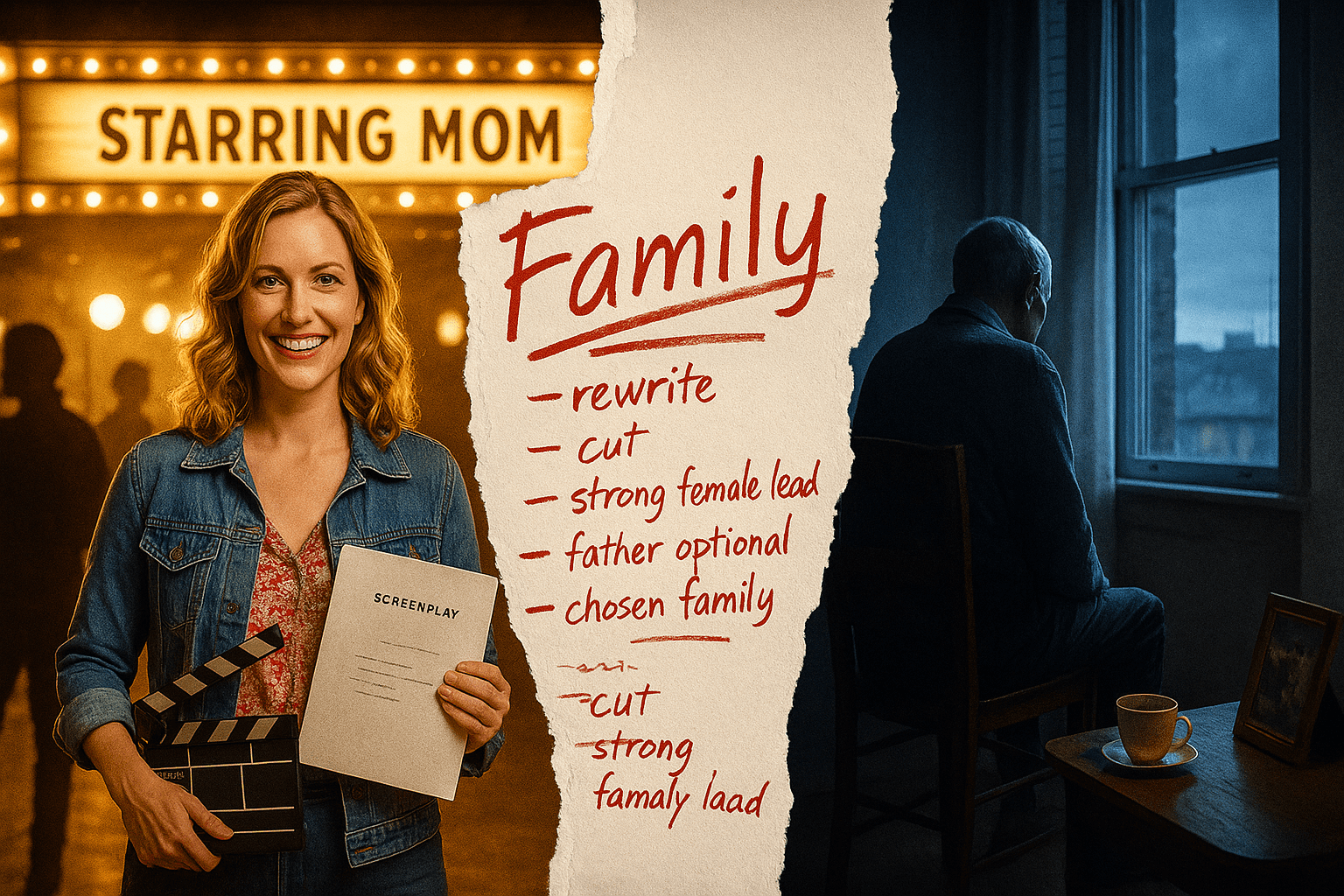
    You know what? It is not subtle anymore. The biggest storytellers in America keep selling the same package. The single mom as the icon. The boss babe as the hero. Dad as a punchline, a sperm donor, or a problem to overcome. Marriage is flexible, optional, or a relic. The message is clear enough for a middle schooler. Traditional family, step aside.

    I am not mad at any one film. I am looking at the pattern. Culture is a drumbeat. Movies, streaming, influencers, classroom posters. The beat says: you do not need a father, motherhood is a personal brand, and the word patriarchy is the villain in every act. That drumbeat did not start in a Hollywood writers room. The theory was on paper long before the studio notes.

    From theory to prime time

    Marx and Engels said it out loud. In the Communist Manifesto they target the bourgeois family and tie it to capital and private gain. They talk about the abolition of the family in a future order that breaks inheritance and private property. That is the frame. Family is not sacred, it is a class machine. (Marxists Internet Archive )

    Engels took it further in “The Origin of the Family, Private Property and the State.” He linked monogamy to property and power, and treated the nuclear home as a historical stage to move beyond. When early Bolsheviks got power, they ran the play. They secularized marriage, made divorce easy, legalized abortion in 1920, and tried to shift cooking, washing, and child care into public systems. The Zhenotdel, a party women’s department, pushed campaigns to make private family life less central. Then the state yo-yoed back under Stalin when the social costs bit hard. It was not a secret. It was written down, then tried in real life. (Encyclopedia Britannica)

    So when people say there is no “anti-family” strain in left ideology, I point to the text and the history. The family was a target because the family competes with the state for loyalty, resources, and identity.

    Kate Millett, her sister’s story, and the line into mainstream culture

    Second-wave feminism then reframed private life as power politics. Kate Millett’s “Sexual Politics” made that lens a best seller in 1970 and pushed the idea that the bedroom and the family are arena and battleground, not refuge. That text helped set the vibe for a generation of activists and writers. Millett worked in NOW’s orbit as an education committee chair.

    Mallory Millett, Kate’s sister, later described a 1960s meeting where a call-and-response allegedly pledged to “destroy the American family” by dismantling the patriarch and monogamy. That account circulates widely in conservative and religious media. It is a claim from a single source, not a transcript in an archive, but the sentiment maps to the theory we just walked through. Hollywood did not invent that tone. It amplified it. (The Father’s Rights Movement)

    The island musical that made it feel cute

    “Mamma Mia” is a fun jukebox fantasy. It is also a clear blueprint. Independent mom. No father in sight. Daughter shops for a dad like she is scrolling a menu. In the end, nobody needs paternity to define family. The crowd cheers. Confetti. Credits. That is not an accident. It is the culture telling you that a father is optional, even quaint. And it is one of many titles with the same spirit. (Rotten Tomatoes)

    Look around. “Erin Brockovich.” “Baby Boom.” “Waitress.” “Where the Heart Is.” The beats repeat. A woman against the system, often without a husband, sometimes with a child in tow, proving she can carry it all. Sometimes the dad returns. Sometimes he is a reward for the credits. The point is survival without him, not life with him.

    Do some of these stories inspire? Sure. People overcome hard things. My argument is not that you cannot root for a strong woman. My argument is that one model dominates, and the industry keeps doubling down while research groups cheerlead the trend and lobby for more of it. Even the Geena Davis Institute, which does careful media audits, says the industry has reached gender parity for leads in family films and now aims to “rewrite motherhood” on screen. That is an agenda. They say it out loud. (Geena Davis Institute)

    But does it matter?

    Stories matter. Kids eat narratives long before they touch policy. The same groups show that portrayals of mothers are curated, tidy, and often detached from the messy work of real care. When you normalize the single path and flatten dads into props, you train expectations. It is like watering down your whiskey. Same glass, less kick. (Geena Davis Institute)

    You can feel the shift in the numbers too. The United States total fertility rate fell to about 1.62 in 2023 and about 1.60 in 2024. Replacement is 2.1. Many rich countries are sliding under 1.4, the UN’s red zone for rapid population decline and hard aging. This is not a vibe, it is a line graph. (NCBI)

    As birth rates stay low and people age, the old-age dependency ratio climbs. In the OECD, it rose from 19 percent in 1980 to 31 percent in 2023 and is projected to hit about 52 percent by 2060. That means fewer workers per retiree, more strain on pensions, health care, and the informal care network. In plain English, fewer adult kids to check on grandma. (OECD)

    Who fills the gap today? Families, mostly unpaid. In the United States, around 38 to 63 million people are providing unpaid eldercare, and across the OECD about 60 percent of older people who get help at home receive only informal care. That is heroic. It is also fragile. When your culture trains people to delay family or avoid it, the pool of caregivers shrinks. The state then steps in with programs that never quite keep up. Paying taxes for this is like handing the town drunk your wallet and hoping he buys groceries instead of whiskey. (Bureau of Labor Statistics)

    You can see the extreme case in places like Japan. Record aging, more seniors living alone, and a surge of solitary deaths. It is bleak. It is also a warning. If we dismantle family bonds in the name of liberation, the market and the ministry will not love your parents like you do. (Reuters)

    But wait, are movies to blame for birthrates?

    No single thing drives fertility. Costs, housing, wages, trust in the future, faith, and yes, culture. This is a stew. My point is not to cherry pick one driver. My point is to call out a coordinated story that tells young people the family is a trap and dad is a joke, while the math shows we need more families and more care, not less. Culture is the on-ramp to policy. The theory aims at the family. The drumbeat normalizes it. The numbers lock it in.

    What I am for

    I am not saying ban movies. I am not saying shame single parents. Many are heroes. I am saying stop pretending the culture is neutral. It is not. And if you are tired of being lectured by people who think the state is your parent, then build something better in your home, your church, your neighborhood, your business.

    Practical steps:

    • Tell better stories. Celebrate mothers without making them mascots for a politics degree. Put married fathers on screen who lead with service, not swagger. Give kids examples worth copying. (Geena Davis Institute)

    • Stop taxing family time. Kill marriage penalties, expand child tax relief that lets families keep their own money, and strip licensing rules that block in-home child care, tutoring, and micro-schools. Let voluntary exchange do its work.

    • Rebuild civil society. Mutual aid beats bureaucracy. Your community can stand up meal trains, respite co-ops, and elder check-ins faster than a state agency can find a clipboard.

    • Respect tradeoffs. Work is good. So are babies. When the only script for a young woman is “climb hard, maybe kids later,” do not be shocked when later becomes never. The costs are real. So are the joys.

    The family is not a primitive holding tank for patriarchy. It is the smallest, freest unit of self-government. Break it, and you do not get paradise. You get lonely elders, overrun systems, and a horizon with fewer little feet.

    Where Hollywood fits

    Hollywood can keep making boss babe flicks and cute fatherless musicals. Free country. But it should not be surprised that many of us will stop paying for sermons that treat fathers like malware and motherhood like weakness. Call it what it is. A narrative that lines up very neatly with a long paper trail that treats the family as a rival to power. The Fed is like a carnival barker with a money printer, and Hollywood is the house band. The song is catchy. The bill is coming.

    Receipts, not vibes

    • Communist texts target the bourgeois family and imagine its abolition with the end of private property. Early communists turned that into secular marriage, easy divorce, abortion legalization in 1920, and a push to socialize housework through party organs like the Zhenotdel. (Marxists Internet Archive )

    • Second-wave theory mainstreamed the idea that private life is political. Kate Millett’s “Sexual Politics” is exhibit A, and she worked in NOW’s education arm, though she was not a founder. Mallory Millett’s infamous meeting “litany” is a single-source recollection that aligns with the broader theory but is not an official NOW document. (Encyclopedia Britannica)

    • Pop culture reflects and pushes the script. “Mamma Mia” is the glossy template that treats fatherhood as optional and chosen family as superior to blood. Industry advocates now openly campaign to “rewrite motherhood” on screen. (Rotten Tomatoes)

    • The demographic facts are not friendly. Fertility in the U.S. sits around 1.60 to 1.62. Many rich countries have fallen under 1.4. Aging is speeding up, and the care load is shifting to fewer adult children and a tired informal network. (NCBI)

    If you want a healthy society, you do not mock the people who make it. You honor mothers. You expect fathers to show up. You build families that can carry weight. Because when family fails, the state grows. And that trade never pays.


    Sources

    Spun Web Technology SMART SEO

    Spun Web Technology SMART SEO

  • Here’s the story, straight: the “trans explosion” on campus is cooling fast, just like I said it would.

    A new analysis, pulling from the FIRE College Free Speech survey and campus polls, shows the share of undergrads identifying as something other than male or female has fallen to about 3.6% in 2025, down from 6.8% in 2022 and 2023. That is not a blip, that is a slide. Even elite schools that once bragged about double-digit nonbinary numbers are reporting sharp reversals. Brown University’s nonbinary share reportedly went from 5% in 2022–2023 down to 2.6% this year. The Andover survey showed a similar drop. Whatever you want to call it, the trend line points down. (Fox News )

    Now, critics are swinging at the methodology, arguing about weighting and samples, and claiming the decline is exaggerated. Fine, debate it. I welcome that. But the broader pattern appears across multiple samplings, and even the pushback pieces are engaging the same core data because it is too big to ignore. The cultural tide shifted, and students are voting with their identities. (Them)

    You know what? This is what a fad looks like when the subsidies, social pressure, and status points dry up. In May I wrote that the trans trend would cool within five years, a cultural correction in progress. It is arriving on schedule. Not because people suddenly became hateful, but because the political machine took its boot off the scale, and the market for identity labels lost its speculative froth. (disruptarian.com)

    How we got the spike

    We had the White House turning Pride into an official state pageant on the South Lawn, complete with speeches about “LGBTQ families” as a new national standard. The point was obvious: moral validation by the state. That is gasoline on cultural kindling. (AP News)

    Meanwhile, DEI directives became the new HR religion in Washington. Biden signed equity and DEIA executive orders, and agencies cranked out plans, trainings, and hiring targets. When the federal government signals that identity boxes are career currency, institutions follow. That skews incentives. It does not create truth, it creates paperwork, metrics, and a lot of people repeating whatever words get them through the next mandatory training. (The White House)

    At the same time, local governments flirted with compelled speech. New York City’s human rights guidance made refusal to use a person’s declared pronouns a rights violation. California even tried forcing nursing-home staff to use preferred pronouns by statute before a court slapped it down as a free-speech violation. Silencing speech is like putting duct tape over a smoke alarm, the fire still burns, you just cannot hear the warning. (NYC Government)

    This was the atmosphere: state-sponsored celebration, institutional reward structures, and speech codes. Of course identification numbers bubbled up. When you pay bonuses in points for compliance, people line up for points.

    What a correction looks like

    Then two simple things happened.

    First, institutions backed off a bit, or at least lost some of their aura. Political support for mandatory DEI began to wobble. A new administration came in promising to shut the DEI spigot at the federal level, and even where programs stayed, the cultural excitement faded. When the checks and applause slow down, performative identity cools. Inflation is like watering down your whiskey, same glass, less kick, and that is what happened to prestige around these labels. (The White House)

    Second, students got tired. Constant identity policing is exhausting. You start to feel like the school hall monitor is living in your head. The 2025 FIRE data shows fewer freshmen leaning into “trans or queer” than seniors, a flip from 2022–2023. That is not just statistics, that is a mood on campus. (Fox News )

    And remember, this is not a judgment about individuals who are trans, or who will always live that way with dignity. It is an observation about a social wave that had a hype cycle. Think of it like the Fed playing Monopoly with real people’s lives; when easy cultural credit floods the system, valuations go crazy. When the spigot tightens, assets reprice. Identity markets are not immune to human incentives.

    The Disney piece and the subsidy economy

    Let’s talk about the corporate side for a second. Big companies leaned in hard, Disney being the poster child. Whether out of conviction or PR risk management, they wrapped themselves in the new orthodoxy while enjoying a long history of state and local subsidies and carve-outs. Independent trackers tally billions in public support flowing to Disney over the years across multiple states. You do not need a federal task force to see the pattern; the corporate welfare receipts are public. Paying taxes while your government bankrolls a media giant’s special deals is like handing the town drunk your wallet and hoping he buys groceries instead of whiskey. (subsidytracker.goodjobsfirst.org)

    As for DOGE, both the federal and Florida versions have been loudly “exposing waste,” including money aimed at DEI and LGBT-branded programming. Some of those claims are contested, and verification is ongoing, but the political signal has been loud enough: the subsidy era for certain cultural campaigns is no longer a guaranteed win. When the political tailwind switches to a headwind, boardrooms stop using social signaling as a shield. (ABC News)

    Why this matters for liberty

    Here is the thing: social freedom thrives when the state is neutral and individuals make choices without coercion. What we lived through was not neutral. It was a top-down push, complete with public-sector incentives, corporate subsidies, and speech rules that tried to turn contested beliefs into mandated slogans.

    When governments police pronouns, they are not protecting people, they are training citizens to fear conversation. When the White House runs culture from the lawn, the message to dissenters is simple: sit down. When HR says your career depends on ritual affirmations, you are not “learning,” you are complying. Dealing with government paperwork is like waiting for dial-up internet in 2025, it is painful, unnecessary, and you know it will freeze halfway through.

    So yes, the drop in trans-identifying students looks like a fad cooling off. Not because people stopped caring about their friends, but because the push stopped being cool and started being costly. Once the spectacle calms down, people rethink. They find their own words again. They stop announcing a new label every term and get back to the business of being a student, or a worker, or a parent.

    A simple proposal

    I am not asking Congress to micromanage identity. I am asking government to get out of it. No compelled speech, no tax-funded culture campaigns, no corporate welfare for studios that lecture the country from behind a subsidy. Let people live how they want, and let ideas compete without the referee wearing a team jersey.

    Five years ago, I said this cultural correction was coming. It is here. The lesson is old and simple: freedom scales, propaganda does not. Take the boot off the scale and people step off the stage.

    If you want to respect individuals, protect their rights. If you want to respect society, stop bribing it.

    That is the whole play.


    Sources

    • Fox News report on campus identification declines and FIRE data, Oct 15, 2025. (Fox News )
    • Eric Kaufmann at UnHerd summarizing declines and data sources, Oct 14, 2025. (UnHerd)
    • Critique of Kaufmann’s methodology and debate over weighting. (Them)
    • NYC Commission on Human Rights, pronoun guidance under NYCHRL. (NYC Government)
    • California appellate ruling striking down pronoun-use provision for nursing homes. (Washington Blade)
    • White House Pride event materials and coverage, June 10, 2023. (AP News)
    • Biden equity and DEIA directives: EO 13985 and EO 14035. (The White House)
    • Good Jobs First Subsidy Tracker, Walt Disney subsidies. (subsidytracker.goodjobsfirst.org)
    • Florida and federal DOGE efforts targeting waste and DEI spend, ongoing verification. (ABC News)
    • Prior Disruptarian prediction: “Trans Will Cool Off in 5 Years.” (disruptarian.com)
    Spun Web Technology SMART SEO

    Spun Web Technology SMART SEO

  • This Week In Feminism: Break The Spell, Save The Family

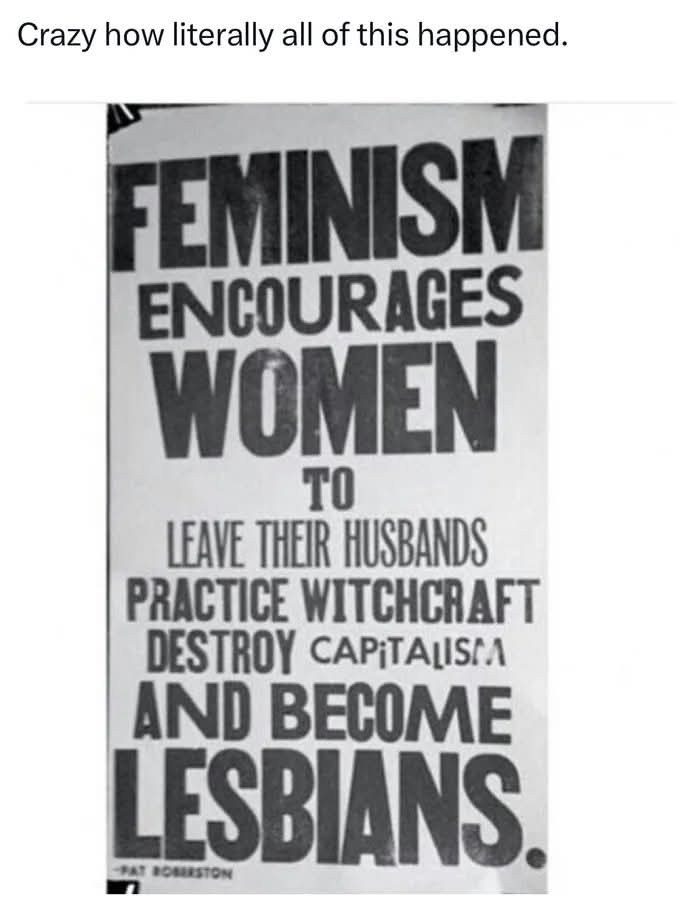
    From a popular meme going around:
    “Feminism encourages women to leave their husbands, practice witchcraft, destroy capitalism, and become lesbians.”

    Feminism encourages women to leave their husbands, practice witchcraft, destroy capitalism, and become lesbians.

    Pat Robertson said it. The internet memed it. People laughed. And then a lot of that cultural program rolled right into policy, pop media, and classrooms.

    On my Facebook page I shared that image and said what I’ve been saying for years. Modern feminism, especially the third-wave flavor that dominates institutions, is toxic for families. A commenter shot back, “not true.” I replied with what I know. The biggest feminist org in the country has spent decades normalizing ideas that undercut marriage, motherhood, and male responsibility, and I pointed to my video about Kate Millett as part of that story.

    Now, a quick correction for the record. The National Organization for Women was founded in 1966 by Betty Friedan, Pauli Murray, and others, not Kate Millett. It is still the largest feminist organization in the United States by membership. That said, Millett’s writing and the radical wing she shaped influenced the movement for half a century, and her own sister Mallory described early “consciousness-raising” sessions that fixated on tearing down the family. You do not have to accept every recollection to see the trend. Plenty of influential feminist texts call the nuclear family a problem to be solved, not a home to be strengthened. Shulamith Firestone asked out loud whether the family should be abolished. Newer theorists openly market “anti-capitalist” feminism and family abolition manifestos. If you think that never jumped from seminar rooms into HR departments and school policy, I have a speed camera to sell you.

    So let’s frame this week’s headline moment.

    Ayesha Curry, Crowder, and the new normal

    Steven Crowder’s latest breakdown of Ayesha Curry’s Call Her Daddy interview is brutal, sometimes crass, and not wrong about the core point. A wife of a faithful, publicly Christian, wildly successful husband went on a top podcast and said she never wanted kids or marriage, resented losing “identity,” and complained her husband can’t understand her level of scrutiny. That went viral, drew a pile-on, and Steph defended his wife. Of course he did. He is the man in his house.

    Here is the thing. A culture that treats family as optional lifestyle décor teaches wives to talk like solo brands and husbands to shut up and take it. It tells girls that fulfillment is out there somewhere, never in the home, and it tells boys that provision is a one-way bargain. You know what? That bargain crashes societies. It also wrecks kids.

    But what about the history?

    Second-wave and third-wave feminism did win real legal equality in places where it was missing. Good. Keep that. Keep due process. Keep equal protection. Keep the right to leave a truly abusive situation. None of that requires turning the family into an enemy.

    Yet a clear strain inside the movement has pushed for exactly that. Firestone’s The Dialectic of Sex questioned the family as an institution and dreamed of technological work-arounds for motherhood. Today’s “feminism for the 99%” markets itself as explicitly anti-capitalist and treats the home economy as class warfare. Academic departments publish “abolish the family” essays like it is edgy, then shrug when those talking points show up in school board training.

    This is not fringe anymore. It is faculty-lounge ideology with corporate PR. The meme looks less like a joke and more like a checklist.

    The costs you can measure

    I said on Facebook that single-mother households fuel antisocial behavior. That ruffled feathers. It should. It is a hard truth. The specifics vary by study, but the direction is not in dispute. Kids raised without a resident father are at substantially higher risk of poverty, behavioral problems, and trouble with the law. Educational outcomes decline. Teen pregnancy risk rises. None of this means single moms are villains. It means father absence is a social crater we keep pretending is a pothole.

    And about “abuse goes one way.” It does not. Bidirectional intimate partner violence is common, and women perpetrate a significant share of lower-level physical aggression, even as men tend to inflict more injury. That is not a talking point. That is CDC survey work and peer-reviewed research.

    Men also take the harder hit in suicide after family breakdown. The exact numbers vary, and I am not going to claim a clean line from custody court to every tragedy. But the risk spike for separated and divorced men is real, and child-contact problems correlate with chronic mental health issues. We should care about that if we claim to care about men and boys.

    “That’s third wave.” Right, and third wave runs the show

    My commenter said the extremism is just third wave. Fine. But third wave runs the largest nonprofits, the campus clubs, and the press releases. NOW, the most powerful U.S. feminist org, has hundreds of thousands of members and a national network. That is the mainstream. Pretending it is fringe is like pretending the Federal Reserve is a book club.

    And yes, feminism intersects with anti-capitalist projects on purpose. Read the manifestos. They say it plainly. Housework is “unwaged labor,” the family is a “site of exploitation,” and a real feminism must be anticapitalist. That is not me spinning. That is their copy.

    Where Crowder is useful, and where we go further

    Crowder’s rant hits a nerve because it says what a lot of men are quietly thinking. If a man can do everything right, love his wife, provide for his kids, keep his vows, and still get treated as a hindrance to a woman’s “brand,” then why risk it. I do not want young men tapping out of marriage. I want them to marry well, and I want them to stay. Which means we have to fix the incentives and the culture.

    Here is the libertarian part nobody on daytime TV will touch.

    1. Shared-parenting as the default after separation. Children do better, on average, when they have real time with both parents. We should presume equal parenting time unless there is clear evidence of danger. That is not “men’s rights.” That is child rights.
    2. End the state-funded culture war. Stop using public dollars to launder ideology through agencies, grants, and school “equity” programs that pathologize motherhood, fatherhood, and the nuclear family.
    3. School choice and real civics. Teach kids that strong families precede strong states, not the other way around. Teach them how markets lift households. If you want to help women, make it easier to start a business, homeschool, or work part time while raising children.
    4. Drop the double standard at work. Equality is not the HR brochure. If we want “equal representation,” then we talk honestly about brick-and-mortar jobs too. About 97 percent of bricklayers are men. No protests, no quotas, no glossy campaigns. Just men sweating in the cold. You want total equality, start on the scaffolding.
    5. Stop lying about what humans want. Men and women overlap, but they are not identical. Many men still want to protect and provide. Many women still want to nurture and build homes. We should honor that without shaming either sex out of their strengths.

    Answering the pushback

    “Divorce was illegal in Ireland. Women had zero rights.” History is messy. There were unjust laws. Fixing those did not require treating every husband as a suspect and every family as a power structure to be smashed. The state should prosecute actual abuse and then get out of the way. Liberty protects people best when it limits rulers, not fathers and mothers.

    “The patriarchy is over.” Maybe. Maybe not. But I will tell you what is not over. Human nature. When you humiliate men in family court, mock them in media, and treat fatherhood as a punchline, you do not get a utopia. You get lonely women, checked-out men, and kids growing up without anchors. Inflation is like watering down your whiskey. Same glass, less kick. Cultural inflation works the same. We watered down marriage with slogans. Less kick, less joy, more hangover.

    The better path

    The family is the smallest, freest unit in a free society. It is the original voluntary association. It predates kings, Congress, and the Supreme Court. You do not have to be religious to see why it matters. The Fed can print dollars. It cannot print fathers. No legislature can mass-produce unconditional love.

    So here is my challenge to my friends who still defend modern feminism as the only path to dignity. Look at the scoreboard. Family formation is down. Births are down. Loneliness is up. Anxiety is up. Kids are medicated and miserable. Meanwhile, the same writers who call the family oppressive are selling you anticapitalism out of a university office paid for by your taxes. It is like hiring the fire department to mow your lawn. Expensive, slow, and you will probably lose the house.

    If you want women safe, kids thriving, and men honorable, stop treating the family like a prison. Treat it like what it is. The best startup most of us will ever build. A place where resources pool, love multiplies, and freedom gets learned around a dinner table.

    And that Facebook thread? I stand by it. We are living with the results of a movement that told women to despise the home and told men they are disposable. Time to break the spell. Build families that outlast hashtags. And yes, defend capitalism, because free exchange is the best friend a mom-and-dad shop ever had.

    You know what? If that sounds radical, the culture drifted farther than I thought.


    Sources

    Spun Web Technology SMART SEO

    Spun Web Technology SMART SEO

  • Why Immigration Laws Aren’t Racist: A Disruptarian Analysis


    Introduction

    In a video titled “Why Immigration Laws Aren’t Racist — A Libertarian Take,” the speaker films outside an immigration office in Cebu City, Philippines. He explains why immigration laws are necessary and why calling them racist doesn’t hold up. He’s been to over 17 countries and followed each country’s immigration rules. His take is simple: borders exist for a reason, and following the law isn’t an act of hate.

    The video also covers topics like crime statistics, Marxist regimes, the impact of welfare on family structure, and the misuse of words like “Nazi.” This article takes those arguments apart, looks at the facts, and lays it out clearly.


    Real Experience, Not Theory

    The speaker starts by grounding his credibility. He says he’s traveled to more than 17 countries, including the UK, Mexico, and Ireland, and always followed their immigration laws. That’s key to his argument: immigration rules aren’t racist or unfair if you just follow the process. They exist to help countries manage infrastructure, services, and resources.


    Immigration Laws Have a Purpose

    He argues that immigration systems are there to help a country stay functional. Without control, he says, there’s chaos. Infrastructure breaks down. Tax systems can’t keep up. Social services stretch thin. Immigration bottlenecks exist not out of hate, but out of necessity. This argument isn’t new and is backed by many legal scholars who agree that border enforcement is part of national sovereignty.


    Overusing the Word “Nazi”

    One of the speaker’s strongest points is that labeling everyone you disagree with a “Nazi” waters down the meaning of the word. He says calling supporters of immigration laws fascists or racists is dishonest and lazy. Instead of debate, people throw out labels. That kind of rhetoric, he argues, disrespects the real victims of actual fascist regimes.


    Marxist Governments and Mass Deaths

    The video also dives into history. He claims that Marxist regimes have caused more deaths in the past century than any nationalist policy. He cites examples from the Soviet Union, Maoist China, and Cambodia under Pol Pot. Scholars like Robert Conquest and R. J. Rummel back up those numbers, with estimates reaching into the hundreds of millions. His argument: if you’re going to judge ideology by its impact, Marxism has a bloodier record than any conservative immigration stance.


    The Crime Statistics Argument

    The speaker brings up U.S. crime data and says Black males make up 6.5% of the U.S. population but commit more than 50% of violent crimes. He says these stats aren’t about race, but culture. This point is controversial. The numbers do exist, but criminologists warn against using them without context. Issues like poverty, systemic bias, and education gaps play a big role. Still, he argues that facts shouldn’t be called racist.


    Minimum Wage and Welfare Backfire

    He says well-meaning policies like the minimum wage can hurt the same communities they’re supposed to help. He brings up economist Thomas Sowell, who has long argued that minimum wage laws can price young or low-skilled workers out of the job market. Historical data supports this, especially for Black teens in the 1940s and 50s when minimum wage laws weren’t strongly enforced due to inflation. In his view, raising the minimum wage and expanding welfare does more harm than good.


    Family Breakdown and Social Fallout

    Another big argument is about family structure. He points out that kids raised without fathers are more likely to get involved in crime, drugs, and other antisocial behavior. He says welfare programs often reward single-parent households rather than support keeping families together. Studies from groups like the Heritage Foundation support this link between family stability and social outcomes. Critics of this view say family breakdown is a symptom of deeper issues, like mass incarceration and economic inequality.


    Calling Out Fake Activists

    Near the end, the speaker addresses anonymous critics. He accuses them of deleting their own comments and then blaming him for censorship. His point is clear: if you believe in what you say, put your name on it. Make a video. Write a post. Hiding behind fake accounts while slinging insults adds nothing to the conversation.


    Final Thoughts

    This video pulls no punches. Some of the arguments are backed by data. Others simplify complicated issues. Still, it taps into a growing frustration with political labels and forced silence. Whether you agree or not, the message is honest: don’t call people racist just because they believe in borders. And don’t ignore the damage done by the policies you support.

    The speaker pushes back hard against the narrative that being pro-border is hateful. Instead, he calls for debate based on facts, not feelings. That alone makes the video worth watching.


    Sources

    Spun Web Technology SMART SEO

    Spun Web Technology SMART SEO

  • Disruptarian Radio Immigration Laws Aren’t Racist — Stop Whining and Learn Why

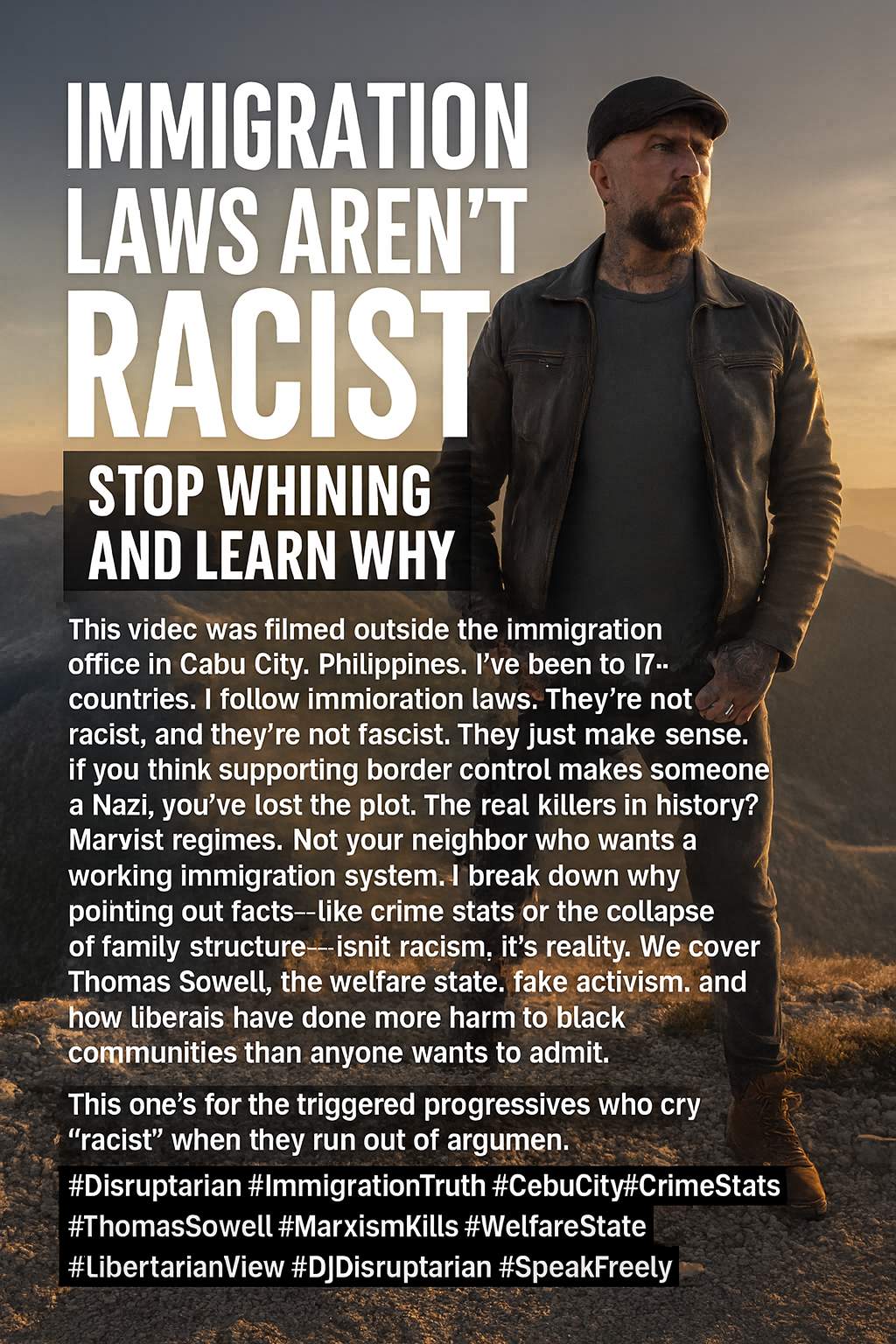
    This video was filmed outside the immigration office in Cebu City, Philippines. I’ve been to 17+ countries. I follow immigration laws. They’re not racist, and they’re not fascist. They just make sense.

    If you think supporting border control makes someone a Nazi, you’ve lost the plot. The real killers in history? Marxist regimes. Not your neighbor who wants a working immigration system.

    I break down why pointing out facts—like crime stats or the collapse of family structure—isn’t racism, it’s reality. We cover Thomas Sowell, the welfare state, fake activism, and how liberals have done more harm to black communities than anyone wants to admit.

    This one’s for the triggered progressives who cry “racist” when they run out of arguments.

    #Disruptarian #ImmigrationTruth #CebuCity #CrimeStats #ThomasSowell #MarxismKills #WelfareState #LibertarianView #DJDisruptarian #SpeakFreely

    Spun Web Technology SMART SEO

    Spun Web Technology SMART SEO

  • SERIES: “Civil Discourse vs. Political Violence” Part 3

    Part 3: Why Free Speech is Worth Fighting For — Even When It Hurts
    By Ryan “Dickie” Thompson


    Introduction

    We’ve talked about Steven Crowder, Charlie Kirk, and the rise of political violence in Part 1. We’ve talked about my own activism—protests, pirate radio, YouTube, and civil discourse—in Part 2.

    Now, let’s get to the root of it all: free speech.

    Free speech isn’t just a constitutional amendment. It’s not just a legal technicality. It’s the foundation of a peaceful society.

    And it’s under attack.

    Not just from mobs with bricks and Molotovs, but from governments, corporations, and even ordinary people who’ve been convinced that silencing their opponents is “justice.”

    This installment is about why free speech matters even when it offends, even when it stings, even when it makes you uncomfortable. Because once you lose free speech, you lose everything else.


    Why Free Speech Matters

    Let’s start with a simple question: why do we even need free speech?

    The answer is because truth doesn’t emerge without friction. You don’t find truth in echo chambers. You find it in conflict—when two ideas clash, and one survives the test.

    Censorship kills that process. When you censor an idea, you’re not proving it wrong—you’re just hiding it. And hidden ideas don’t go away. They fester. They turn into rage. And eventually, they explode in violence.

    That’s why political violence is on the rise. Because instead of debating ideas, we’re silencing them.


    Offensive Speech Is the Price of Freedom

    Here’s the hard truth: free speech isn’t about protecting polite conversation. It’s about protecting speech you hate.

    The First Amendment doesn’t exist so you can say “I like puppies.” It exists so you can say things that offend people, that challenge power, that make the comfortable squirm.

    When Charlie Kirk gave speeches about conservative values, he offended people. When Steven Crowder set up his Change My Mind table, he offended people. When I went to drug court or tax day protests with a mic, I offended people.

    Good. That’s how you know speech is working.

    But here’s the flip side: I’ve also been offended. I’ve listened to people defend taxation, defend war, defend surveillance. I didn’t like it. But I let them speak, because that’s the deal. If I want the right to challenge them, they get the right to challenge me.

    The moment you say, “I believe in free speech, but…” you don’t believe in free speech at all.


    Censorship Creates Violence

    Here’s the paradox: people think censorship prevents violence. In reality, it causes it.

    Take the war on drugs. For decades, we censored honest discussions about addiction. We shut down anyone who suggested decriminalization or medical treatment. The result? Black markets, cartel wars, militarized policing, and mass incarceration. Violence everywhere.

    Or take 2020. The media censored dissenting voices about COVID policy, lockdowns, and vaccines. What happened? Trust collapsed. Protests exploded. Some turned violent.

    When you silence people, they don’t disappear. They harden. And eventually, some of them decide words don’t work anymore, so they pick up rocks or guns.

    That’s where we are today. Censorship fuels the violence it claims to stop.


    The Rhetoric from the Top

    Part of the problem is the rhetoric coming from political leaders.

    Joe Biden called half the country “semi-fascists.” Kamala Harris compared election skeptics to Confederates. Elizabeth Warren said pro-lifers want to strip women of their humanity.

    When leaders frame their opponents as Nazis, fascists, or existential threats, what do you think their followers hear? They hear: “These people don’t deserve a platform. They don’t deserve dialogue. They don’t deserve to live.”

    And so we get assassinations like Charlie Kirk’s. We get riots like Portland. We get targeted harassment campaigns against conservatives on campus.

    It’s not because speech is dangerous. It’s because censorship and demonization have replaced dialogue.


    My Experience With Free Speech Battles

    I’ve lived this personally.

    When I was on pirate radio, I knew the FCC could shut me down at any moment. But I did it anyway, because I’d rather risk fines than silence myself.

    When I went to protests with my mic, I got yelled at, shoved, and threatened. But I kept asking questions, because the conversation mattered more than my comfort.

    On YouTube, I’ve had videos demonetized, flagged, or shadowbanned. But I keep uploading—@xcannabiscom , @utahpirateradio, @slu2com—because these platforms, flawed as they are, are still avenues for dialogue.

    Every time someone tries to shut me up, I double down. Because if they succeed, the alternative isn’t peace—it’s violence.


    The Hypocrisy of “Hate Speech” Laws

    One of the most dangerous trends in America and Europe is the rise of so-called “hate speech” laws.

    On the surface, they sound nice. Nobody likes hate, right? But the problem is who gets to define it.

    In practice, “hate speech” laws are just censorship with lipstick. They’re always applied unevenly. A conservative quoting the Bible can be charged. A progressive calling conservatives Nazis gets a free pass.

    We’ve seen it in Canada. We’ve seen it in the UK. We’ve even seen it in parts of the US, with universities enforcing speech codes that ban “offensive” ideas.

    But here’s the reality: the cure for bad speech isn’t censorship. It’s better speech.

    If someone says something truly hateful, the best response is to expose it, debate it, and defeat it in the open. Shutting it down just makes martyrs out of fools.


    Civil Discourse as the Alternative

    The reason I keep circling back to civil discourse is because it’s the only real alternative to violence.

    If I can sit across from someone who thinks taxation is noble, and I can calmly compare it to handing your wallet to the town drunk and hoping he buys groceries instead of whiskey, then we’ve had a dialogue. They may not agree, but we’ve exchanged ideas.

    If instead I call them a fascist and they call me a bigot, the conversation ends. And when conversations end, fights begin.

    That’s why I keep going out in public. That’s why I keep interviewing people. Because every conversation is a chance to defuse a bomb.


    Why We Must Defend All Speech

    The temptation is always to make exceptions. “Of course I believe in free speech, but not for that group. Not for Nazis. Not for racists. Not for extremists.”

    But here’s the problem: once you make exceptions, free speech no longer exists. It becomes conditional. It becomes permission granted by the state. And the state never stops moving the goalposts.

    Today it’s Nazis. Tomorrow it’s you.

    That’s why I defend all speech—even speech I despise. Because the principle is bigger than the content.

    If Charlie Kirk doesn’t get free speech, neither do I. If Steven Crowder doesn’t get free speech, neither do you.


    The Way Forward

    So what do we do?

    1. Reject censorship in all forms. No more hiding behind “hate speech” or “misinformation.” Those are just excuses to silence dissent.
    2. Recommit to civil discourse. Go out. Talk to people. Listen, even when you hate what they say. Debate, don’t destroy.
    3. Defend lawful self-defense. Talking doesn’t mean being defenseless. Dialogue is the goal, but security is the shield.
    4. Hold leaders accountable for rhetoric. Stop electing people who demonize half the country. Demand that politicians talk like leaders, not agitators.
    5. Build alternative platforms. Pirate radio, independent sites, Rumble, Substack—whatever it takes to keep the conversation alive.

    Conclusion

    Free speech is not just a right. It’s the thin line between civilization and chaos.

    When speech dies, violence takes its place. We’ve already seen it with the assassination of Charlie Kirk. We’ve seen it with Crowder behind bulletproof glass. We’ve seen it in the riots, the firebombings, the silenced voices.

    But it doesn’t have to end that way.

    We can choose dialogue over violence. We can choose civil discourse over censorship. We can defend speech even when it hurts, because the alternative is far worse.

    This concludes my three-part series on Civil Discourse vs. Political Violence.

    If you take nothing else from this, remember this: silencing speech doesn’t end conflict. It guarantees it.

    Civil discourse is the best answer. Always.

    Spun Web Technology SMART SEO

    Spun Web Technology SMART SEO

  • SERIES: “Civil Discourse vs. Political Violence” Part 2

    Part 2: Civil Discourse in the Streets – Protests, Pirate Radio, and Public Debate
    By Ryan “Dickie” Thompson


    Introduction

    If Part 1 was about Steven Crowder and Charlie Kirk, Part 2 is about me.

    Not because my story is more important, but because it proves the same point: civil discourse is dangerous, but necessary.

    Before I ever wrote a word on this site, before podcasts were popular, before YouTube turned into a battleground for speech, I was already out there with a mic. I was on the streets, on pirate radio, and eventually on YouTube, talking with people who didn’t always see things my way.

    I’ve gone out on tax day protests, stood outside drug courts, and hosted radio call-ins with people who ranged from libertarian purists to die-hard statists. I’ve interviewed activists, politicians, and everyday people with stories to tell.

    And I’ve done all of it with one principle in mind: civil dialogue is better than violence.

    That doesn’t mean it’s easy. Sometimes it’s hostile. Sometimes you leave more frustrated than when you started. But it’s still better than rocks, Molotov cocktails, or bullets.

    In this installment, I’ll share how those experiences shaped me, how they connect to the current climate of political violence, and why I keep pushing for dialogue even when it’s unpopular.


    Protests and the Streets

    Let’s start with the protests.

    If you want to understand America’s pulse, don’t watch cable news. Don’t scroll Twitter. Go to the courthouse on tax day. Walk through a drug court lobby. Stand outside city hall during a public protest.

    That’s what I did.

    I brought my camera, my mic, and sometimes just a notebook. And I asked people why they were there. Some were angry about taxes. Some were furious about government overreach. Others showed up to defend government programs.

    I didn’t go to preach. I went to ask. And I learned something: people are more willing to talk than you think.

    I once asked a man at a tax protest if he thought taxation was theft. He said no—it was “the price we pay for civilization.” That’s the cliché line. But when I pushed him gently—“what happens if I refuse to pay?”—he paused. He admitted that the government would eventually take his property or throw him in jail. That moment of honesty cracked open a conversation he’d probably never had before.

    It didn’t mean he changed his mind right there. But it planted a seed. And more importantly, it proved something: civil conversation forces people to think.

    Now compare that to what we see today: when leftist mobs burn down buildings, loot stores, or assault political opponents, nobody learns anything. Everyone just digs in deeper. The violence justifies the other side’s worst fears.

    That’s why I keep showing up. Because dialogue works where force fails.


    Drug Court and Hard Conversations

    Drug court was another arena where I learned the value of civil discourse.

    Here were people whose lives had been torn apart by addiction and by the justice system. Some of them saw the court as salvation. Others saw it as just another cage.

    I would sit and talk with people—sometimes before hearings, sometimes after. And what struck me most was how differently people viewed the same experience.

    One man told me that drug court saved his life, because it forced him into rehab. Another told me it destroyed his life, because it robbed him of his freedom while doing nothing to cure his addiction.

    Both were right, in their own ways. And that’s the kind of complexity you never hear in political talking points.

    The war on drugs is one of the clearest examples of how government violence replaces dialogue. Instead of sitting down and asking why people use drugs, we send in SWAT teams. Instead of debating medical approaches, we fill prisons.

    If we had more civil discourse about addiction, we wouldn’t have needed drug court in the first place.


    Pirate Radio: Free Speech Without Permission

    Before podcasts were a thing, I was on pirate radio.

    That wasn’t about money or fame. It was about bypassing gatekeepers. It was about free speech without asking permission from the FCC, advertisers, or corporate suits.

    On pirate radio, the conversations were raw. People called in with unfiltered opinions. Sometimes I agreed. Sometimes I strongly disagreed. But the point wasn’t to agree. The point was to talk.

    And those conversations mattered. When someone called in to defend big government, I didn’t mute them. I challenged them. I asked questions. I gave them space to speak.

    Compare that to what we see today: tech companies censoring speech, governments pressuring platforms, mobs calling for deplatforming. Pirate radio proved that dialogue can survive without gatekeepers—and that’s why I carried the same spirit into YouTube.


    YouTube: Protest, Debate, and Open Forums

    My YouTube channels—@xcannabiscom , @utahpirateradio, and @slu2com—became my way to keep that ethos alive.

    Search “protest” or “radio show” on my channel, and you’ll find countless examples of me putting the mic in front of people who disagreed with me. Not dunking on them. Not clipping them for clickbait. Just real conversations.

    That’s the same spirit Crowder tapped into with Change My Mind. And it’s the same spirit Charlie Kirk embodied before his assassination.

    We don’t have to agree. But we do have to talk.


    Civil Discourse vs. Political Violence

    Here’s the contrast I want people to understand.

    When I go to a protest and talk to someone about taxes, nobody gets hurt. When I sit down in a drug court lobby and interview someone about addiction, nobody dies. When I host a call-in radio show, nobody ends up in the hospital.

    But when extremists decide that talking is no longer enough, the result is bloodshed.

    Charlie Kirk was murdered for talking. Steven Crowder had to armor up for talking. I’ve been threatened for talking.

    So the question is simple: do we want a society where disagreements are solved with dialogue, or with violence?

    History shows us what happens when dialogue collapses. The French Revolution. The Bolshevik Revolution. Mao’s Cultural Revolution. All fueled by the belief that opponents didn’t deserve conversation—only elimination.

    That’s where America is heading if we don’t recommit to civil discourse.


    Why I Keep Going

    Some people ask me why I bother. Why risk it? Why keep putting myself out there in hostile environments?

    My answer is simple: because it works.

    I’ve seen minds change. Not always instantly. Not always dramatically. But enough to know it matters.

    I’ve had people write me months later, saying our conversation made them rethink an issue. I’ve had former opponents become allies. I’ve even had people who hated my guts admit, grudgingly, that they respected my willingness to talk.

    That’s enough for me. Because every mind changed through dialogue is one less body lost to violence.


    Conclusion

    Part 1 of this series showed what happens when civil discourse is attacked: Steven Crowder hiding behind bulletproof glass, Charlie Kirk assassinated for speaking his mind.

    Part 2 shows the alternative: civil discourse in action. In the streets. In drug courts. On pirate radio. On YouTube. It’s messy, it’s uncomfortable, but it works.

    I’ve lived it. And I’ll keep living it.

    Because the choice is simple: civil dialogue, or civil war.


    Coming Next in the Series

    • Part 3: Why Free Speech is Worth Fighting For—Even When It Hurts
      A deep dive into why free speech is under attack, why censorship fuels violence, and why defending speech—even offensive speech—is the only way to keep a free society alive.
    Spun Web Technology SMART SEO

    Spun Web Technology SMART SEO

  • Disruptarian Radio Everyone I Don’t Like Is a Nazi: Racism, Religion & Reality

    For over 20 years, my brother and I have argued about racism, religion, and politics. In this video, I share parts of that conversation and explain why the label “Nazi” has become the lazy weapon of choice in today’s culture.

    We dive into:

    Growing up punk rock and anti-racist in Utah

    The truth about skinhead culture and my 1999 anti-racist biography (archived here
    )

    Christianity vs. Gnosticism, and how Rome corrupted the Bible

    Why atheists often “preach” harder than Christians

    Family conflict, victimhood, and the misuse of racism accusations

    Political defamation campaigns: Trump, Elon Musk, Charlie Kirk

    Ryan Long’s comedy sketch on outrage culture

    Tim Pool & Steven Crowder on Charlie Kirk and political violence

    This isn’t just about me and my brother. It’s about free speech, defamation, and how honest discussion is being destroyed by weaponized labels.

    👉 Watch the full conversation and decide for yourself.

    Spun Web Technology SMART SEO

    Spun Web Technology SMART SEO

  • Everyone I Disagree With Is a Nazi: Racism, Religion and Reality

    Everyone I Disagree With Is a Nazi: Racism, Religion and Reality

    Disruptarian featured image for Everyone I Disagree With Is a Nazi: Racism, Religion and Reality

    Verified at: 2026-06-21T04:15:10

    Everyone I Disagree With Is a Nazi: Racism, Religion and Reality is the kind of subject that fits the Disruptarian lane because it sits where independent media, culture, music, and political commentary collide.

    The source description frames it this way: A long-form Disruptarian commentary on racism, religion, politics, family arguments, and why the word Nazi has become a lazy weapon in modern debate. Ryan Thompson challenges label-driven politics and argues for reality, definitions, and honest disagreement. Original source video: https://www.youtube.com/watch?v=QGAaze9fkBE Disruptarian: https://www.disruptarian.com

    The useful question is not only what happened, but why the story matters to people who distrust scripted narratives, recycled outrage, and corporate-approved commentary.

    A Disruptarian reading starts with individual agency. The listener is not asked to accept a packaged conclusion. The point is to pull the claim apart, compare incentives, and look for the pressure points that legacy media often skips.

    That approach matters for libertarian radio commentary because the audience is usually looking for more than a headline. They want context, motive, contradiction, and a practical sense of how public stories become private consequences.

    The cultural layer is just as important. Disruptarian music and reggae punk energy are not decorations around the message. They give the work its rhythm: skeptical, confrontational, and rooted in the idea that speech should stay alive even when institutions prefer silence.

    For search readers arriving cold, the primary source is included below either as an embed or as a direct source link. Start there if you want the full tone, timing, and argument. The written analysis expands the title and description into a searchable article that can stand on its own.

    The strongest SEO value here is clarity. The article keeps the title language visible, uses descriptive headings, and connects the topic to Disruptarian Radio, independent media, libertarian commentary, political culture, and original music without stuffing the page with empty repetition.

    The larger takeaway is simple: independent commentary survives by documenting what was said, preserving the source, and adding a point of view that does not depend on permission from gatekeepers.

    That is why this post exists as part of the static Disruptarian archive. The video remains embedded, the title and description remain traceable, and the surrounding article gives search engines and readers enough context to understand why the episode belongs in the broader Disruptarian catalog.

    The title itself carries the first keyword signal, but a durable post needs more than a copied headline. It needs a clear H1, a concise meta description, a featured image with descriptive alt text, and enough editorial framing for readers to know why the video is part of this archive.

    From an independent media perspective, the value is in keeping the primary source visible. Embedding the video prevents the article from becoming detached commentary. Readers can compare the written interpretation against the actual recording and decide whether the argument holds up.

    The libertarian angle is not automatic partisanship. It is a suspicion of concentrated power, public manipulation, and narratives that ask citizens to outsource judgment. That suspicion applies to government, platforms, corporations, activist institutions, and media brands alike.

    Disruptarian Radio also treats culture as evidence. Music, political language, online mobs, censorship fights, moral panics, and personal stories all reveal where pressure is being applied. That is why a radio episode can be more than entertainment; it can become a record of a moment.

    For listeners who follow DJ Disruptarian, the same pattern shows up in the music catalog: reggae rhythm, punk edge, spiritual critique, and anti-authoritarian instinct. The written post keeps that identity attached to the video instead of letting it disappear into a platform feed.

    Good SEO on a page like this should help people find the conversation without flattening the voice. The article uses natural phrases such as Disruptarian Radio, independent media, libertarian podcast, political commentary, original music, and disruptive conversations only where they make sense.

    The featured image should follow the Disruptarian editorial-collage style: torn paper, smoke, halftone grit, dirty cream paper, black and oxblood pressure, muted gold accents, and symbolic props tied to the subject rather than generic filler. Its alt text names the subject so search engines and screen readers get useful context.

    The article also keeps a stable URL under the static blog. That matters because feeds move, platforms change embeds, and social links decay. A static post gives the episode a second home that can be indexed, backed up, linked, and reviewed later.

    The final point is documentation. When a channel publishes a new video, the title and description are often the only structured metadata available. Turning that metadata into a post creates a stronger archive without pretending to replace the original recording.

    This is the practical Disruptarian method: preserve the video, state the source, add commentary, keep the searchable terms honest, and let the reader move between the embedded media and the written analysis without friction.

    This additional context keeps the post useful for readers who arrive from search rather than from the original channel. It explains the source, preserves the embed, and connects the subject back to the larger Disruptarian archive.

    This additional context keeps the post useful for readers who arrive from search rather than from the original channel. It explains the source, preserves the embed, and connects the subject back to the larger Disruptarian archive.

    This additional context keeps the post useful for readers who arrive from search rather than from the original channel. It explains the source, preserves the embed, and connects the subject back to the larger Disruptarian archive.

    This additional context keeps the post useful for readers who arrive from search rather than from the original channel. It explains the source, preserves the embed, and connects the subject back to the larger Disruptarian archive.


    The shortlink was copied to your clipboard

    X
    f
    r

    Related Reading

    Similar posts


    Disruptarian Blog

    2026-06-22

    Disruptarian Blog

    Disruptarian commentary on Is the Nuclear Family Under Attack? Communism, Feminism, and BLM with embedded source video, independent media context, and libertarian radio analysis.

  • Everyone I Don’t Like Is a Nazi | Racism, Religion & Family Politics

    For more than two decades, my brother and I have circled the same arguments about racism and religion. The script rarely changes. We’ll be talking about music, our childhood in Utah, or addiction recovery, and before long it shifts into accusations:

    “You’re too religious.”
    “You’re pushing your beliefs on me.”
    “You were a skinhead when you were a kid.”

    Now it’s extended even further. His wife’s family? Racists. The people he doesn’t like? Nazis. It’s the same tired line that we hear on cable news and social media every single day: everyone I don’t agree with is a Nazi.

    The irony is that this exact script has played out not just in my family, but across culture. You can watch late-night comedy or browse Twitter and see the same accusation: racist, Nazi, fascist — all because someone disagreed.


    My Anti-Racist Past and the Punk Rock Years

    When my brother brings up my youth, he throws around “skinhead” like it’s a conviction. But he conveniently leaves out the rest of the story.

    When I was 15, I got a tattoo across my foot: SPEAR — Skins and Punks Everywhere Against Racism . I made a clear public stand against racism in a scene where shaved heads often got lumped in with neo-Nazis.

    I didn’t hide it. I even wrote my story into a biography back in 1999 — it’s still online in the Internet Archive. I denounced racism back then, and I still do today.

    My first girlfriend was Navajo back then. My closest friends were Polynesian. My favorite bands were anti-racist ska groups like the Mighty Mighty Bosstones. The first concert I ever saw at age 12 was ska — not hate rock, not white power music.

    I’ve lived in the Philippines for a long while now. My son is Filipino. To this day, my family is mixed and multi-ethnic. But somehow, decades later, I’m still defending myself from lazy labels.


    Christianity, Religion, and My Brother

    Religion is the other landmine between us.

    I haven’t been a churchgoer in decades. I have no pastor, no pulpit, no pew. Yet if I mention that I quit drugs at 19 after an encounter with the Holy Spirit, suddenly I’m “too religious.” Suddenly I’m “preaching.”

    Meanwhile, my brother — who calls himself an atheist — takes his kid to Mormon church. My brother has been ordained in that system. So who’s more religious?

    What I actually believe is simple: the Romans corrupted Christianity. They edited the Bible, built a church to save their empire, and turned faith into politics. But we’ve since uncovered older manuscripts — the Nag Hammadi library and Gnostic gospels — that predate Roman canon. They show a faith closer to Judaism and focused on righteous living here and now, not on eternal damnation.

    That’s not church religion. That’s history. That’s philosophy. That’s my position.

    If you want to hear how I tried to explain this to my brother, I put the conversation online: Talking with my brother about Christianity and racism.


    The Broader Culture: “Nazi” As a Political Weapon

    This isn’t just a family problem. It’s become a cultural one.

    Ryan Long made a comedy sketch about the firing of Jimmy Kimmel that nails the absurdity of our outrage culture: Ryan Long Comedy on Facebook. It’s all the same template — someone offends you, so they must be racist, sexist, Nazi, fascist, or whatever label fits the moment.

    Meanwhile, real political violence is minimized or ignored. Tim Pool and Steven Crowder recently discussed the Charlie Kirk assassination attempt and the spike in death threats against conservatives. You can watch that discussion here: Timcast News video.

    That’s not fringe internet gossip. That’s mainstream politics in America right now. Death threats against conservatives aren’t even headline news anymore, while “mean words” on Twitter get turned into full-blown moral panics.


    Defamation, Victimhood, and Free Speech

    What frustrates me most isn’t disagreement. It’s the cheapness of the labels.

    Accusing someone of being a racist or Nazi without evidence is defamation. It’s a way to win an argument without ever addressing the argument. It’s politics by character assassination.

    I’ve seen the same tactic used against Elon Musk, Donald Trump, Charlie Kirk, Jordan Peterson — the list goes on. And I’ve seen it used in my own family.

    But I refuse to let false labels define me. I’ve been open about my past, my mistakes, and my beliefs. I’ve written them, archived them, and stood by them. I’ve fought for free speech and honest discussion for more than 20 years on radio and podcasting.

    If discussion is replaced with defamation, then free speech is dead. And if family conversation can’t exist without name-calling, then family suffers too.


    Conclusion

    The truth is simple: I’m not a racist, I’m not a Nazi, and I’m not out here preaching religion. I’m someone who believes in conversation, history, philosophy, and freedom.

    If my brother or anyone else disagrees, that’s fine. But disagreement isn’t hate. Criticism isn’t fascism. And having faith in something greater doesn’t make me a zealot.

    Maybe one day, we’ll be able to talk about addiction, music, and growing up in Utah without dragging racism and religion into it. But until then, I’ll keep defending myself from false labels — because the truth matters more than the narrative.


    Sources

    Spun Web Technology SMART SEO

    Spun Web Technology SMART SEO