Category: Culture

  • SERIES: “Civil Discourse vs. Political Violence” Part 1

    Part 1: Steven Crowder, Charlie Kirk, and the Rise of Political Violence
    By Ryan “Dickie” Thompson


    Introduction

    When Steven Crowder walked back onto a college campus in 2025 for his first Change My Mind in years, it was more than a comeback. It was a statement.

    Charlie Kirk, his friend and mentor, had been assassinated in cold blood. Not in a car accident. Not in some random tragedy. Murdered for being a conservative.

    So Crowder returned to the table, but not like before. This time he was wrapped in Kevlar, backed by an army of private security, and surrounded by bulletproof glass. His sign read: “The Left is Violent. Change My Mind.”

    That image—one man trying to have a conversation while encased in armor—is the perfect snapshot of where America is today.

    And it hits me personally.

    For years, I’ve gone out in public with nothing more than a microphone. On tax day, at drug court, at protests. Hosting radio shows, running pirate stations, putting myself in front of people who disagreed with me. I’ve always believed that civil discourse—not violence—is the way forward.

    But what happens when one side of the debate starts using bullets instead of words? That’s the question we need to face.

    This is Part 1 of my series on Civil Discourse vs. Political Violence. Today I’ll break down Crowder’s return, Kirk’s assassination, the double standards in how we talk about political violence, and why this matters for anyone who still believes in free speech.


    Crowder’s Dangerous Return

    Back in 2017, Change My Mind was revolutionary. A table. A sign. A man willing to listen. It sparked memes, debates, and even a few real conversions.

    But the years since have been brutal. Security threats. Cancel culture. Physical attacks. It got so bad Crowder pulled back.

    Until now.

    And when he came back, he had to treat an open dialogue like a war zone. Bulletproof glass. Secret location drops. Millions spent on security.

    Ask yourself: what does that say about America?

    Have you ever seen Elizabeth Warren, Bernie Sanders, or Kamala Harris shield themselves behind bulletproof walls just to speak on a campus? No. And they never will.

    That difference isn’t about personality. It’s about who is actually under threat in today’s America. And the answer is obvious: it’s not the left.


    What Counts as Political Violence?

    Crowder started his discussion with an important question: what exactly is political violence?

    The answer is simple but crucial: it’s violence committed for a political end.

    • If you get drunk and hit someone in a bar fight, that’s crime.
    • If you assault someone because of their political views, that’s political violence.

    This distinction matters because the media constantly manipulates it.

    • When a lunatic with no political motive happens to have once voted Republican, the media counts it as “right-wing violence.”
    • When Antifa shoots a Trump supporter at point-blank range, it gets left out of the data.

    Look at the numbers carefully and you’ll see the game being played.


    Charlie Kirk: Murdered for His Beliefs

    Charlie Kirk was not a violent man. He didn’t call for revolution. He didn’t rally mobs. He built Turning Point USA to encourage young conservatives to get active in the battle of ideas.

    For that, he was hunted down and killed.

    The assassin admitted it. He engraved “anti-fascist” slogans on his bullets. He said he killed Kirk because of his politics and wanted to terrify others into silence.

    That’s not random. That’s not “mental illness.” That’s terrorism.

    And yet, what was the reaction? Vigils for Kirk were vandalized. Conservatives mourning him were assaulted. Online, leftist activists celebrated.

    Imagine for a moment if this had been reversed—if a left-leaning leader had been assassinated by a conservative. The media and the political class would have shut the nation down for weeks.

    But because Charlie Kirk was conservative? Silence. Shrugs. Or worse—cheers.


    The Numbers Tell the Story

    Here’s the uncomfortable truth the mainstream won’t report: leftists are more likely to justify political violence.

    After Kirk’s assassination, polling found:

    • 62% of liberals said political violence was “somewhat to completely acceptable.”
    • 77% of conservatives said political violence was “not acceptable at all.”

    This same pattern shows up again and again:

    • After the attempted assassination of Donald Trump.
    • After BLM riots left billions in damage.
    • After the firebombing of Tesla dealerships.

    The left shrugs. The right condemns.

    And yet the studies and think tanks that get cited—like the Prosecution Project—omit left-wing examples while overcounting right-wing ones.

    They exclude:

    • Aaron Danielson murdered by Antifa in Portland.
    • 37 dead in the Floyd riots.
    • The Waukesha massacre.
    • The assassination of Charlie Kirk.

    But they’ll include any act of violence by someone who once voted Republican, regardless of motive.

    It’s a rigged game. And people are dying because of it.


    Why Civil Discourse Still Matters

    This is where I get personal.

    I’ve gone out to the streets myself. On tax day, I’ve set up outside the courthouse. At drug court, I’ve asked tough questions. I’ve stood at protests with my recorder running. And I’ve opened up the phone lines on pirate radio, YouTube, and livestreams for anyone who wanted to call in.

    I’ve had heated debates with people who disagreed with me. I’ve been yelled at. I’ve been threatened. But I’ve always believed that talking is better than fighting.

    Civil discourse is messy. It’s uncomfortable. Sometimes it gets ugly. But it’s the only way out of the spiral we’re in.

    That’s why Charlie Kirk’s murder hit me so hard. He represented that spirit—solving problems through conversation. And his life was stolen because of it.

    The temptation in times like this is to give up. To say talking doesn’t work anymore. To arm up and prepare for conflict.

    But I reject that.

    The answer isn’t silence or surrender. It’s more dialogue. Harder dialogue. Riskier dialogue. Because if we stop talking, the other side wins.


    Where We Go From Here

    Steven Crowder’s return shows us what’s at stake. We’re in a country where one side of the debate literally has to armor up just to speak. That’s not freedom. That’s fear.

    Charlie Kirk’s assassination wasn’t just about him. It was a warning shot to every conservative: “shut up or else.”

    But here’s the truth they don’t want us to admit: if we stop talking, they win.

    That’s why I’ll keep going out. I’ll keep hosting conversations. I’ll keep uploading shows at:

    Civil discourse is the best answer we have. It always will be.


    Conclusion

    This is Part 1 of a series. And it’s just the beginning.

    Next, I’ll take you behind the microphone and into the streets with Part 2: “Civil Discourse in the Streets – Protests, Pirate Radio, and Public Debate.”

    After that, I’ll close the series with Part 3: “Why Free Speech is Worth Fighting For—Even When It Hurts.”

    Because here’s the bottom line: dialogue is dangerous, but silence is deadly.

    10 Relevant Links for Further Reading & Viewing

    1. Steven Crowder’s Change My Mind (YouTube Archive)
      https://www.youtube.com/@StevenCrowder
    2. Charlie Kirk’s Official Turning Point USA
      https://www.tpusa.com
    3. Ryan “Dickie” Thompson – Protest & Radio Show Archives (@xcannabiscom)
      https://www.youtube.com/@xcannabiscom/search?query=protest
    4. Ryan “Dickie” Thompson – Radio Show Episodes (@xcannabiscom)
      https://www.youtube.com/@xcannabiscom/search?query=radio%20show
    5. Utah Pirate Radio – Community Broadcasts (@utahpirateradio)
      https://www.youtube.com/@utahpirateradio
    6. SLU2 Community Channel (@slu2com)
      https://www.youtube.com/@slu2com
    7. YouGov Polling on Political Violence
      https://today.yougov.com/politics/articles/43113-political-violence-poll
    8. Reuters: Survey on Acceptance of Political Violence in America
      https://www.reuters.com/world/us/americans-political-violence-survey-2022-09-01/
    9. Prosecution Project (TPP) Database of Political Violence
      https://theprosecutionproject.org
    10. Ludwig von Mises Institute – On Free Speech & Civil Society
      https://mises.org

    Spun Web Technology SMART SEO

    Spun Web Technology SMART SEO

  • Equal Rights, Equal Duties: Why Custody Laws Must Catch Up With Reality

    By Ryan “Dickie” Thompson

    Parenthood isn’t complicated until the state gets involved. Raising kids is the most natural, human responsibility we have: you bring them into this world, you care for them, you love them. But when parents separate, the courts step in and turn that responsibility into a contest. Lawyers get rich, judges make decisions based on bias or “tradition,” and children become bargaining chips.

    Texas Senate Bill 2794 was a recent attempt to fix part of this mess. It proposed a “three strikes” penalty for interfering with court-ordered custody: a $500 fine for the first and second violation, then a state jail felony on the third. The idea was to stop habitual gatekeepers—parents who repeatedly block the other parent from seeing their child.

    It wasn’t revolutionary. It simply laid out a ladder of consequences. But like many “family law” reforms, the bill didn’t survive. It was replaced by SB 65, then quietly died in the 2025 session. Another empty promise in the graveyard of good intentions.

    But here’s the thing: this fight is bigger than one Texas bill. This is about whether governments, nationwide and worldwide, will treat parenthood as an equal right and duty—or whether they’ll keep protecting one-sided systems that punish one parent while excusing the other.


    The Double Standard

    Let’s be blunt. When a father doesn’t pay child support, the system throws the book at him. His wages get garnished, his license gets suspended, sometimes he even goes to jail. But when a mother blocks custody or visitation, the system shrugs. Maybe she pays a fine. Maybe nothing happens at all.

    That’s not equality. That’s hypocrisy dressed up as justice.

    You know what? Electing a new politician to fix government is like swapping deck chairs on the Titanic and calling it a rescue mission. Family law has been broken for decades, and politicians keep tinkering at the edges instead of facing the core issue: both parents are essential. Both parents deserve equal standing. And both parents should be held accountable when they fail their kids.


    What the Research Says About Fathers in Children’s Lives

    This isn’t just about fairness for parents. It’s about outcomes for kids. And the evidence is overwhelming: when fathers are actively involved, children thrive.

    1. Cognitive and Academic Outcomes

    A 2019 meta-analysis found that children whose fathers engaged in early learning—reading, math, language—showed stronger language skills and better cognitive development. Teachers consistently reported higher academic performance for these kids (PMC6823210 ).

    Another study tracked long-term outcomes and confirmed that father involvement boosted both academic success and cognitive growth across childhood (PMC8923429).

    2. Behavior and Emotional Regulation

    Kids with engaged fathers show fewer behavior problems, less aggression, and stronger social adjustment (PMC6415916).

    A 2024 study underscored that it’s not just quantity, but also quality—fathers who are emotionally present help their children regulate emotions far better than those who are distant, even if they live in the same house (BMC Psychology, 2024).

    3. Mental Health and Wellbeing

    Father involvement correlates with lower rates of depression and anxiety in children (PMC8923429).

    One pediatric study emphasized that father engagement improves mental health while reducing behavioral challenges, effectively making fathers a protective factor for kids growing up in high-stress environments (Academic Pediatrics).

    4. Social Skills and Peer Relationships

    Fathers help children develop stronger social skills and healthier peer relationships. Kids raised with active dads are less aggressive and more empathetic (IRP Wisconsin).

    5. Reduced Risky Behavior and Better Adult Outcomes

    Children close to their fathers are 75% less likely to experience teen pregnancy and 80% less likely to end up in jail (All4Kids).

    On the flip side, divorce that cuts fathers out—especially before age 5—is tied to worse long-term outcomes in earnings, stability, and life success (AP News).

    6. Quality Over Quantity

    Presence alone isn’t enough. The research shows it’s the quality of involvement that matters—emotional support, consistency, and active engagement in education and everyday life (PMC6415916).

    The Bottom Line

    Smarter, healthier, more resilient, less troubled. Kids do better across the board when their dads are active participants. The presence of a father isn’t symbolic—it’s transformative.


    Nationwide Implications

    This isn’t just a Texas issue. Across the United States, family courts tilt toward custody arrangements that sideline fathers. Joint custody is slowly gaining traction, but in practice, one parent—usually the mother—still gets the lion’s share of time, while the father is reduced to a “visitor.”

    That bias is out of step with the research. If kids thrive when both parents are involved, then courts should be creating structures that guarantee equal involvement. Not “every other weekend” involvement. Real, 50/50 parenting as the default starting point.

    And enforcement matters. If the system is ruthless in chasing child support, it should be equally ruthless in ensuring parenting time. Anything less is government-sponsored discrimination.


    Global Implications

    Look beyond America, and the same pattern repeats.

    • In many countries, custody defaults to mothers, with fathers relegated to financial duty and occasional visits.
    • In parts of Europe, shared custody laws are stronger, but enforcement remains inconsistent.
    • In developing nations, legal recognition of fatherhood is often tangled in bureaucracy or outright ignored when parents aren’t married.

    The irony is that “progressive” nations that pride themselves on gender equality often lag when it comes to parental equality. Real progressivism would mean protecting a child’s right to both parents, regardless of gender, marital status, or tradition.

    If we can recognize that children deserve access to healthcare and education as basic rights, why not recognize access to both parents as equally fundamental?

    This isn’t about privileging fathers over mothers, or mothers over fathers. It’s about a child’s right to love and guidance from both. That should be the global standard.


    What Real Reform Should Look Like

    If politicians really cared about children, they’d stop writing bills that criminalize family disputes and start enshrining equality. Here’s what meaningful reform would look like:

    1. Default 50/50 Custody: Make equal parenting the baseline in every custody case, unless clear evidence of abuse exists.
    2. Equal Enforcement: Child support and parenting time should both be enforced with equal seriousness. One without the other is lopsided justice.
    3. Civil Over Criminal Remedies: Instead of turning parents into felons, use civil remedies: financial penalties, loss of custody time, mandatory make-up visitation.
    4. Global Standards for Parenthood Equality: Treat access to both parents as a universal child right, not a privilege handed down by judges.
    5. Cultural Shift: Encourage media, schools, and communities to value fatherhood as much as motherhood. Stop perpetuating the “dad as visitor” stereotype.

    The Bigger Picture

    Family is the first government we ever know. If that government is unfair, biased, or broken, kids grow up believing that’s how power works. And then we wonder why societies become cynical, divided, and dependent on bigger bureaucracies to “fix” problems.

    Silencing a parent is like putting duct tape over a smoke alarm. The problem doesn’t go away—you just can’t hear it anymore. And when the state decides that one parent matters more than the other, it is teaching kids the worst lesson of all: that equality is conditional, not inherent.


    Final Thought

    SB 2794 might be dead, but the fight isn’t. If we care about liberty, we have to care about families. Equal rights for parents. Equal accountability for neglect. And most importantly, a child’s equal right to both mom and dad.

    This is not a conservative issue or a liberal issue. It’s a human issue. A global issue. And if societies want to call themselves modern, fair, or progressive, they need to start where it matters most: protecting kids from being weaponized, and protecting parents from being erased.

    Because freedom begins at home. And if we can’t get equality right there, we’ll never get it right anywhere else.


    Sources

    Spun Web Technology SMART SEO

    Spun Web Technology SMART SEO

  • Charlie Kirk’s Funeral and My Journey Back to Faith

    On September 21st in the US (22nd here in the Philippines), I found myself listening to the funeral ceremony for Charlie Kirk. The stadium in Arizona was filled with people—family, friends, leaders, students, and thousands who had been touched by his relentless ministry. As I listened, it stirred something deep in me. Memories of my own faith journey came flooding back, and I realized I’ve fallen short in ways I can no longer ignore.

    This post is not just about Charlie. It’s about how his life reminded me of my own calling, my failures, and why I need to return to the man I was meant to be.

    Finding Christ

    I found Christ as a teenager. Back in Salt Lake City, I was spending time at the Main Street Coffee House. My pastor, Clint Roberts, and the team at Summit Church showed me a kind of love and forgiveness I’d never experienced. I was welcomed despite who I was, and in that forgiveness, I found strength. Through them, Christ became real to me.

    From that moment, I had a fire in me. I gave up drinking. I gave up marijuana. I even turned myself in on old warrants, spending nine months in jail when I was just 19. Why? Because Romans 12 weighed heavy on me—I wanted to be accountable. I wanted to live for Jesus fully, without compromise.

    Early Outreach

    In those early years, I was effective at reaching people who didn’t want to be reached. My brother came to church with me. My mother, a devout Mormon, joined me in services. Friends who’d never set foot in a church before came with me. My first wife also gave her life to the Lord around that time. For three or four years, it felt like I was doing what I was meant to do: helping people encounter Christ.

    I even poured my energy into media outreach. I created Utah Pirate Radio and ran websites like BehindZionCurtain.com and later XCannabis.com (short for “Christians for Cannabis”). I debated Mormon apologists from BYU for years, never backing down when it came to defending my faith. Like Charlie, I wasn’t apologetic about loving Jesus. I confronted lies head-on but tried to do it in love.

    Falling Away

    But life has a way of breaking you down. My ex-wife and I struggled. I got distracted by work, pouring myself into jobs that demanded 96 hours a week. Eventually, I was isolated—just me in a room, answering calls for six years. Ministry and friendships faded away.

    Then came the accident. Broken bones, surgeries, titanium in my legs, even losing my front teeth. I was confined to a wheelchair. But the physical pain wasn’t the hardest part. The emotional trauma from my ex-wife’s relentless attacks nearly destroyed me. I spiraled into depression and PTSD. Twice I came close to ending it all. A gun in my mouth once, a bottle of pills another time. The only thing that kept me here was my kids.

    Divorce was the only path forward. I hate divorce. I hate what it does to families and kids. But in my case, it was either divorce or death. That’s the truth.

    Losing My Fire

    After the accident and the years of trauma, I withdrew from everyone—mentors, pastors, even family. I ignored emails and messages, cutting myself off from the people who once gave me strength. I stopped being the man who brought others to Christ and became someone who avoided responsibility. My ministry, my testimony, my outreach—all of it crumbled.

    Charlie’s Example

    Then I listened to Charlie’s memorial. You can watch it yourself here: Charlie Kirk Memorial . What I heard humbled me. Charlie was relentless. He ran Turning Point USA, traveled the world, hosted a major podcast, debated on college campuses, and still found time to personally respond to emails from strangers. Not just once, but back-and-forth conversations with multiple people daily. Who does that? Who has that much love, discipline, and drive?

    Charlie did. And it broke me to realize how much I’ve avoided in my own life. I once had that same fire, but I let the world, trauma, and excuses steal it from me.

    Why This Matters

    As I listened to the speakers at his funeral, I couldn’t help but compare myself to Charlie. Not in a way that leads to jealousy, but in a way that convicted me. I’ve wasted years avoiding people when I should have been helping them. I’ve hidden when I should have stood up. And I know I owe it to my children, my friends, my community, and most of all Christ, to stop running.

    Charlie’s life is a challenge to me, and maybe it should be to you too. None of us are guaranteed time. He was young, and yet his impact was massive. Imagine what we could do if we lived with the same conviction.

    My Next Step

    I’m done avoiding. I’m done letting trauma and fear control me. I need to return to who I was when I first found Christ—a man on fire to reach the lost, unapologetic about his faith, willing to confront lies, but always with love.

    I don’t know what my outreach will look like yet. Maybe it’s picking up the microphone again, maybe it’s answering those emails I’ve ignored, maybe it’s reconnecting with the mentors and friends I’ve shut out. But it starts now.

    Charlie’s legacy will live on through Turning Point USA and through Erica, his wife, who is stepping forward with strength. But his legacy also lives on in anyone willing to take up the same call. I want to be one of them.

    If you want to understand why his life mattered so much, I encourage you to watch both videos:

    And if you want to learn more about my story after I first found Christ, you can read my old biography archived here: My Story

    Thank you, Charlie, for inspiring me to face myself again. May your example push many of us back into the fight this broken world desperately needs.


    Sources

    Spun Web Technology SMART SEO

    Spun Web Technology SMART SEO

  • The Global Uprising After Charlie Kirk’s Assassination: Millions Rally for Free Speech

    By Ryan “Dickie” Thompson – Disruptarian Radio


    Charlie Kirk is dead, and the world is awake.

    I’ve been around long enough to see the outrage machine spin after tragedies. But what we’re seeing right now after Kirk’s assassination isn’t just outrage. It’s uprising. And not just in the United States—this has lit a fuse around the globe.


    Millions in the Streets

    Look at London. Depending on who you ask, there were 110,000 people in the streets or over 3 million. Shoulder to shoulder, mile after mile. Chanting Charlie’s name. Holding his picture. Singing.

    Mainstream media rushed to paint it as a “far-right anti-immigration rally.” NBC even tried to frame it as a nationalist surge. But the footage tells a different story. These weren’t mobs screaming about borders. These were ordinary people mourning a man killed for speaking his mind.

    And you know what? That scares the hell out of the elites. Because if people rally in the millions for a guy who asked simple questions like “What is a woman?”—it proves that free speech is still sacred to the human spirit.


    The Spin vs. The Truth

    NBC, MSNBC, and their cousins can’t help themselves. To them, every gathering of people not chanting for “equity” must be a far-right riot. It’s lazy. It’s dishonest. And it’s predictable.

    But on the ground? The chants weren’t about race or immigration. They were about freedom. They were about speech. They were about faith.

    From the haka in New Zealand by the Maori people, to vigils across Spain, to a mass march in South Korea chanting “We are Charlie Kirk”—this isn’t nationalism. It’s humanity. It’s people everywhere saying: “We refuse to let speech be silenced with bullets.”


    Religion and Resolve

    There’s also no denying the religious pulse in this movement. Before Kirk’s killing, there was the Catholic school shooting in Minnesota. Christians are under attack—from America to Europe—and people know it.

    In London, chants of “Christ is King” broke out. Vigils were prayers. Hymns filled the air. For all the smears about Christianity being “oppressive,” it’s clear faith is one of the last refuges of people who want to live free.

    The irony here is brutal. An assassin thought killing Charlie Kirk would silence him. Instead, it made him global. Instead of shrinking the movement, it multiplied it. Instead of stopping his voice, it unleashed a chorus.


    Everyday People Taking a Stand

    One of the most striking things isn’t the organized rallies. It’s the spontaneous moments. At a Gavin Adcock concert, a crowd suddenly erupted into chants of “Charlie.” At vigils, strangers sang hymns together.

    That doesn’t come from PR campaigns. That doesn’t come from party machinery. That comes from people’s guts.

    And here’s the thing: movements built from the bottom up are the ones that scare power the most.


    The Left’s Panic

    The left’s response tells you everything.

    Professors joked. Corporate PR people celebrated. MSNBC called him “divisive” while the body was still warm. Democrats in Congress booed when asked for a prayer.

    This is the mask slipping. People who claim “compassion” cheered assassination. People who cry “tolerance” mocked death.

    And millions around the world saw it. That’s the shift. Not everyone in those crowds were Republicans. Many weren’t even Americans. But they saw the difference between people mourning and people celebrating. And they’re choosing sides.


    A Multicultural Awakening

    The talking heads love to say conservatism is for old white men. Yet look who’s rallying.

    • Latinos chanting in the streets.
    • Black Americans saying “the Democrats are cooked.”
    • Filipinos, Asians, Armenians, Romanians—all saying they stand with Charlie.
    • Indigenous New Zealanders performing sacred rituals in his honor.

    That’s not a “far-right rally.” That’s a global awakening.


    A Turning Point

    History isn’t written in real time. But I’ll say this: when millions of people across continents mourn a man murdered for speaking, that’s a turning point.

    Charlie Kirk is gone. But his assassin failed. Failed to silence him. Failed to scare people into submission. Failed to kill the idea that speech matters.

    If anything, the assassin created an army of new Charlie Kirks—ordinary people who now feel called to stand up.

    And that should terrify anyone who thought violence could win the argument.


    Final Thoughts

    The left wanted a martyr. What they got was a movement.

    You can smear, you can lie, you can de-legitimize. But you can’t fake millions of voices rising from London to Seoul to Madrid.

    This isn’t just grief. This is resolve.

    The truth is simple: silence won’t save us. But courage might. And right now, the world is choosing courage.

    — Ryan “Dickie” Thompson
    Disruptarian Radio

    Spun Web Technology SMART SEO

    Spun Web Technology SMART SEO

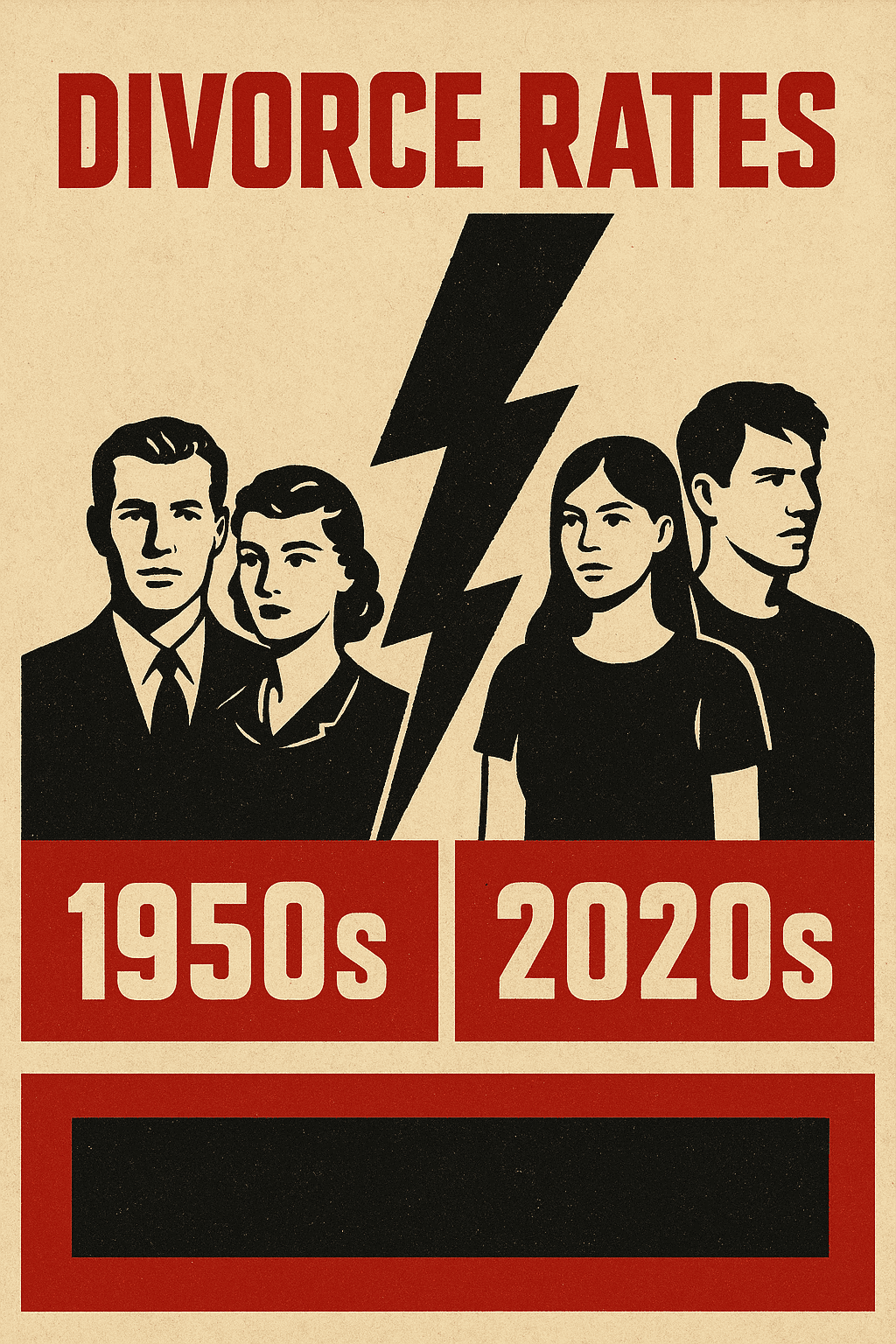
  • Part 5: Divorce Then and Now – 1950s vs 2020s

    To understand how Western relationships have collapsed, you have to compare two eras: the 1950s and the 2020s. One generation saw stable marriages as the norm. The other sees divorce as practically inevitable. What changed?

    The 1950s marriage model

    In the 1950s, marriage was practically universal. People married young, often in their early 20s. Divorce was rare, stigmatized, and legally difficult. Families were built around loyalty and responsibility, not convenience.

    • Men worked and provided.
    • Women raised children and managed households.
    • Communities reinforced marriage as the foundation of life.

    It wasn’t perfect. There were unhappy marriages and limited options for women who wanted independence. But the stability was undeniable. Children grew up in two-parent homes. Divorce rates were low. Marriage was seen as permanent.

    The rise of no-fault divorce

    Fast forward to the 1970s. Western governments introduced “no-fault divorce.” Suddenly, anyone could walk away from a marriage without proving wrongdoing. The floodgates opened. Divorce rates skyrocketed. By the 1980s, nearly half of all marriages ended in divorce.

    The legal shift sent a cultural message: marriage isn’t permanent, it’s optional. If it gets tough, you don’t work it out—you file the papers.

    The 2020s marriage crisis

    Today, the fallout is clear. Fewer people are marrying at all. Those who do often delay it into their 30s. Cohabitation replaces commitment. Children are increasingly raised in single-parent homes or blended families.

    And the divorce rate? It’s lower now than in the 1980s, but that’s because fewer people are marrying. Cohabiting couples break up at even higher rates, but the state doesn’t count those splits. The stability of the 1950s is gone, replaced by relationship roulette.

    Why it matters

    Marriage isn’t just a personal choice—it’s the foundation of a healthy society. Strong marriages mean stable families. Stable families mean resilient communities. When marriage collapses, society weakens.

    Compare outcomes:

    • Children of intact families have better education, lower crime rates, and stronger futures.
    • Children of broken homes face higher risks of poverty, depression, and instability.
    • Communities with stable marriages have lower welfare dependency and stronger economies.

    The 1950s weren’t perfect, but the structure worked. The 2020s are “free,” but the freedom comes with chaos.

    What we lost

    We lost the cultural expectation that marriage was sacred. We replaced it with an attitude that relationships are temporary. We lost the legal protections that once discouraged frivolous divorce. And we lost the idea that responsibility outweighs personal convenience.

    Now, people enter relationships with one foot out the door. They don’t trust marriage to last. They don’t see family as worth the sacrifice. And the state—through welfare programs and family courts—often makes it easier to leave than to stay.

    What we can learn

    We don’t need to copy the 1950s. Women deserve freedom and independence. Men deserve fairness in family law. But we can learn from the past:

    • Marriage must mean something again.
    • Responsibility has to outweigh convenience.
    • The state should stop incentivizing family breakdown.

    Closing thought

    The 1950s were far from perfect, but they built families that lasted. The 2020s glorify choice and freedom, but they leave us lonely and unstable. The lesson isn’t to turn back the clock—it’s to reclaim what worked: commitment, responsibility, and the idea that family is worth fighting for.

    If we don’t, the next generation won’t just compare the 1950s to the 2020s. They’ll be comparing a society with families to one without them.

    • Divorce: More than a Century of Change, 1900–2022 – Historical data on divorce trends in the U.S. Bowling Green State University
    • The Evolution of Divorce (National Affairs) – 1950s vs 1970s divorce rates comparison. National Affairs
    • How Has Marriage in the US Changed Over Time? (USAFacts) – Gives percentages of divorce in 1950 vs 2024. USAFacts
    • Marriage and Divorce Since World War II – Economic modeling of marriage patterns over time. NBER Users
    • Divorce Decline: About 40% of Today’s Marriages Will End in Divorce – Recent findings on marital stability since the 1950s. Institute for Family Studies

    This is part of a 5 part series on modern relationships between men and women (real men, and real women)

    Part 1: Men in the Modern West

    • How men lost their traditional roles as providers/protectors
    • The collapse of purpose: passivity, dominance, or online bitterness
    • What true masculinity means today (integrity, resilience, direction)
    • Impact of state interference and fear of divorce courts
    • Call to action for men to take responsibility and build strength

    Part 2: Women in the Modern West (scheduled for September 10th 2025)

    • The false promise of “having it all” (career, independence, family later)
    • Biology vs ideology: fertility realities ignored by culture
    • Loneliness epidemic despite career success
    • The myth of independence leading to isolation
    • Re-centering respect, cooperation, and family priorities

    Part 3: The State, Society, and the Breakdown of Trust (scheduled for September 11th 2025)

    • How marriage became a government contract instead of a personal bond
    • No-fault divorce and the legal incentives to break families
    • Cultural poison: men labeled toxic, women told commitment is settling
    • Dating apps and the “marketplace” mentality of relationships
    • Libertarian perspective: kick the state out, rebuild trust through responsibility

    Part 4: Age Gap Dating – West vs East (scheduled for September 12th 2025)

    • Western stigma against older men dating younger women
    • Biological attraction vs ideological resistance
    • Why Southeast Asia and other cultures accept age gaps
    • Economic and cultural practicality in non-Western contexts
    • Libertarian take: consenting adults should be free to choose

    Part 5: Divorce Rates – 1950s vs 2020s (scheduled for September 13th 2025)

    • Stable marriages and social norms of the 1950s
    • The rise of no-fault divorce and its impact on family breakdown
    • 2020s reality: fewer marriages, higher instability, more single-parent homes
    • Consequences for children and communities
    • Lessons to reclaim: responsibility, loyalty, and family as the foundation of society
    Spun Web Technology SMART SEO

    Spun Web Technology SMART SEO

  • Part 4: Age Gap Dating – West vs East

    If you want to see how culture shapes relationships, just compare how the West and East view age gaps in dating. In the United States, a 20-year-old woman dating a 40-year-old man raises eyebrows. Social media erupts with accusations: “predatory,” “creepy,” “exploitative.” But in Southeast Asia—or much of the world outside the Western bubble—this isn’t controversial at all. It’s normal.

    The Western obsession with “equal” dating

    Western culture has absorbed the idea that couples should be as close to identical as possible. Same age bracket, similar income, matched education. If there’s too big a gap in wealth or years, society assumes exploitation.

    This thinking comes from two sources:

    1. Feminist ideology: Women are taught that dating older men somehow undermines their independence. They’re warned it makes them “victims” of power imbalance.
    2. Egalitarian culture: The West obsesses over equality, even in personal relationships. Any difference—age, money, experience—is seen as a threat to fairness.

    The irony? These “equal” relationships often collapse because they ignore how human attraction really works.

    Biology tells a different story

    Biology doesn’t care about social narratives. Men are wired to be attracted to youth and fertility. Women are wired to be attracted to stability, competence, and resources. That doesn’t mean every couple fits this mold, but it’s a pattern as old as humanity.

    So when a younger woman chooses an older man, it’s not brainwashing. It’s natural. She sees maturity, stability, and direction. He sees youth, beauty, and vitality. Both sides benefit.

    Western culture treats this as scandalous, but everywhere else, it’s just life.

    Why the East doesn’t care

    In Southeast Asia, for example, a 25-year-old woman marrying a 40-year-old man barely raises a comment. Why? Because the culture values family outcomes more than appearances.

    • Older men are often more established, better providers, and more serious about family.
    • Younger women are often more interested in building a household than competing in careers.
    • Both sides see the relationship as complementary, not competitive.

    There’s no shame in a man being older, because age is associated with wisdom, not exploitation.

    In contrast, Western society shames both the man and the woman. The man is called “creepy.” The woman is called “a gold digger.” Instead of respecting their choices, the culture ridicules them.

    The economic factor

    There’s also a blunt economic reality here. In many parts of Asia, life is harder, money goes further, and community ties remain strong. A younger woman choosing an older, financially stable man isn’t “selling out”—it’s practical.

    In the West, where welfare safety nets exist and careers are glorified, women are told they don’t need to factor stability into their choices. They’re encouraged to chase excitement in their 20s and only look for stability later—usually when their options have narrowed.

    That’s why Western women often resent younger women who “marry up.” They see it as unfair competition. But biology and economics don’t care about resentment.

    The freedom argument

    From a libertarian point of view, the issue is simple: consenting adults should be free to form whatever relationships they want, regardless of age gaps. If a 23-year-old woman and a 45-year-old man choose each other, that’s their business—not the state’s, not society’s.

    But Western culture doesn’t trust individuals. It insists on moral policing, shaming age-gap couples as if adults can’t make their own choices. Meanwhile, the East quietly proves that when you leave people alone, these relationships can thrive.

    What this reveals about the West

    The outrage over age-gap dating says less about the couples and more about Western insecurity. A society that mocks older men for dating younger women is really exposing its own collapse:

    • Men in their 30s and 40s are often so unprepared for family that women their own age avoid them.
    • Women in their 30s and 40s are frustrated that younger women have more options, so they lash out instead of addressing the choices they made.
    • The culture worships equality so much that it forgets attraction isn’t about spreadsheets.

    Closing thought

    Age-gap dating isn’t creepy, predatory, or exploitative. It’s human nature meeting cultural choice. The West stigmatizes it because it fears inequality more than it values happiness. The East accepts it because it cares more about outcomes than ideology.

    At the end of the day, adults should be free to choose their partners without a mob deciding what’s “acceptable.” And maybe the real “creepiness” is a culture that shames love just because it doesn’t fit an arbitrary formula.

    A previous article about this age gap in dating comparing the west to the east

    /blog/age-gaps-cultural-norms-and-the-infantilization-of-modern-societ

    • An Exploration of Age-Gap Relationships in Western Society – Academic study of older men pairing with younger women. Purdue e-Pubs
    • Values Moderate Age Differences in Relationship Orientation – How cultural values shape acceptance of age gaps. ScienceDirect
    • A Cross-Cultural Test of the Mate Preference Priority Model – Eastern vs. Western dating priorities and attractions. InK
    • Cross-Cultural Perspectives on Dating and Marriage – Cultural timing and norms around relationships across societies. ResearchGate
    • Age Differences Between Spouses: Sociodemographic Variation – Swedish data on age-gap marriages by demographics. ResearchGate

    This is part of a 5 part series on modern relationships between men and women (real men, and real women)

    Part 1: Men in the Modern West

    • How men lost their traditional roles as providers/protectors
    • The collapse of purpose: passivity, dominance, or online bitterness
    • What true masculinity means today (integrity, resilience, direction)
    • Impact of state interference and fear of divorce courts
    • Call to action for men to take responsibility and build strength

    Part 2: Women in the Modern West (scheduled for September 10th 2025)

    • The false promise of “having it all” (career, independence, family later)
    • Biology vs ideology: fertility realities ignored by culture
    • Loneliness epidemic despite career success
    • The myth of independence leading to isolation
    • Re-centering respect, cooperation, and family priorities

    Part 3: The State, Society, and the Breakdown of Trust (scheduled for September 11th 2025)

    • How marriage became a government contract instead of a personal bond
    • No-fault divorce and the legal incentives to break families
    • Cultural poison: men labeled toxic, women told commitment is settling
    • Dating apps and the “marketplace” mentality of relationships
    • Libertarian perspective: kick the state out, rebuild trust through responsibility

    Part 4: Age Gap Dating – West vs East (scheduled for September 12th 2025)

    • Western stigma against older men dating younger women
    • Biological attraction vs ideological resistance
    • Why Southeast Asia and other cultures accept age gaps
    • Economic and cultural practicality in non-Western contexts
    • Libertarian take: consenting adults should be free to choose

    Part 5: Divorce Rates – 1950s vs 2020s (scheduled for September 13th 2025)

    • Stable marriages and social norms of the 1950s
    • The rise of no-fault divorce and its impact on family breakdown
    • 2020s reality: fewer marriages, higher instability, more single-parent homes
    • Consequences for children and communities
    • Lessons to reclaim: responsibility, loyalty, and family as the foundation of society
    Spun Web Technology SMART SEO

    Spun Web Technology SMART SEO

  • Part 3: The State, Society, and the Breakdown of Trust

    So far we’ve looked at men and women in the modern West. Both are struggling—men unsure of their role, women caught between biology and ideology. But there’s a bigger player in this story, one that too often gets ignored: the state.

    When governments insert themselves into relationships, things stop being private and start being political. Love turns into paperwork. Trust turns into contracts. And when those contracts are rigged, men and women start treating each other less like partners and more like potential liabilities.

    Marriage as a government contract

    Let’s be blunt: marriage in the West isn’t just a personal vow. It’s a legal agreement overseen by the state. You don’t need a judge to love someone, but you need one to divorce them. And the state takes its cut every step of the way.

    • Alimony, custody, property division—these aren’t private negotiations, they’re dictated by courts.
    • Lawyers become middlemen in what should be intimate commitments.
    • And when things go bad, it’s not just heartbreak, it’s a courtroom battle where the state decides who “wins.”

    What should be the most personal bond in human life—marriage—has been hijacked by bureaucrats. It’s like hiring the DMV to referee your wedding vows.

    Divorce as a weapon

    Here’s the ugly truth: divorce law in the West often incentivizes breaking families apart. If you think that’s an exaggeration, look at the numbers. Since no-fault divorce became the norm in the 1970s, rates skyrocketed. Why? Because one person could walk away, take half the assets, and often gain custody of the kids.

    Now, imagine being a man watching his peers lose their homes, their savings, and sometimes their kids. Do you think he’s going to run to the altar? No way. He’ll see marriage less as love and more as Russian roulette.

    This isn’t just paranoia. Men know the system is stacked. Even women quietly admit it, though many benefit from the imbalance. And when both sides treat relationships like potential lawsuits, trust evaporates.

    Society as referee

    But it’s not just the state. Society itself has poisoned the well. Cultural narratives paint men as abusers-in-waiting and women as oppressed victims, even though reality is far more complex.

    • Men are told they’re “toxic” just for being masculine.
    • Women are told commitment is “settling.”
    • Hookup culture is glorified while loyalty is mocked as old-fashioned.

    This constant drumbeat erodes the foundation of trust between the sexes. Men and women stop seeing each other as natural allies and start seeing each other as rivals—or worse, enemies.

    Love as a marketplace

    Throw in technology and you get another layer of dysfunction. Dating apps treat people like commodities. Swipe left, swipe right—it’s shopping for humans. Attraction becomes transactional. Relationships become disposable.

    Combine that with the state’s legal incentives, and you get a perfect storm: people who enter relationships cautiously, half-committed, always with one eye on the exit. It’s like building a house with the front door already open. No wonder families collapse under the first sign of stress.

    Trust: the missing ingredient

    At the heart of this mess is trust—or the lack of it.

    • Men don’t trust women not to exploit the legal system.
    • Women don’t trust men to stay committed when things get hard.
    • Both don’t trust society to respect their choices.

    So what do they do? They retreat into control mechanisms: prenups, ultimatums, games. They hold back emotionally. They test instead of committing. And all the while, the state sits in the background, ready to swoop in if things go wrong.

    It’s like duct-taping a broken bridge and wondering why no one wants to cross it.

    Libertarian view: keep the state out

    From a liberty perspective, the solution is obvious: get the state out of relationships. Marriage should be a private contract between adults, not a government program.

    • If you want a religious wedding, fine—take it to your church.
    • If you want a civil contract, fine—write one and sign it with your partner.
    • But why does the state need to hold your hand?

    Government has no business deciding who gets what in a breakup or who “owns” the kids. Those decisions should be handled privately or through voluntary arbitration, not by a bureaucrat with a gavel.

    When the state inserts itself into human bonds, it distorts incentives. People start gaming the system instead of trusting each other. That’s not love, that’s politics.

    The cultural shift we need

    Of course, kicking the state out won’t magically solve cultural rot. People also need to rethink their values. Loyalty, responsibility, family—these used to be central to Western life. Now they’re treated as burdens.

    You know what? Convenience has replaced commitment. Why fight for a relationship when you can just swipe for a new one? Why work through problems when you can file for divorce and let the courts split the assets?

    That mindset is poison. And the only antidote is a cultural shift back to responsibility. Men and women need to stop treating each other like enemies and start acting like allies again.

    What this means for men and women

    • For men: Don’t let fear of the state paralyze you. Yes, the system is unfair. But hiding in bitterness only makes you weaker. Build trust carefully, choose wisely, and be a man of integrity.
    • For women: Stop viewing men as disposable or replaceable. Respect and loyalty go further than short-term thrills. Don’t buy the lie that commitment is oppression—it’s strength.
    • For both: Push back on the culture that glorifies hookups and mocks family. Real rebellion in the West today isn’t sleeping around—it’s building a strong family that can’t be broken by courts or cultural fads.

    Closing thought

    The state and society have poisoned the relationship well, but the antidote is still in our hands. Trust, loyalty, and responsibility aren’t old-fashioned—they’re revolutionary in a world that treats everything as temporary.

    If men and women start rejecting the state’s interference and society’s poison, they can rebuild what’s been lost. And when they do, they’ll find out that true partnership isn’t a contract enforced by government—it’s a voluntary bond that no courtroom can destroy.

    • Social Norms and the Legal Regulation of Marriage – Explains covenant marriage vs. no-fault systems. scholarship.law.columbia.edu
    • The History of American Divorce Law and Its Ghosts – Legal overview of no-fault divorce consequences. aaml.org
    • Why No-Fault Divorce Is Bad for Families and Society – Critique of societal impacts from a cultural viewpoint. Public Square Magazine
    • Economic Origins of the No-Fault Divorce Revolution – Academic look into the economic logic behind marital law reforms. peterleeson.com
    • Repealing No-Fault Divorce… (AP News) – Contemporary debate around undoing no-fault divorce in the U.S. AP News

    This is part of a 5 part series on modern relationships between men and women (real men, and real women)

    Part 1: Men in the Modern West

    • How men lost their traditional roles as providers/protectors
    • The collapse of purpose: passivity, dominance, or online bitterness
    • What true masculinity means today (integrity, resilience, direction)
    • Impact of state interference and fear of divorce courts
    • Call to action for men to take responsibility and build strength

    Part 2: Women in the Modern West (scheduled for September 10th 2025)

    • The false promise of “having it all” (career, independence, family later)
    • Biology vs ideology: fertility realities ignored by culture
    • Loneliness epidemic despite career success
    • The myth of independence leading to isolation
    • Re-centering respect, cooperation, and family priorities

    Part 3: The State, Society, and the Breakdown of Trust (scheduled for September 11th 2025)

    • How marriage became a government contract instead of a personal bond
    • No-fault divorce and the legal incentives to break families
    • Cultural poison: men labeled toxic, women told commitment is settling
    • Dating apps and the “marketplace” mentality of relationships
    • Libertarian perspective: kick the state out, rebuild trust through responsibility

    Part 4: Age Gap Dating – West vs East (scheduled for September 12th 2025)

    • Western stigma against older men dating younger women
    • Biological attraction vs ideological resistance
    • Why Southeast Asia and other cultures accept age gaps
    • Economic and cultural practicality in non-Western contexts
    • Libertarian take: consenting adults should be free to choose

    Part 5: Divorce Rates – 1950s vs 2020s (scheduled for September 13th 2025)

    • Stable marriages and social norms of the 1950s
    • The rise of no-fault divorce and its impact on family breakdown
    • 2020s reality: fewer marriages, higher instability, more single-parent homes
    • Consequences for children and communities
    • Lessons to reclaim: responsibility, loyalty, and family as the foundation of society
    Spun Web Technology SMART SEO

    Spun Web Technology SMART SEO

  • Part 2: Women in the Modern West

    If men are lost in the modern West, women are caught in a tug-of-war. They’re told they can “have it all”: career, independence, sexual freedom, and family—whenever they feel like it. But biology doesn’t care about slogans. And the pressure to juggle all of it is leaving a lot of women exhausted, lonely, and resentful.

    The promise of “having it all”

    Since the 1960s, Western culture has sold women a promise. Go to school, climb the career ladder, delay marriage, explore your options, then settle down when you’re ready. Supposedly, this would create empowered women who could design life on their own terms.

    And in some ways, it worked. Women now dominate universities, outpace men in certain industries, and often out-earn their male peers in urban centers. They have freedoms their grandmothers could only dream of.

    But here’s the twist: the promise came with a cost. Fertility doesn’t wait for career goals. Love and family don’t fall neatly into a calendar plan. The result is millions of women in their 30s and 40s who have success on paper but emptiness at home.

    Biology versus ideology

    Let’s be blunt: biology hasn’t changed. A woman’s fertility window peaks in her 20s, declines in her 30s, and becomes a real challenge in her 40s. That’s not sexist. That’s reality. Yet society pushes women to act as if biology is just a social construct.

    What happens? Many women delay family, thinking it will always be an option. Then the panic sets in. Dating apps are full of men, but serious commitment is rare. The men they want are either married, uninterested, or chasing younger women. It’s not cruelty—it’s nature at work.

    This doesn’t mean women must become housewives at 21. But ignoring biology while chasing an ideology of “limitless independence” has left many women blindsided.

    The loneliness epidemic

    Western women often have more money and more degrees than their mothers ever dreamed of. Yet depression and anxiety rates among women are higher than ever.

    Why? Because success at work doesn’t guarantee success in relationships. A six-figure salary can’t replace a partner who loves you. Titles and promotions don’t hug you when you’re sick or build a family with you.

    Some women settle for situationships—half-relationships with no real commitment. Others dive into hookup culture, only to find it leaves them empty. And a growing number simply give up, declaring “men aren’t worth it,” while secretly wishing they had someone worth it.

    The myth of independence

    You know what? Independence is a half-truth. Yes, women can survive alone. They can buy homes, travel the world, and build careers without a man. But thriving isn’t the same as surviving. Humans are wired for connection, not isolation.

    The feminist slogan of “a woman needs a man like a fish needs a bicycle” sounds empowering until you realize fish don’t raise families, don’t crave companionship, and don’t suffer loneliness in empty apartments. Humans do.

    The truth is, independence without partnership often becomes isolation. And isolation is brutal, no matter how “empowered” the narrative sounds on Instagram.

    What women actually want

    Despite the noise, studies show most women still want traditional things: love, marriage, family, stability. They may not want to admit it in every setting, but surveys consistently reveal the desire for long-term commitment is strong.

    The problem is the modern culture teaches women to delay or devalue those desires. Career first, family later. Independence now, commitment whenever. But later often comes too late.

    And here’s the catch: women who lead with their independence often intimidate or repel men who would have been great partners. Not because men hate strong women, but because strength without warmth feels like competition, not cooperation.

    The respect equation

    Relationships work best when there’s respect both ways. Women want men they can respect—men with purpose, strength, and direction. But men want women they can admire too. Not just for beauty, but for femininity, loyalty, and the ability to build a life together.

    Too often, Western women are taught to compete with men rather than complement them. And when you compete, you don’t respect—you resent.

    The path forward for women

    So what’s the answer for women in the modern West?

    1. Be honest about priorities. If family is important, don’t wait until biology makes it nearly impossible. Own that desire and plan accordingly.
    2. Reject the false promises. Career success is good, but it’s not a substitute for love or children if those are things you want.
    3. Value cooperation over competition. Men aren’t enemies. They’re potential partners. Respect goes both ways.
    4. Choose character, not just status. A man’s income or social standing matters less than his integrity and direction.

    Closing thought

    Western women have been told they’re freer than ever. And in many ways, that’s true. But freedom without truth is a trap. Ignoring biology, relationships, and the real cost of delay has created a generation of women who have everything except the things they wanted most.

    The future for women isn’t about pretending to be men. It’s about embracing their unique role as women—nurturers, builders of families, partners who bring warmth and stability. That doesn’t mean giving up independence. It means using independence wisely, not as a shield against the very things that make life fulfilling.

    Because at the end of the day, the women who find balance—who pursue purpose and family together—will be the ones who prove that tradition wasn’t oppression, it was wisdom.

    • Loneliness is a Feminist Issue – Explores loneliness among women as a political and social problem. SAGE Journals
    • From Low to Rising: How Loneliness Trends Shape Women’s Health Over Time – An 18-year study linking female loneliness to health outcomes. Research Communities by Springer Nature
    • The Harvard Study on Loneliness and Social Isolation – Insights into how Western social isolation affects everyone. BioMed Central
    • Modern Motherhood and Loneliness (The Guardian) – How isolation impacts new mothers in individualistic societies. The Guardian
    • Does Anyone Care That Young Women Are Just as Lonely as Men Are? (Cosmopolitan) – Highlights female loneliness often ignored by media. Cosmopolitan

    This is part of a 5 part series on modern relationships between men and women (real men, and real women)

    Part 1: Men in the Modern West

    • How men lost their traditional roles as providers/protectors
    • The collapse of purpose: passivity, dominance, or online bitterness
    • What true masculinity means today (integrity, resilience, direction)
    • Impact of state interference and fear of divorce courts
    • Call to action for men to take responsibility and build strength

    Part 2: Women in the Modern West (scheduled for September 10th 2025)

    • The false promise of “having it all” (career, independence, family later)
    • Biology vs ideology: fertility realities ignored by culture
    • Loneliness epidemic despite career success
    • The myth of independence leading to isolation
    • Re-centering respect, cooperation, and family priorities

    Part 3: The State, Society, and the Breakdown of Trust (scheduled for September 11th 2025)

    • How marriage became a government contract instead of a personal bond
    • No-fault divorce and the legal incentives to break families
    • Cultural poison: men labeled toxic, women told commitment is settling
    • Dating apps and the “marketplace” mentality of relationships
    • Libertarian perspective: kick the state out, rebuild trust through responsibility

    Part 4: Age Gap Dating – West vs East (scheduled for September 12th 2025)

    • Western stigma against older men dating younger women
    • Biological attraction vs ideological resistance
    • Why Southeast Asia and other cultures accept age gaps
    • Economic and cultural practicality in non-Western contexts
    • Libertarian take: consenting adults should be free to choose

    Part 5: Divorce Rates – 1950s vs 2020s (scheduled for September 13th 2025)

    • Stable marriages and social norms of the 1950s
    • The rise of no-fault divorce and its impact on family breakdown
    • 2020s reality: fewer marriages, higher instability, more single-parent homes
    • Consequences for children and communities
    • Lessons to reclaim: responsibility, loyalty, and family as the foundation of society
    Spun Web Technology SMART SEO

    Spun Web Technology SMART SEO

  • Part 1: Men in the Modern West

    Something has gone wrong for men in the West. You don’t need a sociology degree to see it. Just walk into a bar, scroll through Tinder, or listen to the way men talk about relationships today. What you’ll find is a mix of bitterness, confusion, and apathy.

    Men are asking themselves: what am I here for?

    The old script is gone

    For centuries, the role of men was clear. You worked, you provided, you protected. Women needed you because survival wasn’t optional—it was life or death. You chopped the wood, defended the home, brought home the paycheck. That meant respect.

    But in the modern world, women don’t need men for survival in the same way. They can earn money, buy homes, even raise children alone if they choose. They’ve got birth control, bank accounts, legal independence, and rights that previous generations fought for. And let’s be real: those are good things. No libertarian worth his salt would argue against equality under the law.

    But when women gained independence, men lost the script that once gave them automatic purpose. Now, a lot of guys are floating in no-man’s land, trying to figure out what role they’re supposed to play.

    The collapse of purpose

    Here’s what’s happening.

    • Some men drift into passivity. They live like perpetual teenagers. They get by with low ambition, a gaming console, and just enough money to scrape through. These guys are roommates, not partners.
    • Others double down on outdated dominance. They think “being a man” means barking orders, controlling women, and expecting obedience. That’s not masculinity, that’s insecurity.
    • Then there’s the online crowd: men who spend their days ranting on forums about how women are the problem. They treat the opposite sex like an enemy camp. Instead of improving themselves, they wallow in resentment.

    None of these approaches work. They all share one thing: they dodge responsibility.

    The truth about masculinity

    Here’s the hard truth men don’t want to hear: women still want men. They don’t want pushovers, and they don’t want tyrants either. What they respect is a man with purpose.

    Being a man today isn’t about earning the biggest paycheck or bench pressing 300 pounds, though those things don’t hurt. It’s about character.

    • Integrity: do your words mean something?
    • Resilience: can you take a hit and keep moving?
    • Direction: do you actually know where you’re going in life?

    That’s provision in the modern sense. Not just money, but steadiness. Leadership without arrogance. Strength without cruelty.

    Women aren’t looking for perfection, but they are looking for competence. And competence is built, not given.

    The shadow of the state

    You can’t talk about modern masculinity without mentioning the state. Government has turned relationships into contracts, complete with courts, lawyers, and custody battles. Men see horror stories of divorce settlements and child support systems that feel rigged. It’s no wonder some men hesitate to commit.

    But here’s the problem: fear of the state has turned into fear of women. Too many men think every relationship is just one step away from financial ruin. That mindset poisons trust.

    Yes, family law is broken. Yes, the state has no business being the referee in personal commitments. But hiding from relationships because the system is unfair only guarantees you’ll lose before the game starts.

    Why men matter

    Let’s make this clear: men still matter. The idea that men are “obsolete” is nonsense. Societies collapse without strong, capable men. And families thrive when men step into their role—not as dictators, but as anchors.

    Look around:

    • Who builds the infrastructure we all rely on?
    • Who takes the most dangerous jobs?
    • Who risks their lives in defense, even when governments misuse that sacrifice?

    Men are not optional. They never have been. The question is whether men today will live up to that truth or waste it.

    The call to action

    So what should men in the modern West do?

    1. Stop whining. Life isn’t fair. The system isn’t fair. But complaining on forums won’t fix it. Build yourself.
    2. Get strong. Physically, mentally, financially. Weakness is a choice. Strength is built brick by brick.
    3. Find purpose. Whether it’s a trade, a business, a craft, or a family, have a direction. Drift is death.
    4. Lead by example. Leadership isn’t about bossing people around. It’s about showing through your actions that you’re reliable.

    The men who do this will be respected by women, trusted by their peers, and valued in their communities. The men who don’t will keep sitting in the corner, angry at a world that moved on without them.

    Closing thought

    Being a man in the West today isn’t easy. The old script is gone, the state interferes, and the culture mocks masculinity. But you know what? That makes it more important than ever to get it right.

    A man who can rise above bitterness and confusion, who can live with integrity and strength, will stand out in a society that desperately needs him.

    And that’s the point: men aren’t obsolete. They’re just unpracticed in what true masculinity looks like today. It’s time to bring it back—not by clinging to the past, but by stepping into the responsibility that never really disappeared.

    Sources

    • State of American Men 2025 – A data-rich study showing men’s economic anxiety and identity struggles. Equimundo
    • Understanding Men and Masculinity in Modern Society – A sociological overview of masculinity today. ResearchGate
    • Musings on Modern Masculinity (Medium) – A cultural critique of masculinity’s collapse in Western youth. Medium
    • Men, Women and Social Connections – Pew data on loneliness and how men form—or avoid—emotional bonds. Pew Research Center
    • Positive Humanity, When? Is Masculinity Worth Saving? – Conference paper exploring caring and inclusive masculinities. Taylor & Francis Online

    This is part of a 5 part series on modern relationships between men and women (real men, and real women)

    Part 1: Men in the Modern West

    • How men lost their traditional roles as providers/protectors
    • The collapse of purpose: passivity, dominance, or online bitterness
    • What true masculinity means today (integrity, resilience, direction)
    • Impact of state interference and fear of divorce courts
    • Call to action for men to take responsibility and build strength

    Part 2: Women in the Modern West (scheduled for September 10th 2025)

    • The false promise of “having it all” (career, independence, family later)
    • Biology vs ideology: fertility realities ignored by culture
    • Loneliness epidemic despite career success
    • The myth of independence leading to isolation
    • Re-centering respect, cooperation, and family priorities

    Part 3: The State, Society, and the Breakdown of Trust (scheduled for September 11th 2025)

    • How marriage became a government contract instead of a personal bond
    • No-fault divorce and the legal incentives to break families
    • Cultural poison: men labeled toxic, women told commitment is settling
    • Dating apps and the “marketplace” mentality of relationships
    • Libertarian perspective: kick the state out, rebuild trust through responsibility

    Part 4: Age Gap Dating – West vs East (scheduled for September 12th 2025)

    • Western stigma against older men dating younger women
    • Biological attraction vs ideological resistance
    • Why Southeast Asia and other cultures accept age gaps
    • Economic and cultural practicality in non-Western contexts
    • Libertarian take: consenting adults should be free to choose

    Part 5: Divorce Rates – 1950s vs 2020s (scheduled for September 13th 2025)

    • Stable marriages and social norms of the 1950s
    • The rise of no-fault divorce and its impact on family breakdown
    • 2020s reality: fewer marriages, higher instability, more single-parent homes
    • Consequences for children and communities
    • Lessons to reclaim: responsibility, loyalty, and family as the foundation of society

    Spun Web Technology SMART SEO

    Spun Web Technology SMART SEO

  • Thailand’s Cannabis Crackdown: Why I’m Rethinking My Retirement Plan


    When I landed in Thailand in late July 2025, I felt a deep sense of relief. For a long time, Thailand had been one of the few countries in Asia brave enough to break ranks with the global war on drugs, and instead chart its own path by legalizing cannabis.

    As a liberty-minded American, I saw this as a bold move in the right direction—an embrace of individual freedom and market innovation. I’ve spent years advocating for limited government, personal responsibility, and voluntary exchange. So being in Thailand, where cannabis was once sold openly and legally in brightly lit dispensaries, felt like coming home.

    Unfortunately, that freedom didn’t last.


    My Visit to Thailand: July–August 2025

    I traveled across Thailand for several weeks—from the bustling streets of Bangkok to the serene mountains of Chiang Mai, and then down to the islands near Krabi. Everywhere I went, cannabis had left a positive imprint: cleaner storefronts, honest entrepreneurs, and a growing industry that reminded me of the early days of legalization in California.

    I visited dispensaries that looked like high-end apothecaries—run by locals, with knowledgeable staff and customers ranging from curious tourists to elderly Thais seeking pain relief. I even considered putting down roots here and retiring in this vibrant and culturally rich country.

    From the golden Buddhist temples to the elephant sanctuaries, Thailand’s beauty was undeniable. But what struck me the most was how cannabis seemed to fit seamlessly into Thai society. Not as some destructive vice, but as a plant—medicinal, recreational, and economic.

    Then I got the news.


    A Tragic Reversal: The End of Recreational Cannabis

    On June 25, just a few weeks before I arrived, Thailand’s Ministry of Public Health passed a law that abruptly reversed recreational cannabis use. Dispensaries were ordered to sell cannabis only for medical purposes—and even that came with a mountain of red tape.

    Suddenly, a customer had to get a prescription from a doctor. Their identity, nationality, medical diagnosis, and dosage had to be documented in a central database. Dispensaries were required to register on a government platform, adhere to strict cultivation standards (GACP), and face potential jail time and fines if they broke the rules.

    This wasn’t a gentle policy shift. It was a policy gut punch.

    Legal sales plummeted by up to 90%, according to business owners. Many small shop owners simply couldn’t comply with the new rules. They’d invested their life savings into their stores, only to be pushed to the brink of financial ruin. Some began operating in a legal grey zone just to survive. Others shut down entirely.


    What Caused the Crackdown?

    The short answer: politics.

    Thailand’s cannabis legalization was never fully protected under constitutional or stable regulatory frameworks. Instead, it became a political football. The ruling Pheu Thai Party, which had previously shown signs of support, suddenly pushed cannabis toward re-criminalization. Meanwhile, the Bhumjaithai Party, which had originally spearheaded legalization, was squeezed out of influence after coalition breakdowns and a leaked phone call scandal involving Cambodia’s ex-PM Hun Sen.

    So what’s the result? A deeply schizophrenic national policy—where cannabis is technically still legal, but treated like a controlled substance in practice.

    Public Health Minister Somsak Thepsuthin defended the policy, saying:

    “Thailand should not be seen as a destination for recreational cannabis use.”

    That’s an odd statement coming from a country that previously welcomed tourists to cannabis-friendly neighborhoods like Khaosan Road or Chiang Mai’s Old Town.


    The Real Impact: Back to the Black Market

    Just like in any top-down crackdown, the unintended consequences hit hard.

    Since the June reversal, the black market for cannabis has exploded. Prices underground are 60–80% cheaper than in the tightly regulated dispensaries. Some sellers now offer bulk cannabis through social media or discreet online shops. Growers, like one known only as “Anawat,” gave up trying to go legit and now operate entirely under the table.

    Even legitimate dispensaries feel forced to “bend” the rules just to keep their doors open—filling out fake prescriptions, skipping the database entry, or quietly serving tourists who refuse to get registered.

    This is what always happens when the government overreaches: people opt out. They adapt. They find voluntary alternatives.

    And yet the government calls this “progress.”


    Why I’m Rethinking My Retirement Plan

    I’ve always admired Thailand for its entrepreneurial energy and stunning landscapes. The people are warm. The food is world-class. And for a while, it seemed like the government was finally respecting the rights of individuals to make choices about their own bodies and businesses.

    But now I’m not so sure.

    This cannabis policy reversal, combined with recent tensions at the Cambodian border and political infighting, shows me that Thailand’s laws are not grounded in principle—but in power.

    I can’t plan a future in a country that changes its laws based on the whims of shifting coalitions or media optics. I’m not looking to live in a place where legal business owners face jail time for selling a plant that was fully legal just weeks before.

    So yes, I’m rethinking my plans. Retirement in Thailand? Maybe not. At least not until the country finds some legal consistency—and stops punishing people for daring to be free.


    What Freedom Should Look Like

    Let’s be clear: this isn’t just about cannabis.

    It’s about freedom.
    It’s about the right to control your own body, to start a business, to buy and sell in peace without government intrusion.

    Countries like Thailand had a chance to lead on this front. To show the world that you don’t need to be the West to support liberty. For a brief moment, they were leading. But that moment has passed—for now.

    Liberty doesn’t have to be chaotic. Legal cannabis didn’t destroy Thai society—it created jobs, helped patients, and boosted tourism. What’s destroying it now is political gamesmanship, fear-mongering, and central control.

    As a libertarian, I’ll always advocate for personal responsibility and voluntary association. Let adults decide what’s best for them. Let the market decide what survives.

    That’s not just good policy—it’s moral policy.


    Final Thoughts

    I still love Thailand. I still recommend visiting. Experience the temples, the street food, the elephants, the kindness of the people. But if you’re a cannabis user or a freedom-minded retiree like me, be warned: the climate of freedom here has gotten colder.

    Until Thailand finds its footing again, I’ll be exploring new plans—and new destinations—where freedom isn’t just a fad.

    Because real liberty isn’t seasonal. It’s foundational.

    Spun Web Technology SMART SEO

    Spun Web Technology SMART SEO