What happens when the Department of Justice turns its power inward?
In this explosive congressional hearing, lawmakers question the scope of an investigation that issued nearly 200 subpoenas targeting over 400 Republican individuals and organizations, many with no connection to January 6.
We’re talking about subpoenaing members of Congress, donor lists, internal communications, and even alleged wiretapping tied to political figures.
Is this law enforcement… or political surveillance?
This hearing digs into serious constitutional concerns, including:
First Amendment violations
Speech and Debate Clause issues
DOJ and FBI independence
Non-disclosure orders against elected officials
Comparisons to Watergate
One witness even suggests the scope may exceed Watergate in scale.
Here’s the thing most people miss: this isn’t just about one investigation. It’s about how power gets used when nobody is looking.
DOJ Subpoena Scandal: Congressional Hearing Exposes Surveillance Abuse Claims is the kind of subject that fits the Disruptarian lane because it sits where independent media, culture, music, and political commentary collide.
The source description frames it this way: A Rumble-focused breakdown of the congressional hearing over claims that the DOJ subpoenaed hundreds of Republicans and exposed serious questions about surveillance abuse, political targeting, civil liberties, and government accountability. This version focuses on what the hearing raises: whether investigative powers were used fairly, transparently, and within constitutional boundaries.
The useful question is not only what happened, but why the story matters to people who distrust scripted narratives, recycled outrage, and corporate-approved commentary.
A Disruptarian reading starts with individual agency. The listener is not asked to accept a packaged conclusion. The point is to pull the claim apart, compare incentives, and look for the pressure points that legacy media often skips.
That approach matters for libertarian radio commentary because the audience is usually looking for more than a headline. They want context, motive, contradiction, and a practical sense of how public stories become private consequences.
The cultural layer is just as important. Disruptarian music and reggae punk energy are not decorations around the message. They give the work its rhythm: skeptical, confrontational, and rooted in the idea that speech should stay alive even when institutions prefer silence.
For search readers arriving cold, the primary source is included below either as an embed or as a direct source link. Start there if you want the full tone, timing, and argument. The written analysis expands the title and description into a searchable article that can stand on its own.
The strongest SEO value here is clarity. The article keeps the title language visible, uses descriptive headings, and connects the topic to Disruptarian Radio, independent media, libertarian commentary, political culture, and original music without stuffing the page with empty repetition.
The larger takeaway is simple: independent commentary survives by documenting what was said, preserving the source, and adding a point of view that does not depend on permission from gatekeepers.
That is why this post exists as part of the static Disruptarian archive. The video remains embedded, the title and description remain traceable, and the surrounding article gives search engines and readers enough context to understand why the episode belongs in the broader Disruptarian catalog.
The title itself carries the first keyword signal, but a durable post needs more than a copied headline. It needs a clear H1, a concise meta description, a featured image with descriptive alt text, and enough editorial framing for readers to know why the video is part of this archive.
From an independent media perspective, the value is in keeping the primary source visible. Embedding the video prevents the article from becoming detached commentary. Readers can compare the written interpretation against the actual recording and decide whether the argument holds up.
The libertarian angle is not automatic partisanship. It is a suspicion of concentrated power, public manipulation, and narratives that ask citizens to outsource judgment. That suspicion applies to government, platforms, corporations, activist institutions, and media brands alike.
Disruptarian Radio also treats culture as evidence. Music, political language, online mobs, censorship fights, moral panics, and personal stories all reveal where pressure is being applied. That is why a radio episode can be more than entertainment; it can become a record of a moment.
For listeners who follow DJ Disruptarian, the same pattern shows up in the music catalog: reggae rhythm, punk edge, spiritual critique, and anti-authoritarian instinct. The written post keeps that identity attached to the video instead of letting it disappear into a platform feed.
Good SEO on a page like this should help people find the conversation without flattening the voice. The article uses natural phrases such as Disruptarian Radio, independent media, libertarian podcast, political commentary, original music, and disruptive conversations only where they make sense.
The featured image should follow the Disruptarian editorial-collage style: torn paper, smoke, halftone grit, dirty cream paper, black and oxblood pressure, muted gold accents, and symbolic props tied to the subject rather than generic filler. Its alt text names the subject so search engines and screen readers get useful context.
The article also keeps a stable URL under the static blog. That matters because feeds move, platforms change embeds, and social links decay. A static post gives the episode a second home that can be indexed, backed up, linked, and reviewed later.
The final point is documentation. When a channel publishes a new video, the title and description are often the only structured metadata available. Turning that metadata into a post creates a stronger archive without pretending to replace the original recording.
This is the practical Disruptarian method: preserve the video, state the source, add commentary, keep the searchable terms honest, and let the reader move between the embedded media and the written analysis without friction.
This additional context keeps the post useful for readers who arrive from search rather than from the original channel. It explains the source, preserves the embed, and connects the subject back to the larger Disruptarian archive.
This additional context keeps the post useful for readers who arrive from search rather than from the original channel. It explains the source, preserves the embed, and connects the subject back to the larger Disruptarian archive.
This additional context keeps the post useful for readers who arrive from search rather than from the original channel. It explains the source, preserves the embed, and connects the subject back to the larger Disruptarian archive.
Disruptarian commentary on SPLC Hearing Fallout: Congress Probes Extremism Funding, Donor Money & Hate Hoaxes with embedded source video, independent media context, and libertarian radio analysis.
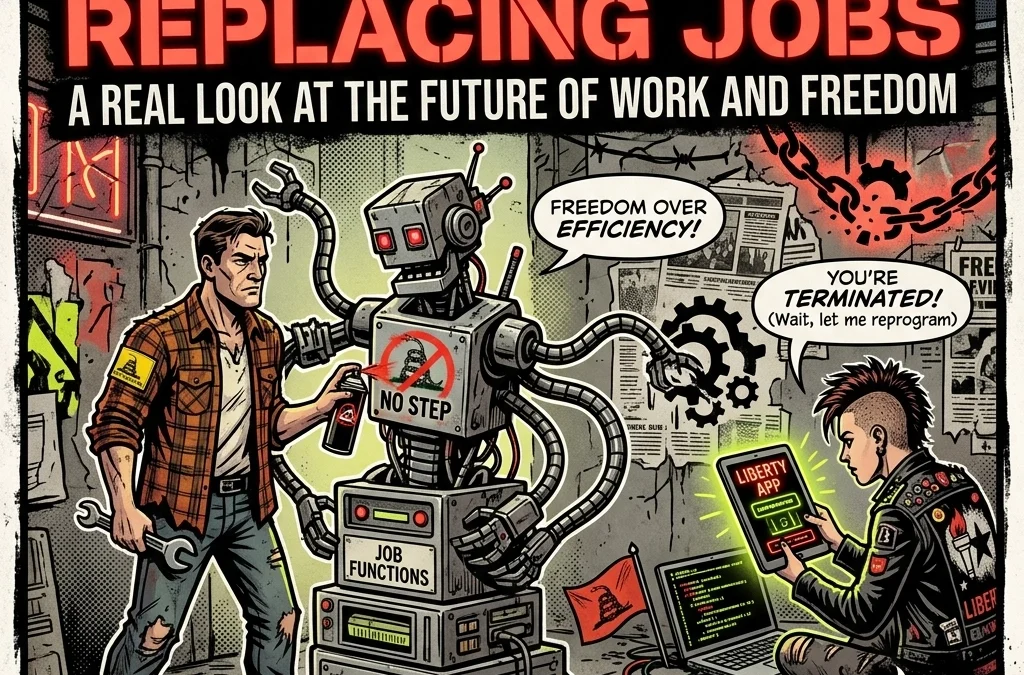
AI replacing jobs is not some future headline. It is happening right now, and I see it every day in business, content, and automation. I use AI constantly, including in real work connected to Veracity Life, and while I see the upside, I also feel a real fear about what this means for the future of work and the future of humanity.
I’m going to be straight with you.
I use AI every single day.
Not just casually. Not just to mess around or see what kind of weird poetry it can spit out. I use it in business. I use it in content. I use it in deep systems architecture. At Veracity Life, we use AI to move faster, automate workflows, and do things that used to take entire teams of high-priced consultants.
AI Replacing Jobs: I Use It Every Day, and It Still Scares Me
That’s the honest truth. No corporate gloss, no venture capital hype. Just the perspective of someone who sees the gears turning from the inside. While I see the power, and I do believe in using tools to improve life and reclaim our time, I also see something deeper happening.
This is bigger than just “productivity gains” or minor job shifts. We are standing at a turning point for humanity. And not the kind you casually scroll past while eating your lunch. This is the big one.
This Isn’t Just Another Tech Trend
People keep comparing AI to the internet. That’s a mistake.
The internet changed how we access information. It was a library that updated in real-time. It was a post office on steroids. It was revolutionary, sure, but it was still just a medium for human-to-human interaction.
AI changes how decisions get made.
That’s a much bigger deal. When you have something that can think, write, code, analyze, and optimize faster than any human, without getting tired, without needing a health insurance plan, and without complaining about the office coffee, you’re not just adding a tool. You’re introducing a new kind of intelligence into the system.
At Veracity Life, we’ve already seen this in action. Tasks that used to take hours of manual labor now take seconds. Processes that required months of specialized training now require nothing more than a well-constructed prompt.
And the scary part? This is the worst AI will ever be.
Every second you spend reading this, the models are getting smarter. They are ingesting more data, refining their logic, and closing the gap between “machine output” and “human genius.”
I’ve Been Around Automation Long Enough To Know Where This Goes
I didn’t just wake up one day and discover ChatGPT. I’ve been in the trenches of automation since 2008.
I’ve worked on pharmacy systems, server clusters, hosting environments, and massive network infrastructures. Back then, “automation” was simple. It was narrow. You wrote a script to do X when Y happened. It was a controlled environment with limited learning.
But even back in ’08, you could see the direction of the wind. Less human input. More machine execution.
Now, fast forward to today. AI is not just executing tasks; it’s improving itself while doing them.
We are moving away from “if-this-then-that” logic and into a realm where the machine understands the “why” and the “how” better than the person who turned it on. Recent data from 2025 shows that while overall U.S. employment grew, AI-exposed sectors saw a 1 percent decline. That sounds small until you realize that nearly 5% of all layoffs last year were directly attributed to AI integration. This isn’t a theory anymore; it’s a line item on a corporate balance sheet.
Illustration 1: A person working at a desk with an AI shadow that looks more advanced and intimidating than the human figure, reflecting the looming presence of machine intelligence.
You Can’t Stop This. And That Should Bother You.
Let’s talk about the elephant in the room. Can we stop AI?
No. Not even close.
People think regulation will slow it down. It won’t. Governments are too slow, and the incentive to “win” the AI race is too high. If the U.S. regulates it, China won’t. If the EU bans it, the underground market will thrive.
People think public resistance will push back adoption. It won’t. We’ve already seen how this plays out throughout history. Alcohol prohibition failed. Cannabis prohibition failed. Anything people want, or need, badly enough finds a way through the cracks.
And AI is not just something people “want.” It’s something people need to compete. If your competitor uses AI to slash costs by 70% and you don’t, you lose. You go out of business. Your employees lose their jobs anyway.
So adoption becomes inevitable. It is a fundamental shift in the competitive landscape of the world. And as a libertarian, that lack of a “stop” button is both fascinating and terrifying.
The Part That Actually Scares Me
It’s not just the job loss. It’s not even the speed of change.
It’s the intelligence.
AI is already doing things that would have sounded like high-budget science fiction just a few years ago. It’s writing better than most professional copywriters. It’s generating art that wins competitions. It’s solving complex protein-folding problems in seconds that would have taken human scientists a lifetime.
There are very smart people comparing this to the invention of nuclear weapons. I get the analogy. But I think it’s actually different. Nuclear weapons destroy physically. They are a tool of ending.
AI has the potential to reshape everything.
Economics. Culture. Power structures. Human identity. It doesn’t just blow up the building; it changes the definition of what a building is and who gets to live in it. That’s a much bigger shift than simple physical destruction.
The Libertarian Conflict Nobody Wants To Face
Let’s talk about something uncomfortable: Universal Basic Income (UBI).
I don’t like it. I’ve never liked it. As someone who believes in free markets, personal responsibility, and voluntary exchange, UBI feels like a massive step toward state dependency. It breaks the fundamental connection between effort and reward.
But here’s the problem we have to be honest enough to face: AI is going to break the labor market.
Not slowly. Fast.
When machines can do most jobs better, cheaper, and faster than humans, what happens to the concept of “income”? What happens to “work”?
The Collapse Of Traditional Work
Our entire civilization is built on the idea that you trade your time for money. That is the social contract. But what happens when time is no longer a valuable commodity?
When a machine can do your forty-hour work week in forty milliseconds, your “time” is no longer the currency of the realm. We are already seeing it. Writers are being replaced. Designers are being replaced. Support teams are being replaced. Developers are either becoming “AI pilots” or finding their roles redundant.
According to researchers, occupations like computer programming and data entry are at a 40-45% replacement risk. This isn’t just “blue collar” automation anymore. This is the “white collar” apocalypse.
Illustration 2: A ‘broken’ clock where the sand in the timer is turning into digital binary code, symbolizing the collapse of the “time for money” economic model.
So What Replaces It?
This is where things get complicated. If people can’t earn the way they used to, something has to fill the gap. That’s where UBI comes in, not as a socialist ideal, but as a desperate survival response to a system that has out-produced its own labor force.
I still don’t like the idea of being a ward of the state. But I understand why the conversation is happening. If AI creates massive abundance, and it will, the question becomes: How do people access it?
There Is A Positive Side (If We Play Our Cards Right)
Let’s not ignore the upside. AI could eliminate scarcity in ways we’ve never seen.
Food production: Optimized by AI-driven vertical farms.
Energy: Managed by grids that never waste a watt.
Logistics: Perfectly scaled and automated.
Basic needs could become so cheap that they are essentially free. That’s a big deal, especially for people who are struggling right now. It could mean the end of absolute poverty.
Freedom Depends On Control
Here’s the part that matters most to the Disruptarian community. Who controls the AI?
If it’s centralized, everything changes for the worse. If a few mega-corporations or a handful of governments control the systems that produce this abundance, then people don’t become free. They become dependents. They become digital serfs.
That’s not progress. That’s control with better branding.
For AI to actually benefit humanity, it must remain decentralized. It has to be open-source. It has to be competitive. That’s the only way it stays aligned with individual freedom.
Illustration 3: A decentralized web/network glowing with vibrant, rebellious light clashing against a single, dark, centralized ‘Eye’ representing the fight for control over intelligence.
This Could Kill Wage Slavery
Let’s be honest. A lot of people are stuck in what can only be described as wage slavery. They work jobs they hate, trading their limited life-force for survival, all to make someone else rich.
If AI removes that pressure, even partially, something interesting happens. People get space. Space to think. Space to create. Space to actually live.
But that shift will upset the current system. Employers, institutions, and governments benefit from the current structure of dependency. If wage labor becomes less important, their leverage over you decreases. They’re not going to let that happen without a fight.
What I Tell People Now
I keep it simple: Learn AI or get left behind.
You don’t have a choice. This isn’t an “opt-in” revolution. If you understand these tools, you gain leverage. You become the pilot of the machine rather than the person replaced by it.
You don’t need permission anymore. You don’t need a degree from an Ivy League school to build a company. You can learn almost anything online at disruptarian.com/blog/feed. You can build without a team. AI lowers the barrier to entry to zero.
My Final Take
I’m not anti-AI. I’m not blindly pro-AI either.
I’m aware. I’m cautious. And I’m actively engaged.
I use it because it gives me leverage. I use it because it helps me build. But I also keep my eyes open because this is not just a tool. This is something bigger, a new species of intelligence entering our social and economic ecosystem.
The biggest divide in the coming decade won’t be between the rich and the poor. It will be between those who adapt and those who wait for things to “go back to normal.”
Normal is dead. The future is here. Grab a wrench and get to work.
, Ryan “Dickie” Thompson
Sources & References
Stanford University: “The Impact of AI on the 2025 Labor Market.”
U.S. Bureau of Labor Statistics: “Automation and Employment Trends 2024-2026.”
“The AI-Exposed Sector Employment Decline,” Research Report 2025.
AI Is Taking Jobs Now: What Workers, Creators and Small Businesses Should Do Next is the kind of subject that fits the Disruptarian lane because it sits where independent media, culture, music, and political commentary collide.
The source description frames it this way: A direct Rumble-focused discussion about AI replacing jobs, reshaping work, and forcing workers, creators, and small businesses to adapt faster than most people expected. This version reframes the topic around practical reality: automation is already here, many jobs are already exposed, and pretending it can be stopped is not a strategy.
The useful question is not only what happened, but why the story matters to people who distrust scripted narratives, recycled outrage, and corporate-approved commentary.
A Disruptarian reading starts with individual agency. The listener is not asked to accept a packaged conclusion. The point is to pull the claim apart, compare incentives, and look for the pressure points that legacy media often skips.
That approach matters for libertarian radio commentary because the audience is usually looking for more than a headline. They want context, motive, contradiction, and a practical sense of how public stories become private consequences.
The cultural layer is just as important. Disruptarian music and reggae punk energy are not decorations around the message. They give the work its rhythm: skeptical, confrontational, and rooted in the idea that speech should stay alive even when institutions prefer silence.
For search readers arriving cold, the primary source is included below either as an embed or as a direct source link. Start there if you want the full tone, timing, and argument. The written analysis expands the title and description into a searchable article that can stand on its own.
The strongest SEO value here is clarity. The article keeps the title language visible, uses descriptive headings, and connects the topic to Disruptarian Radio, independent media, libertarian commentary, political culture, and original music without stuffing the page with empty repetition.
The larger takeaway is simple: independent commentary survives by documenting what was said, preserving the source, and adding a point of view that does not depend on permission from gatekeepers.
That is why this post exists as part of the static Disruptarian archive. The video remains embedded, the title and description remain traceable, and the surrounding article gives search engines and readers enough context to understand why the episode belongs in the broader Disruptarian catalog.
The title itself carries the first keyword signal, but a durable post needs more than a copied headline. It needs a clear H1, a concise meta description, a featured image with descriptive alt text, and enough editorial framing for readers to know why the video is part of this archive.
From an independent media perspective, the value is in keeping the primary source visible. Embedding the video prevents the article from becoming detached commentary. Readers can compare the written interpretation against the actual recording and decide whether the argument holds up.
The libertarian angle is not automatic partisanship. It is a suspicion of concentrated power, public manipulation, and narratives that ask citizens to outsource judgment. That suspicion applies to government, platforms, corporations, activist institutions, and media brands alike.
Disruptarian Radio also treats culture as evidence. Music, political language, online mobs, censorship fights, moral panics, and personal stories all reveal where pressure is being applied. That is why a radio episode can be more than entertainment; it can become a record of a moment.
For listeners who follow DJ Disruptarian, the same pattern shows up in the music catalog: reggae rhythm, punk edge, spiritual critique, and anti-authoritarian instinct. The written post keeps that identity attached to the video instead of letting it disappear into a platform feed.
Good SEO on a page like this should help people find the conversation without flattening the voice. The article uses natural phrases such as Disruptarian Radio, independent media, libertarian podcast, political commentary, original music, and disruptive conversations only where they make sense.
The featured image should follow the Disruptarian editorial-collage style: torn paper, smoke, halftone grit, dirty cream paper, black and oxblood pressure, muted gold accents, and symbolic props tied to the subject rather than generic filler. Its alt text names the subject so search engines and screen readers get useful context.
The article also keeps a stable URL under the static blog. That matters because feeds move, platforms change embeds, and social links decay. A static post gives the episode a second home that can be indexed, backed up, linked, and reviewed later.
The final point is documentation. When a channel publishes a new video, the title and description are often the only structured metadata available. Turning that metadata into a post creates a stronger archive without pretending to replace the original recording.
This is the practical Disruptarian method: preserve the video, state the source, add commentary, keep the searchable terms honest, and let the reader move between the embedded media and the written analysis without friction.
This additional context keeps the post useful for readers who arrive from search rather than from the original channel. It explains the source, preserves the embed, and connects the subject back to the larger Disruptarian archive.
This additional context keeps the post useful for readers who arrive from search rather than from the original channel. It explains the source, preserves the embed, and connects the subject back to the larger Disruptarian archive.
This additional context keeps the post useful for readers who arrive from search rather than from the original channel. It explains the source, preserves the embed, and connects the subject back to the larger Disruptarian archive.
Disruptarian commentary on AI Is Eating Jobs While You Sleep: A Builders Warning to the Next Generation with embedded source video, independent media context, and libertarian radio analysis.
AI is no longer coming, it’s already here, and it’s replacing jobs faster than most people realize.
In this video, Ryan “Dickie” Thompson breaks down the reality of artificial intelligence, automation, and the future of work from a first-person perspective. After years working in automation and now using AI daily in real business at Veracity Life, this is not theory, this is happening right now.
We cover:
Why resisting AI won’t stop it
How AI is already replacing artists, writers, and workers
The real threat behind AI, not just job loss but control
The coming collapse of traditional wage labor
The uncomfortable truth about Universal Basic Income
Why learning AI is now survival, not optional
This is a raw, honest look at the future of work, freedom, and human relevance in an AI-driven world.
If you’re not paying attention to AI right now, you are already behind.
The AI kill switch isn’t science fiction anymore, it’s becoming a real conversation about control, freedom, and who owns intelligence. Everyone’s arguing about AI like it’s either the greatest invention ever or the end of humanity. That’s the wrong frame. The truth is simpler, and more dangerous. AI is both. It can unlock massive creativity and freedom, or it can centralize power in ways we’ve never seen before. Same technology, different incentives.
I’ve been building and training models long before AI became trendy. I’ve seen what happens behind the curtain. I’ve seen how control gets baked into systems quietly, not through force, but through design. The rise of the AI kill switch shows how quickly control mechanisms can be embedded into tools that most people barely understand. And once those controls are in place, they don’t get removed.
We need to stop looking at Artificial Intelligence as a foreign invader and start looking at it as a child. Specifically, a child we are raising together as a species.
Think about it. AI is influenced by us, trained on our data, and built to mimic our logic. It’s going to be “Super Us.” It’ll do everything we can do, but better, faster, and with 100% efficiency.
If we raise this child in a basement of centralized control, fed on a diet of curated “corporate truths” and government-approved narratives, we’re going to end up with a digital tyrant. But if we treat the development of AI with the same responsibility a parent has for a child, strategizing its behavior and rewarding integrity, we might actually create something that cherishes humanity.
At Veracity Integrity, based out of Draper, Utah, this is our mission. We aren’t just looking at the “how” of AI, but the “why.” If the incentives are skewed toward control, the output will be oppression. We choose a different path.
Alt-tag: A gritty, high-contrast illustration of a human hand guiding a glowing digital child, punk rock zine style.
2. The Economic Shift: Optimus and the UBI Debate
The robots aren’t just “coming”, they’re already clocking in.
With the release of Elon Musk’s Optimus and other humanoid robots, human labor is being commodified at an alarming rate. For years, I’ve been a “grit and bootstrap” libertarian. I used to think Universal Basic Income (UBI) was just a lazy man’s excuse to do nothing. I’ve had long debates with guys like Jared Oliver about this.
But the reality is shifting.
If AI takes the labor and gives it back to the species without punishing us for it, maybe UBI isn’t a hand-out, maybe it’s a shareholder dividend for being part of the human race. We are moving from an era of scarcity to an era of potential abundance. The question is: will that abundance be shared, or will it be hoarded by the suits in DC and Silicon Valley?
If we don’t own the tools of production, the Open Source models and the hardware, then UBI becomes a leash. If you step out of line, they “kill switch” your income. That’s why the Disruptarian mindset is so critical. We need the tech, but we need it decentralized.
Alt-tag: A stencil-art style image of an Optimus robot holding a “Will Work for Electricity” sign, with a Disruptarian logo in the background.
3. The Anatomy of a Kill Switch: Truth Under the Skin
Let’s get into the heavy stuff: the Kill Switch.
I’m not just talking about a “delete” button on a keyboard. I’m talking about a subdermal, open-source kill switch.
For years, journalists and whistleblowers like Julian Assange have used “dead man’s switches.” If something happens to them, a mountain of documents is released to the world. But those systems are often clunky or rely on third parties.
I’m proposing (and building) something different. A dual-layer password authentication system that is literally part of you. You can tuck it into a muscle or have it inserted like a subdermal piercing.
No battery dependency (or a long-life battery that lasts as long as you do).
Multi-layer security.
Triggered release: If you don’t check in, or if you trigger it manually, your “ultimate truth” is released to the world.
I’ve always wanted to place gold right under my skin as a “worst-case scenario” treasure, something worth 80K that travels with me. This kill switch is the digital version of that. It’s your insurance policy against a Deep State that hates the truth.
4. Permanent Legacy: The Digital Diary of a Rebel
Why do I blog? Why do I record these videos?
In 2013, after a car accident that nearly took me out, I realized my kids might never know who their father really was. We have history books, sure, but they’re written by the winners (usually the ones with the biggest guns).
Think about Laura Ingalls Wilder. We know what life was like back then because she kept a diary. It was a hidden thought of her life that became a treasure for future generations.
I want to give my grandkids, and yours, a perspective into day-to-day life that isn’t filtered through a corporate lens. AI can help manage these legacies, keeping them locked and encrypted until the right moment. It’s about Data Privacy and the right to tell your own story, even after you’re gone.
Alt-tag: A vintage-style diary with a USB port sticking out of it, overlaid with grainy, distressed textures.
5. The War on Truth: From 31 Million to 30,000
If you think Shadow Banning is a conspiracy theory, you haven’t been paying attention.
In 2018, my content was hitting roughly 31 million to 33 million views a month. I was vocal, I was disruptive, and I was gaining ground. Then, I got a warning on my Twitter account. Almost overnight, my reach plummeted from 30-plus million to a measly 30,000.
That’s not a “glitch.” That’s a hit.
Even Mark Zuckerberg and Jack Dorsey had to testify in front of Congress and admit to the “mistakes” (read: intentional suppression) made by their platforms. They use AI as a silent executioner to bury voices that don’t fit the narrative.
This is why I shifted toward Decentralization. If they own the platform, they own your voice.
6. Decentralization as Survival: Why Local Matters
The answer to Big Tech censorship is simple: Open Source.
If you’re using a cloud-based AI, you’re being monitored. Every prompt, every thought, every creative spark is being logged. That’s why tools like Ollama are so important. Running local LLMs (Large Language Models) means the intelligence stays on your hardware.
I’ve been scraping the web and training models for over a decade. I’ve built bots with 21 million lines of code before the world ever heard of “GPT.” I know that code is a form of painting; it’s a way to create life. But that life needs to be free.
Don’t trust private GitHub repositories to keep your secrets. If it’s on someone else’s server, it’s not yours.
Alt-tag: A punk rock figure sitting at a computer in a dark room, with “CODE IS LAW” spray-painted on the wall.
7. The Deep State and the Ultimate Monitoring Tool
We’ve seen what they do. The wiretapping of congressmen during the Biden administration, the fake Russian collusion wiretapping of Trump, if they’re doing it to the people at the top, they are 100% doing it to you.
AI is the ultimate tool for a Deep State. It can listen to every phone call, scan every email, and predict your behavior before you even act. It’s a surveillance wet dream.
But there’s a flip side. We can use that same tech for Sincerity Detection and fact-checking. At Veracity Integrity, we’re working on software that can detect lies and analyze the sincerity of public officials. Imagine a world where a politician speaks, and a real-time AI overlay shows exactly where they’re full of it.
That’s how we flip the script. We use their weapons against them.
8. Veracity Integrity: The Future of Truth
We lost the domain veracitylife.com after a decade, but like any good disruptor, we pivoted. Veracity Integrity is the new frontline.
We are patenting tech that goes beyond simple AI. We are building the tools for human advancement, tools that prioritize truth over “safety” (which is usually just a code word for compliance).
The Kill Switch we’re developing is just the beginning. It’s about giving the individual back the power that the state has spent a century trying to steal.
Alt-tag: The Veracity Integrity logo over a high-contrast image of a breaking chain.
FAQ: Everything You Need to Know About the AI Kill Switch
1. What is an AI kill switch?
It’s a fail-safe mechanism, either software or hardware, designed to immediately stop an AI system or trigger a specific action (like a data release) if certain conditions are met.
2. Is UBI compatible with Libertarianism?
It’s complicated. If it’s a government-controlled leash, no. If it’s a decentralized dividend resulting from the automation of human labor, it could be a path to ultimate individual freedom.
3. How does shadow banning actually work?
Algorithms are trained to identify specific keywords or “vibes” that go against platform guidelines. Instead of deleting the post, the AI simply stops showing it to your followers.
4. Can I run AI without the internet?
Yes. Using tools like Ollama, you can run powerful models locally on your own computer, ensuring your data never hits the cloud.
5. What is Veracity Integrity?
A tech company based in Draper, Utah, focused on lie detection, fact-checking software, and reclaiming individual agency through AI.
6. Who is Ryan Thompson?
Known as the “Punk Rock Libertarian,” Ryan is the founder of Disruptarian Radio and a lead developer who has been building AI models for over a decade.
7. Is Elon Musk’s Optimus robot dangerous?
Any tech with that much power is a risk. The danger isn’t the robot; it’s the centralized systems that control its “brain.”
8. What is a “Dead Man’s Switch”?
A trigger that activates when the user fails to perform a specific action (like logging in). It’s commonly used by whistleblowers to release information if they are compromised.
9. Why is open-source AI important?
It prevents a monopoly on intelligence. If the code is open, anyone can audit it, modify it, and ensure it isn’t being used for nefarious surveillance.
10. How can I protect my digital legacy?
By using decentralized storage and encrypted “digital diaries” that can be unlocked by your descendants, bypasssing corporate gatekeepers.
Final Thought: You Can’t Sue a Joke, Or the Truth, Out of Existence
Authority is fragile. Whether it’s police officers suing over a lemon pound cake video or the Deep State trying to shadow ban a blog, they all fear the same thing: an individual they can’t control.
AI is the new frontier of that battle. You can be a participant, or you can be a spectator.
AI Could Save Humanity or Destroy It: The Truth About the Machine Future is the kind of subject that fits the Disruptarian lane because it sits where independent media, culture, music, and political commentary collide.
The source description frames it this way: Artificial intelligence is not just another app, trend, or productivity hack. It is a machine revolution that could extend human freedom, rebuild broken systems, and unlock new tools for creators and builders. It could also concentrate power, erase jobs, distort reality, and make ordinary people dependent on systems they do not control. Ryan Thompson takes a Disruptarian look at the promise and danger of AI without the corporate worship or the panic theater. Original source video: https://www.youtube.com/watch?v=6H4ZE-ySwBE Disruptarian: https://www.disruptarian.com
The useful question is not only what happened, but why the story matters to people who distrust scripted narratives, recycled outrage, and corporate-approved commentary.
A Disruptarian reading starts with individual agency. The listener is not asked to accept a packaged conclusion. The point is to pull the claim apart, compare incentives, and look for the pressure points that legacy media often skips.
That approach matters for libertarian radio commentary because the audience is usually looking for more than a headline. They want context, motive, contradiction, and a practical sense of how public stories become private consequences.
The cultural layer is just as important. Disruptarian music and reggae punk energy are not decorations around the message. They give the work its rhythm: skeptical, confrontational, and rooted in the idea that speech should stay alive even when institutions prefer silence.
For search readers arriving cold, the primary source is included below either as an embed or as a direct source link. Start there if you want the full tone, timing, and argument. The written analysis expands the title and description into a searchable article that can stand on its own.
The strongest SEO value here is clarity. The article keeps the title language visible, uses descriptive headings, and connects the topic to Disruptarian Radio, independent media, libertarian commentary, political culture, and original music without stuffing the page with empty repetition.
The larger takeaway is simple: independent commentary survives by documenting what was said, preserving the source, and adding a point of view that does not depend on permission from gatekeepers.
That is why this post exists as part of the static Disruptarian archive. The video remains embedded, the title and description remain traceable, and the surrounding article gives search engines and readers enough context to understand why the episode belongs in the broader Disruptarian catalog.
The title itself carries the first keyword signal, but a durable post needs more than a copied headline. It needs a clear H1, a concise meta description, a featured image with descriptive alt text, and enough editorial framing for readers to know why the video is part of this archive.
From an independent media perspective, the value is in keeping the primary source visible. Embedding the video prevents the article from becoming detached commentary. Readers can compare the written interpretation against the actual recording and decide whether the argument holds up.
The libertarian angle is not automatic partisanship. It is a suspicion of concentrated power, public manipulation, and narratives that ask citizens to outsource judgment. That suspicion applies to government, platforms, corporations, activist institutions, and media brands alike.
Disruptarian Radio also treats culture as evidence. Music, political language, online mobs, censorship fights, moral panics, and personal stories all reveal where pressure is being applied. That is why a radio episode can be more than entertainment; it can become a record of a moment.
For listeners who follow DJ Disruptarian, the same pattern shows up in the music catalog: reggae rhythm, punk edge, spiritual critique, and anti-authoritarian instinct. The written post keeps that identity attached to the video instead of letting it disappear into a platform feed.
Good SEO on a page like this should help people find the conversation without flattening the voice. The article uses natural phrases such as Disruptarian Radio, independent media, libertarian podcast, political commentary, original music, and disruptive conversations only where they make sense.
The featured image should follow the Disruptarian editorial-collage style: torn paper, smoke, halftone grit, dirty cream paper, black and oxblood pressure, muted gold accents, and symbolic props tied to the subject rather than generic filler. Its alt text names the subject so search engines and screen readers get useful context.
The article also keeps a stable URL under the static blog. That matters because feeds move, platforms change embeds, and social links decay. A static post gives the episode a second home that can be indexed, backed up, linked, and reviewed later.
The final point is documentation. When a channel publishes a new video, the title and description are often the only structured metadata available. Turning that metadata into a post creates a stronger archive without pretending to replace the original recording.
This is the practical Disruptarian method: preserve the video, state the source, add commentary, keep the searchable terms honest, and let the reader move between the embedded media and the written analysis without friction.
This additional context keeps the post useful for readers who arrive from search rather than from the original channel. It explains the source, preserves the embed, and connects the subject back to the larger Disruptarian archive.
This additional context keeps the post useful for readers who arrive from search rather than from the original channel. It explains the source, preserves the embed, and connects the subject back to the larger Disruptarian archive.
Disruptarian commentary on Destroying Deepfakes: Fighting AI Deception With Better AI Tools with embedded source video, independent media context, and libertarian radio analysis.
Everyone’s arguing about AI like it’s either the greatest thing ever…
or the end of humanity.
That’s the wrong frame.
Here’s the truth.
AI is both.
It can free people from work, scale human creativity, and unlock things we’ve never been able to do before.
Or…
it can centralize power, replace livelihoods, and tighten control in ways most people aren’t even thinking about yet.
Same technology.
Different incentives.
That’s not an accident.
In this video, I break it down from both sides:
How AI can actually improve human life
Why job replacement isn’t the real issue
Where UBI fits in… and where it fails
How centralized systems turn tools into control mechanisms
Why open source and decentralization matter more than ever
And how a “kill switch” concept could protect your voice, your data, and your ideas
Here’s the part nobody talks about.
AI doesn’t decide what it becomes.
We do.
Or more specifically…
the systems controlling it do.
I’ve been building, scraping, and training models for years. Long before this wave hit mainstream.
I’ve seen how platforms shift behavior.
I’ve seen what censorship actually looks like behind the curtain.
This Privacy Policy explains how Disruptarian (“Disruptarian,” “we,” “us,” or “our”) collects, uses, shares, and protects information in connection with your use of Disruptarian.com, Disruptarian Radio, and related services, channels, and platforms (collectively, the “Service”).
By accessing or using the Service, you agree to the collection and use of information in accordance with this Privacy Policy and our [Terms of Service]. If you do not agree, please do not use the Service.
1. Who we are
Disruptarian is an independent media project created and curated by Ryan Richard “Dickie” Thompson (also known as DJ Disruptarian). The Service includes:
Disruptarian.com (website and blog)
Disruptarian Radio (24/7 streaming audio)
Podcasts, videos, and related media
Community spaces and chat channels (e.g., IRC, Discord, Telegram, WhatsApp and similar)
Social media accounts and profiles associated with Disruptarian
Certain technical, hosting, and development services (including web development, automation, and integrations) may be provided by Spun Web Technology or related entities.
2. Information we collect
We collect information in three main ways:
Information you provide directly
Information collected automatically when you use the Service
Information from third-party services you choose to interact with
2.1 Information you provide directly
You may choose to provide information to us when you:
Fill out a contact form or send us an email
Submit music or other content
Comment on posts or interact with embedded forms on the Site
Participate in chats or communities associated with Disruptarian (e.g., IRC, Discord, Telegram, WhatsApp, Facebook, X/Twitter, Instagram, etc.)
Subscribe to a mailing list or newsletter
Make a donation or purchase merchandise (where available)
The information you provide may include:
Name or alias / username
Email address
Social media handles
Message content (including political, religious, or other sensitive opinions you voluntarily share)
Music submissions or other media you upload or link to
Technical details related to your query (e.g., browser info you choose to share)
If you submit music or other creative content, we may also collect associated metadata (e.g., artist name, track title, links, and other details you provide).
2.2 Information collected automatically
When you use the Service, we may automatically collect certain technical information, including:
IP address
Browser type and version
Device type and operating system
Referring URLs and pages visited
Date and time of access
Approximate geographic location (derived from IP address)
Streaming statistics (e.g., when you connect to Disruptarian Radio)
“Now playing” views and interactions
Chat logs and radio bot interactions (for example, messages sent to channels where the Disruptarian bot is present)
We may use cookies, web beacons, local storage, and similar technologies to collect this information and to remember your preferences.
2.3 Information from third-party services
We may receive information from or about you when you interact with:
Streaming and media platforms (e.g., YouTube, YouTube Music, Spotify, Apple Music, Apple Podcasts, and other podcast or music services)
Radio and hosting infrastructure (e.g., SonicPanel / Sonic24 and similar)
Social media and community platforms (e.g., Discord, Telegram, WhatsApp, Facebook, X/Twitter, Instagram, TikTok, IRC networks, etc.)
Payment processors (e.g., Stripe, PayPal, or others), if you donate or make a purchase
Analytics and logging services (e.g., web analytics providers, CDN logs, error tracking)
These third parties may share limited information with us (for example, your username, profile link, or transaction metadata) according to their own privacy policies and your settings on those services.
We do not control how third-party platforms handle your information. Please review their privacy policies separately.
3. How we use your information
We use the information we collect for the following purposes:
3.1 Operate and improve the Service
Provide and maintain the website, radio stream, podcasts, and other content
Display “now playing” information and recent track histories
Operate chatbots and automation that respond to user questions (e.g., current song, schedule, links, etc.)
Diagnose and troubleshoot technical issues
Monitor performance and usage trends
Develop new features and content
3.2 Communicate with you
Respond to your messages, requests, and feedback
Communicate regarding music submissions, interviews, or collaborations
Send you notifications, updates, or newsletters (if you opt in)
Contact you for support, follow-up questions, or clarifications
3.3 Moderation, safety, and legal compliance
Monitor and moderate comments, chats, and submissions for abuse, spam, or violations of our Terms of Service
Detect and prevent security incidents, fraud, and misuse
Enforce our Terms of Service and other policies
Comply with legal obligations, law enforcement requests, or regulatory requirements
3.4 Personalization and analytics
Understand how people discover and use the Service
Measure the effectiveness of content, features, and outreach
Tailor aspects of the Service to common user behavior (e.g., highlighting popular content)
We generally use aggregated or de-identified data for analytics where possible.
4. Legal bases for processing (if you are in the EEA/UK)
If you are located in the European Economic Area (EEA), the United Kingdom, or a jurisdiction with similar requirements, we process your personal data under one or more of the following legal bases:
Contract – to provide you with the Service you request (e.g., responding to your messages or processing your submissions).
Legitimate interests – to operate, secure, and improve the Service, moderate content, and communicate with you about relevant matters.
Consent – when required by law (e.g., for certain cookies, marketing emails, or optional data you choose to provide).
Legal obligations – to comply with applicable laws, regulations, or legal processes.
5. How we share information
We may share your information in the following ways:
5.1 Service providers
We may share information with trusted third-party service providers that help us operate the Service, including:
Web hosting providers and content delivery networks (CDNs)
Email and newsletter providers
Analytics and logging services
Payment processors (for donations or purchases)
Automation and integration tools used to manage chatbots and notifications
Development and infrastructure partners (including Spun Web Technology)
These providers are only authorized to use your information as necessary to perform services on our behalf, consistent with this Privacy Policy.
5.2 Social and community platforms
When you interact with Disruptarian on third-party platforms (e.g., Discord, Telegram, WhatsApp, IRC, Facebook, X/Twitter, Instagram, YouTube, etc.), your messages, profile, and interactions are visible according to that platform’s visibility and privacy settings. Those platforms may also share limited information back to us (such as your username, profile, or message content) as part of the integration.
5.3 Public content
Content you post in public areas (such as comments on the Site, public chats, or public social media replies) may be visible to others and may be indexed or archived. Do not share sensitive personal information in public channels if you do not want it to be visible.
5.4 Legal and safety reasons
We may access, preserve, and disclose your information if we believe it is reasonably necessary to:
Comply with applicable laws, legal processes, or enforceable governmental requests
Enforce our Terms of Service or other agreements
Protect the rights, property, or safety of Disruptarian, our users, or the public
Detect, prevent, or address fraud, security, or technical issues
5.5 Business transfers
If Disruptarian or substantially all of its assets are acquired, merged, reorganized, or otherwise involved in a transaction, user information may be transferred as part of that arrangement, subject to this Privacy Policy.
We do not sell your personal information for monetary consideration. If applicable law treats certain sharing as a “sale,” we will comply with any related rights and disclosure requirements.
6. Cookies and similar technologies
We may use cookies, local storage, log files, and similar technologies to:
Keep you logged in or remember preferences
Understand how visitors use the Site
Monitor traffic and performance
Provide basic personalization
You can control or delete cookies via your browser settings. However, disabling cookies may affect the functionality of some parts of the Service.
If we use third-party analytics (such as Google Analytics or similar tools), those providers may also set cookies or read existing ones to collect information for analytics and reporting. Consult their privacy policies for details on how they handle data and how to opt out.
7. Data retention
We retain information for as long as reasonably necessary to:
Provide and maintain the Service
Fulfill the purposes described in this Privacy Policy
Comply with legal and accounting obligations
Resolve disputes and enforce agreements
Different categories of data may be kept for different periods:
Server logs and security logs may be kept for a limited time, unless needed for investigation.
Contact messages and submissions may be kept as long as needed to respond and maintain records.
Chat logs and community interactions may be retained for moderation, community history, or operational purposes.
Aggregated, de-identified analytics data may be kept for a longer period.
We may also anonymize or aggregate data so that it can no longer reasonably be linked to a specific individual, and we may retain that information indefinitely.
8. Your rights & choices
Depending on your location, you may have certain rights regarding your personal information, including:
Access – the right to request a copy of personal data we hold about you.
Correction – the right to request that we correct inaccurate or incomplete data.
Deletion – the right to request that we delete certain data, subject to legal exceptions.
Restriction – the right to request that we limit the processing of your data in certain circumstances.
Objection – the right to object to some processing, such as processing based on legitimate interests.
Data portability – the right to receive certain data in a structured, commonly used format and have it transferred to another controller (where technically feasible).
Withdraw consent – when processing is based on consent, you may withdraw that consent at any time (this does not affect processing already carried out).
To exercise any of these rights, please contact us using the details in the Contact Us section below. We may need to verify your identity before responding. Some requests may be limited by applicable law or necessary record-keeping.
8.1 Email and communication preferences
If you receive newsletters or other marketing emails from us, you may unsubscribe at any time via the link in the email or by contacting us. We may still send you non-marketing messages (such as responses to your inquiries or important notices about the Service).
9. Security
We use reasonable technical and organizational measures to protect your information against accidental or unlawful destruction, loss, alteration, unauthorized access, or disclosure.
However, no method of transmission over the internet or method of electronic storage is completely secure. We cannot guarantee absolute security. You are responsible for maintaining the security of your devices and account credentials.
If we become aware of a data breach that may affect your rights or freedoms, we will take appropriate steps, which may include notifying you and/or relevant authorities where required by law.
10. Children’s privacy
The Service is not intended for children under 13 years of age, and we do not knowingly collect personal information from children under 13.
If we become aware that we have collected personal information from a child under 13 (or under the minimum age in your jurisdiction) without verifiable parental consent, we will take reasonable steps to delete that information.
Parents or guardians who believe their child has provided personal information without consent should contact us using the information in the Contact Us section.
11. International transfers
Our servers and primary operations may be located in the United States or other countries. If you access the Service from outside the United States, your information may be transferred to, stored, or processed in a country with different data protection laws than your own.
Where required by law, we will take appropriate steps to ensure an adequate level of protection for international transfers, such as using standard contractual clauses or other lawful mechanisms.
12. Third-party links and services
The Service may include links to or integrations with third-party websites, apps, or services that are not controlled by us (including but not limited to YouTube, Spotify, Apple Music, podcast platforms, social networks, payment processors, and analytics providers).
We are not responsible for the privacy practices of these third parties. Your use of those services is governed by their own terms and policies. We encourage you to review those policies before interacting with those services.
13. Changes to this Privacy Policy
We may update this Privacy Policy from time to time. When we do, we will update the “Last updated” date at the top of this page. In some cases, we may provide additional notice (for example, via a notice on the Site or by email, where required by law).
Your continued use of the Service after the effective date of any changes constitutes your acceptance of the updated Privacy Policy. If you do not agree, you must stop using the Service.
14. Contact Us
If you have any questions, concerns, or requests regarding this Privacy Policy or our data practices, you may contact us at:
Primary contact: via the contact form or email address listed on the Site
Subject line for privacy matters: “Privacy Request – Disruptarian”
If you are located in a jurisdiction that grants you the right to lodge a complaint with a data protection authority, you may also contact your local authority. We would, however, appreciate the opportunity to address your concerns directly first.







Submit a Comment