AI productivity is not some future idea for me. It is already changing how I build, restore, write, design, package, and ship work.
Every project listed here has older roots. Long before today’s AI tools, long before ChatGPT, long before AI image tools, and long before AI coding assistants, I was already building websites, writing content, creating graphics, publishing articles, and maintaining independent digital projects by hand.
My first live websites date back to 1999 with CreativeGrace.org and Behindzioncurtain.com. Those early projects can still be reviewed through Archive.org, which matters because the history did not start when AI became fashionable.
I wrote the content by hand. I built the websites by hand. I created the graphics by hand. I handled the SEO by hand. I published more than 6,000 articles without AI doing the writing for me.
So when I talk about AI, I am not talking about a shortcut. I am talking about leverage.
AI did not replace my skills. AI multiplied my skills.
AI Did Not Build My History
That part matters. AI did not create my old articles. AI did not build the early versions of these sites. AI did not design the old graphics. AI did not sit there for years coding static HTML pages, fixing WordPress themes, making banners, writing posts, cleaning menus, and publishing content. I did that.
Now AI helps me rebuild and improve those projects faster. Restoration is different from fake creation. Restoration means respecting what was already there, preserving identity, cleaning the mess without destroying the memory, and updating old code without losing the original purpose.
What Used To Take 6 To 18 Months Took One Month
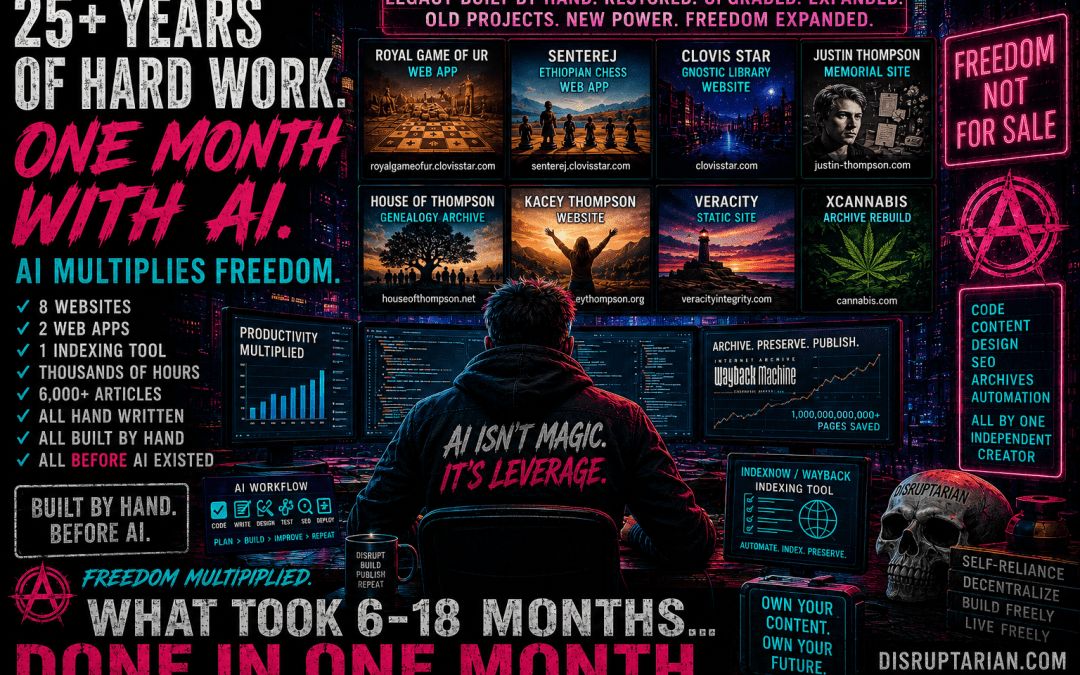
From May 1 to June 3, I rebuilt, restored, upgraded, and expanded a group of old projects that normally would have taken me 6 months to 18 months. This time, the work happened in about one month.
Not because AI made me creative. I was already creating. Not because AI gave me ideas. I already had years of ideas, content, code, graphics, domains, archives, and work. AI helped me move through the work faster. It helped me test faster, clean faster, write support copy faster, fix bugs faster, improve SEO faster, organize old content faster, and package working Android apps faster.
The Websites And Apps Rebuilt
Royal Game of Ur Web App — royalgameofur.clovisstar.com
Rebuilt as a playable online game with AI play, local play, multiplayer rooms, shared rules, and mobile support.
Senterej: Ethiopian Chess Web App — senterej.clovisstar.com
Built around Ethiopian chess, Werera opening play, AI opponents, 2D and 3D board work, profiles, rooms, and live gameplay.
Clovis Star / Gnostic Library — clovisstar.com
Strengthened as a library and archive site with mobile fixes, metadata, sitemap work, banners, and a better reader experience.
Justin Thompson Memorial Website — justin-thompson.com
Restored and preserved as a static memorial archive with recovered media, SEO, metadata, sitemap, and long-term preservation work.
House of Thompson — houseofthompson.net
Rebuilt as a family history and genealogy archive with searchable profiles, family views, place views, media pages, and PWA support.
Kacey Thompson Website — kaceythompson.org
Cleaned up and modernized with navigation fixes, accessibility work, media sections, Web3 content, footer updates, and validation scripts.
Veracity Integrity Static Site — veracityintegrity.com
Restored as a clean static site with product pages, blog pages, contact pages, media inventory, sitemap, robots, and supporting assets.
Xcannabis Archive Rebuild — cannabis.com
Rebuilt from older archive content with article cleanup, image recovery, homepage thumbnails, SEO, navigation, and related-site banners.
IndexNow / Wayback Indexing Tool
A reusable automation tool for submitting changed URLs to legitimate IndexNow endpoints and requesting Archive.org snapshots for long-term preservation.
Website Projects Matched To Android APKs
Several of the rebuilt websites now have Android APKs connected to them. These are not vague concepts; they are public GitHub release repositories under github.com/veracitylife and direct APK links from the related websites.
Before AI, every task had to be done one step at a time: write code, fix code, test pages, resize images, write meta descriptions, check links, build sitemaps, clean articles, fix mobile layouts, make banners, create archive maps, review old files, and publish updates.
That work still exists. AI did not remove the work. It helped me move through the work faster.
A 2023 MIT study found that ChatGPT reduced time spent on certain writing tasks by 40% and improved average quality by 18%. A National Bureau of Economic Research study found that access to a generative AI assistant increased productivity for customer support agents by 14% on average.
My own result matches the direction of that research. With the right tools and enough existing skill, AI can multiply output without replacing judgment.
Freedom Multiplied
The point is not that AI is magic. It is not. AI is leverage. Skill plus tools equals freedom.
For independent builders, creators, publishers, archivists, and small business owners, that leverage matters. It means old projects can be restored. Forgotten archives can be preserved. Websites can become apps. Static sites can be cleaned and secured. Content can be indexed, backed up, and made useful again.
I built by hand before AI. I still build by hand now. The difference is that I can move faster, verify more, publish cleaner, and preserve more of what matters.
Built by hand. Restored with better tools. Freedom multiplied.
The Royal Game of Ur is one of the oldest known board games in the world. The British Museum dates one famous board from Ur to around 2600 BC to 2400 BC, from ancient Mesopotamia, in what is now Iraq.
That means people were playing this game roughly 4,500 years ago. Different lives. Different cities. Same basic human drive: take your shot, make your move, and outplay the other guy.
A Classic Game, Rebuilt for the Web
The Clovis Star version keeps the feel of the ancient game while making it easy to play today.
You can:
Play against the computer
Challenge someone locally
Compete in real online multiplayer
Learn the board, dice, rosettes, captures, and race-to-the-finish strategy
The Royal Game of Ur is simple to learn, but it is not mindless. It mixes luck, timing, risk, and strategy. You can get ahead fast, but one bad move can cost you.
That is what makes old games last. They are not just toys. They are small lessons in life.
Why This Game Still Matters
Ancient people were not as different from us as we like to think.
They traded. They built cities. They argued. They raised families. They played games.
The Royal Game of Ur reminds us that culture does not need a central planner to survive. Good ideas spread because people use them, share them, and pass them on.
A game carved into wood and decorated with shell survived for thousands of years because it was worth playing. The modern rules are linked to work by Irving Finkel of the British Museum, who studied ancient rule material tied to the game.
Now it is free on the open web.
No museum ticket needed. No gatekeeper needed. Just open the site and play.
Clovis Star Royal Game Of Ur
Play It Now
Whether you are a gamer, history lover, student, teacher, or just curious, The Royal Game of Ur is worth a few rounds.
Destroying Deepfakes: Fighting AI Deception With Better AI Tools is the kind of subject that fits the Disruptarian lane because it sits where independent media, culture, music, and political commentary collide.
The source description frames it this way: A Disruptarian look at deepfakes, AI deception, synthetic media, and the fight to protect truth in the machine age. Ryan Thompson breaks down why the answer is not panic or censorship, but better tools, sharper media literacy, open verification, and using AI to expose manipulation before it controls public reality. Original source video: https://www.youtube.com/watch?v=F4aA1pHuBRM Disruptarian: https://www.disruptarian.com
The useful question is not only what happened, but why the story matters to people who distrust scripted narratives, recycled outrage, and corporate-approved commentary.
A Disruptarian reading starts with individual agency. The listener is not asked to accept a packaged conclusion. The point is to pull the claim apart, compare incentives, and look for the pressure points that legacy media often skips.
That approach matters for libertarian radio commentary because the audience is usually looking for more than a headline. They want context, motive, contradiction, and a practical sense of how public stories become private consequences.
The cultural layer is just as important. Disruptarian music and reggae punk energy are not decorations around the message. They give the work its rhythm: skeptical, confrontational, and rooted in the idea that speech should stay alive even when institutions prefer silence.
For search readers arriving cold, the primary source is included below either as an embed or as a direct source link. Start there if you want the full tone, timing, and argument. The written analysis expands the title and description into a searchable article that can stand on its own.
The strongest SEO value here is clarity. The article keeps the title language visible, uses descriptive headings, and connects the topic to Disruptarian Radio, independent media, libertarian commentary, political culture, and original music without stuffing the page with empty repetition.
The larger takeaway is simple: independent commentary survives by documenting what was said, preserving the source, and adding a point of view that does not depend on permission from gatekeepers.
That is why this post exists as part of the static Disruptarian archive. The video remains embedded, the title and description remain traceable, and the surrounding article gives search engines and readers enough context to understand why the episode belongs in the broader Disruptarian catalog.
The title itself carries the first keyword signal, but a durable post needs more than a copied headline. It needs a clear H1, a concise meta description, a featured image with descriptive alt text, and enough editorial framing for readers to know why the video is part of this archive.
From an independent media perspective, the value is in keeping the primary source visible. Embedding the video prevents the article from becoming detached commentary. Readers can compare the written interpretation against the actual recording and decide whether the argument holds up.
The libertarian angle is not automatic partisanship. It is a suspicion of concentrated power, public manipulation, and narratives that ask citizens to outsource judgment. That suspicion applies to government, platforms, corporations, activist institutions, and media brands alike.
Disruptarian Radio also treats culture as evidence. Music, political language, online mobs, censorship fights, moral panics, and personal stories all reveal where pressure is being applied. That is why a radio episode can be more than entertainment; it can become a record of a moment.
For listeners who follow DJ Disruptarian, the same pattern shows up in the music catalog: reggae rhythm, punk edge, spiritual critique, and anti-authoritarian instinct. The written post keeps that identity attached to the video instead of letting it disappear into a platform feed.
Good SEO on a page like this should help people find the conversation without flattening the voice. The article uses natural phrases such as Disruptarian Radio, independent media, libertarian podcast, political commentary, original music, and disruptive conversations only where they make sense.
The featured image should follow the Disruptarian editorial-collage style: torn paper, smoke, halftone grit, dirty cream paper, black and oxblood pressure, muted gold accents, and symbolic props tied to the subject rather than generic filler. Its alt text names the subject so search engines and screen readers get useful context.
The article also keeps a stable URL under the static blog. That matters because feeds move, platforms change embeds, and social links decay. A static post gives the episode a second home that can be indexed, backed up, linked, and reviewed later.
The final point is documentation. When a channel publishes a new video, the title and description are often the only structured metadata available. Turning that metadata into a post creates a stronger archive without pretending to replace the original recording.
This is the practical Disruptarian method: preserve the video, state the source, add commentary, keep the searchable terms honest, and let the reader move between the embedded media and the written analysis without friction.
This additional context keeps the post useful for readers who arrive from search rather than from the original channel. It explains the source, preserves the embed, and connects the subject back to the larger Disruptarian archive.
This additional context keeps the post useful for readers who arrive from search rather than from the original channel. It explains the source, preserves the embed, and connects the subject back to the larger Disruptarian archive.
This additional context keeps the post useful for readers who arrive from search rather than from the original channel. It explains the source, preserves the embed, and connects the subject back to the larger Disruptarian archive.
Disruptarian commentary on AI Could Save Humanity or Destroy It: The Truth About the Machine Future with embedded source video, independent media context, and libertarian radio analysis.
AI Is Eating Jobs While You Sleep: A Builders Warning to the Next Generation is the kind of subject that fits the Disruptarian lane because it sits where independent media, culture, music, and political commentary collide.
The source description frames it this way: A raw Disruptarian warning about automation, work, and the next generation. AI is not waiting for permission. It is already replacing tasks, compressing careers, and forcing workers, creators, builders, and small businesses to decide whether they will adapt or get erased by the new machine economy.
The useful question is not only what happened, but why the story matters to people who distrust scripted narratives, recycled outrage, and corporate-approved commentary.
A Disruptarian reading starts with individual agency. The listener is not asked to accept a packaged conclusion. The point is to pull the claim apart, compare incentives, and look for the pressure points that legacy media often skips.
That approach matters for libertarian radio commentary because the audience is usually looking for more than a headline. They want context, motive, contradiction, and a practical sense of how public stories become private consequences.
The cultural layer is just as important. Disruptarian music and reggae punk energy are not decorations around the message. They give the work its rhythm: skeptical, confrontational, and rooted in the idea that speech should stay alive even when institutions prefer silence.
For search readers arriving cold, the primary source is included below either as an embed or as a direct source link. Start there if you want the full tone, timing, and argument. The written analysis expands the title and description into a searchable article that can stand on its own.
The strongest SEO value here is clarity. The article keeps the title language visible, uses descriptive headings, and connects the topic to Disruptarian Radio, independent media, libertarian commentary, political culture, and original music without stuffing the page with empty repetition.
The larger takeaway is simple: independent commentary survives by documenting what was said, preserving the source, and adding a point of view that does not depend on permission from gatekeepers.
That is why this post exists as part of the static Disruptarian archive. The video remains embedded, the title and description remain traceable, and the surrounding article gives search engines and readers enough context to understand why the episode belongs in the broader Disruptarian catalog.
The title itself carries the first keyword signal, but a durable post needs more than a copied headline. It needs a clear H1, a concise meta description, a featured image with descriptive alt text, and enough editorial framing for readers to know why the video is part of this archive.
From an independent media perspective, the value is in keeping the primary source visible. Embedding the video prevents the article from becoming detached commentary. Readers can compare the written interpretation against the actual recording and decide whether the argument holds up.
The libertarian angle is not automatic partisanship. It is a suspicion of concentrated power, public manipulation, and narratives that ask citizens to outsource judgment. That suspicion applies to government, platforms, corporations, activist institutions, and media brands alike.
Disruptarian Radio also treats culture as evidence. Music, political language, online mobs, censorship fights, moral panics, and personal stories all reveal where pressure is being applied. That is why a radio episode can be more than entertainment; it can become a record of a moment.
For listeners who follow DJ Disruptarian, the same pattern shows up in the music catalog: reggae rhythm, punk edge, spiritual critique, and anti-authoritarian instinct. The written post keeps that identity attached to the video instead of letting it disappear into a platform feed.
Good SEO on a page like this should help people find the conversation without flattening the voice. The article uses natural phrases such as Disruptarian Radio, independent media, libertarian podcast, political commentary, original music, and disruptive conversations only where they make sense.
The featured image should follow the Disruptarian editorial-collage style: torn paper, smoke, halftone grit, dirty cream paper, black and oxblood pressure, muted gold accents, and symbolic props tied to the subject rather than generic filler. Its alt text names the subject so search engines and screen readers get useful context.
The article also keeps a stable URL under the static blog. That matters because feeds move, platforms change embeds, and social links decay. A static post gives the episode a second home that can be indexed, backed up, linked, and reviewed later.
The final point is documentation. When a channel publishes a new video, the title and description are often the only structured metadata available. Turning that metadata into a post creates a stronger archive without pretending to replace the original recording.
This is the practical Disruptarian method: preserve the video, state the source, add commentary, keep the searchable terms honest, and let the reader move between the embedded media and the written analysis without friction.
This additional context keeps the post useful for readers who arrive from search rather than from the original channel. It explains the source, preserves the embed, and connects the subject back to the larger Disruptarian archive.
This additional context keeps the post useful for readers who arrive from search rather than from the original channel. It explains the source, preserves the embed, and connects the subject back to the larger Disruptarian archive.
This additional context keeps the post useful for readers who arrive from search rather than from the original channel. It explains the source, preserves the embed, and connects the subject back to the larger Disruptarian archive.
Disruptarian commentary on AI Is Taking Jobs Now: What Workers, Creators and Small Businesses Should Do Next with embedded source video, independent media context, and libertarian radio analysis.
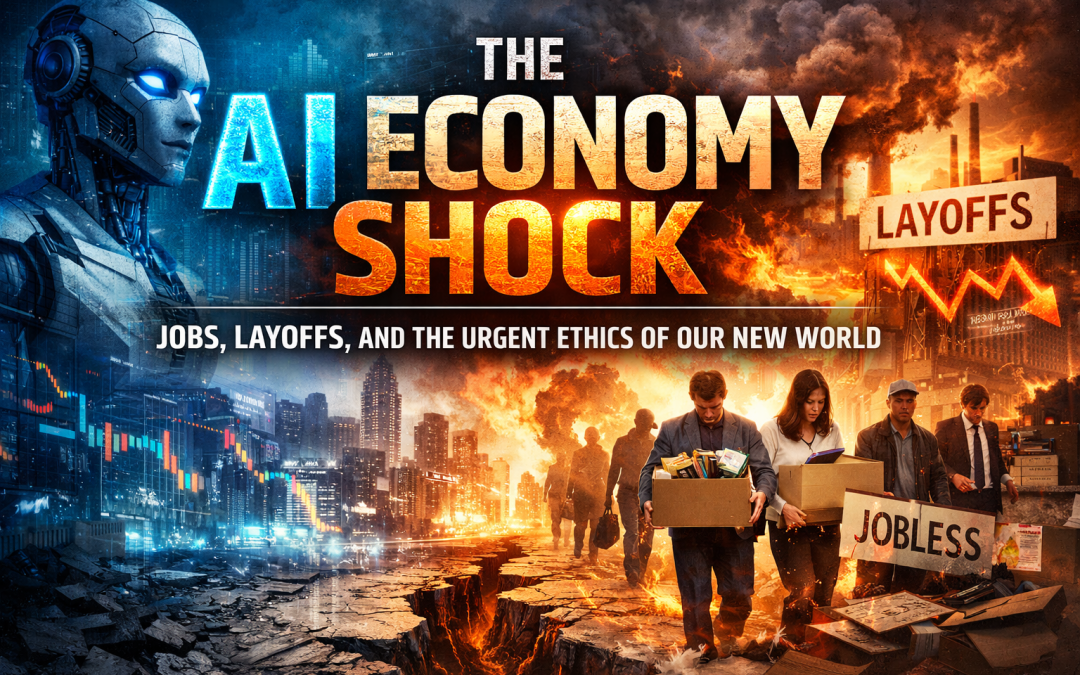
The AI disruption isn’t coming. It’s already here — written in layoff notices, rising home inventories, and a stock market that just rewarded a company for eliminating half its human workforce. The real question is what we do about the world we helped build.
Let me be straight with you from the jump, because that’s what we do here. What is happening right now — in the labor market, in the boardrooms, in the quiet desperation of a generation raised on the promise of credentials — is unlike anything I’ve witnessed in my career. And I’ve watched a lot of disruptions come and go. This one is different. This one isn’t a wave. It’s a tide shift. The ocean floor is moving.
So let’s start where this has to start: with a single corporate decision that should be setting off alarm bells in every office building in America.
The Number That Tells You Everything
Jack Dorsey — founder of Twitter, now running his payments company Block — just laid off 4,000 people. Not a restructuring. Not a strategic pivot with a promise to hire in other areas. A flat 50% reduction of his entire company’s headcount. One in two people, shown the door. The stated reason? Artificial intelligence can now do the work.
Now here’s the part that should make you set down your coffee and stare at the wall for a minute.
50% Largest percentage layoff in S&P 500 history
When Block cut half its workforce citing AI capabilities, Wall Street didn’t punish the decision. The stock went up. The market rewarded the elimination of humans — not for profitability gains, not for growth, simply for the act of replacing people with machines.
That moment deserves to be understood for what it is. Financial markets — which are at their core a collective bet on the future — just sent a clear signal. The signal says: companies with fewer humans and more AI are worth more. That is the new incentive structure baked into our economic system. Every CEO reading those stock reports absorbed that lesson. Many of them are acting on it right now.
For the 4,000 people who lost their jobs at Block, the consequences are concrete and immediate. These aren’t statistics. These are mortgages, daycare payments, health insurance continuations, and the particular psychological weight of being told your skills have been automated away. For the broader economy, this event is a data point in a pattern that is becoming impossible to ignore.
The Numbers Underneath the Headlines
Here’s what the broader picture looks like right now, on the ground, in the actual economy that actual people are living in:
1 in 4 Unemployed Americans out of work for 27+ weeks
27% Of new hires this month accepted a pay cut to get the job
44% More home sellers than buyers — unprecedented in modern data
66% Of Americans report running out of cash — scarier to them than death
That housing number should stop you cold. Forty-four percent more sellers than buyers. That doesn’t happen in a healthy economy where people are building equity, growing their families into bigger homes, and feeling secure enough to put down roots. That happens when people need liquidity. When they’re nervous. When the math of staying put no longer works.
And here is the technological reality underlying all of it: at current capability levels, AI agents can already handle tasks that account for 44% of all U.S. work hours. Add robotics into the equation — another 13% on top — and you’re looking at well over half of the American labor economy at some level of displacement risk. Right now. With technology that, by every measure, is only going to get more capable.
“At current capability, AI agents could handle tasks making up 44% of all U.S. work hours. Robots add another 13% on top. And this is the worst this technology will ever be.”
— The economic reality we need to reckon with, 2026
Think about that last line. The worst this technology will ever be. The disruption we are experiencing today — the layoffs, the wage compression, the credential deflation — is happening at the floor of what AI can do. The ceiling isn’t visible from here.
The Credential Collapse
There’s a generational story buried inside all of this that doesn’t get told with enough honesty. We told an entire generation — particularly Millennials and Gen Z — that the path was clear: get the degree, pay the tuition, collect the credential, get the job, build the life. It was always more of a promise than a guarantee, but at least the map was legible.
That map is gone.
Fifty-one percent of Gen Z now says their college degree was a waste of money. Sixty percent of Gen Z workers are in jobs that have nothing to do with their field of study. And the brutal irony is that the very analytical and administrative roles that a university education was supposed to unlock — the white-collar knowledge work — are precisely the jobs most exposed to AI displacement. The barbell economy, as some economists are calling it, is here: high-skill, high-output builders on one end; skilled trades on the other; and a collapsing middle ground in between.
Only 1.6 jobs currently exist for every 100 white-collar service workers. That number alone should reframe how we think about what it means to be educated and employable in 2026.
What Jack Dorsey’s Layoff Actually Tells Us About the Future
Let’s return to Block, because there’s more to this story than the headline number. When a company cuts 50% of its workforce and the stock rises, the effect ripples outward in ways that go beyond that company’s four walls.
First, it establishes a template. Other CEOs — already under constant pressure from boards and institutional investors — now have a case study. A real-world data point that says: the market tolerates, even rewards, aggressive AI substitution. The social compact that once existed between corporations and their employees — loyalty exchanged for stability — has been quietly renegotiated without anyone signing off on the new terms.
Second, it accelerates the timeline. What might have taken a decade of gradual adoption has been compressed. When bold moves get rewarded publicly, the pressure on competitors to follow intensifies. The CEO who doesn’t move fast enough now looks like a liability, not a humanist.
Third — and this is where it gets existential — it exposes the absence of a social safety net designed for structural, technology-driven unemployment. The unemployment system was built for cyclical job loss: people lose jobs in a downturn, they find new ones in the recovery. What happens when the recovery doesn’t produce the same kinds of jobs in the same quantities? That is not a hypothetical. Credible economists are raising the prospect of Great Depression-level structural unemployment. Not as a worst-case fringe scenario. As a serious forecast.
For the 4,000 people at Block, the immediate reality involves navigating a job market where AI competency is increasingly a baseline requirement, where mid-level roles are shrinking, and where the skills that made them valuable in the previous chapter may or may not translate to the next one. That transition — individual, unguided, and largely unsupported — is happening simultaneously to workers across industries, across geographies, across age groups. The human cost is real. It is happening now. And it is, largely, invisible in the stock charts.
The Mirror Problem: AI Learns From Us
Here’s the conversation that almost nobody is having, and it might be the most important one.
We are not building AI in a vacuum. We are building it in a society — our society, with our values, our incentive structures, our biases, our history, and our habits. Every interaction, every dataset, every decision about what to optimize for, is a form of teaching. And what we teach, the machines will learn.
The Ethics We Cannot OutsourceThe way humans treat other humans right now is not separate from the AI ethics conversation. It is the AI ethics conversation. The algorithms being trained today are being trained on the world we have built — a world where a company eliminating half its people is celebrated in financial markets, where people who have been unemployed for six months are treated as statistically inconvenient, where the economic security of millions is weighed against quarterly earnings reports and found lighter.
If we normalize the dehumanization of labor — if we treat displacement as an acceptable externality, if we build systems that optimize for efficiency with no weight given to dignity, stability, or human flourishing — we should not be surprised when the machines reflect those values back to us at scale. You cannot outsource your ethics to a model that was trained on your behavior.
The machines are watching how we treat each other. They are learning what we value. They are being trained on our cruelty as much as our creativity, on our indifference as much as our generosity. This isn’t a future problem. The training data is being generated right now, in every boardroom decision, every layoff notice, every policy choice about who deserves support and who gets to be a rounding error in someone else’s efficiency calculation.
This is not a call to slow down AI development. That ship has sailed, and frankly, the technology itself is not the villain here. But it is a call to be deliberately, intentionally, stubbornly ethical in how we build, deploy, and govern these systems. Because the values we bake in now — through training data, through objective functions, through the incentive structures we build around these tools — will shape how AI interacts with humans for decades.
Kindness is not weakness. Dignity is not inefficiency. And a system that treats humans as disposable inputs will, if left unchecked, eventually produce AI that treats humans the same way. We don’t get to be brutal in practice and then demand that our machines be gentle. Ethics isn’t a feature you add at the end. It’s the architecture.
The Opportunity in the Wreckage
None of this means the future is only dark. But I refuse to skip past the wreckage to get to the silver lining, because too many people are doing exactly that, and it is leaving real people behind.
The opportunity is real. The ability to build useful things — software, systems, services — has never been more democratized. Non-coders are building working products. Small businesses are sitting on enormous inefficiencies that a person with AI tools and genuine curiosity can address and monetize. The barrier to entry for starting something, building something, helping someone, has never been lower.
But the opportunity does not erase the obligation. The people who will build well in this moment are not just the ones who learn to use the tools. They are the ones who bring genuine values to what they build. The builders who ask not just “what can this automate?” but “who does this serve, and how, and at what cost to whom?” Those people will build things that last. And they will build a version of the future that’s worth living in.
The trades are undervalued and about to become more so. The electrician billing $180 an hour doesn’t have to worry about her work being automated away. Physical presence, embodied skill, the judgment that comes from working with your hands in a specific place at a specific time — these are not things that current AI can replace, and they won’t be for a long time. The cultural stigma around skilled trades has always been more about class signaling than actual value. That’s worth reconsidering, urgently.
AI literacy is not optional anymore — but it’s also not sufficient on its own. Knowing how to use these tools is table stakes. The real differentiator is having something worth building toward: a genuine understanding of a problem, a relationship with the people who have that problem, the judgment to know what matters. Curiosity plus craft plus ethics. That combination is still rare enough to be worth something.
What We Owe Each Other Right Now
I want to end where I started, because I think it matters more than the strategic advice.
The people who are most exposed to this disruption — the mid-level white-collar workers, the recent graduates who followed the rules and are now watching the rules change, the 4,000 people at Block and the hundreds of thousands in similar situations elsewhere — they did not create this moment. They navigated the world they were handed, made reasonable decisions with the information they had, and are now caught in a structural shift they didn’t cause and cannot individually stop.
What we owe them is honesty. Not the soft-pedaled reassurance that everything will be fine, that the jobs will come back, that disruption always creates more than it destroys. Maybe it will. But maybe this time is different, and pretending otherwise doesn’t help anyone prepare.
What we also owe them — what we owe each other — is humanity. In how we design these transitions. In whether we build systems that catch people or just let them fall. In how we talk about the displaced: as people with dignity and history and specific skills, not as inefficiencies that have been optimized away.
The machines are watching. They’re learning. The humans we choose to be right now — in this exact moment, at this exact inflection point — will echo through the systems we build and the future we create. That’s not a metaphor. That is the mechanism. The ethics we live, the machines will learn.
Build accordingly.
— Ryan “Dickie” Thompson
Founder, Disruptarian.com
Trusted Partner · Web & AI Services
Spun Web Technology
The Disruptarian Network runs on the infrastructure and AI integration services built by Spun Web Technology — a full-stack web and AI services company that helps businesses move from exposure to capability. If you’re a business owner who can feel the ground shifting but doesn’t know where to run, Spun Web Technology specializes in exactly that translation: taking the complexity of AI implementation and turning it into concrete, working systems for your business.
From web presence and SEO to custom AI tooling, automation pipelines, and intelligent infrastructure, Spun Web Technology operates at the intersection of what’s technically possible and what actually makes your business more resilient. No enterprise budget required. No internal AI team needed. Just a clear-eyed partner who has already built the thing you’re trying to figure out.
AI as a Tool, Not a Career: How Workers and Creators Can Use Automation Wisely is the kind of subject that fits the Disruptarian lane because it sits where independent media, culture, music, and political commentary collide.
The source description frames it this way: A practical Rumble-focused discussion about treating AI as another tool in your toolbox instead of turning it into your entire identity or career plan. This version focuses on using automation wisely, learning useful workflows, and staying grounded while technology changes how work gets done.
The useful question is not only what happened, but why the story matters to people who distrust scripted narratives, recycled outrage, and corporate-approved commentary.
A Disruptarian reading starts with individual agency. The listener is not asked to accept a packaged conclusion. The point is to pull the claim apart, compare incentives, and look for the pressure points that legacy media often skips.
That approach matters for libertarian radio commentary because the audience is usually looking for more than a headline. They want context, motive, contradiction, and a practical sense of how public stories become private consequences.
The cultural layer is just as important. Disruptarian music and reggae punk energy are not decorations around the message. They give the work its rhythm: skeptical, confrontational, and rooted in the idea that speech should stay alive even when institutions prefer silence.
For search readers arriving cold, the primary source is included below either as an embed or as a direct source link. Start there if you want the full tone, timing, and argument. The written analysis expands the title and description into a searchable article that can stand on its own.
The strongest SEO value here is clarity. The article keeps the title language visible, uses descriptive headings, and connects the topic to Disruptarian Radio, independent media, libertarian commentary, political culture, and original music without stuffing the page with empty repetition.
The larger takeaway is simple: independent commentary survives by documenting what was said, preserving the source, and adding a point of view that does not depend on permission from gatekeepers.
That is why this post exists as part of the static Disruptarian archive. The video remains embedded, the title and description remain traceable, and the surrounding article gives search engines and readers enough context to understand why the episode belongs in the broader Disruptarian catalog.
The title itself carries the first keyword signal, but a durable post needs more than a copied headline. It needs a clear H1, a concise meta description, a featured image with descriptive alt text, and enough editorial framing for readers to know why the video is part of this archive.
From an independent media perspective, the value is in keeping the primary source visible. Embedding the video prevents the article from becoming detached commentary. Readers can compare the written interpretation against the actual recording and decide whether the argument holds up.
The libertarian angle is not automatic partisanship. It is a suspicion of concentrated power, public manipulation, and narratives that ask citizens to outsource judgment. That suspicion applies to government, platforms, corporations, activist institutions, and media brands alike.
Disruptarian Radio also treats culture as evidence. Music, political language, online mobs, censorship fights, moral panics, and personal stories all reveal where pressure is being applied. That is why a radio episode can be more than entertainment; it can become a record of a moment.
For listeners who follow DJ Disruptarian, the same pattern shows up in the music catalog: reggae rhythm, punk edge, spiritual critique, and anti-authoritarian instinct. The written post keeps that identity attached to the video instead of letting it disappear into a platform feed.
Good SEO on a page like this should help people find the conversation without flattening the voice. The article uses natural phrases such as Disruptarian Radio, independent media, libertarian podcast, political commentary, original music, and disruptive conversations only where they make sense.
The featured image should follow the Disruptarian editorial-collage style: torn paper, smoke, halftone grit, dirty cream paper, black and oxblood pressure, muted gold accents, and symbolic props tied to the subject rather than generic filler. Its alt text names the subject so search engines and screen readers get useful context.
The article also keeps a stable URL under the static blog. That matters because feeds move, platforms change embeds, and social links decay. A static post gives the episode a second home that can be indexed, backed up, linked, and reviewed later.
The final point is documentation. When a channel publishes a new video, the title and description are often the only structured metadata available. Turning that metadata into a post creates a stronger archive without pretending to replace the original recording.
This is the practical Disruptarian method: preserve the video, state the source, add commentary, keep the searchable terms honest, and let the reader move between the embedded media and the written analysis without friction.
This additional context keeps the post useful for readers who arrive from search rather than from the original channel. It explains the source, preserves the embed, and connects the subject back to the larger Disruptarian archive.
This additional context keeps the post useful for readers who arrive from search rather than from the original channel. It explains the source, preserves the embed, and connects the subject back to the larger Disruptarian archive.
This additional context keeps the post useful for readers who arrive from search rather than from the original channel. It explains the source, preserves the embed, and connects the subject back to the larger Disruptarian archive.
Disruptarian commentary on AI Is Taking Jobs Now: What Workers, Creators and Small Businesses Should Do Next with embedded source video, independent media context, and libertarian radio analysis.
Sometimes you do not fight broken systems. You replace them.
That is where Disruptarian is right now.
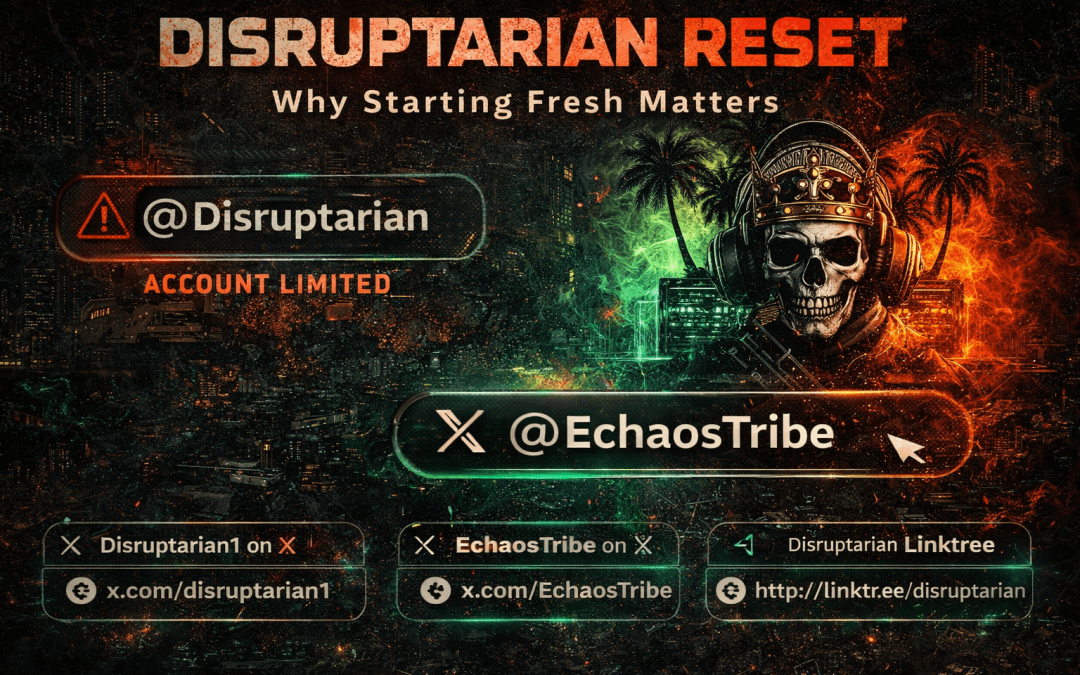
The original X account, @Disruptarian, is basically gone from public view. Many people cannot access it. If you are logged out, it shows nothing. No posts. No history. Like it never existed. In reality there is almost 50K posts on that account
That account still has some API access, but visibility is questionable. If people cannot reliably see your content, then the platform is controlling your reach, not you.
This is a clean slate. No restrictions. No hidden limits. Just a fresh channel to build from. It will be verified soon, and growth starts from zero again, but this time with control.
This is what a free market mindset looks like. You do not stay stuck where you are limited. You move. You adapt. You rebuild.
Social media platforms are not your foundation. They are just tools. And when a tool stops working, you switch it out.
DOJ Surveillance Scandal: What This Congressional Hearing Really Exposed
I watched this hearing twice.
Not because I enjoy political theater. Most of it is scripted noise designed to keep you arguing about which color tie is worse.
But this one? This one slipped.
And when something slips inside a system like this, when the mask of “standard procedure” cracks just enough to show the gears grinding underneath, you pay attention. Because what came out wasn’t just about subpoenas. It was about how power actually moves behind the curtain. It’s about the infrastructure of control being built right under our noses while we’re distracted by the latest culture war skirmish.
[TOC: Add Rank Math “Table of Contents” block here]
Watch the Hearing
Before we dive into the meat of this, you need to see the primary source. Don’t take my word for it. Watch the witnesses squirm when the numbers start getting read into the record.
The Headline Everyone Should Be Talking About
Let’s strip this down to the cold, hard data.
Nearly 200 subpoenas.
Over 400 individuals and organizations targeted.
And we’re not just talking about random people who were in the wrong place at the wrong time. We are talking about sitting U.S. Senators and members of the House. Think about that for a second. This wasn’t some narrow, surgical investigation into a specific crime. Even the witnesses at the hearing had to admit, under pressure, that this was something else.
This was a wide net. A digital dragnet.
And here’s where it gets really uncomfortable for anyone who still believes in the “blind justice” fairy tale: some of those targets had zero connection to the events of January 6. I’m not saying “tenuous connection.” I’m saying zero.
When the government starts pulling the records of people who weren’t even in the same zip code as a crime, you aren’t looking at law enforcement anymore. You’re looking at an intelligence operation directed at domestic political rivals.
And libertarians need to zoom out here. This isn’t just “DOJ being the DOJ.” This is what happens when you combine:
A legal system built around compliance-by-paper
Telecom and platform companies that store everything forever
A political class that treats privacy like an inconvenience
A bureaucracy that gets rewarded for scope creep
That mix creates a machine that doesn’t need warrants the way you think it does. It just needs process. It needs forms. It needs a judge to rubber-stamp a request nobody will ever read on the evening news.
This is the modern surveillance state: not one boot kicking down one door, but a thousand subpoenas quietly vacuuming up an entire social graph.
The “400 Targets” Number Isn’t Random—It’s a Network Map
People hear “400 targets” and imagine 400 suspects. That’s not how this works.
In practice, a “target list” like that often includes:
The main subject(s)
Staffers and aides
Lawyers
Journalists and sources
Donors and vendors
Family members
Anyone who texted, emailed, or called at the “wrong” time
That’s why these investigations metastasize. The moment you can grab phone metadata, emails, cloud accounts, payment records, and location pings, you can rebuild someone’s life without ever meeting them.
You don’t need to prove guilt first. You just need to pull enough threads until something “interesting” appears—something embarrassing, something prosecutable, or something useful for leverage.
That’s why the phrase “fishing expedition” isn’t just a complaint. It’s a description of the method.
Subpoenas vs. Warrants: The Loophole Most People Miss
A warrant is supposed to be hard. Probable cause. Particularity. A judge. The Fourth Amendment model.
A subpoena can be easier to get, easier to scale, and easier to hide—especially when paired with gag orders and secrecy rules. Subpoenas also put pressure on third parties (telecoms, email providers, banks) who don’t want to fight the government. Most people never even find out.
So even if you’re the kind of person who says, “Well, if they had a warrant, it’s fine,” you should be asking a nastier question:
How much surveillance is happening through subpoenas that never face real adversarial review?
Because once the government normalizes “bulk subpoena” behavior, your privacy isn’t protected by the Constitution anymore. It’s protected by corporate courage and bureaucratic restraint—two things that don’t exactly have a great track record.
This Is a Free-Market Problem Too
I’m pro-market, but I’m not blind. There’s a brutal reality in play:
Companies profit by collecting data.
Governments profit by accessing data.
You lose by being legible.
That’s why the “just use the free app” economy has a hidden price tag: your life becomes queryable.
And when that query power gets pointed at politics—especially dissent, opposition, or “wrongthink”—you’re not dealing with normal justice anymore. You’re dealing with a compliance regime.
The scary part is you can build that regime without changing a single law. You just reinterpret “investigation” broadly, pile up subpoenas, and let inertia do the rest.
What the Hearing Exposed (Even If They Didn’t Mean To)
This is the part that hit me hardest watching the testimony:
They weren’t ashamed of the scale.
They acted like the scale was normal.
They leaned on procedure as if procedure equals legitimacy.
That’s how power talks when it’s comfortable. Not with an evil laugh. With a shrug.
And that’s why this story matters more than whatever partisan spin you’re seeing online. Because the capability is the scandal. Once the state can surveil hundreds of people through “routine process,” the only thing left is deciding who counts as a threat.
Today it’s “January 6 networks.”
Tomorrow it’s “misinformation networks.”
The next day it’s “extremism-adjacent” donors.
Same machine. Different label.
ALT: Red digital dragnet scanning the US Capitol during a DOJ surveillance scandal | Style: Watermarked disruptive imagery with glitch textures and bold red contrast
This Is Where It Stops Being About Politics
Most people are going to process this through their partisan team lenses. If you’re on the “Blue Team,” you’ll probably find a way to justify it as “protecting democracy.” If you’re on the “Red Team,” you’ll scream about the “Deep State.”
That’s the trap. That’s exactly how they want you to react.
Because the real question isn’t who got targeted this time. The real question is whether the system now has the ability and the willingness to target at that scale. Once that door opens, it doesn’t close. It doesn’t matter who is sitting in the Oval Office or who holds the gavel in the Senate.
Power like this just changes hands. If you’re okay with it being used against your enemies today, don’t complain when the same machinery is turned on you tomorrow. This is about the weaponization of the DOJ surveillance scandal as a permanent feature of American governance.
“If You’ve Got Nothing to Hide…” Is a Trap Phrase
Every time this kind of story breaks, somebody says the line like it’s wisdom: “If you’ve got nothing to hide, you’ve got nothing to fear.”
That’s not an argument. That’s an obedience test.
Privacy isn’t about hiding crime. Privacy is about:
Not letting the state pre-crime your life
Not letting bureaucrats pick through your relationships
Not turning politics into a game where the government can “audit” your enemies
Maintaining a zone where you can think, speak, organize, and associate without being cataloged
The founders didn’t write protections for “innocent people.” They wrote protections for everyone, because government doesn’t stay well-behaved. It expands. It rationalizes. It finds excuses.
The Libertarian Issue: Centralized Power + Data = Political Weapon
I don’t care what your party is. I care about physics.
Centralized power behaves like centralized power. If you give the federal government:
the legal ability to demand private records,
the technical ability to process it at scale,
and the cultural permission to do it “for safety,”
then it will be used. Not might be. Will be.
And the worst part? The system doesn’t even need “bad guys.” It just needs incentives:
Prosecutors want wins.
Agencies want relevance.
Politicians want control.
Contractors want money.
That’s the recipe.
So yeah—this stops being about politics fast. Because politics changes every election. But the surveillance infrastructure stays in place like a landmine under everyone’s feet.
The Free-Market Answer Isn’t “Trust the Government More”
When the state overreaches, the solution isn’t to beg for “better people” in charge.
The solution is to limit the machine:
Narrow subpoena scope
Increase transparency after investigations end
Remove or sunset gag orders
Strengthen penalties for “scope creep”
Reinforce separation of powers so Congress isn’t treated like just another group of suspects
You don’t fix a predatory system by asking it to be nicer. You fix it by building hard limits it can’t negotiate around.
Subpoenaing Congress: That’s Not Normal
Here’s something buried in the hearing that should’ve blown up the headlines, but the mainstream media treated it like a footnote.
The DOJ subpoenaed the private phone records of sitting members of Congress.
Let me say that again: The executive branch (the guys with the guns and the handcuffs) went after the legislative branch’s private communications. In a constitutional republic, that triggers something called the Speech and Debate Clause.
That clause isn’t some dusty legal technicality. It exists for a very specific reason: to protect lawmakers from exactly this kind of pressure and intimidation from the executive branch. It’s a firewall. And the DOJ didn’t just knock on the door; they tried to kick it in.
Even AT&T reportedly refused to comply at one point because of those constitutional concerns. Think about how bad it has to be for a multi-billion dollar telecom giant, who usually hands over data like it’s candy, to say, “Whoa, this looks like a constitutional violation.” That’s not a minor procedural hiccup. That’s a massive red flag.
Why the Speech and Debate Clause Exists (In Plain English)
This clause exists because the founders knew something most modern Americans forgot:
If the executive branch can spy on legislators, it can control legislators.
And if it can control legislators, it can control lawmaking. That’s not “checks and balances.” That’s a hostage situation with nicer suits.
The Speech and Debate Clause is supposed to keep Congress from being intimidated for doing its job—investigating the executive branch, debating policy, and communicating with constituents. If DOJ can pull members’ phone records whenever it wants, what’s the message?
“Play nice, or we’ll go digging.”
Even if they never say it out loud, the threat does the work.
“Separation of Powers” Isn’t a Vibe—It’s a Safety Feature
This is why I keep calling this infrastructure. A lot of people treat constitutional limits like old poetry. But separation of powers is not decoration. It’s an anti-tyranny design.
Once you normalize the executive branch collecting communications from lawmakers, you’ve basically installed a hidden surveillance camera in the room where laws get written.
And for the people yelling “nothing will happen,” here’s the question:
What happens when the next administration decides your favorite senator is “connected” to the wrong group?
The precedent is the weapon. The party label is just the wrapping paper.
The “Fishing Expedition” Problem
One of the witnesses called it what it looked like: a fishing expedition.
That phrase matters. In legal terms, you’re supposed to have “probable cause” or at least a specific reason to believe a crime was committed before you start digging through someone’s life. If you already have evidence, you don’t cast a net this wide. You go get the target.
But if you don’t have the evidence? You start pulling data. Names. Contacts. Locations. Personal networks. You map people. You find out who talks to whom, who funds whom, and who is friends with whom.
That’s where this shifts from a criminal investigation into a surveillance state. It’s about building a database of dissent. Whether it’s AI replacing jobs or DOJ subpoenas, the goal is the same: total visibility into the lives of the “uncontrolled.”
Metadata Is the Real Weapon (Not Just Your “Content”)
A lot of folks still think privacy means “they can’t read my messages.”
Cool. But you can ruin somebody’s life without reading a single sentence.
Phone and internet metadata can show:
who you talk to,
how often,
when,
from where,
and how your patterns change.
That’s enough to build a story—sometimes a false one. It’s enough to pressure people, to intimidate them, to make them radioactive. And when it’s done under secrecy, you can’t even defend yourself in public because you don’t know it happened.
That’s why the “bulk subpoena” model is so dangerous. It treats everyone’s relationships like evidence and assumes innocence is something you prove after you’ve been cataloged.
How “Fishing” Becomes Policy
Here’s the bureaucratic logic chain:
Start with a big public event (high emotion, high media attention).
Define the goal broadly (“protect democracy,” “stop extremism,” “defend institutions”).
Expand the list of “relevant” people until it includes whole ecosystems.
Claim secrecy is necessary so “bad actors” don’t “evade justice.”
Normalize it.
Repeat it on the next target set.
That’s how an exception becomes a standard operating procedure.
ALT: A detective’s corkboard with strings connecting photos of politicians and citizens | Style: Watermarked disruptive imagery, grainy zine-style photocopy effect
Donor Lists, Communications, and Association
Here’s the part most people gloss over because they think “I don’t donate to politicians, so I’m safe.”
Subpoenaing donor lists and internal organizational records touches the very heart of the First Amendment and the freedom of association. The Supreme Court has been clear on this since the 1950s, the same principle that protected groups like the NAACP from being harassed by racist state governments.
So now ask yourself: What happens when the government can map exactly who supports what? What happens when they can trace networks of influence, funding, and communication with the click of a button?
That’s not law enforcement. That’s leverage. If you have someone’s entire digital footprint, you don’t need to charge them with a crime to ruin them. You just need the threat of disclosure.
The Chilling Effect Is the Point
When the state gets access to donor lists, even “law-abiding” people start thinking:
“Do I want my name in a federal database?”
“Do I want to be on a list if the political wind changes?”
“Do I want my employer seeing headlines that imply I’m a ‘target’?”
That’s how you kill political participation without banning it. You don’t need to outlaw association. You just make association costly.
And that’s why this issue isn’t left vs. right. It’s citizens vs. a government that wants your activism to come with a fear tax.
Free Speech Doesn’t Work Without Private Organizing
This is basic, ugly reality: people organize before they speak publicly. They test ideas in private. They vent. They argue. They build alliances. They figure out messaging. They decide if they can trust each other.
If the state can pierce that layer with subpoenas whenever it wants, then speech becomes performative and safe. The only people who speak freely are the people aligned with power.
That’s not a living republic. That’s a managed narrative.
The Crimes That Weren’t There
This might be the most telling part of the entire hearing. When the DOJ representatives were asked what actual crimes were uncovered through these 200 subpoenas and 400 targets… the answer was basically none.
Think about that.
Hundreds of targets.
Massive data collection.
Years of investigation.
And no clear underlying crime.
If there’s no crime, why the data? Why the subpoenas? Why the surveillance? It suggests the objective wasn’t to find a “what,” but to find out “who” and “how.” It’s about mapping the opposition.
“No Crimes Found” Doesn’t Mean “No Damage Done”
Even if nobody gets charged, surveillance still punishes people:
Legal bills
Time and stress
Lost jobs
Lost opportunities
Social stigma
Broken trust inside organizations (“who flipped?” “who’s being watched?”)
And that’s the quiet genius of a broad dragnet. You don’t need convictions to create deterrence. You just need people to believe involvement comes with risk.
That’s why libertarians should treat this like an attack on the culture of dissent. The state doesn’t just want to win cases. It wants to make resistance feel expensive.
The Bureaucratic Incentive: “Collect Now, Justify Later”
If you’re inside a giant agency, the safest move is to over-collect:
If you collect too little, you might miss something and get blamed.
If you collect too much, it becomes “thoroughness.”
This is why Fourth Amendment protections can’t depend on “good judgment.” The incentives don’t reward restraint. They reward cover-your-ass data hoarding.
Watergate… But Scalable
One comparison came up during the hearing that most media outlets will avoid like the plague: Watergate.
But here’s the twist. Watergate was a physical break-in. It was clunky, risky, and involved five guys in a hotel room with some duct tape.
This? This is digital. It’s scalable. It’s invisible.
Instead of one office, you’re looking at hundreds of people. Instead of physical files, you’re pulling entire communication networks. You don’t need a locksmith when you have a subpoena and a server. This is Watergate 2.0, but on a level Nixon couldn’t have even dreamed of. It’s the ultimate expression of government overreach in the digital age.
Watergate Had Limits. This Doesn’t.
Old-school political spying had friction:
You needed humans to do it.
You needed time.
You needed risk.
You needed someone to physically enter a space.
Modern spying is mostly paperwork plus database queries.
Once the system is built, the marginal cost of targeting the next person approaches zero. That’s why the number “200 subpoenas” matters so much—it’s not just scandal, it’s proof of capacity. It’s proof the machine can scale.
And a scalable surveillance machine doesn’t stay pointed at “bad people.” It gets pointed at whoever makes the ruling class nervous.
Non-Disclosure Orders and Silence
Another piece that matters: Non-disclosure orders.
This means the people being targeted didn’t even know they were being investigated. They didn’t know their records were being pulled. They didn’t know the government was looking over their digital shoulder.
According to testimony, many of them might have never known if political control hadn’t shifted and a new committee started asking questions. Let that sink in. We have a system where surveillance can happen quietly, at massive scale, with zero immediate accountability. That’s the definition of a “star chamber.”
Gag Orders Turn “Due Process” Into a One-Player Game
The state’s ideal setup is simple:
You don’t know you’re being investigated.
You can’t challenge it.
The company handing over your data can’t tell you.
The court record is sealed or buried.
Years pass.
That’s not “justice.” That’s administrative power wearing a legal costume.
And even if there are valid cases where secrecy makes sense (like real threats, real violence, real urgent national security issues), the whole point of libertarian skepticism is that exceptions get abused.
If secrecy becomes default, then oversight becomes a fairy tale you tell yourself so you can sleep.
ALT: A citizen silhouette scanned by a government barcode beam in a DOJ surveillance star chamber | Style: Bold black and white high-contrast punk rock aesthetic
Incentives: The Part Nobody Talks About
As a developer and a founder, I look at systems. And systems are driven by incentives.
What does the current DOJ system reward? If you’re inside a bureaucracy and you expand your reach, you gain influence. You gain budget justification. You gain relevance.
There is zero internal incentive to shrink power. None. No bureaucrat ever said, “You know what? I think we have too much power and not enough work to do. Let’s cut our budget.”
So when you see something like 200 subpoenas and 400 targets, don’t think “mistake.” Think structure. This is the system performing exactly as it was designed to, to grow, to consume more data, and to protect itself.
The “Compliance Stack”: Courts, Carriers, and Contractors
There’s another angle that doesn’t get enough daylight: the industry around surveillance.
Big investigations create:
Outside counsel work
Compliance departments
Government contracts
Data tooling purchases
Expert witness fees
Endless “oversight” theater
There are entire career ladders attached to “bigger cases” and “bigger scope.” The result is a compliance stack where everyone downstream benefits from expansion, and the only party that consistently loses is the citizen whose life becomes a file folder.
That’s why I don’t buy the “it was just a few overzealous people” excuse. Overreach is not an anomaly in a centralized system. It’s the default setting.
This Is Not About One Administration
This is the mistake people keep making. They attach this scandal to one name, one party, or one specific moment in time.
That’s too small.
The machinery of the surveillance state doesn’t disappear when leadership changes. It gets inherited. It gets refined. It gets reused. Today it’s being used against one group. Tomorrow it’s another. That is how centralized power works. It is a weapon that is always loaded, just waiting for the next person to pull the trigger.
The Real Risk: Normalization
Here’s the part that keeps me up at night. It’s not the event itself, it’s the normalization of it.
If this becomes “just another investigation,” then the boundaries are already gone. If we accept that the government can subpoena the records of hundreds of people without clear evidence of a crime, then we have already conceded the ground.
And once people accept it… it scales. Quietly.
Quick Side Note: Why This Feels Bigger Than It Looks
Most people see headlines. They don’t see systems. But this hearing exposed something deeper. The ability to:
Map political networks.
Access private communications without notice.
Target elected officials to create leverage.
Operate under total secrecy.
That’s not just a “scandal.” That’s infrastructure. And infrastructure doesn’t get built for a one-time use. It’s built to be used over and over again.
So What Now?
I’m not here to tell you what to think. I’m a punk-rock libertarian; I want you to think for yourself.
But I will tell you what I’m watching. I’m watching how this gets framed by the legacy media. I’m watching what parts of the testimony get ignored by the “fact-checkers.” And I’m watching whether anyone, on either side of the aisle, actually pushes back on the structure of the DOJ itself.
Because that’s the real issue. Not the headline. The system behind it.
Practical Pushback (Stuff Normal People Can Actually Do)
I’m not going to pretend you can “opt out” of the surveillance state by buying a cool hoodie and tweeting harder. But you can reduce your exposure and support structural limits.
Here are real moves:
Support transparency reforms
Push for rules that require notification after investigations close, limits on gag orders, and public reporting on subpoena volume. Sunlight doesn’t fix everything, but secrecy is how this stuff grows.
Treat your data like cash
If an app is “free,” you’re paying with your behavior and your network map. Choose services that minimize data collection and don’t build their entire business model on surveillance capitalism.
Use end-to-end encrypted messaging for sensitive organizing
Not because you’re doing anything wrong, but because you don’t want your associations to become “leads.” Privacy is a seatbelt, not a confession.
Decentralize your communications
The less your entire social world runs through a few chokepoints, the harder it is to vacuum up your life in one request.
Stop cheering when surveillance hits “the other side”
This is the big one. If you celebrate it now, you’re building the precedent that will be used later.
None of this replaces legal limits, but it buys you margin. And in a world where the state wants total visibility, margin matters.
Final Thought
Power doesn’t announce itself when it expands. It doesn’t come with a press release saying, “Hey, we’re taking your rights today.”
It just moves. Quietly.
Until one day, you realize the boundaries you assumed were there… aren’t. And by then, it’s already normal.











Submit a Comment