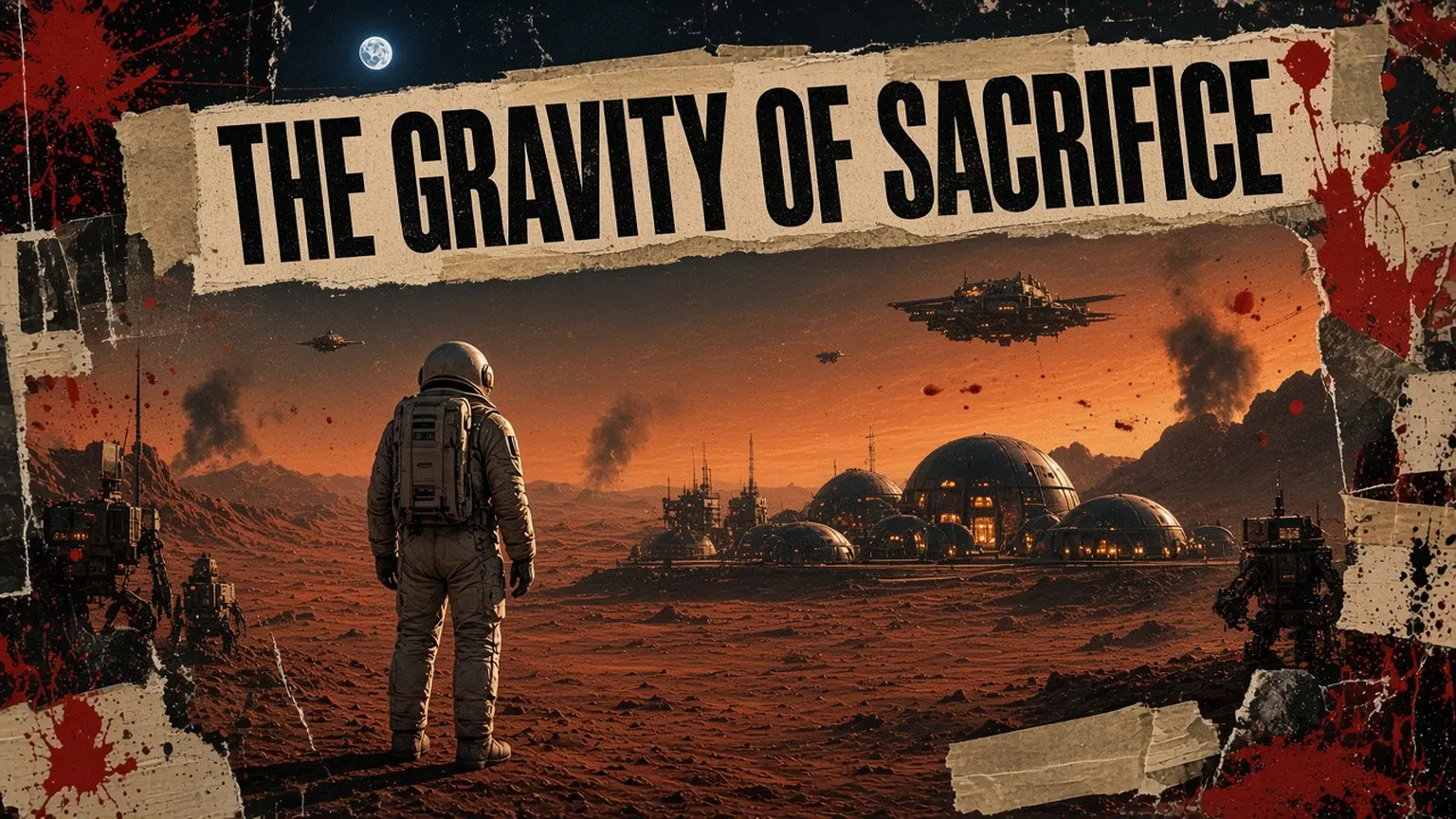
Richard Garvey Banton builds robots that can mend bones and clean the air. On the day his wife tells him they are expecting their fifth child, he learns that the colony on Mars is failing, and that he may be the only one who can save it. If he goes, he may never hold his new daughter. If he stays, people on Mars will die.
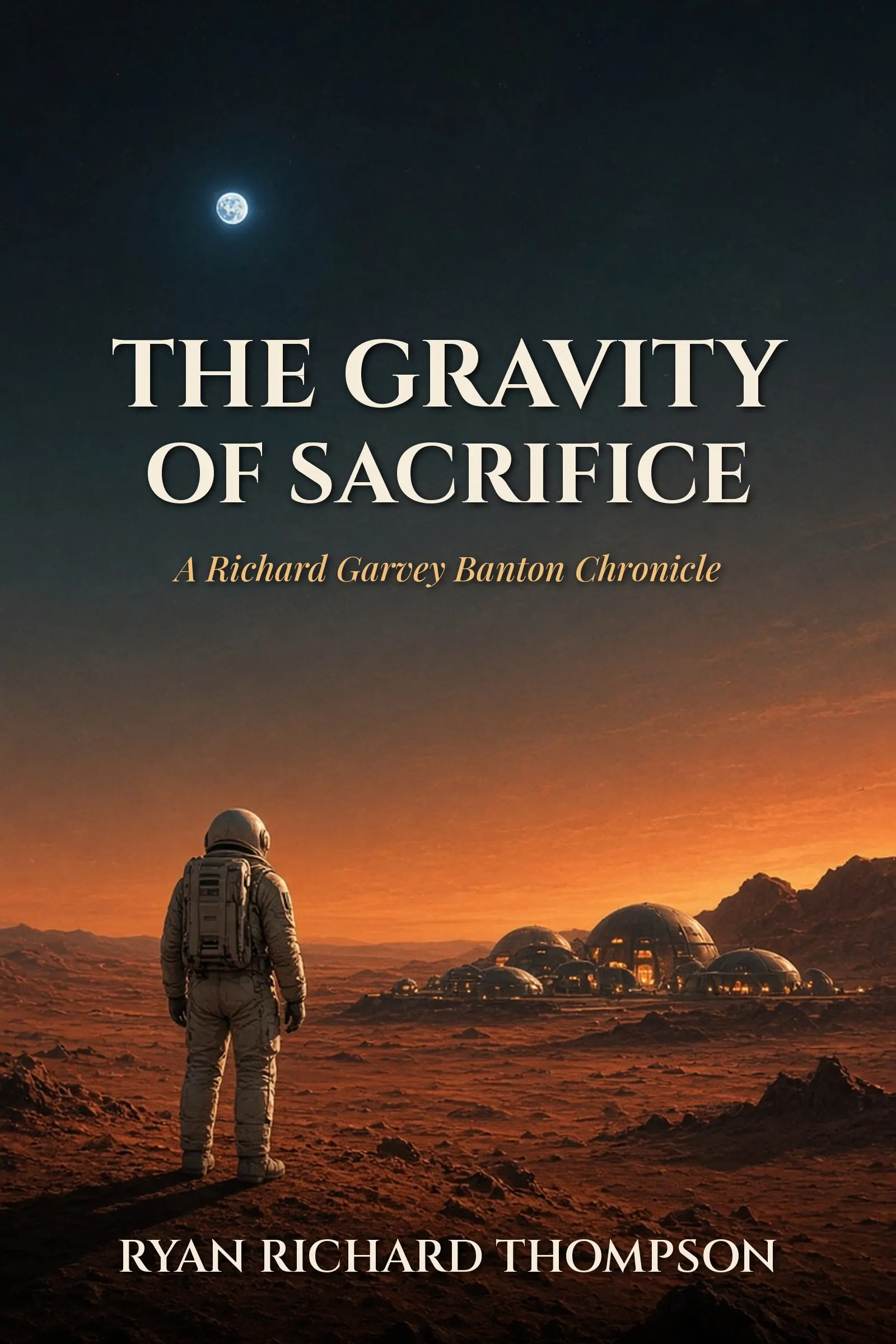
The Gravity of Sacrifice is a short novel about that choice, and about what it costs after the choice is made. It is a Richard Garvey Banton chronicle: a story of Mars, fatherhood, and the long way home. I wrote it as fiction, not as a policy paper, but the question at the center is plain. What does a man owe the people who need his skill, and what does he owe the family who will have to live with his absence?
The book opens on an Earth that has finally achieved political and environmental stability. Richard is in his home office, surrounded by work he understands, when his wife, Clara, tells him they are pregnant again. The news arrives in the same breath as the Mars mission. The colony is in crisis. Richard’s work in biomedical robotics and energy sustainability may be able to save lives, thousands of them. The journey is not a convenient assignment. It is the kind of leaving that may close a door behind him.
He looks at a family portrait on his desk. He has four children already, each with a life of their own: a reader with a defiant spirit, an artist with a public conscience, a young scientist, and a younger artist whose focus is already beyond her years. I will not turn those children into a roll call here. The novel’s point is not their names. It is the fact that each of them would have to grow up with a father who is minutes late on every message, if he can get a message through at all.
He goes, and the cost comes due on both worlds
He goes. On Mars the problems are worse than the reports said, and every fix brings a new risk. Back on Earth, his four children grow up without him. Their messages reach him late. He answers, and he writes letters to the daughter he has never met. The book is interested in that lag, not as a gadget, but as a moral fact. Love that travels at the speed of a transmission is still love. It is also not the same thing as being in the room.
Richard can invent machines that mend broken bones and purify air. The novel does not let him hide in that talent. Early on he says the obvious thing out loud: what is the point of that work if he cannot be there to mend the cracks in his own family? Clara does not pretend the decision is easy. She tells him he is constantly torn between two worlds, and that the decision is impossible, and that only he can make it. He makes it anyway.
Over time, Richard finds people on Mars who need him too, and his heart starts to split between two worlds. So he does what he knows how to do. He builds a ship to take him home. I will not tell you how that voyage ends. The book earns its last pages, and they are not a speech. They are the bill for a sacrifice he chose in full knowledge that someone he loved would pay part of it.
A published story about duty, not a lecture
I have always been drawn to stories in which responsibility is not a slogan. Richard is famous enough, in the world of the book, that other people want a formula from him. The novel is more interested in the private cost of being the person who can help. It is a story about a father’s love, the cost of doing the right thing, and how far a man will go to see his child.
Before he leaves, Richard makes a quieter decision that matters as much as the public one. He promises that his children will have his words, whether he is in the room or millions of miles away. Clara tells him that his words will be his presence. The novel takes that seriously. Richard writes. He writes for the children he already has, for the child he has not met, and for himself, trying to make sense of a decision that will alter more than one life. The book is not only about robots, radiation, and a failing colony. It is about whether a man can remain a father when he can no longer be physically present, and about the letters that try to stand in the gap.
I will not pretend the science-fiction furniture is the point. The colony, the mission, and the ship exist so the cost can be made large enough to see. A father who can save strangers and still miss a childhood is not a puzzle confined to Mars. The setting just refuses to let anyone call the absence a small thing.
If you read space exploration fiction, family drama, or stories about a parent trying to keep faith with children across an impossible distance, this is that book. It is now published, and you can get the ebook from the Disruptarian shop. I hope you find in it what I was writing toward: not a tidy moral, but a clear look at what sacrifice actually weighs when a life on one world means absence on another.
The title is not decoration. Gravity, in this story, is the pull of duty in two directions at once. Richard can see the colony’s danger clearly enough to go. He can also see, from the first day, that going will cost him the ordinary years of fatherhood: the meals, the arguments, the chance to be in the room when a child needs him. The people on Mars who come to need him as well do not cancel that cost. They add to it. That is why the ship home matters. It is not a trick ending setup. It is a father trying, with the only tools he trusts, to close a distance he chose. I wrote the book as a chronicle, not as a sermon. Richard’s skill can save a colony and still not cancel a missed childhood. That is the gravity I wanted on the page, and that is why I published the book.
More books by Ryan Richard Thompson
- This Ragged Life Renewed: A memoir of rebellion, faith, loss, and starting over.
- Echoes of Power: Paul, Rome, and the making of the early Church, with the first edition’s mistakes corrected in the open.
- The Unsettled Story: Ancient scriptures and the questions they leave open.
- The Transparent Future: A novel about trust in a city that measures honesty.
- Pillars of Strength: Fatherhood, family distance, and the weight of truth.
- The Weight of Evidence: What research can and cannot say about parental alienation.
Buy the book: The Gravity of Sacrifice is available at the Disruptarian shop.
Leave a Reply