
What happens when a parent-child relationship begins to disappear? How do we distinguish genuine parental alienation from justified estrangement? And what happens when decisions that shape a child’s future are made before all the evidence is understood? The Weight of Evidence is my attempt to answer those questions without pretending the research says more than it does.
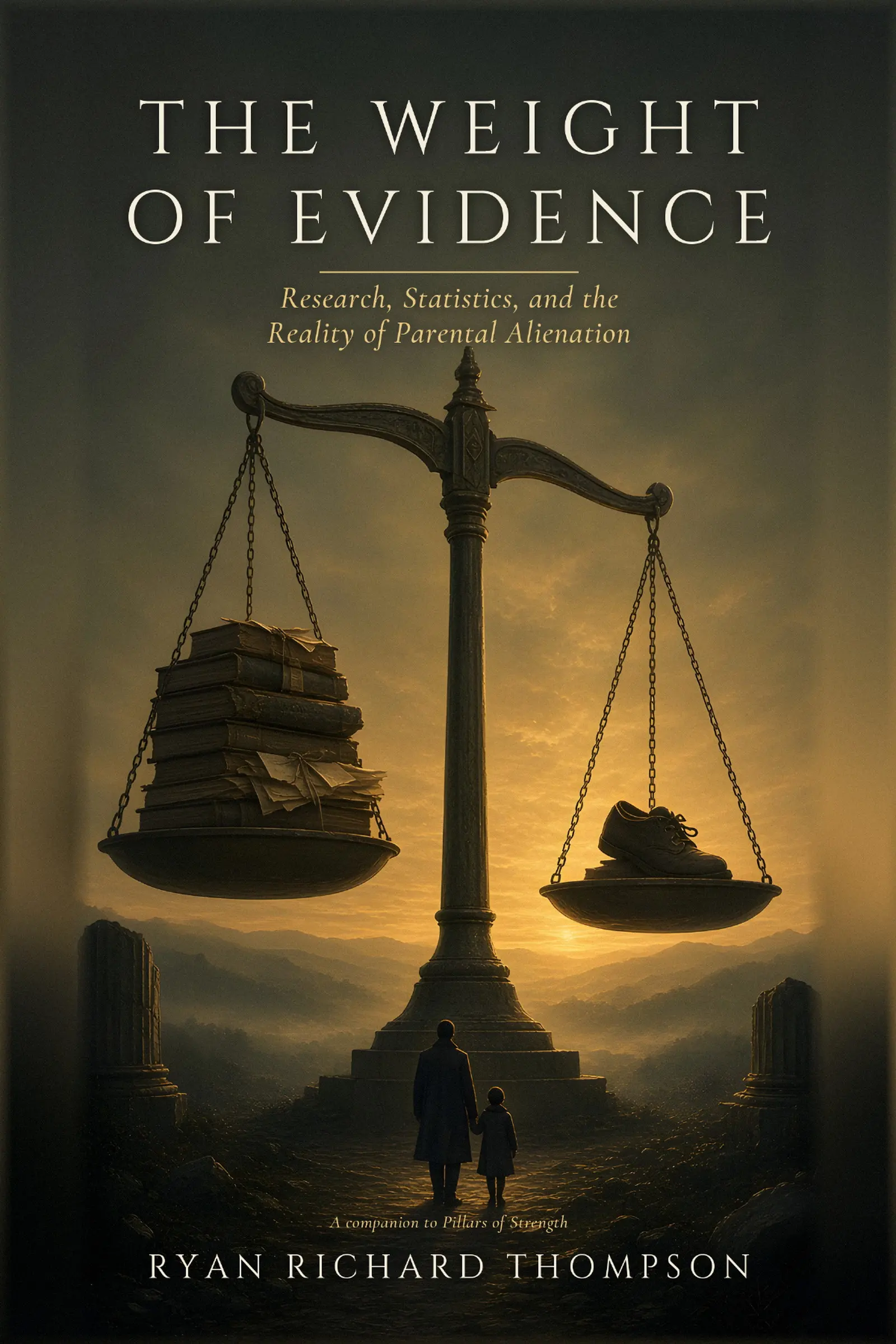
Parental alienation is one of the most contentious subjects in modern family law and psychology. It involves deeply personal experiences, disputed scientific theories, competing allegations, and legal decisions that can permanently alter family relationships. Beyond the arguments lies a more important question: what does the evidence actually show?
My first book, Pillars of Strength, was the lived account. It gave me a way to put experience into words. A personal account has limits. It is one person’s memory, one person’s documents, one person’s understanding of events. It cannot settle every question about another person’s motives or a child’s inner life. That is why I wrote this second book. I needed to learn what the research says, what it does not say, and why reasonable people can look at the same term and see different risks.
This book is part of a two-book series. Pillars of Strength is the lived account of fatherhood, family distance, and the weight of truth. The Weight of Evidence asks what research can and cannot say about parental alienation. Both are at the Disruptarian shop: buy Pillars of Strength and buy The Weight of Evidence.

Some people argue that parental alienation describes a real pattern of adult behavior that can damage a child’s relationship with a parent. Others warn that the concept is vague, unsupported, or likely to be used against a parent who raises an abuse concern. I do not think either side is served by pretending the other side has no serious point.
The numbers that travel farther than the studies
The debate gets distorted by numbers. Before tracing the sources, I had heard the claim that more than 21 million children in the United States suffer through parental alienation. The evidence behind the commonly repeated number is narrower. Harman, Leder-Elder, and Biringen used a 2015 North Carolina telephone poll to sketch about 22 million American adults who reported feeling alienated from a child. Their later work used a national panel to sketch just over 22 million U.S. parents as targets of alienating behaviors. These are self-reports and extrapolations. They are not a census of alienated children.
The later study also produced a smaller estimate of about 3.9 million parents, described as 1.3 percent of the total U.S. population, who fell into a moderate-to-high range on a parent-completed scale. That is a parent measure. It is not 1.3 percent of U.S. children.
Another number I had seen was about 8 to 9 percent. Janet Johnston’s 2003 study examined 215 children in the San Francisco Bay Area and found “much” alignment with one parent in about 8 to 9 percent of that sample. This is evidence about strong alignment in one regional clinical and community study. It is not a national rate for American children, and Johnston did not treat alignment as automatic proof of unjustified alienation.
I also hoped to find a counted source for the claim that thousands of organizations are working on this issue. I could not find one. Many people and groups are trying to raise attention, but I will not turn an unsupported count into a fact simply because it sounds encouraging. The book later names selected groups whose own material I was able to examine. Naming them is not an endorsement of every claim they make.
What the book examines, and what it refuses to do
The chapters that follow examine the history and definitions of parental alienation, the competing theories, and the ongoing debate over its scientific standing. They look at what published studies actually measure, how reliable their findings are, and why some widely repeated numbers deserve closer examination. They look at the emotional and developmental consequences of family conflict, disrupted relationships, and pressure to choose between parents. They look at the psychological, emotional, and practical costs for a parent who loses meaningful contact with a child. They also look at the documented research on deliberately fabricated allegations, unsubstantiated reports, and the importance of distinguishing between them, and at how American and international legal systems approach custody disputes and allegations of alienating behavior. The last movement of the book asks what may help, including interventions and professional guidance, without treating any of that as a guarantee.
I am not writing to tell a child what to feel. I am not writing to tell a parent that every loss of contact has one cause. If you are a parent, do not use this book to recruit a child into your case. Keep safety concerns serious. Keep your records calm and factual. Seek advice about your own circumstances from qualified professionals who can examine the facts and the law where you live. If you are reading as a professional, I hope the book makes the cost of loose language visible. A label can organize attention, but it can also close it down. The child remains a person, not a piece of evidence for one parent’s position.
There is a point in a difficult family conflict when a person stops asking only, “What happened to me?” The next question is, “What can I actually know about what happened?” I have lived with both questions. The second one is why this book exists. I wanted a place where a widely repeated claim has to survive contact with its source, and where a parent or a professional can see the difference between a self-report, a clinical sample, a legal category, and a child’s own experience.
The chapters on children and targeted parents keep harm and uncertainty together. The chapters on allegations, courts, and custody separate categories that get blurred in public argument. A fabricated allegation is not the same thing as an unsubstantiated report, and neither is the same thing as a safety concern that deserves a serious hearing. I try to keep those distinctions visible, because collapsing them is one of the ways a debate becomes cruel.
The subject reaches into safety, evidence, court procedure, professional training, mental health, money, and the ordinary grief of a parent who cannot speak with a child in the way that parent hoped. It also reaches into the freedom of a child to have an experience that does not fit an adult’s preferred account. I wrote this book to put those things in their right places, and to refuse the comfort of a claim that has outrun its sources.
If you have heard a confident number about parental alienation and wondered what study was actually behind it, this book is for you. If you have lived through a broken contact with a child and wanted a careful account rather than a rally, it is for you too. I cannot make the evidence heavier than it is. I can refuse to make it lighter.

More books by Ryan Richard Thompson
- This Ragged Life Renewed: A memoir of rebellion, faith, loss, and starting over.
- Echoes of Power: Paul, Rome, and the making of the early Church, with the first edition’s mistakes corrected in the open.
- The Unsettled Story: Ancient scriptures and the questions they leave open.
- The Transparent Future: A novel about trust in a city that measures honesty.
- Pillars of Strength: Fatherhood, family distance, and the weight of truth.
- The Gravity of Sacrifice: A published Mars novel about a father and the cost of going.
Buy the book: The Weight of Evidence is available in paperback, hardcover, and ebook at the Disruptarian shop.
Leave a Reply